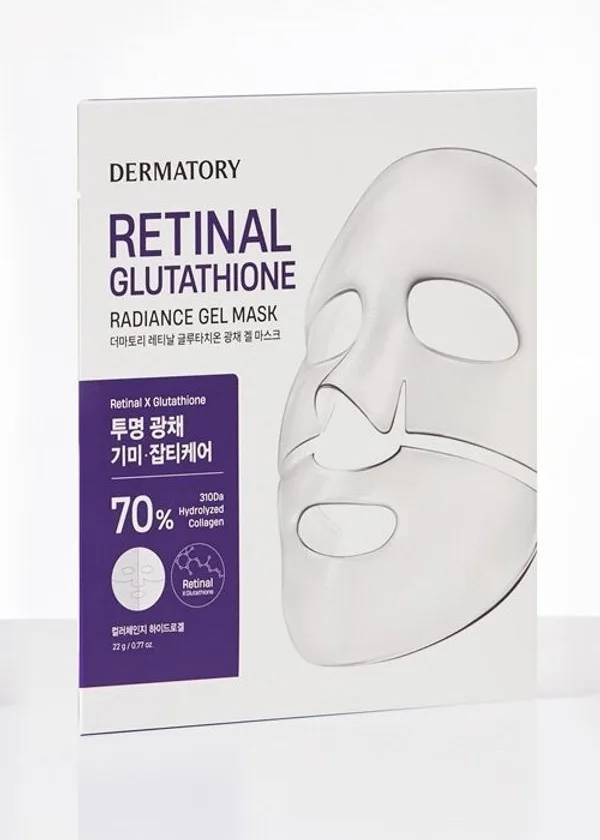
It is a hydrogel rather than a cotton sheet, built on 70 percent hydrolyzed collagen and 10 percent sea buckthorn water, with niacinamide and alpha-arbutin for brightening. The gel format clings without dripping and becomes transparent as it absorbs.
A luxurious-feeling collagen hydrogel mask that clings closely and leaves skin plump, dewy and visibly brighter for an evening out, helped by niacinamide and alpha-arbutin. The glutathione and retinal on the label are token amounts, though, and at about seven dollars a sheet it is best treated as an occasional glow boost rather than a brightening treatment.
Olive Young's review count pools this mask with its collagen sibling, so product-specific feedback is limited, and the evaluation relies on the declared formula. Trace concentrations of glutathione and retinal mean their contribution is judged from published research rather than measured for this mask.
Verdicts
How well it fits each concern
Verdict by concern tap a concern for the case
Supporting rolefor DehydrationIn your profileYou chose · Nothing here targets dehydration directly; humectant hydration is the recognised companion to treating it, and this sheet mask does that without known triggers.Not yet assessedStandard tolerabilityNo reviews collected yet
The case for it
Hydrolyzed Collagen has no evidence row yet for this concern — it is in the research queue.
The formula carries no trigger this concern is sensitive to, with the cautions noted.
What would change this: A researched evidence row for the lead active would replace this with a verdict.
Same rule for everyone. “Supporting role” is the verdict on 8,197 of 45,024 concern verdicts across the catalog; rule R8 decided 4,250 of them.
As of September 25, 2026, engine 5.1.1.
R8 — The category's job (barrier care, humectant hydration, gentle cleansing, photoprotection) is the documented supportive role for this concern. This is the honest verdict for a moisturizer on an acne page. · the full register
Promisingfor Dark SpotsIn your profileYou chose · Niacinamide has trial-level evidence for dark spots but no guideline or regulatory standing yet — promising, short of a recommendation; the other actives here are not yet assessed for it.Moderate evidenceStandard tolerabilityNo reviews collected yet
The case for it
Niacinamide has trial-level evidence for this concern but no guideline or regulatory standing yet.
It is plausibly present at a working level, though the concentration is not declared.
The formula carries no trigger this concern is sensitive to, with the cautions noted.
What would change this: A declared concentration would move this to a firmer reading of the dose.
Same rule for everyone. “Promising” is the verdict on 7,858 of 45,024 concern verdicts across the catalog; rule R9p decided 7,858 of them.
As of September 25, 2026, engine 5.1.1.
R9p — 0.5.0: 'Unproven' beside three filled dots read as one question answered twice with opposite words (7,018 rows). The chip measures standing, the dots measure trial volume; where the row carries at least one RCT or a tier-2 source (moderate dots) and the active is present at a working level, the honest word is Promising. Unproven is reserved for plausible-standing rows with limited or weak evidence, or an under-dosed form. Same rank as Unproven — a bet either way; the dots order them. · the full register
Carrying active
Niacinamide
Standing
plausible — trials support it
Form
plausible
Tolerability
standard
Row checked
against its sources on July 17, 2026 (evidence table ev-2026.09-r228)
Also listed for Dullness — the actives here (Hydrolyzed Collagen, Niacinamide, Retinal (Retinaldehyde) are in our research queue for that concern; there is no verdict until their evidence rows are written. That is a gap in our table, not a mark against the product.
As a maskNot judged: what a mask is for — works within its wear time, benefit outlasts the mask, comes off cleanly — cannot yet be measured from the ingredient list (only intensity without injury can).
A verdict is DermApproved’s assessment of how well a product’s ingredients fit a concern — never a claim about what the product treats. Evidence dots and collected reviews sit beside it and are never blended in.
Rules 0.5.1 · evidence table ev-2026.09-r228 · how we decide
Assessment
Pros & Cons
Pros
✓ Hydrogel clings closely without dripping
✓ 70 percent collagen gives an immediate plump, dewy look
✓ Niacinamide and alpha-arbutin add real brightening actives
✓ Cooling, comfortable feel on most skin
✓ Soothing allantoin, panthenol and licorice derivative
✓ Glow often lasts into the next day
Cons
✗ Glutathione and retinal are trace amounts
✗ Contains fragrance
✗ Relatively expensive per sheet
✗ Brightening effect is subtle and short-term
✗ Not suitable for fungal acne routines
✗ Contains retinal, which some avoid in pregnancy
Review
Full Review
Dermatory is refreshingly specific about what goes into its Retinal Glutathione Radiance Gel Mask. The pack and ingredient list state that hydrolyzed collagen makes up 70 percent of the gel, sea buckthorn water 10 percent, retinal 5ppm and glutathione 10ppm. Those numbers tell a clear story: this is a collagen hydrogel mask with a few brightening extras, and the two ingredients in its name are present in amounts measured in parts per million.
That is not a criticism of the experience, which is genuinely enjoyable. Hydrogel masks differ from cotton or pulp sheets. Rather than a fabric soaked in liquid essence, the mask is a gel set with seaweed-derived carrageenan and carob and guar gums, which holds the ingredients within its structure. It feels cool and bouncy, clings firmly to the contours of the face without dripping, and gradually turns more transparent as the skin absorbs moisture from it. After twenty to thirty minutes, skin looks plump, dewy and noticeably more luminous, the kind of result that makes a gel mask popular before events.
Where does the glow come from? Mostly from hydration. Hydrolyzed collagen at 70 percent is a powerful humectant and film-former, drawing water into the upper skin and leaving a smooth surface that reflects light evenly. Glycerin, sodium hyaluronate, betaine and panthenol support that effect. Niacinamide, fifth in the list, is the most substantial brightening active, supporting barrier function and more even tone over time. Alpha-arbutin, a tyrosinase inhibitor, adds another brightening angle, and vitamin C derivatives, bisabolol and ubiquinone appear in small amounts.
Glutathione, the mask's namesake, is present at 10ppm, or 0.001 percent. Glutathione is a powerful antioxidant inside the body, and its reputation for skin lightening comes largely from oral and injectable use in some markets, where evidence is mixed and safety concerns exist. Topical evidence is limited, and at this concentration in a mask used for half an hour, any contribution is minimal. The same applies to the retinal at 5ppm, which gives the product line its name but will not deliver retinoid effects at that level.
The mask also contains fragrance, listed last, and several emollient and emulsifying ingredients, including macadamia oil and ceteth compounds, that make it unsuitable for fungal acne routines. For most skin types, though, the formula is gentle, with allantoin, dipotassium glycyrrhizate and panthenol providing soothing support.
In practical terms, the mask works best in the evening after toner. The two-part sheet requires a little care to separate from its protective films, and aligning the upper and lower halves takes a moment. Once on, it stays in place even when moving around. After removal, patting in the residue and applying a moisturizer seals in the hydration. The glow often lasts into the next morning.
Expectations around brightening should be realistic. A single mask gives an immediate optical brightness from hydration. Regular weekly use may contribute modestly to a more even tone thanks to niacinamide and alpha-arbutin, but dark spots and melasma need consistent daily serums and sunscreen. The mask is a complement, not a treatment.
It helps to think about the mask as a stage in an evening routine rather than a standalone product. A good sequence is a gentle cleanse, a hydrating toner, the mask for twenty to thirty minutes, then a thin serum and a moisturizer to seal everything in. Because hydrogel leaves the skin well hydrated, anything applied afterward tends to spread and absorb easily, which makes the post-mask window a sensible time for a niacinamide or vitamin C serum if you already use one. That way the mask provides immediate glow, and the serum provides the daily, cumulative brightening that the mask alone cannot.
Storage can add to the experience. Keeping a couple of sheets in the refrigerator makes the gel even more cooling, which many people find soothing after sun exposure, a long flight or a late night. Cold does not change the formula, but it can temporarily reduce puffiness and make the ritual feel more restorative.
There is also a sensible caution for anyone with reactive skin: hydrogel sits very close to the skin for half an hour, which increases contact with every ingredient, including fragrance. A patch test on the jaw with a small piece of the gel before first full use is a simple precaution.
For pregnant users, the trace retinal is worth noting; many clinicians prefer to avoid retinoid-containing products during pregnancy as a precaution, even at low levels.
The review count on Olive Young is pooled with the collagen version of the mask, so product-specific feedback is harder to separate. General feedback praises the adherence, cooling feel and immediate glow, and notes the price per sheet.
Value depends on how you use it. At about seven dollars per sheet regular price, often discounted, it is more expensive than basic sheet masks. As an occasional pre-event treat, it delivers a satisfying result. As a weekly brightening routine, the cost adds up for modest long-term benefits.
For normal, dry and combination skin that wants a quick, reliable glow and enjoys the hydrogel experience, it is a pleasant choice. Anyone buying it for glutathione or retinal benefits should look instead to serums with meaningful concentrations of proven actives.
Formula
Key Ingredients
The hero actives that drive this product's performance.
The gel's main ingredient, a collagen solution set with seaweed and carob gums into a hydrogel sheet that clings closely and floods the surface with humectant hydration for a plump, glassy finish.
Apply after toner, leave for 20 to 30 minutes, then pat in any residue and follow with moisturizer. It works well the evening before an event for a plump, luminous look.
Results Timeline
Skin looks plumper, dewier and slightly brighter immediately after use, with the glow lasting into the next day. Any tone-evening benefit is modest and cumulative with regular weekly use.
Dermatory Retinal Glutathione Radiance Gel Mask Sheet
Moisturizer
Evidence
Science & Expert Perspective
The Science
Hydrogel masks use polysaccharide gels, here carrageenan from Chondrus crispus, carob gum and guar gum, to hold active ingredients in a semi-solid matrix. Studies comparing occlusive mask formats suggest they increase skin hydration more than leaving the same ingredients uncovered, because the gel limits evaporation during contact. Hydrolyzed collagen at high concentration acts as a humectant and film-former, improving surface smoothness and light reflection.
Niacinamide inhibits the transfer of melanosomes to keratinocytes and supports barrier function; clinical studies at 2 to 5 percent in leave-on formulations show improvements in hyperpigmentation over weeks. Alpha-arbutin inhibits tyrosinase and is widely used for brightening at up to 2 percent in leave-on products. In a mask used for 20 to 30 minutes, their effects are smaller but may add up with regular use.
Glutathione is an endogenous antioxidant involved in melanogenesis regulation, and has been studied orally and topically for skin lightening with mixed results. At 10ppm, the amount in this mask is far below concentrations used in topical studies.
Retinal is a potent retinoid at 0.05 to 0.1 percent, but at 5ppm (0.0005 percent) its contribution is negligible. The formula's soothing agents, including allantoin, bisabolol and dipotassium glycyrrhizate, support tolerability.
Dermatologist Perspective
Dermatologists generally view sheet and hydrogel masks as cosmetic, hydrating treatments rather than therapeutic ones. Their occlusive format can temporarily improve hydration and the appearance of skin, which is why they are popular before events. For patients seeking brightening, clinicians typically recommend daily use of niacinamide, azelaic acid, tranexamic acid or other proven actives, together with sunscreen, rather than relying on masks with trace doses of glutathione. The fragrance may be a concern for sensitive patients, and many clinicians advise avoiding retinoid-containing products during pregnancy as a precaution. Occasional use as a hydrating treat is unlikely to cause problems for most patients.
Guidance
Usage & Recommendations
How to Use
After cleansing and toning, open the pouch and separate the upper and lower gel halves from their protective films. Apply the upper half first, aligning the eye openings, then the lower half, pressing gently so the gel adheres. Leave on for 20 to 30 minutes until the gel becomes more transparent. Remove, pat any remaining essence into the skin, and follow with moisturizer. Use once or twice a week in the evening. Chill the pouch beforehand for an extra-cooling effect.
Value Assessment
At a regular price of about seven dollars per sheet, the mask is on the expensive side for a single-use product, though frequent discounts improve that. The value lies in the immediate cosmetic glow and the pleasant hydrogel experience, not in concentrated actives; the glutathione and retinal are token doses. For occasional use before an event, it is a fair indulgence. For regular brightening, a daily serum offers far better value. It is typically sold as single sheets or in multi-packs.
Who Should Buy
Normal, dry and combination skin that wants a quick, reliable glow and plumpness before an event, and anyone who enjoys the cooling, clinging feel of hydrogel masks as an occasional pampering step alongside an otherwise simple, serum-led daily skincare routine.
Who Should Skip
People buying it specifically for glutathione or retinal benefits will find only trace amounts. Fragrance-sensitive skin, fungal-acne sufferers, pregnant users avoiding retinoids and budget-focused shoppers may prefer a simpler, less expensive hydrating mask for regular weekly use at home instead.
Ready to try Dermatory Retinal Glutathione Radiance Gel Mask Sheet?
A translucent, bouncy hydrogel sheet that becomes clearer as it absorbs, clinging firmly to the face.
Scent
A light added fragrance.
Packaging
A single-use foil pouch containing a two-part hydrogel sheet with protective film layers.
Finish
dewyglowy
What to Expect on First Use
The gel feels cool and adheres closely, with no dripping essence. After removal, skin looks noticeably plumper and luminous. Fragrance-sensitive skin should patch test.
How Long It Lasts
Single use per sheet.
Best Season
All Year
Background
The Story Behind This Product
Dermatory launched its Retinal gel masks in 2023 as two variants, Collagen Lifting and this Glutathione Radiance version, extending its retinal line into quick at-home treatments.
About Dermatory Established Brand (5–20 years)
Dermatory is a Korean dermo-cosmetic brand from the CLIO group, manufactured by Cosmax. Its retinal gel masks, launched in 2023, declare collagen percentages and retinal ppm on the pack; there is no published clinical testing of this mask.
Brand founded: 2018 · Product launched: 2023
Myth vs. Reality
Common Myths
Myth
Glutathione in a sheet mask whitens skin.
Reality
At 10ppm and a single short application, the glutathione here is a trace. Any brightening comes mainly from niacinamide, alpha-arbutin and the optical glow of well-hydrated skin.
Myth
Gel masks deliver collagen into the skin.
Reality
Hydrolyzed collagen acts as a surface humectant and film-former. It plumps the look of skin temporarily but does not replenish dermal collagen.
FAQ
Frequently Asked Questions
How long should I leave on the Dermatory Glutathione Gel Mask?
About 20 to 30 minutes, until the gel turns more transparent. Remove it, pat in any remaining essence and follow with moisturizer.
Does the Glutathione Radiance mask brighten skin?
It gives an immediate luminous look from hydration and contains niacinamide and alpha-arbutin. Glutathione and retinal are present only in trace amounts, so long-term brightening is modest.
What's the difference between the Collagen and Glutathione gel masks?
Both use a collagen hydrogel base. The Glutathione version adds sea buckthorn water, alpha-arbutin, glutathione and vitamin C derivatives for radiance; the Collagen version focuses on firming with bakuchiol and more collagen.
Can I use this gel mask during pregnancy?
It contains a trace of retinal, a retinoid. Many clinicians advise avoiding retinoids in pregnancy, so it is best to check with a clinician or choose a retinoid-free mask.
How often can I use the Dermatory gel mask?
Once or twice a week is typical. It is gentle enough for regular use, but its cost makes it more of an occasional treat.
Is the Glutathione Gel Mask fragrance-free?
No, fragrance is listed at the end of the ingredient list. Most people will barely notice it, but sensitive skin should patch test.
Reviews
What Reviewers Tend to Say
Recurring themes our editors read across retailer reviews of this product — summaries in our words, not quotations, and not a substitute for your own patch test.
Five brands that own the feed, judged on their ingredient lists rather than their view counts — including the one active all five suddenly added at once, and what that tells you.
The evidence runs backwards. Topical and oral glutathione have small randomised trials behind them; the intravenous version — the most expensive, most heavily promoted route — has none at all.
It was invented to stop bleeding during surgery. In 2026 it's in dozens of brightening serums — and the evidence is better than most trend ingredients can claim.
Products, answers, therapy guides, tools and articles in one search. Brand names,
slang and abbreviations all work — accutane finds isotretinoin, bacne finds truncal acne.