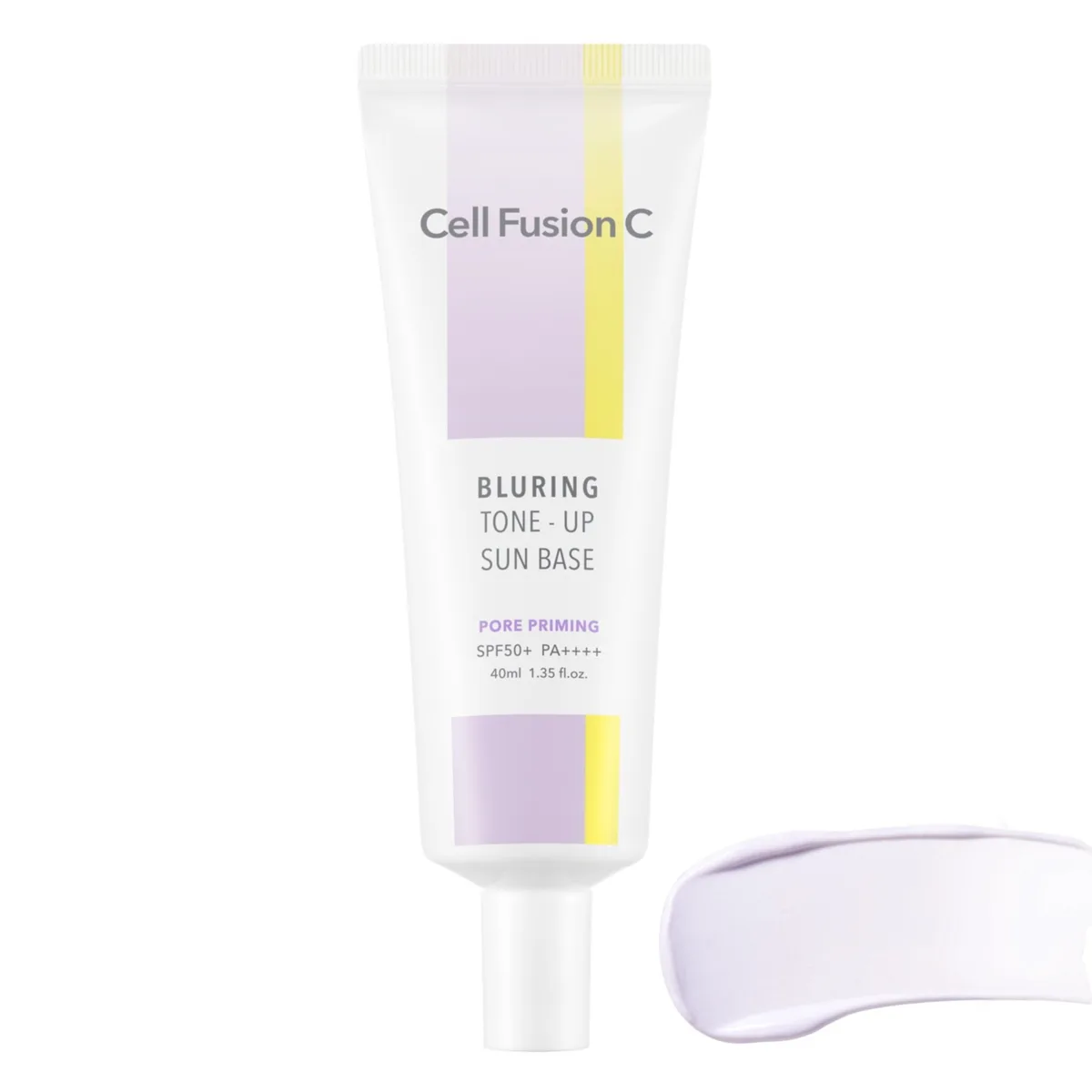
It is the oily-skin member of Cell Fusion C's tone-up trio: a lavender corrector on coated titanium dioxide that cancels sallowness, a silicone elastomer, silica and microsphere blur that behaves like a pore primer, witch hazel water and mastic gum for a tightened feel, and a leaner three-filter European set with Uvinul A Plus and Tinosorb M. Like its siblings it cannot be sold as a sunscreen in the US, and unlike them it carries alcohol high on the list.
The oily-skin member of Cell Fusion C's tone-up trio: a lavender corrector with a genuine pore-primer blur, silica, witch hazel and a lean European filter set, matte and fast on a shiny summer face. Alcohol sixth on the list and two essential oils make it the least gentle of the three, the purple greys on deeper skin, and it cannot be sold as a sunscreen in the US. Imported, for the right face, it earns its place.
This is the youngest of Cell Fusion C's tone-up bases, on Korean shelves for about a year and with US resellers only since spring 2026, so a few dozen reviews and the brand's own Korean testing are all that stand behind it. The filters, blurring agents and niacinamide are well documented and this assessment leans on that literature; how the finished formula wears over a full summer on a range of skin has barely been observed.
Verdicts
How well it fits each concern
Verdict by concern tap a concern for the case
Full protectionfor Sun DamageIn your profileYou chose · Broad-spectrum SPF 50 with titanium dioxide, Uvinul A Plus, bisoctrizole (Tinosorb M): the protection sun damage calls for.Moderate evidenceGentleNo reviews collected yet
The case for it
Titanium Dioxide is a first-line active — approved, monograph-listed or named in current guidelines — for this concern.
It is plausibly present at a working level, though the concentration is not declared.
The formula carries none of the triggers this concern is sensitive to.
What would change this: A declared concentration would move this to a firmer reading of the dose.
Same rule for everyone. “Full protection” is the verdict on 2,288 of 45,024 concern verdicts across the catalog; rule P1 decided 2,232 of them.
As of September 25, 2026, engine 5.1.1.
P1 — Photoprotection standing is regulatory (M020 / Annex VI filters; 21 CFR 201.327 attaches the early-skin-aging claim to tested broad-spectrum SPF 15+). SPF 30 is the AAD daily-use bar. · the full register
Carrying active
Titanium Dioxide
Standing
first line — a regulator recognises it for this use; trials support it · per § 352.10 Sunscreen active ingredients. (U.S. Food and Drug Administration — 21 CFR Part 352 (Sunscreen Drug Products for Over-the-Counter Human Use), Code of Federal Regulations via GovInfo), opened July 27, 2026
Form
plausible — studied range up to 25%, from the OTC monograph or label; needs leave-on contact
Tolerability
gentle
Row checked
against its sources on July 27, 2026 (evidence table ev-2026.09-r228)
21 CFR 352.10 — Sunscreen active ingredients — US Food and Drug Administration / Electronic Code of Federal Regulations (retrieved 2026-07-16; note stayed effective date), opened July 16, 2026
Also listed for Large Pores, Excess Oiliness and Dullness — the actives here (Titanium Dioxide, Alcohol Denat., Silica, Uvinul A Plus (DHHB) are in our research queue for those concerns; there is no verdict until their evidence rows are written. That is a gap in our table, not a mark against the product.
Does the jobDoes what a sunscreen is for: UVA coverage, kind to the skin wearing it. Not measured from the label: pleasant enough to actually use.
A verdict is DermApproved’s assessment of how well a product’s ingredients fit a concern — never a claim about what the product treats. Evidence dots and collected reviews sit beside it and are never blended in.
Rules 0.5.1 · evidence table ev-2026.09-r228 · how we decide
Assessment
Pros & Cons
Pros
✓ Silicone elastomer, silica and microspheres blur pores and hold shine down like a primer
✓ Lavender corrector lifts sallow, yellow-toned light skin without a white mask
✓ Uvinul A Plus for photostable long-wave UVA and Tinosorb M for broad cover
✓ Niacinamide eleventh on the list, a working brightening dose
✓ Fast, matte set that takes foundation without pilling
✓ Witch hazel and mastic give oily skin a tightened, clean feel
✓ No added fragrance or parabens
Cons
✗ Filters are not FDA-approved, so no legal SPF claim in the US
✗ Alcohol sixth on the list stings dry, reactive or barrier-compromised skin
✗ Rosemary and grapefruit peel oils with limonene declared
✗ Purple-grey cast on medium and deep skin tones
✗ Leaner three-filter set than its Clear and Water Fit siblings
✗ Forty millilitres lasts a month at the proper dose; no verifiable US price
Review
Full Review
Cell Fusion C now sells its tone-up sun base in three colours, and the colours are a diagnosis. Green, in the Clear base, cancels red for skin that flushes. Pink, in the Water Fit, warms sallow, dry skin. Lavender, in this Blurring base, cancels yellow, and the rest of the formula tells you the yellow it has in mind is the yellow of an oily forehead by lunchtime: alcohol sixth on the list, silica, a silicone elastomer, witch hazel water and mastic gum, all inside the top twenty-three. This is the brand's sunscreen for the skin that shines, and it is built with the single-mindedness of a good pore primer.
The list is a Korean hybrid with a primer's toolkit folded in. Water, then butyloctyl salicylate, an SPF-boosting ester, glycerin, coated titanium dioxide at fourth, an adipate, alcohol at sixth, a dimethicone crosspolymer elastomer and cyclopentasiloxane, then Uvinul A Plus at ninth, the photostable long-wave UVA filter that lets Korean sunscreens claim PA++++ without avobenzone, and niacinamide at eleventh. Silica follows, then a small Korean extract cluster, persimmon leaf, safflower, coffee, knotweed, green tea, chestnut shell, Japanese pepper, and the pore pair, witch hazel water and mastic gum, with rosemary and grapefruit peel oils threaded between them. The other two filters come later: ethylhexyl triazone for UVB and Tinosorb M, a hybrid particulate that absorbs and scatters across both bands. Emulsifiers, gellants and thickeners fill the tail, with ultramarine blue as the lavender tint and limonene declared last. Three organic filters plus the pigment is a leaner set than the five-filter Clear and Water Fit bases carry, which is worth knowing, though the rating is the same.
On the face it does exactly what a matte, blurring base should. It spreads thin, the alcohol flashes off in a few seconds with a brief cool sting, and the elastomer, silica and microspheres set to a soft-focus velvet that softens pore openings and holds shine down into the afternoon; the witch hazel adds a faint tightening that oily skin reads as clean. On light to light-medium skin the lavender lifts a sallow, tired complexion a cool half-shade without a mask, and foundation goes over it as it would over a silicone primer, cleanly and without pilling. As a one-step morning base for oily, pore-conscious light skin in summer it is good, and it replaces two products.
The same construction is the reason to pass on it. Alcohol sixth in a leave-on sunscreen, with rosemary and grapefruit peel oils and limonene at the tail, is the least gentle formula in a line from a brand that made its name calming post-procedure skin; on dry, sensitive, rosacea-prone or barrier-compromised skin it stings and tightens, and grapefruit peel oil brings a furocoumarin phototoxicity question that is awkward in a sun product. The lavender rides on a white titanium dioxide base, so on medium, olive and deep skin the correction becomes a purple-grey veil that no colour theory overcomes; deeper tones need a pigment-free sunscreen, and the brand makes several. And the blur is silicone and silica for the day, not a change in the pores, whatever the mastic gum and witch hazel imply; the niacinamide at eleventh is the only ingredient doing anything that lasts, a slow evening of tone over twelve weeks.
The filters are the reason to import it, and the reason it must be imported. Uvinul A Plus, ethylhexyl triazone and Tinosorb M are three of the modern European filters that give Korean sunscreens their thin, high-UVA elegance, and none has completed the FDA's approval process, which is a regulatory gap rather than a safety finding. The brand's US store sells FDA-monograph reformulations; this base travels through Korean resellers without a US-legal SPF claim, and its rating comes from Korean and ISO testing at a full quarter-teaspoon face dose that empties the forty-millilitre tube in a month. Worn as a thin blurring primer under another sunscreen, which is how most people will actually use it, it lasts twice as long and protects a fraction as much, and buyers should decide which product they are wearing.
It is new. The Blurring version followed the Clear and Water Fit bases by a year or more, reached resellers serving the US in spring 2026, and has a few dozen reviews behind it rather than the few hundred its siblings carry; the early verdicts praise the matte blur and the lift on light skin, note the alcohol, and confirm the cast on deeper tones, which is what the list predicts. The price is an import-market range of roughly nine to fifteen dollars, not a retail figure, since Cell Fusion C does not sell it in America and YesStyle does not currently list it.
So the door is narrow and clearly labelled. Oily, combination, resilient, light to light-medium skin that wants one morning step to blur pores, kill shine, cancel sallowness and carry SPF 50+ PA++++, and that already shops Korean sun care through resellers: this is a well-made answer. Dry, reactive and deeper-toned faces should reach past it, to the Water Fit, the Clear, or the brand's American sunscreens, which by leaving this one off the US shelf Cell Fusion C has quietly recommended.
Formula
Key Ingredients
The hero actives that drive this product's performance.
Coated white pigment at fourth, tinted lavender by ultramarine blue at the tail so that it cancels the yellow in a sallow complexion rather than simply whitening it; the tone-up half of the name, and the half that decides which skin tones it suits.
Regulator-approvedfor Sun Damage · limited certainty
Uvinul A Plus at ninth, the photostable long-wave UVA filter that carries the PA++++ rating without avobenzone, and one of the two filters here the FDA has not approved, which is why this base reaches American buyers only through importers.
Regulator-approvedfor Sun Damage · limited certainty
Uvinul T 150 for high-efficiency UVB and Tinosorb M, a hybrid particulate filter that absorbs, scatters and reflects across UVB and UVA; with the Uvinul A Plus and the titanium dioxide they make up a leaner filter set than the Clear and Water Fit siblings, which is part of why this one leans on the blur.
Regulator-approvedfor Sun Damage · limited certainty
The blurring engine: a silicone elastomer that fills and softens pores, silica spheres that absorb sebum and scatter light, and silicone microspheres that keep the surface matte. It is a primer's toolkit inside a sunscreen, and the reason the finish reads soft-focus rather than dewy.
The pore-care pair the brand names: an astringent hydrosol that tightens the surface and a resin the Korean market credits with sebum control, both in the top twenty-three; a sensory tightening more than a measured change, and a cue that this base was built for oily skin.
Ethanol sixth on the list for a fast, dry flash-off, plus two essential oils with limonene declared at the tail; the combination is what oily skin experiences as fresh and what reactive skin experiences as sting, and it is the formula's one real tension with the brand's calming heritage.
Not yet assessed
Ingredient standings describe the active at treatment-level doses and
vehicles; this product's own condition grades weigh its actual formula.
Wear it as the final morning step over a light, fully absorbed moisturiser at the full sunscreen dose; it replaces a pore primer under foundation, and on medium or deep skin a pigment-free sunscreen is the better choice than fighting the lavender cast.
Results Timeline
Sun protection, the pore blur and the lavender lift are immediate and wash off at night. The niacinamide's evening of tone builds over eight to twelve weeks of daily use; the witch hazel and mastic tighten the look of pores for the day and do not change them.
Cell Fusion C Blurring Tone-Up Sun Base SPF 50+ PA++++
Foundation if desired
Sample PM Routine
Cleansing oil to remove pigment, silicones and filters
Gel cleanser
Treatment serum
Light moisturiser
Evidence
Science & Expert Perspective
The Science
The protection science is that of modern European filters, in a leaner set than the brand's other tone-up bases. Diethylamino hydroxybenzoyl hexyl benzoate absorbs long-wave UVA with high photostability and needs no stabiliser; ethylhexyl triazone is a highly efficient UVB absorber at low concentration; methylene bis-benzotriazolyl tetramethylbutylphenol is a particulate hybrid filter that absorbs, scatters and reflects across UVB and UVA and is itself photostable. With coated titanium dioxide and an SPF-boosting butyloctyl salicylate they reach SPF 50+ and PA++++ under Korean and ISO methods. None of the three organic filters has completed the FDA's monograph data requirements, a regulatory gap rather than a safety finding and the reason the product is not sold on the brand's American store.
The blur is physics. Dimethicone/vinyl dimethicone crosspolymer is a silicone elastomer that spreads as a flexible film and fills the micro-relief of pores and fine lines; silica spheres absorb sebum by capillary action and scatter reflected light; polymethylsilsesquioxane microspheres add a diffuse, matte surface. These are the documented mechanisms of silicone pore primers, cosmetic and reversible at cleansing. The lavender tone-up is optics too: coated titanium dioxide scatters visible light and lightens the surface, and ultramarine blue shifts the result toward violet so that it subtracts yellow from the reflected light, an effect that is shade-dependent by nature.
The pore-care botanicals are traditional. Witch hazel water is a mild astringent whose tannins produce a transient tightening, with anti-inflammatory activity reviewed in Molecules in 2025; mastic gum from Pistacia lentiscus has Korean market use for sebum control and in vitro antibacterial data without clinical sebum studies. Niacinamide at eleventh is plausibly at a cosmetic working level, where its evidence for evening tone and reducing pigment transfer applies. The remaining extracts are label-level antioxidants.
The tolerance question is the alcohol and the oils. Ethanol high on a leave-on list degreases and volatilises quickly, which oily skin experiences as freshness and compromised skin as barrier disruption; rosemary and grapefruit peel oils add terpenes, with limonene declared, whose oxidised hydroperoxides are among the most frequent fragrance-allergen positives in patch-test series, and grapefruit peel carries a furocoumarin phototoxicity consideration in a product worn in sunlight. For oily, resilient skin these are unremarkable; for the reactive minority they are the most relevant lines on the label.
Clinicians generally welcome the European and Korean filter systems this base uses for their photostable, high-UVA protection in wearable textures, and a matte, blurring sunscreen that oily patients actually apply is worth more than a heavier formula left in the drawer. The reservations are specific. Alcohol this high in a leave-on sunscreen, with rosemary and citrus oils, is the combination most often advised against in rosacea, seborrhoeic dermatitis, eczema and barrier-compromised skin, and a citrus peel oil in a sun product is an avoidable phototoxicity consideration. A blurring base will almost always be under-applied, since the cosmetic instinct is a primer-thin layer and the protective requirement is a full one, so patients are told to use the full dose or to treat it as a base under a second sunscreen. The lavender titanium dioxide base is a poor fit for medium and deep skin tones. Pore claims are read as cosmetic; nothing topical changes pore size, and the niacinamide is the only ingredient with a lasting effect.
Guidance
Usage & Recommendations
How to Use
Every morning as the last skincare step, after a light moisturiser has fully absorbed, apply about a quarter teaspoon across the face and blend outward with fingertips until the lavender disappears into an even, matte finish; it flashes off within seconds and sets in a minute, and foundation goes straight over it. Reapply every two hours outdoors, or wear a second sunscreen over it if it is being used as a thin blurring base. Test a thin layer in daylight if your skin is medium or deeper, and patch test on the jaw for a few days if you react to alcohol, rosemary or citrus oils. Keep it off the eye contour. Remove at night with an oil or balm cleanser followed by a foaming wash, since the pigment, silicones and filters leave a film water alone will not lift.
Value Assessment
No confident US price exists: Cell Fusion C does not sell this base in America, YesStyle does not list it, and Korean resellers price the 40 ml tube at roughly nine to fifteen dollars before shipping. At that import-market level it is inexpensive for a European-filter sunscreen that also does the work of a pore primer and a colour corrector, and it compares well with mid-range Korean sunscreens sold through the same channels. The value is tempered by a small tube that lasts a month at the proper dose, by the import route and the absence of a US-legal SPF claim, and by a formula narrow enough that many buyers will find it too drying or too purple. For oily-skinned, light-toned Korean sun-care shoppers it is worth the trouble; for everyone else the brand's US-store sunscreens are the sensible purchase.
Who Should Buy
Oily and combination, resilient, light to light-medium skin that wants a single morning step to blur pores, hold shine down, cancel sallowness and carry high-UVA protection, and is comfortable importing Korean sun care through resellers. It suits summer routines and anyone who has found dewy or mineral sunscreens too shiny or too heavy.
Who Should Skip
Anyone whose skin is dry, reactive, rosacea- or eczema-prone or barrier-compromised, for whom alcohol sixth on the list and two essential oils are the wrong start; medium, olive and deep skin tones, on whom the lavender titanium dioxide base turns purple-grey; and anyone who needs a sunscreen with a US-legal SPF claim and a stable retail price.
Ready to try Cell Fusion C Blurring Tone-Up Sun Base SPF 50+ PA++++?
A light, pale-lavender cream with a silicone-and-silica slip that spreads thin, flashes off its alcohol and sets to a soft-focus, velvet-matte finish.
Scent
No added fragrance, but a brief note of alcohol on application and a faint herbal-citrus trace of rosemary and grapefruit oil that fades within a minute.
Packaging
A slim white squeeze tube with lavender and yellow bands, a white screw cap and the SPF 50+ PA++++ rating printed on the front; 40 ml only.
Finish
mattevelvetynatural
What to Expect on First Use
The first application behaves like a pore primer: a pale purple cream that vanishes into a soft, matte, evened finish on light skin within a minute, with pores visibly blurred and shine gone. The alcohol flash-off is noticeable, reactive cheeks may warm, and on medium and deeper skin the lavender turns grey, all on day one.
How Long It Lasts
About four weeks at the full quarter-teaspoon face dose every morning; six to eight weeks as a thin blurring base under another sunscreen.
Korean functional cosmetic registration for UV protection and brightening (brand claim)
Background
The Story Behind This Product
Cell Fusion C expanded its tone-up sun base line from the Clear green corrector and the Water Fit pink hydrator to a third, Blurring, version aimed at oily, pore-conscious skin, borrowing the elastomer-and-silica blur of its Glass Skin serum and the witch-hazel-and-mastic pore story from Korean pore-care lines. It reached Korean resellers serving the US in spring 2026; the brand's own US store carries only FDA-monograph reformulations.
About Cell Fusion C Legacy Brand (20+ years)
Cell Fusion C has sold sunscreens through Korean dermatology clinics since 2002 and sun care is the category its reputation rests on. This base uses two filters cleared in Korea and Europe but not by the FDA, so it is absent from the brand's US store and carries no US-legal SPF claim; its standing comes from the brand's clinic record and the filters' published data, not from independent testing of the finished formula.
Brand founded: 2002 · Product launched: 2024
Myth vs. Reality
Common Myths
Myth
A blurring sunscreen shrinks pores over time.
Reality
The blur is a silicone elastomer, silica and silicone microspheres filling and softening pore openings for the day, and the tightened feel is witch hazel's astringency; both wash off at night. Nothing in a sunscreen changes pore size, and the niacinamide's slow effect on tone is the only lasting one.
Myth
Lavender tone-up is the universal corrector because it neutralises yellow on every skin tone.
Reality
The lavender rides on coated titanium dioxide at fourth on the list, a white base that lightens whatever it covers, so on medium, olive and deep skin it reads as a purple-grey veil rather than a lift. Colour theory does not override pigment physics; deeper tones need a pigment-free sunscreen.
FAQ
Frequently Asked Questions
Why is the Cell Fusion C Blurring Tone-Up Sun Base not on the brand's US website?
Two of its filters, diethylamino hydroxybenzoyl hexyl benzoate and methylene bis-benzotriazolyl tetramethylbutylphenol, along with ethylhexyl triazone, are approved in Korea and Europe but not by the FDA, so the base cannot carry a legal SPF claim in the US. Cell Fusion C sells FDA-monograph reformulations on its American store, and this one reaches US buyers only through Korean resellers.
What does the purple colour in the Blurring Sun Base do?
Ultramarine blue tints a coated titanium dioxide base lavender so that it optically cancels yellow and sallowness on light skin, lifting a dull complexion toward a brighter, cooler tone. It is a colour-correcting primer effect on sunscreen duty, and it suits light to light-medium skin only.
Is the Blurring Tone-Up Sun Base good for oily or acne-prone skin?
It is built for oily skin: silica absorbs sebum, a silicone elastomer blurs pores, witch hazel tightens and alcohol gives a fast matte set. Blemish-prone but resilient skin tends to like it; inflamed or reactive acne may sting from the alcohol and citrus oil, and the hexyl laurate and polyglyceryl esters keep it off strict fungal-acne lists.
Does the Blurring Sun Base contain alcohol or fragrance?
No added fragrance, but alcohol sits sixth on the list for the quick, dry flash-off, and rosemary leaf oil and grapefruit peel oil are present with limonene declared at the end. That combination is refreshing on oily skin and stinging on dry, sensitive or rosacea-prone skin, which should choose an alcohol-free sunscreen.
How does the Blurring Sun Base differ from the Clear and Water Fit versions?
Same brand, size and SPF 50+ PA++++ rating, three different jobs. Blurring is lavender, alcohol-carried and matte with elastomer, silica and witch hazel for oily, pore-conscious skin; Clear is mint green with six cica ingredients for redness-prone skin; Water Fit is pink and dewy with ten hyaluronates for dry skin. Choose by skin type first and tint second.
Can I wear the Blurring Sun Base as a primer under foundation?
Yes, and that is its most natural use. The elastomer and microspheres set to a velvet-matte surface that grips foundation like a silicone primer, so a separate primer is redundant. Apply it at the full sunscreen dose rather than a primer-thin swipe, or wear a second sunscreen over it, because a thin layer delivers a fraction of the rated protection.
Reviews
What Reviewers Tend to Say
Recurring themes our editors read across retailer reviews of this product — summaries in our words, not quotations, and not a substitute for your own patch test.
Common Praise
Blurs pores like a primer with real SPF underneath
The supplier specification for standard witch hazel water caps the tannin content — the fraction all the research is about — at a level indistinguishable from none. The tightness you feel is the solvent.
Pore size is mostly genetic and you can't permanently shrink it — but you can dramatically change how visible pores look, and the products that do it aren't the ones labeled 'pore-minimizing.'
Nearly every trial that made this ingredient famous ran at 2–5%. The double-digit numbers on the shelf are answering a question the biology never asked.
Products, answers, therapy guides, tools and articles in one search. Brand names,
slang and abbreviations all work — accutane finds isotretinoin, bacne finds truncal acne.