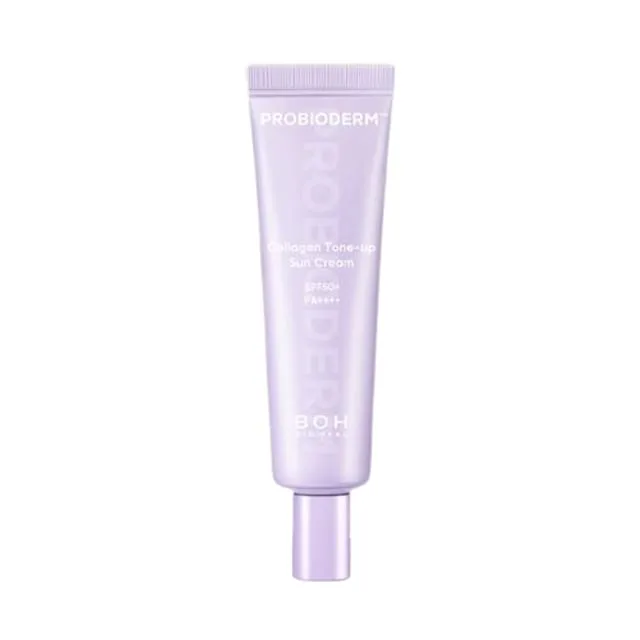
It is a genuine hybrid rather than a tinted chemical sunscreen: four photostable organic filters including the rarely licensed Mexoryl XL sit alongside coated titanium dioxide and two iron oxides, which adds visible-light protection and a peach-beige brightening that most Korean tone-ups achieve with pigment alone. Niacinamide in seventh position and a fragrance-free Probioderm base give it more skincare substance than a typical tone-up, and the collagen-and-peptide deck is the part to ignore.
A properly engineered hybrid tone-up: four photostable organic filters including Mexoryl XL, coated titanium dioxide and iron oxides for brightening and a little visible-light cover, niacinamide high enough to matter, and no fragrance. It brightens fair to medium skin convincingly and primes like a silicone base. The one shade limits who it flatters, the collagen and peptides are decoration, and a firm US price could not be pinned down.
Although this tone-up has sold in Korea since 2024, its US availability runs through Asian-beauty storefronts rather than major retailers, the one US listing found carried a single review, and the export sites that stock it display a brand-wide review count rather than one for this tube. The grade therefore rests on the filter and pigment chemistry, the ingredient order and the brand's Korean SPF, PA and irritation testing; a verified US retail price was not available when this was written.
Verdicts
How well it fits each concern
Verdict by concern tap a concern for the case
Full protectionfor Sun DamageIn your profileYou chose · Broad-spectrum SPF 50 with Uvinul A Plus, Mexoryl XL, bisoctrizole (Tinosorb M), titanium dioxide: the protection sun damage calls for.Moderate evidenceGentleNo reviews collected yet
The case for it
Ethylhexyl Triazone + Diethylamino Hydroxybenzoyl Hexyl Benzoate is a first-line active — approved, monograph-listed or named in current guidelines — for this concern.
It is plausibly present at a working level, though the concentration is not declared.
The formula carries none of the triggers this concern is sensitive to.
What would change this: A declared concentration would move this to a firmer reading of the dose.
Same rule for everyone. “Full protection” is the verdict on 2,288 of 45,024 concern verdicts across the catalog; rule P1 decided 2,232 of them.
As of September 25, 2026, engine 5.1.1.
P1 — Photoprotection standing is regulatory (M020 / Annex VI filters; 21 CFR 201.327 attaches the early-skin-aging claim to tested broad-spectrum SPF 15+). SPF 30 is the AAD daily-use bar. · the full register
Full protectionfor HyperpigmentationIn your profileYou chose · Broad-spectrum SPF 50 with Uvinul A Plus, Mexoryl XL, bisoctrizole (Tinosorb M), titanium dioxide: the protection hyperpigmentation calls for.Moderate evidenceGentleNo reviews collected yet
The case for it
Niacinamide has trial-supported standing for this concern.
It is plausibly present at a working level, though the concentration is not declared.
The formula carries none of the triggers this concern is sensitive to.
What would change this: A declared concentration would move this to a firmer reading of the dose.
Same rule for everyone. “Full protection” is the verdict on 2,288 of 45,024 concern verdicts across the catalog; rule P1 decided 2,232 of them.
As of September 25, 2026, engine 5.1.1.
P1 — Photoprotection standing is regulatory (M020 / Annex VI filters; 21 CFR 201.327 attaches the early-skin-aging claim to tested broad-spectrum SPF 15+). SPF 30 is the AAD daily-use bar. · the full register
Carrying active
Niacinamide
Standing
supported — trials support it
Form
plausible — studied range 2–5%, from the trials on the row; needs leave-on contact; judge it after ~8 weeks
Tolerability
gentle
Row checked
against its sources on July 17, 2026 (evidence table ev-2026.09-r228)
Full protectionfor AgingIn your profileYou chose · Broad-spectrum SPF 50 with Uvinul A Plus, Mexoryl XL, bisoctrizole (Tinosorb M), titanium dioxide: the protection aging calls for.Moderate evidenceGentleNo reviews collected yet
The case for it
Collagen Extract has early or mechanistic evidence for this concern, not trial-backed standing.
It is present at an effective concentration, declared or high in the ingredient list.
The formula carries none of the triggers this concern is sensitive to.
What would change this: Trial evidence for the active on this concern would move this from a bet to a recommendation.
Same rule for everyone. “Full protection” is the verdict on 2,288 of 45,024 concern verdicts across the catalog; rule P1 decided 2,232 of them.
As of September 25, 2026, engine 5.1.1.
P1 — Photoprotection standing is regulatory (M020 / Annex VI filters; 21 CFR 201.327 attaches the early-skin-aging claim to tested broad-spectrum SPF 15+). SPF 30 is the AAD daily-use bar. · the full register
Carrying active
Collagen Extract
Standing
plausible — trials support it
Form
adequate (declared 0.01%) — studied range 0.0003%, from the trials on the row; needs leave-on contact
Tolerability
gentle
Row checked
against its sources on July 17, 2026 (evidence table ev-2026.09-r228)
Basic protectionfor MelasmaIn your profileYou chose · Broad-spectrum SPF 50, but no iron oxides — melasma is worsened by visible light, which UV filters alone do not block.Moderate evidenceGentleNo reviews collected yet
The case for it
Niacinamide has early or mechanistic evidence for this concern, not trial-backed standing.
It is plausibly present at a working level, though the concentration is not declared.
The formula carries none of the triggers this concern is sensitive to.
What would change this: A declared concentration would move this to a firmer reading of the dose.
Same rule for everyone. “Basic protection” is the verdict on 175 of 45,024 concern verdicts across the catalog; rule P3 decided 68 of them.
As of September 25, 2026, engine 5.1.1.
Latin American consensus on the treatment of melasma — International Journal of Dermatology — Delphi regional expert consensus (9 dermatologists), NOT GRADE, NOT a tier-1 guideline body (2024), opened July 16, 2026
Also listed for Dullness — the actives here (Uvinul A Plus (DHHB) are in our research queue for that concern; there is no verdict until their evidence rows are written. That is a gap in our table, not a mark against the product.
Does the jobDoes what a sunscreen is for: UVA coverage, kind to the skin wearing it. Not measured from the label: pleasant enough to actually use.
A verdict is DermApproved’s assessment of how well a product’s ingredients fit a concern — never a claim about what the product treats. Evidence dots and collected reviews sit beside it and are never blended in.
Rules 0.5.1 · evidence table ev-2026.09-r228 · how we decide
Assessment
Pros & Cons
Pros
✓ Four photostable organic filters, including the rarely used Mexoryl XL, plus coated titanium dioxide
✓ Yellow and red iron oxides add brightening and a measure of visible-light protection
✓ Niacinamide in seventh position, high enough for a slow, genuine evening of tone
✓ Silicone-elastomer slip makes it a convincing primer or light tinted base
✓ Fragrance-free, alcohol-free base with bisabolol, panthenol and beta-glucan
✓ Sets to a satin veil that resists pilling under foundation
✓ Completed irritation testing and a comfortable feel on sensitive skin
Cons
✗ One peach-beige shade that can look ashy on deeper skin tones
✗ Tint transfers onto collars, masks and phone screens unless set with powder
✗ Collagen at 0.01 percent and twelve trace peptides add label appeal, not firming
✗ Can cling to dry patches if skin is not moisturized first
✗ US retail price could not be confirmed and varies widely across storefronts
✗ Filters are not US-approved, so ratings come from Korean testing only
Review
Full Review
Tone-up sunscreens live a double life. In the first ten seconds they are cosmetics, lifting a sallow morning face a shade and blurring the pores; for the next eight hours they are drugs, or would be anywhere with a sunscreen monograph, holding UV off the skin. The Bioheal BOH Probioderm Collagen Tone Up Sun Cream is a more interesting example of the type than most because it is honest about doing both jobs with real ingredients, and because the last two lines of its long list, yellow iron oxide and red iron oxide, quietly give it something its untinted sibling lacks.
Start with the protection, since that is what you are paying for. Ethylhexyl triazone and Uvinul A Plus in fifth and sixth position are the photostable UVB and long-wave UVA backbone shared with the Essence version. Where the Essence uses a water-phase Mexoryl SX and Tinosorb S, the Tone Up swaps in Mexoryl XL, a silicone-soluble broad-spectrum filter that L'Oréal rarely licenses and Korean brands almost never use, and the particulate Tinosorb M. Then comes titanium dioxide at eleventh, coated with a silane and aluminium hydroxide so it disperses without clumping. That is four organic filters plus a mineral, a genuine hybrid, and the ordering says the organics carry the SPF while the titanium contributes scattering and, more to the point, whiteness. The iron oxides at the tail warm that whiteness into a peach-beige and, as a bonus that the packaging does not mention, absorb a portion of visible light, the wavelength band that UV filters ignore and that drives melasma and post-inflammatory darkening in deeper skin.
The cosmetic half is well judged for its intended customer. The texture is a light peach lotion-cream with the slip of a silicone primer, thanks to a crosspolymer elastomer and dimethiconol in the base, and it sets to a soft satin veil that blurs texture and evens redness enough for many people to skip foundation. On fair to medium skin the tint reads as a healthy brightening rather than a mask, and it takes powder or foundation over the top without pilling. On deeper skin the same titanium dioxide that flatters a pale face turns ashy, and there is only one shade; that is the standing limitation of the whole tone-up category and this tube does not escape it. The tint also transfers, onto collars, phone screens and masks, which a setting powder mostly fixes.
Between the filters and the pigments sits more skincare than a tone-up usually bothers with. Niacinamide is seventh, above two of the four filters, a placement consistent with a working dose and the source of the slow, real evening of tone that shows after a month, distinct from the instant cosmetic lift. The Probioderm complex, a Lactobacillus ferment at thirteenth with a Sphingomonas ferment and prebiotic sugars lower down, conditions and calms under the pigment layer; the microbiome language around it is marketing, but the soothing is consistent with what sensitive-skin users report. Bisabolol, panthenol, beta-glucan, squalane and argan oil round out a base with no fragrance, no alcohol and no essential oils. And then, positions sixteen to twenty-nine, the deck the brand is proudest of: collagen extract declared at 102,000 parts per billion, which is 0.01 percent, followed by twelve peptides from argireline to copper tripeptide-1 at trace levels. They put the word Collagen on the tube. They do not firm anything. The anti-ageing effect of this product is the UV and visible light it keeps off your face every day, which is a better one anyway.
In daily wear it behaves like a good tinted base with serious protection behind it. Normal and dry skin get comfort and glow; combination skin gets a satin finish that holds through the afternoon; oily skin can wear it but will want powder by lunch, and skin prone to fungal acne should patch test for the shea butter and fatty esters near the end of the list. Reapplication over makeup works with a sponge. The 50 ml tube lasts about a month at the correct quarter-teaspoon dose, which is worth remembering when the price is considered, and the price is the muddled part: the Essence sibling sells at Target for around forty dollars, while the Tone Up has reached US buyers mainly through Asian-beauty storefronts listing it anywhere from the mid-teens to the high twenties, so a firm figure could not be confirmed for this review.
Bioheal BOH is a five-year-old label owned by the retailer that sells it, with credible in-house SPF, PA and irritation testing and no independent studies; none of its organic filters is on the US list, so the tube is regulated here as an import. Users on the Korean side and the export sites are largely delighted with the brightening and the comfort, and reserve their doubts for the shade range and the collagen story, and both doubts are fair.
For fair to medium skin that wants one morning step to protect, brighten and prime, particularly skin with dullness, early sun damage or a melasma tendency that benefits from the iron oxides, this is a strong and unusually well-filtered choice. Deeper skin tones, people who dislike any tint transfer, and anyone shopping on a confirmed US price should reach for the untinted Essence version instead, which shares almost everything here except the pigments and the shade problem they bring.
Formula
Key Ingredients
The hero actives that drive this product's performance.
What makes this the Tone Up version: titanium dioxide at eleventh, coated with triethoxycaprylylsilane and aluminium hydroxide, supplies both a top-up of UV scattering and the brightening white base, while the two iron oxides closing the list warm it toward a peachy beige. Together they lift dull or sallow skin a shade and add a small measure of visible-light protection the untinted sibling lacks.
Regulator-approvedfor Sun Damage · limited certainty
The organic core at fifth and sixth: the most efficient UVB absorber available paired with a photostable long-wave UVA filter. Because neither needs a stabiliser, the formula can carry the mineral pigment load and the silicone elastomers that give the tone-up its primer-like slip without turning heavy.
Regulator-approvedfor Sun Damage · limited certainty
The third and fourth organic filters, eighth and ninth, both photostable and both broad-spectrum. Mexoryl XL is silicone-soluble and rarely seen in Korean sun care; alongside the particulate Tinosorb M it deepens UVA coverage and helps the film hold together over the mineral pigments through a day of wear.
Regulator-approvedfor Sun Damage · limited certainty
Seventh on the list, above two of the four filters, which is an unusually high placement for a sunscreen and consistent with a working dose. It backs the cosmetic tone-up with a slow, real evening of tone, slows pigment transfer under the UVA filters and supports the barrier beneath a daily pigment film.
The brand's signature microbiome complex, with the Lactobacillus ferment at thirteenth and a second Sphingomonas ferment further down. In a tinted sunscreen their contribution is conditioning and calming under the pigment layer; the microbiome framing is aspiration, but the soothing effect fits the low irritation users report.
The firming story carried over from the Probioderm creams: collagen extract declared at 0.01 percent followed by twelve peptides including argireline, copper tripeptide-1 and the matrixyl family, all at trace positions. They earn the 'elasticity' line on the tube; the anti-ageing work is done by the filters and pigments blocking UV and some visible light.
Limitedfor Aging
Ingredient standings describe the active at treatment-level doses and
vehicles; this product's own condition grades weigh its actual formula.
Apply as the final morning step over a fully absorbed moisturizer and let it set for a minute; the silicone elastomers give it a primer-like slip that takes foundation well or replaces it on light-makeup days. Blend the edges at the jaw, since the peach-beige tint can leave a line on deeper skin tones, and reapply with a sponge over makeup.
Results Timeline
The brightening is instant and cosmetic: skin looks a shade lighter, more even and softly blurred the moment it sets, and the effect lasts until cleansing. Sun protection is immediate. A genuine, subtle evening of tone from the niacinamide shows after four to six weeks of daily wear, and slowing of new pigmentation is a matter of months; the collagen and peptides are not expected to produce visible firming.
Pairs Well With
vitamin C serumniacinamide serumlightweight gel moisturizerretinol (night)setting powder
Bioheal BOH Probioderm Collagen Tone Up Sun Cream SPF 50+ PA++++
Sample PM Routine
Oil cleanser
Water cleanser
Toner
Retinol or treatment serum
Moisturizer
Evidence
Science & Expert Perspective
The Science
A hybrid sunscreen distributes its protection between organic absorbers and inorganic scatterers, and this formula's ingredient order shows how the balance was struck. The organic filters, ethylhexyl triazone, diethylamino hydroxybenzoyl hexyl benzoate, drometrizole trisiloxane and methylene bis-benzotriazolyl tetramethylbutylphenol, occupy positions five, six, eight and nine, and all four are photostable, so none needs a stabiliser and the system retains its absorbance through prolonged exposure in the way that published photostability comparisons of European filter combinations have documented. Drometrizole trisiloxane is notable for being silicone-soluble, which suits the elastomer-rich base and gives broad UVB-to-UVA coverage; methylene bis-benzotriazolyl tetramethylbutylphenol is a micro-fine particulate that absorbs, scatters and shields the dissolved filters. Titanium dioxide at eleventh, coated with triethoxycaprylylsilane and aluminium hydroxide, contributes UVB and short-UVA scattering and the white base of the tone-up effect; the coating is what keeps it dispersed and reduces its photocatalytic activity.
The iron oxides are the scientifically interesting addition. Randomised and split-face studies in melasma patients have shown that tinted sunscreens containing iron oxides reduce relapse and pigmentation more than untinted sunscreens of equal SPF, because iron oxides absorb visible light, particularly the blue-violet band that induces melanogenesis in darker skin phototypes and that organic UV filters do not touch. The concentration here is modest, positioned at the end of the list, so the effect is smaller than in a dedicated iron-oxide sunscreen, but it is real and it is the mechanism by which a tone-up can be more than cosmetic for pigmentation-prone skin.
On the skincare side, niacinamide at seventh has strong randomised-trial support for reducing hyperpigmentation, improving barrier function and moderating UV-induced immunosuppression at 2 to 5 percent, and its placement above two filters is consistent with such a level, though undisclosed. The Lactobacillus and Sphingomonas ferments with prebiotic sugars have laboratory data for conditioning and mild anti-inflammatory effects and no clinical evidence of microbiome modulation in a leave-on product. Collagen extract at 102,000 ppb, or 0.01 percent, is a humectant at that level and cannot penetrate; the twelve peptides, including acetyl hexapeptide-8, copper tripeptide-1 and palmitoyl pentapeptide-4, each have trial evidence only at concentrations orders of magnitude above what their positions imply. Bisabolol, panthenol, beta-glucan and squalane form a soothing base with established roles, which, with the absence of fragrance and alcohol, accounts for the low irritation reported.
Dermatologist Perspective
Tinted sunscreens have a specific place in clinical advice: for patients with melasma or post-inflammatory hyperpigmentation, particularly in darker skin phototypes, dermatologists increasingly recommend formulas containing iron oxides because visible light contributes to pigmentation and untinted sunscreens do not block it. A hybrid such as this, with four photostable organic filters, titanium dioxide and iron oxides, meets that recommendation in principle, though the modest iron-oxide level means clinicians may still prefer a more heavily tinted product for severe melasma. The single peach-beige shade is the usual practical objection, since a tint that reads ashy on deeper skin tends to go unworn, and the standard advice is to test the shade before committing or to choose an untinted formula with high UVA protection instead. The fragrance-free, alcohol-free base with bisabolol, panthenol and beta-glucan suits sensitive and rosacea-prone skin, and the niacinamide placement is a welcome supporting detail for pigmentation patients, though not a substitute for a dedicated brightening treatment. The collagen and peptide claims generally draw a dismissive note at the declared levels. As with any imported sunscreen whose filters are not FDA-approved, patients are reminded that the SPF and PA figures come from Korean testing and that the tested protection assumes about a quarter teaspoon for the face, reapplied every two hours in sun.
Guidance
Usage & Recommendations
How to Use
Moisturize first and let it absorb, because the pigments cling to dry patches on bare skin; then this goes on as the last morning step. Squeeze out roughly a quarter teaspoon for the face and neck, dot it across the forehead, cheeks, nose and chin, then blend outward with fingertips, working the edges into the jawline and hairline so the peach tint leaves no line. Give it a minute to set before foundation or powder, or wear it alone as a light tinted base. Reapply every two hours in direct sun and after sweating, pressing a fresh layer on with a sponge over makeup rather than rubbing. Set with a translucent powder if transfer onto collars or masks is a concern. Patch test the shade on the jaw first if your skin is deeper than medium. Store the tube closed and cool, and use it within twelve months of opening.
Value Assessment
Value is difficult to state because no US shelf price could be confirmed: the untinted Essence twin sells at Target for around forty dollars, while this Tone Up appears on Asian-beauty storefronts serving the US at anything from the mid-teens to the high twenties, which suggests either heavy reseller discounting or a lower intended price than its sibling. Across that range the formula itself is good value for a hybrid: four photostable organic filters with Mexoryl XL, coated titanium dioxide, iron oxides and a properly placed niacinamide are more than most tone-ups offer, and the primer-like finish can replace a separate base product. What the price should not be paying for is the collagen at 0.01 percent and the trace peptides. There is no larger size, and a 50 ml tube is roughly a month at the correct daily dose. Bioheal BOH is an emerging brand with in-house testing only, so the money buys formulation quality rather than independent validation. Good value for fair to medium, pigmentation-prone skin that will wear it daily; poor value for anyone the shade does not suit.
Who Should Buy
Fair to medium skin that wants one morning step to protect, brighten and prime, especially anyone with dullness, early sun damage, or a melasma tendency who benefits from iron oxides and high UVA coverage. It suits normal, dry and combination skin, sensitive skin that needs a fragrance-free tint, and people who like to skip foundation on ordinary days.
Who Should Skip
Deeper skin tones, for whom the single peach-beige shade tends to look ashy, and anyone who dislikes tint transfer onto clothing. Very oily skin that wants a matte finish, and buyers who need a confirmed US price, should choose the untinted Essence version, which shares the filters and the skincare base without the pigments.
Ready to try Bioheal BOH Probioderm Collagen Tone Up Sun Cream SPF 50+ PA++++?
A light, peach-tinted lotion-cream with a silky silicone slip that spreads thin, sets to a soft satin veil and leaves skin looking blurred and evenly lit.
Scent
Fragrance-free; a faint, neutral mineral smell from the pigment base that vanishes once applied.
Packaging
A slim 50 ml squeeze tube with a narrow nozzle and flip cap in the Probioderm line's white-and-violet livery, with a peach accent to mark it from the untinted Essence version.
Finish
naturalsatinglowy
What to Expect on First Use
The first application brightens the face a visible shade and smooths texture at once, which some people love and others find a touch too pale until it warms into the skin over ten minutes. It feels like a lightweight primer rather than a sunscreen, does not sting, and has no scent; fair to medium skin usually finds the tint natural, while deeper skin should test the shade at the jawline before committing.
How Long It Lasts
About four weeks at the correct quarter-teaspoon face dose applied daily, or eight to ten weeks used more sparingly as a light tinted base.
Bioheal BOH launched this tone-up in 2024 as the tinted twin of its Probioderm Collagen Essence Sun Cream, reworking the filter system around titanium dioxide and iron oxides to serve the Korean preference for a sunscreen that brightens and primes in one step. The pair extended the brand's award-winning Probioderm identity into sun care, and while the Essence version followed the brand into Target in 2026, the Tone Up has so far reached US buyers mainly through Asian-beauty storefronts.
About Bioheal BOH Emerging Brand (2–5 years)
Bioheal BOH is CJ Olive Young's dermo-cosmetic brand, founded in 2021 and built on the Probioderm probiotic-and-peptide range that has won repeated Olive Young Awards and reached US Sephora and Target in 2026. Its sun creams carry Korean SPF and PA test ratings and a completed irritation panel, while the firming and brightening claims rest on in-house consumer surveys rather than independent published studies.
Brand founded: 2021 · Product launched: 2024
Myth vs. Reality
Common Myths
Myth
A tone-up sunscreen brightens skin over time.
Reality
The tone-up effect is cosmetic, from titanium dioxide and iron oxides, and washes off. Any lasting evening of tone comes from the niacinamide at position seven and from the UVA filters preventing new pigmentation, both of which take weeks, not minutes.
Myth
Because it contains titanium dioxide, this is a mineral sunscreen.
Reality
It is a hybrid. The primary protection comes from four organic filters, and the titanium dioxide at eleventh contributes some scattering and most of the brightening. People seeking a purely mineral formula should look elsewhere.
Myth
The collagen and twelve peptides firm the skin while you wear it.
Reality
Collagen extract is declared at 102,000 ppb, or 0.01 percent, and the peptides follow at trace positions. Daily broad-spectrum protection is the real anti-ageing benefit in this tube; the firming deck is label decoration.
FAQ
Frequently Asked Questions
What is the difference between the Bioheal BOH Tone Up and Essence sun creams?
The Essence version is an untinted five-filter chemical sunscreen with Mexoryl SX and Tinosorb S. The Tone Up swaps to Mexoryl XL and Tinosorb M, adds titanium dioxide and yellow and red iron oxides for a peach-beige brightening tint, and uses silicone elastomers for a primer-like finish. Both carry niacinamide, the Probioderm ferment and the same collagen-and-peptide deck.
Does the Probioderm Collagen Tone Up Sun Cream suit deeper skin tones?
It comes in one peach-beige shade that reads natural on fair to medium skin and can look ashy or too light on deeper tones, since the titanium dioxide lifts the complexion by design. Deeper skin should test it at the jawline or choose the untinted Essence version, which has no cast.
Which UV filters are in the Bioheal BOH Tone Up Sun Cream?
Four photostable organic filters, ethylhexyl triazone, diethylamino hydroxybenzoyl hexyl benzoate, drometrizole trisiloxane (Mexoryl XL) and methylene bis-benzotriazolyl tetramethylbutylphenol (Tinosorb M), plus coated titanium dioxide. The iron oxides add a small measure of visible-light protection, which is useful for melasma-prone skin.
Can I wear the Tone Up Sun Cream instead of foundation?
Many users do on light-makeup days. The pigments even out redness and dullness and the silicone elastomers blur texture, so it works as a light tinted base; for fuller coverage it makes a good primer under foundation. It can transfer onto collars and masks, so set it with powder if that matters.
Is the Bioheal BOH Tone Up Sun Cream fragrance-free and good for sensitive skin?
Yes, it contains no perfume, essential oils or alcohol, and the base includes bisabolol, panthenol, beta-glucan and squalane with a completed irritation test. Most reactive skin tolerates it well; skin prone to fungal acne should patch test because of the shea butter and fatty esters.
How much collagen does the Tone Up Sun Cream contain?
The label declares collagen extract at 102,000 parts per billion, which is about 0.01 percent, with twelve peptides listed after it at trace positions. That is far below the levels used in firming trials, so treat the anti-ageing claim as resting on the sun protection rather than on the collagen.
Reviews
What Reviewers Tend to Say
Recurring themes our editors read across retailer reviews of this product — summaries in our words, not quotations, and not a substitute for your own patch test.
Common Praise
Brightens dull or sallow skin instantly without a chalky cast
Works as a primer and evens tone enough to skip foundation
Fragrance-free and comfortable on sensitive skin
Lightweight for a tinted sunscreen and does not pill
Common Complaints
The single peachy shade can look ashy or too light on deeper skin
Tone-up tint transfers onto collars and masks
Can accentuate dry patches if skin is not moisturized first
The collagen and peptides read as marketing on a sunscreen
Notable Endorsements
Sister product to the Probioderm Collagen Essence Sun Cream stocked at Target
Every pigment-fading active runs against a re-pigmenting stimulus, and for melasma part of that stimulus is visible light — which broad-spectrum sunscreen does essentially nothing about unless you can see it on your face.
It was invented to stop bleeding during surgery. In 2026 it's in dozens of brightening serums — and the evidence is better than most trend ingredients can claim.
Products, answers, therapy guides, tools and articles in one search. Brand names,
slang and abbreviations all work — accutane finds isotretinoin, bacne finds truncal acne.