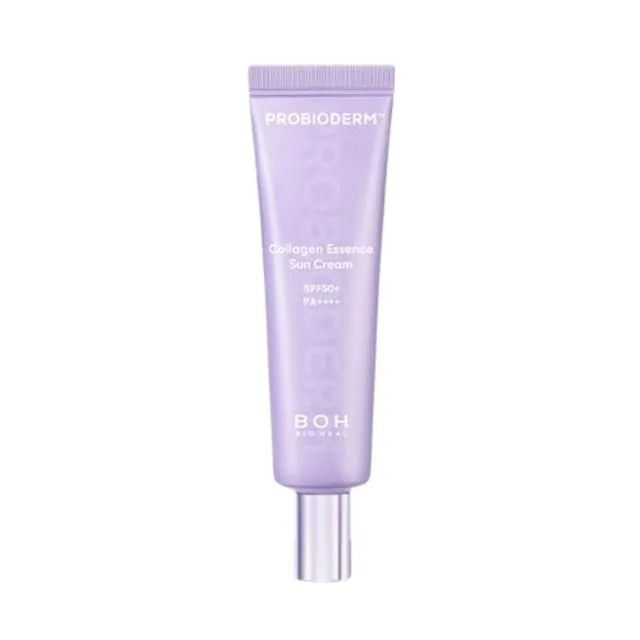
Very few Korean sunscreens carry a water-phase UVA filter, and this one pairs Mexoryl SX with Tinosorb S, Uvinul A Plus, Uvinul T 150 and Polysilicone-15 for a five-filter, two-phase system that reaches SPF 50+ PA++++ while feeling like an essence. It then adds niacinamide high enough to matter and the brand's Probioderm ferment, all fragrance-free; the collagen and twelve peptides on the label are the part you can ignore.
One of the better-engineered chemical sunscreens in the Korean mid-market: five photostable filters split across the water and oil phases, including a rare Mexoryl SX, a genuinely useful niacinamide placement and a fragrance-free essence base that disappears under makeup. The collagen at 0.01 percent and the twelve trace peptides are the label's theatre. At around forty dollars for 50 ml it is priced for the filters, and the filters earn it.
Although this sunscreen has been sold in Korea since 2024, its US retail presence dates only from 2026 and Target had not accumulated ratings when this was written, while the K-beauty export sites that carry it show a brand-wide review count rather than one specific to the tube. The grade rests chiefly on the filter chemistry, which is extensively documented, on the ingredient order, and on the brand's own Korean SPF, PA and irritation testing rather than on a large body of independent user data.
Verdicts
How well it fits each concern
Verdict by concern tap a concern for the case
Full protectionfor Sun DamageIn your profileYou chose · Broad-spectrum SPF 50 with ecamsule (Mexoryl SX), bemotrizinol (Tinosorb S), Uvinul A Plus: the protection sun damage calls for.Moderate evidenceGentleNo reviews collected yet
The case for it
Ethylhexyl Triazone + Bis-Ethylhexyloxyphenol Methoxyphenyl Triazine is a first-line active — approved, monograph-listed or named in current guidelines — for this concern.
It is plausibly present at a working level, though the concentration is not declared.
The formula carries none of the triggers this concern is sensitive to.
What would change this: A declared concentration would move this to a firmer reading of the dose.
Same rule for everyone. “Full protection” is the verdict on 2,288 of 45,024 concern verdicts across the catalog; rule P1 decided 2,232 of them.
As of September 25, 2026, engine 5.1.1.
P1 — Photoprotection standing is regulatory (M020 / Annex VI filters; 21 CFR 201.327 attaches the early-skin-aging claim to tested broad-spectrum SPF 15+). SPF 30 is the AAD daily-use bar. · the full register
21 CFR § 352.10 Sunscreen active ingredients — US FDA — 21 CFR Part 352 (Sunscreen Drug Products for Over-the-Counter Human Use), via Cornell Legal Information Institute; part heading marked [STAYED INDEFINITELY], effective date stayed at 66 FR 67485, opened September 1, 2026
Full protectionfor HyperpigmentationIn your profileYou chose · Broad-spectrum SPF 50 with ecamsule (Mexoryl SX), bemotrizinol (Tinosorb S), Uvinul A Plus: the protection hyperpigmentation calls for.Moderate evidenceGentleNo reviews collected yet
The case for it
Niacinamide has trial-supported standing for this concern.
It is plausibly present at a working level, though the concentration is not declared.
The formula carries none of the triggers this concern is sensitive to.
What would change this: A declared concentration would move this to a firmer reading of the dose.
Same rule for everyone. “Full protection” is the verdict on 2,288 of 45,024 concern verdicts across the catalog; rule P1 decided 2,232 of them.
As of September 25, 2026, engine 5.1.1.
P1 — Photoprotection standing is regulatory (M020 / Annex VI filters; 21 CFR 201.327 attaches the early-skin-aging claim to tested broad-spectrum SPF 15+). SPF 30 is the AAD daily-use bar. · the full register
Carrying active
Niacinamide
Standing
supported — trials support it
Form
plausible — studied range 2–5%, from the trials on the row; needs leave-on contact; judge it after ~8 weeks
Tolerability
gentle
Row checked
against its sources on July 17, 2026 (evidence table ev-2026.09-r228)
Full protectionfor AgingIn your profileYou chose · Broad-spectrum SPF 50 with ecamsule (Mexoryl SX), bemotrizinol (Tinosorb S), Uvinul A Plus: the protection aging calls for.Moderate evidenceGentleNo reviews collected yet
The case for it
Collagen Extract has early or mechanistic evidence for this concern, not trial-backed standing.
It is present at an effective concentration, declared or high in the ingredient list.
The formula carries none of the triggers this concern is sensitive to.
What would change this: Trial evidence for the active on this concern would move this from a bet to a recommendation.
Same rule for everyone. “Full protection” is the verdict on 2,288 of 45,024 concern verdicts across the catalog; rule P1 decided 2,232 of them.
As of September 25, 2026, engine 5.1.1.
P1 — Photoprotection standing is regulatory (M020 / Annex VI filters; 21 CFR 201.327 attaches the early-skin-aging claim to tested broad-spectrum SPF 15+). SPF 30 is the AAD daily-use bar. · the full register
Carrying active
Collagen Extract
Standing
plausible — trials support it
Form
adequate (declared 0.01%) — studied range 0.0003%, from the trials on the row; needs leave-on contact
Tolerability
gentle
Row checked
against its sources on July 17, 2026 (evidence table ev-2026.09-r228)
Basic protectionfor MelasmaIn your profileYou chose · Broad-spectrum SPF 50, but no iron oxides — melasma is worsened by visible light, which UV filters alone do not block.Moderate evidenceGentleNo reviews collected yet
The case for it
Niacinamide has early or mechanistic evidence for this concern, not trial-backed standing.
It is plausibly present at a working level, though the concentration is not declared.
The formula carries none of the triggers this concern is sensitive to.
What would change this: A declared concentration would move this to a firmer reading of the dose.
Same rule for everyone. “Basic protection” is the verdict on 175 of 45,024 concern verdicts across the catalog; rule P3 decided 68 of them.
As of September 25, 2026, engine 5.1.1.
Latin American consensus on the treatment of melasma — International Journal of Dermatology — Delphi regional expert consensus (9 dermatologists), NOT GRADE, NOT a tier-1 guideline body (2024), opened July 16, 2026
Also listed for Dehydration — the actives here (Tinosorb, Mexoryl SX, Niacinamide, Probiotics & Prebiotics) are in our research queue for that concern; there is no verdict until their evidence rows are written. That is a gap in our table, not a mark against the product.
Does the jobDoes what a sunscreen is for: UVA coverage, kind to the skin wearing it. Not measured from the label: pleasant enough to actually use.
A verdict is DermApproved’s assessment of how well a product’s ingredients fit a concern — never a claim about what the product treats. Evidence dots and collected reviews sit beside it and are never blended in.
Rules 0.5.1 · evidence table ev-2026.09-r228 · how we decide
Assessment
Pros & Cons
Pros
✓ Five photostable filters split across water and oil phases, including Mexoryl SX
✓ SPF 50+ PA++++ with deep long-wave UVA coverage from three separate UVA filters
✓ Essence-thin texture sets in seconds with no white cast on any skin tone
✓ Niacinamide placed ninth, high enough to contribute a gradual brightening
✓ Fragrance-free, alcohol-free and low-sting; well tolerated by sensitive skin
✓ Soothing base of panthenol, beta-glucan, ceramide NP and oat extract
✓ Layers cleanly under makeup and reapplies over itself without pilling
Cons
✗ Collagen declared at 102,000 ppb, or 0.01 percent, so the firming claim is decorative
✗ Twelve peptides sit at trace positions and add cost without demonstrable benefit
✗ Dewy finish becomes shine on oily skin by midday
✗ Premium price for 50 ml, about a month's supply at the correct dose
✗ Filters are not US-approved, so the tube is sold as an import with Korean testing only
✗ Availability at US retailers has been patchy
Review
Full Review
Sixth on the ingredient list of the Probioderm Collagen Essence Sun Cream is terephthalylidene dicamphor sulfonic acid, better known as Mexoryl SX, and its presence is the most telling thing about the whole tube. Mexoryl SX is a water-soluble UVA filter, patented by L'Oréal for decades and rarely licensed into Korean formulas, and it does something the four oil-phase filters around it cannot: it protects from inside the water phase. That lets Bioheal BOH stack five photostable filters, ethylhexyl triazone, Tinosorb S, Uvinul A Plus, polysilicone-15 and the Mexoryl, across both phases of the emulsion and still keep the oil load light enough to spread like a hydrating essence. It is a small piece of formulation ambition in a category where most brands settle for two or three filters, and it is the honest reason this sunscreen costs more than its neighbours.
The experience follows directly from that engineering. The cream is soft and off-white in the hand, thins almost to water as it spreads, and sets in a few seconds to a smooth, faintly luminous film with no cast on any skin tone, because there is no zinc or titanium to leave one. It does not sting around the eyes for most people, it does not smell of anything, and it sits under foundation without a hint of pilling, which makes it one of the easier daily sunscreens to actually wear at the full dose. Dry and normal skin get a light day cream's worth of comfort from it; combination skin gets a healthy finish that lasts; oily skin will find the dewiness turns to shine by early afternoon and may want a powder on top.
The skincare half of the formula is where the label's claims and its substance part company, and it is worth reading both. Niacinamide at ninth, above the preservative and the probiotic ferment, is a real inclusion and the likely source of the gradual brightening that users describe after a month. The Probioderm complex, a Lactobacillus ferment in twelfth position with fructooligosaccharides, inulin and fructan closing the list, is the brand's signature and does what ferments do in a leave-on product: it conditions and calms, and the microbiome language around it is aspiration rather than evidence. Panthenol, beta-glucan, ceramide NP, cholesterol and oat kernel extract fill out a soothing base that explains why sensitive-skin users like it so much.
Then there is the collagen, printed with a precision that deserves credit and undermines the point: 102,000 parts per billion. That is 0.01 percent. Behind it march twelve peptides, from argireline and copper tripeptide-1 through the matrixyl family, in positions eighteen to twenty-nine of a sixty-odd-ingredient list, which is trace territory for actives that trials use at far higher levels. 'Defend your youth with the essence-light power of probiotics and collagen', says the tube, and the defence is real, but it is being done by the five filters. The peptides are a story. Nobody should pay for them, and nobody should be put off by them either; they are inert to the experience.
In use over a few weeks the sunscreen behaves as a well-made daily SPF should. Skin stays comfortable rather than tight under it, the niacinamide earns a modest, even tone, and the film reapplies cleanly over itself and over makeup when pressed on with fingertips. The 50 ml tube lasts about a month at the correct quarter-teaspoon face dose, which is the standard for any serious sunscreen and worth remembering when the price is weighed. Feedback across the Korean export sites and the brand's Olive Young home is strongly positive on texture, cast and comfort, with the recurring reservations being the cost, the shine on oily skin and a suspicion that the collagen and peptides are marketing; those reviewers are right on the last point.
The brand context matters for the price. Bioheal BOH is five years old, owned by the retailer that sells it, and its testing is in-house: Korean SPF and PA measurements, a completed irritation panel and consumer satisfaction surveys with suspiciously round numbers. None of its sunscreens has been studied independently, and the five filters, all approved in Europe, Korea and Australia, are not on the US list, so the tube is sold here as an import rather than an FDA-regulated drug. What you are paying around forty dollars for is a filter system that would be at home in a European pharmacy sunscreen, a fragrance-free and thoughtfully soothing base, and a texture that makes daily full-dose use easy. What you are not paying for is proven firming, whatever the front of the tube implies.
For anyone with early sun damage, dark spots or melasma who wants deep, photostable UVA protection in a sunscreen they will actually wear, this is an easy recommendation and a rare Korean tube that carries Mexoryl. For sensitive skin that has struggled with stinging chemical sunscreens, it is worth a try for the same reason. Oily skin in a humid climate should consider a matte alternative, and anyone shopping on price will find similar UVB protection cheaper elsewhere; what they will not find cheaper is this UVA depth in a formula this light.
Formula
Key Ingredients
The hero actives that drive this product's performance.
The water-soluble UVA filter in sixth position, a rarity in Korean sunscreens and the reason this cream's UVA coverage is unusually deep. Because it sits in the water phase while the other four filters sit in oil, it lets the formula hold a high PA rating without loading the oil phase, which is how a five-filter sunscreen can still feel like an essence.
Regulator-approvedfor Sun Damage · limited certainty
The oil-phase core of the filter system, fifth and seventh: the most efficient UVB absorber available paired with a photostable broad-spectrum triazine. Together with the Mexoryl they mean no filter here needs a stabiliser, keeping the emollient load light enough for the dibutyl adipate base to dry down clean and cast-free.
Regulator-approvedfor Sun Damage · limited certainty
The fourth and fifth filters, at fourteen and fifteen, extend long-wave UVA coverage and add a silicone-based UVB booster that also improves spreading. Five photostable filters across both phases is over-engineering by most standards and is the honest reason to pay more for this tube than for a two-filter sunscreen.
Regulator-approvedfor Sun Damage · limited certainty
Ninth on the list, ahead of the preservative and the probiotic ferment, which is high enough to expect a working dose. Under a UVA-heavy filter set it complements the protection by slowing pigment transfer and supporting barrier function, and it is the ingredient most likely behind the brightening users report after a few weeks.
The brand's signature microbiome complex, with the ferment at twelfth and the prebiotic sugars closing the list. In a sunscreen its role is conditioning and calming the skin under a daily film of filters rather than anything measurable about the microbiome, though the ferment's soothing effect is consistent with the low irritation users report.
The anti-ageing story, printed with unusual precision: 102,000 parts per billion is 0.01 percent of collagen extract, followed by twelve peptides that include argireline, copper tripeptide-1 and the matrixyl family. At those positions they are a marketing deck that lends the sunscreen its 'defend your youth' line; the actual anti-ageing work here is done by the filters.
Limitedfor Aging
Ingredient standings describe the active at treatment-level doses and
vehicles; this product's own condition grades weigh its actual formula.
Over moisturizer and under makeup is its place in the morning, with a minute to set between; its essence-thin texture spreads easily over serums and light creams. For dry skin it can double as a light day cream, and it reapplies cleanly over itself without pilling.
Results Timeline
Protection is immediate once the film sets, about a minute after application, and the essence texture leaves skin comfortable and lightly dewy all day. A modest brightening from the niacinamide typically shows after four to six weeks of daily use, and any slowing of new sun-induced spots or lines is a matter of months of consistent wear; the collagen and peptides are not expected to produce visible firming.
Pairs Well With
vitamin C serumniacinamideceramide moisturizerretinol (night)hyaluronic acid serum
Bioheal BOH Probioderm Collagen Essence Sun Cream SPF 50+ PA++++
Sample PM Routine
Oil cleanser
Water cleanser
Toner
Retinol or treatment serum
Moisturizer
Evidence
Science & Expert Perspective
The Science
The protection architecture in this cream is what sunscreen formulators call a two-phase system, and it is uncommon enough in Korean products to merit explanation. Four of the five filters are oil-soluble: ethylhexyl triazone, whose exceptionally high specific extinction makes it the most efficient UVB absorber available; bis-ethylhexyloxyphenol methoxyphenyl triazine, a photostable broad-spectrum triazine; diethylamino hydroxybenzoyl hexyl benzoate, an inherently photostable long-wave UVA absorber; and polysilicone-15, a silicone-backbone UVB filter that also improves film formation. The fifth, terephthalylidene dicamphor sulfonic acid, is water-soluble and absorbs short and mid UVA from within the aqueous phase. Distributing filters across both phases increases the total filter load the emulsion can carry without becoming heavy and, in published photostability work on European filter combinations, yields systems that retain most of their UVA absorbance after hours of simulated sun exposure, unlike unstabilised avobenzone systems that lose a large share within the first hour. That retained UVA absorbance is what a PA++++ rating measures in the laboratory and what the wearer relies on at four in the afternoon.
The skincare layer has one active with strong evidence and several with none. Niacinamide, in ninth position, has randomised, vehicle-controlled trial support at 2 to 5 percent for reducing hyperpigmentation, strengthening the barrier and moderating UV-induced immunosuppression, all of which are relevant beneath a daily filter film; its placement here is consistent with a working level, though the brand does not disclose one. The Probioderm complex, Lactobacillus ferment with fructooligosaccharides, inulin and fructan, has laboratory data for conditioning and mild anti-inflammatory activity, and no clinical evidence of altering the skin microbiome in a leave-on product. Collagen extract at 102,000 ppb, or 0.01 percent, functions as a humectant at that level and cannot penetrate; the twelve peptides that follow, including acetyl hexapeptide-8, copper tripeptide-1 and palmitoyl pentapeptide-4, each have trial data at concentrations orders of magnitude above what their tail positions imply. Panthenol, beta-glucan, ceramide NP with cholesterol and lecithin, and oat kernel extract form a base with established soothing and barrier-supporting roles, which together with the absence of fragrance and alcohol explains the low irritation reported. None of the five filters is a permitted active under the US sunscreen monograph, which is why the product carries Korean rather than FDA-regulated labelling.
Dermatologist Perspective
For patients managing melasma, post-inflammatory hyperpigmentation or early photoageing, clinicians tend to prioritise the depth and stability of UVA protection over almost every other sunscreen attribute, and a five-filter system that combines Mexoryl SX with Tinosorb S and Uvinul A Plus is the kind of formula dermatologists familiar with European sunscreens single out for that purpose. The fragrance-free, alcohol-free base with panthenol, beta-glucan and ceramides also fits the usual recommendation for sensitive or rosacea-prone skin that has abandoned chemical sunscreens over stinging, though a patch test remains sensible for anyone with a history of contact allergy. The collagen and peptide claims generally draw a dismissive note: at the declared 0.01 percent and trace positions they are not expected to contribute, and patients are usually reminded that consistent daily sun protection is itself the most evidence-based anti-ageing intervention available. Two practical cautions are standard. The tested SPF assumes about a quarter teaspoon for the face, so a 50 ml tube should last roughly a month, and because none of the filters is FDA-approved the product is regulated as an import rather than an over-the-counter drug in the US, meaning its ratings come from Korean testing. Dermatologists also commonly suggest pairing a sunscreen of this kind with a morning antioxidant serum and, for pigmentation patients, a separately dosed brightener, since the niacinamide here is supportive rather than treatment-strength.
Guidance
Usage & Recommendations
How to Use
Morning routine, last step, moisturizer already absorbed: that is where this tube belongs. Squeeze out roughly a quarter teaspoon, or two full finger-lengths, for the face and neck, dot it across the forehead, cheeks, nose and chin, and spread with light strokes outward; it thins as it moves and sets within a few seconds. Give it a minute before makeup. Reapply every two hours in direct sun and after sweating or swimming, pressing a fresh layer on with fingertips over makeup rather than rubbing. Sensitive skin can patch test on the jawline first, though the formula is fragrance-free and alcohol-free. Keep the tube closed and out of heat, and use it within twelve months of opening.
Value Assessment
At about forty dollars for 50 ml, confirmed at Target, this sits at the premium end of Korean sunscreens and roughly a month's supply at the correct daily dose, so the annual cost is real. What justifies the price is the filter system: five photostable filters across two phases, with a water-soluble Mexoryl SX that most competitors at half the price cannot license, deliver UVA depth usually found in European pharmacy sunscreens costing as much or more. What does not justify it is the collagen at 0.01 percent and the twelve trace peptides, which add label appeal rather than performance, and buyers should not count them in the value equation. There is no larger size. Bioheal BOH is an emerging brand whose testing is in-house, so the premium buys formulation quality rather than independent validation. For skin that needs serious, wearable UVA protection every day, particularly pigmentation-prone skin, it is worth the money; for someone who mainly wants SPF 50 for the commute, cheaper tubes will do.
Who Should Buy
Anyone with dark spots, melasma, early sun damage or a family history of photoageing who wants deep, photostable UVA protection in a sunscreen light enough to wear at the full dose every day. It particularly suits normal, combination, dry and sensitive skin, and people who wear makeup over SPF and hate pilling or a white cast.
Who Should Skip
Very oily skin in a humid climate that dislikes any shine, and anyone shopping on price who mainly needs basic SPF 50 for short daily exposure. People buying it for the collagen or peptides should know those are at trace levels and look instead to a properly dosed serum for firming.
Ready to try Bioheal BOH Probioderm Collagen Essence Sun Cream SPF 50+ PA++++?
A soft, off-white essence-cream that turns almost watery as it spreads and sets within seconds to a smooth, faintly luminous film with no drag or residue.
Scent
Fragrance-free with a barely-there neutral, slightly starchy smell from the base that disappears on application.
Packaging
A slim 50 ml squeeze tube with a narrow nozzle and flip cap, in the Probioderm line's white-and-violet livery; it doses accurately and travels well.
Finish
dewynaturalinvisible
What to Expect on First Use
First use feels like applying a hydrating essence rather than a sunscreen: it spreads thin, disappears in a few seconds and leaves a soft glow with no tightness or greasiness. There is no adjustment period, no scent and no eye sting for most users, and reactive skin generally reports only the mild dewiness as something to notice.
How Long It Lasts
Around four weeks at the correct quarter-teaspoon face dose applied daily, or eight to ten weeks at a lighter everyday application.
Bioheal BOH extended its Probioderm Collagen line into sun care in 2024 with two sunscreens, this untinted Essence version and a Tone Up sibling, applying the microbiome-and-peptide identity of its award-winning creams to a daily SPF. The 'up to 78 percent skincare ingredients' framing was aimed at Korean consumers who treat sunscreen as a skincare step, and the product followed the brand into Target and Sephora when Olive Young pushed into the US in 2026.
About Bioheal BOH Emerging Brand (2–5 years)
Bioheal BOH is the dermo-cosmetic label owned by CJ Olive Young, launched in 2021 and known for its Probioderm probiotic-and-peptide range, which has taken multiple Olive Young Awards and reached US Sephora and Target by 2026. Its sunscreens carry Korean SPF and PA ratings and a completed irritation panel; the anti-ageing claims rest on in-house consumer surveys rather than independent published trials.
Brand founded: 2021 · Product launched: 2024
Myth vs. Reality
Common Myths
Myth
The collagen and twelve peptides make this an anti-ageing treatment as well as a sunscreen.
Reality
Collagen extract is declared at 102,000 ppb, which is 0.01 percent, and the peptides follow it at trace levels. The genuine anti-ageing effect of this product is its five-filter UVA and UVB protection worn every day, not the peptide deck.
Myth
A sunscreen that feels this light cannot be full SPF 50+.
Reality
The filters used are among the most efficient and photostable available, and one of them works in the water phase, which lets the formula reach a high rating with a small oil load. Lightness reflects filter chemistry, not weaker protection, provided the full dose is applied.
Myth
'Probiotic' sunscreen protects the skin microbiome from UV.
Reality
The Lactobacillus ferment and prebiotic sugars condition and calm the skin, but there is no evidence they alter the microbiome under a sunscreen film. The calmer feel users describe is consistent with the ferment's soothing role and the absence of fragrance.
FAQ
Frequently Asked Questions
Which UV filters does the Bioheal BOH Probioderm Collagen Essence Sun Cream use?
Five: ethylhexyl triazone (Uvinul T 150), terephthalylidene dicamphor sulfonic acid (Mexoryl SX), bis-ethylhexyloxyphenol methoxyphenyl triazine (Tinosorb S), diethylamino hydroxybenzoyl hexyl benzoate (Uvinul A Plus) and polysilicone-15. All are photostable, and the Mexoryl works in the water phase, which is unusual in Korean sunscreens.
Does the Probioderm Collagen Essence Sun Cream leave a white cast?
No. All five filters are organic absorbers with no zinc or titanium, and the cream sets to a transparent, faintly luminous film within seconds on every skin tone. The Tone Up sibling is the version that adds a brightening tint.
How much collagen is in the Bioheal BOH Collagen Essence Sun Cream?
The label states collagen extract at 102,000 parts per billion, which works out to about 0.01 percent. At that level it is a humectant footnote rather than a firming active, and the twelve peptides that follow it are also at trace positions. The sunscreen's real anti-ageing value is its UVA and UVB protection.
Is the Bioheal BOH Essence Sun Cream good for sensitive skin?
It is one of the better chemical sunscreens for reactive skin: fragrance-free, alcohol-free, free of essential oils, with panthenol, beta-glucan, ceramide NP and oat extract in the base and a completed irritation test. Most users report no eye stinging, which is not always true of organic filters.
Can I wear the Probioderm Collagen Essence Sun Cream under makeup?
Yes, and this is where it excels. The essence texture dries down smooth and slightly dewy, so foundation glides over it without pilling, and reapplication over makeup works if pressed on with fingertips rather than rubbed.
Is this sunscreen suitable for oily or acne-prone skin?
The formula is light and free of heavy oils, and the niacinamide is a bonus for congestion-prone skin, but the finish is dewy and can read as shine by midday on very oily faces. Skin prone to fungal acne may want to patch test because of the lecithin and fatty-alcohol emulsifiers.
Reviews
What Reviewers Tend to Say
Recurring themes our editors read across retailer reviews of this product — summaries in our words, not quotations, and not a substitute for your own patch test.
Common Praise
Melts in like a light essence with no white cast on any skin tone
Comfortable and hydrating under makeup for a full day
No stinging around the eyes and no fragrance
Skin looks brighter and more even after a few weeks
Common Complaints
Expensive for 50 ml compared with other Korean sunscreens
Dewy finish can read as shine on oily skin
The collagen and peptide claims feel like marketing on a sunscreen
Not always in stock at US retailers
Notable Endorsements
Stocked by Target and Sephora in the US since 2026
It was invented to stop bleeding during surgery. In 2026 it's in dozens of brightening serums — and the evidence is better than most trend ingredients can claim.
We have spent years praising Japanese filter chemistry while ignoring that the filter is the last line of a system built out of fabric, shade and timing — the part that needs no importing and does not depend on you remembering to reapply.
Every pigment-fading active runs against a re-pigmenting stimulus, and for melasma part of that stimulus is visible light — which broad-spectrum sunscreen does essentially nothing about unless you can see it on your face.
Aug 7, 2026· 8 min
Questions people ask about Hyperpigmentation
Verified answers from our questions library — the nuance a product page cannot carry.
Products, answers, therapy guides, tools and articles in one search. Brand names,
slang and abbreviations all work — accutane finds isotretinoin, bacne finds truncal acne.