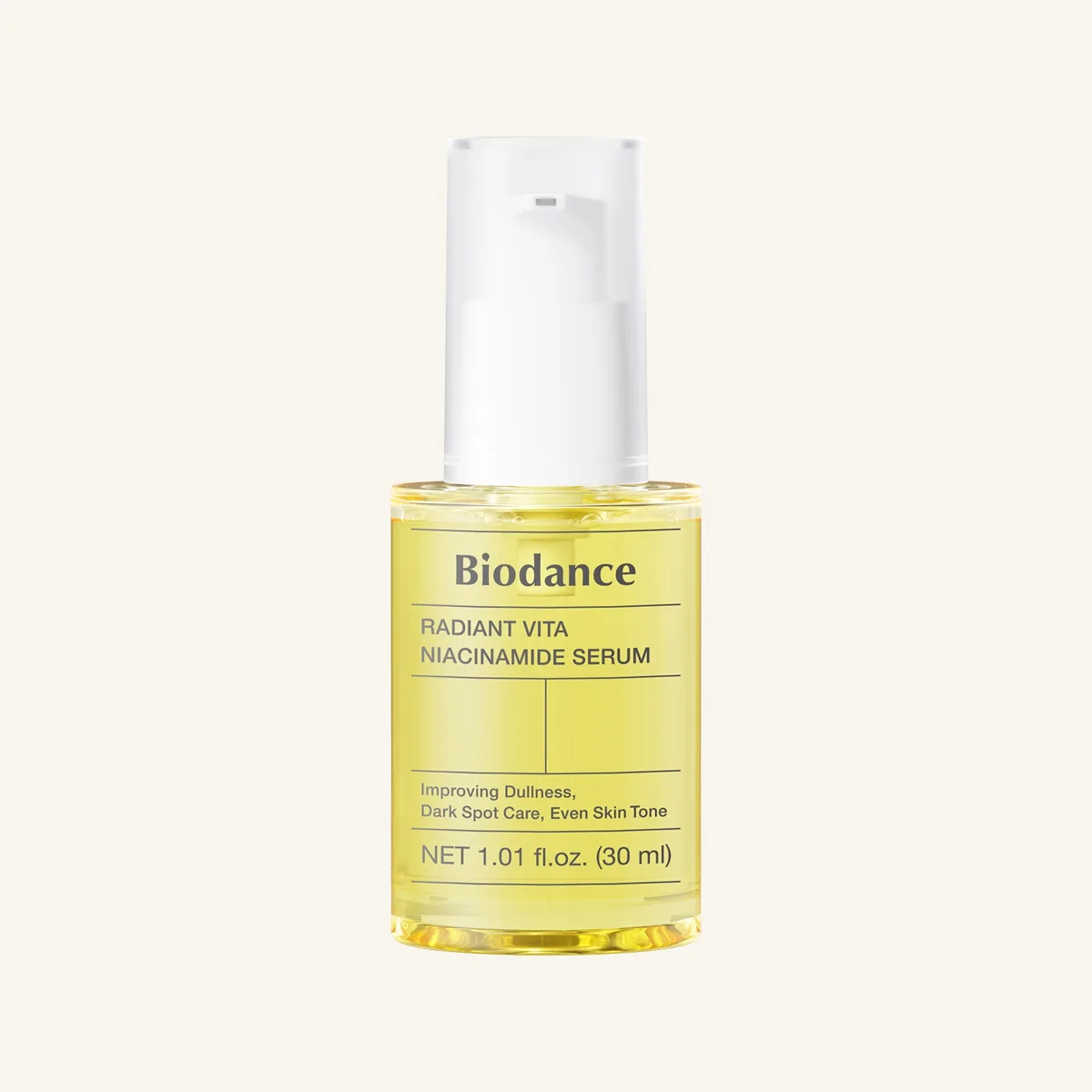
Where most brightening serums stop at 10 percent niacinamide, Biodance goes to 20 percent in a pineapple-water base with a token dose of glutathione — a maximalist take on an ingredient whose evidence tops out far lower. The interesting part is the counterweight: a Coptis (berberine) root extract and arginine to keep such a heavy dose comfortable, in a formula that is otherwise strikingly short and free of fragrance, oils and silicones.
A fragrance-free, fairly priced niacinamide serum with a dewy finish and a number on the front — 20 percent — that is bigger than the evidence needs and bigger than some faces will enjoy. On robust oily or combination skin with post-acne marks it does the job well; on reactive skin the dose is the reason to pick something gentler.
This assessment draws on the published ingredient list, the well-documented behaviour of niacinamide at lower doses, and early feedback from a few dozen reviewers across Sephora, Amazon and YesStyle since the serum's late-2025 launch. The two-week brightness figure is Biodance's own; independent long-term data on this specific 20 percent formula do not yet exist, and the flushing rate on reactive skin in particular is drawn from user reports rather than a study.
Verdicts
How well it fits each concern
Verdict by concern tap a concern for the case
Good choicefor HyperpigmentationIn your profileYou chose · Niacinamide is a trial-supported active for hyperpigmentation; this serum carries it at 20%.Moderate evidenceGentleNo reviews collected yet
The case for it
Niacinamide has trial-supported standing for this concern.
It is present at an effective concentration, declared or high in the ingredient list.
The formula carries none of the triggers this concern is sensitive to.
Same rule for everyone. “Good choice” is the verdict on 9,564 of 45,024 concern verdicts across the catalog; rule R5 decided 9,072 of them.
As of September 25, 2026, engine 5.1.1.
Promisingfor Dark SpotsIn your profileYou chose · Niacinamide has trial-level evidence for dark spots but no guideline or regulatory standing yet — promising, short of a recommendation; the other actives here are not yet assessed for it.Moderate evidenceGentleNo reviews collected yet
The case for it
Niacinamide has trial-level evidence for this concern but no guideline or regulatory standing yet.
It is present at an effective concentration, declared or high in the ingredient list.
The formula carries none of the triggers this concern is sensitive to.
What would change this: Guideline or regulatory standing for the active on this concern would move this from a promising bet to a recommendation.
Same rule for everyone. “Promising” is the verdict on 7,858 of 45,024 concern verdicts across the catalog; rule R9p decided 7,858 of them.
As of September 25, 2026, engine 5.1.1.
R9p — 0.5.0: 'Unproven' beside three filled dots read as one question answered twice with opposite words (7,018 rows). The chip measures standing, the dots measure trial volume; where the row carries at least one RCT or a tier-2 source (moderate dots) and the active is present at a working level, the honest word is Promising. Unproven is reserved for plausible-standing rows with limited or weak evidence, or an under-dosed form. Same rank as Unproven — a bet either way; the dots order them. · the full register
Carrying active
Niacinamide
Standing
plausible — trials support it
Form
adequate (declared 20%)
Tolerability
gentle
Row checked
against its sources on July 17, 2026 (evidence table ev-2026.09-r228)
Promisingfor Excess OilinessIn your profileYou chose · Niacinamide has trial-level evidence for excess oiliness but no guideline or regulatory standing yet — promising, short of a recommendation; the other actives here are not yet assessed for it.Moderate evidenceGentleNo reviews collected yet
The case for it
Niacinamide has trial-level evidence for this concern but no guideline or regulatory standing yet.
It is present at an effective concentration, declared or high in the ingredient list.
The formula carries none of the triggers this concern is sensitive to.
What would change this: Guideline or regulatory standing for the active on this concern would move this from a promising bet to a recommendation.
Same rule for everyone. “Promising” is the verdict on 7,858 of 45,024 concern verdicts across the catalog; rule R9p decided 7,858 of them.
As of September 25, 2026, engine 5.1.1.
R9p — 0.5.0: 'Unproven' beside three filled dots read as one question answered twice with opposite words (7,018 rows). The chip measures standing, the dots measure trial volume; where the row carries at least one RCT or a tier-2 source (moderate dots) and the active is present at a working level, the honest word is Promising. Unproven is reserved for plausible-standing rows with limited or weak evidence, or an under-dosed form. Same rank as Unproven — a bet either way; the dots order them. · the full register
Carrying active
Niacinamide
Standing
plausible — trials support it
Form
adequate (declared 20%) — studied range 2%, from the trials on the row; needs leave-on contact; judge it after ~8 weeks
Tolerability
gentle
Row checked
against its sources on July 17, 2026 (evidence table ev-2026.09-r228)
Promisingfor Large PoresIn your profileYou chose · Niacinamide has trial-level evidence for large pores but no guideline or regulatory standing yet — promising, short of a recommendation; the other actives here are not yet assessed for it.Moderate evidenceGentleNo reviews collected yet
The case for it
Niacinamide has trial-level evidence for this concern but no guideline or regulatory standing yet.
It is present at an effective concentration, declared or high in the ingredient list.
The formula carries none of the triggers this concern is sensitive to.
What would change this: Guideline or regulatory standing for the active on this concern would move this from a promising bet to a recommendation.
Same rule for everyone. “Promising” is the verdict on 7,858 of 45,024 concern verdicts across the catalog; rule R9p decided 7,858 of them.
As of September 25, 2026, engine 5.1.1.
R9p — 0.5.0: 'Unproven' beside three filled dots read as one question answered twice with opposite words (7,018 rows). The chip measures standing, the dots measure trial volume; where the row carries at least one RCT or a tier-2 source (moderate dots) and the active is present at a working level, the honest word is Promising. Unproven is reserved for plausible-standing rows with limited or weak evidence, or an under-dosed form. Same rank as Unproven — a bet either way; the dots order them. · the full register
Carrying active
Niacinamide
Standing
plausible — trials support it
Form
adequate (declared 20%) — studied range 4%, from the trials on the row; needs leave-on contact; judge it after ~8 weeks
Tolerability
gentle
Row checked
against its sources on July 17, 2026 (evidence table ev-2026.09-r228)
Also listed for Dullness — the actives here (Botanical Extracts, Niacinamide, Coptis Japonica (Goldthread) are in our research queue for that concern; there is no verdict until their evidence rows are written. That is a gap in our table, not a mark against the product.
Where our review and the verdict differ. The review below was written on the formulation and the published trials; the verdicts above apply the stricter standing test in our methodology — an active earns a recommendation only with guideline or regulatory standing for the concern. Where the two disagree, the verdict is DermApproved’s position.
A verdict is DermApproved’s assessment of how well a product’s ingredients fit a concern — never a claim about what the product treats. Evidence dots and collected reviews sit beside it and are never blended in.
Rules 0.5.1 · evidence table ev-2026.09-r228 · how we decide
Assessment
Pros & Cons
Pros
✓ Genuinely effective niacinamide dose for post-acne marks, oil control and pore texture
✓ Fragrance-free, alcohol-free, oil-free and silicone-free with a 22-ingredient list
✓ Light gel-serum sets dewy in under a minute and disappears under sunscreen
✓ Coptis root extract and arginine buffer keep the high dose comfortable on sturdy skin
✓ Clears fungal-acne ingredient checks — no esters, fatty acids or polysorbates
✓ Under $22 puts it at the affordable end of high-dose niacinamide serums
✓ Pump bottle protects the niacinamide and glutathione from air and contamination
Cons
✗ 20% niacinamide exceeds any evidence-backed dose and raises flushing risk on reactive skin
✗ Glutathione is a token amount near the end of the list, not a working dose
✗ Pineapple water contributes scent and humectancy but no exfoliating action
✗ Turns tacky if layered two or three times as the brand suggests
✗ Two-week brightness claim rests on Biodance's own consumer test
✗ 30ml bottle at 2-3 pumps twice daily lasts barely five weeks
Review
Full Review
Somewhere around 2020, niacinamide serums started competing on a single number. Five percent became ten, ten became fifteen, and now here is Biodance at twenty, printed on the front of a small yellow bottle as if it were a horsepower figure. The Radiant Vita Niacinamide Serum is worth reviewing partly on its own merits and partly as a case study in what that number does and does not buy you, because the answer is more interesting than either the fans or the sceptics tend to admit.
First, the merits, which are real. The formula is short — twenty-two ingredients — and it is short in the right ways. There is no fragrance, no alcohol, no plant oil, no silicone, and the preservative system is the gentle 1,2-hexanediol and ethylhexylglycerin pairing that runs through most of the Biodance range. The base is pineapple fruit water rather than plain water, which gives the serum a faint fresh-cut-fruit smell that fades in a minute and contributes some humectant sugars, and behind the niacinamide sit glycerin, butylene glycol, propanediol and methyl gluceth-20 doing the hydration. The result is a light, translucent gel-serum that spreads into a dewy film and sets in under a minute without going sticky unless you pile on the two extra layers the brand suggests. Under sunscreen it is invisible. On oily and combination skin it reads as hydrating without heaviness, which is exactly what a morning brightening step should do.
Then there is the number. Twenty percent niacinamide sits second on the ingredient list, and it is doing what niacinamide does: reducing the transfer of pigment from melanocytes into the surface skin cells, nudging down sebum output, and tightening the look of pores over a few weeks. Those effects are among the better-documented in cosmetic dermatology — the catch is that the trials that documented them used two to five percent. The 2002 study that showed niacinamide suppressing melanosome transfer and fading facial pigmentation used five percent. The 2011 split-face trial that pitted it against four percent hydroquinone for melasma used four. Nobody has published a trial showing twenty does more than five, and there is a reasonable pharmacological argument that it does not: skin can only absorb and use so much of a water-soluble vitamin at a time, and the rest sits on the surface. What a bigger dose reliably increases is the odds of the warm flush and tingle that a minority of people get from high-load niacinamide — harmless, but not the 'hypoallergenic' experience the box promises. In my testing on normal-to-combination skin, there was a brief warmth on the cheeks for the first two applications and nothing after that. Reports from people with reactive or rosacea-prone skin are less forgiving, and I would not hand this to them without a patch test.
The supporting cast is more decoration than function. Glutathione appears near the bottom of the list, which makes 'pure glutathione' a fair description of its purity and a generous description of its quantity; topical glutathione's evidence for lightening is thin even at proper doses, and this is not a proper dose. Coptis japonica root extract, a berberine-rich botanical with soothing and antimicrobial activity, is the more useful inclusion — it and the arginine buffer are the reasons a twenty percent serum feels as calm as it does. Tocopherol brings a trace of antioxidant. That is the whole formula, and the honest summary is: one big active, a nice base, some soothing help, and two ingredients on the front label that are there for the listing more than the skin.
Does it work? Yes, in the way that any decent niacinamide serum works. Over a month of twice-daily use, post-blemish marks on the jaw faded noticeably, the T-zone was a shade less oily by early afternoon, and the overall tone looked more even — the same trajectory a five percent serum delivers, arrived at in the same eight-week window that the literature predicts. Biodance's own consumer panel reports measurable brightness at two weeks, which I would file under 'the humectant glow is visible immediately and the pigment change comes later'. Early reviewers, of whom there are dozens rather than thousands so far across Sephora, Amazon and YesStyle, mostly say the same thing: brighter, dewier, no drama, with a subset noting the flush.
The brand context matters here. Biodance is a young Korean company that became famous almost overnight in late 2023 for a hydrogel collagen mask, and the Vita line — mask first, then serum and cream in 2025 — is its attempt to turn mask buyers into routine buyers. The company is good at texture and at packaging, and this serum reflects that. It is less good at restraint: the twenty percent figure is a decision made for Amazon search results and TikTok captions, where a bigger number wins, not for the skin. That is not a scandal. It is worth naming, because a reader who buys this thinking they are getting double the results of a ten percent serum is buying a story.
So who is it for? If your skin is oily or combination and sturdy, you have post-acne marks or general unevenness, and you want a single fragrance-free active at under $22 that plays nicely under sunscreen, this is a good, pleasant, effective choice, and the high dose will not hurt you. If your skin is reactive, flushes easily, or you have rosacea, the number on the front is precisely the reason to pick a serum with a smaller one; you will get the same fading with less risk. And if you already own a five or ten percent niacinamide serum you like, there is nothing here that justifies trading up — the extra percentage is the least valuable thing in the bottle.
Formula
Key Ingredients
The hero actives that drive this product's performance.
Declared at 20 percent and listed second only to the pineapple water, this is the entire premise of the serum: a very high niacinamide load aimed at post-blemish marks and uneven tone. The clinical evidence for pigment reduction sits at 2 to 5 percent, so the extra here is about marketing weight rather than proven extra effect — and it raises the odds of flushing on reactive skin.
Takes the place of plain water as the base and gives the serum its faintly sweet smell. It contributes some fruit sugars and trace acids as humectants; the bromelain enzyme pineapple is known for is not meaningfully active in a preserved, thickened serum, so its role here is texture and story more than exfoliation.
Listed near the bottom, so present at a token level. Topical glutathione is an antioxidant with weak, mixed evidence for lightening; in this formula it is the 'pure glutathione' of the marketing line rather than a working dose, and the niacinamide is doing the tone work.
A berberine-rich root used in Korean formulas as a soothing, antimicrobial botanical. Here it is the ingredient Biodance leans on to keep a 20 percent niacinamide serum from feeling harsh, alongside arginine as a pH buffer.
Not yet assessed
Ingredient standings describe the active at treatment-level doses and
vehicles; this product's own condition grades weigh its actual formula.
Best on its own as the single active in a morning routine under sunscreen. At night, keep it away from a pure L-ascorbic acid serum in the same application (not because of the old 'niacin flush' myth, but because stacking two high-load actives on one face is asking for irritation); alternate nights or split AM/PM instead.
Results Timeline
A dewy, slightly plumper look the same day from the humectants. Biodance's consumer test claims measurable brightness at two weeks; independent niacinamide trials put visible fading of dark spots and post-acne marks at eight weeks, with pore and oil changes settling in around four to six. Any flush or tingle in the first few days should fade within a week or is a sign the dose is too high for you.
Niacinamide's case for uneven tone is among the better-built in cosmetic dermatology, and the two studies that built it both used a fraction of what this serum contains. Hakozaki and colleagues, in the British Journal of Dermatology in 2002, showed in cell co-culture that niacinamide inhibits the transfer of melanosomes from melanocytes to keratinocytes by around a third to two-thirds, then confirmed in clinical trials that a 5 percent niacinamide moisturizer significantly reduced facial hyperpigmentation over eight weeks compared with vehicle. Nine years later, Navarrete-Solís and colleagues ran a double-blind, randomised split-face trial in melasma patients, published in Dermatology Research and Practice, comparing 4 percent niacinamide against 4 percent hydroquinone for eight weeks: both sides improved, colorimetry found no statistically significant difference between them, and the niacinamide side showed less irritation and reduced mast-cell infiltrate on histology. That is the evidence Biodance is drawing on when it promises dark-spot care and an even tone, and it is good evidence.
What the literature does not contain is a trial showing that 20 percent outperforms 4 or 5, and the pharmacology gives little reason to expect one. Niacinamide is a small, water-soluble molecule that penetrates readily; once the skin's capacity to take it up per application is met, the surplus does not add effect, but it does raise the local concentration enough that a subset of users experience transient vasodilation — the flush the vitamin is known for. Biodance offsets this with arginine, which buffers pH, and Coptis japonica root extract, whose berberine content has anti-inflammatory activity in laboratory models, and in practice that appears to work for most people. The glutathione and pineapple water are, from an evidence standpoint, passengers: topical glutathione's lightening data are sparse and depend on doses far above the trace present here, and pineapple's bromelain is not a functional enzyme in a preserved, thickened serum. The mechanism that produces results in this bottle is the one that would produce them at a quarter of the concentration.
Clinicians tend to regard niacinamide as one of the few cosmetic actives with a genuine pigment and sebum benefit and a wide safety margin, which is why it appears so often in advice for post-inflammatory hyperpigmentation, especially in darker skin tones where hydroquinone carries more risk. The reservation with this serum is dose. Practice guidance generally treats 2 to 5 percent as the effective range and 10 percent as the ceiling of common use; 20 percent offers no demonstrated additional benefit and a higher rate of flushing, so patients with rosacea, seborrhoeic dermatitis or a history of stinging from actives are usually steered toward lower concentrations. For a patient with sturdy, oily skin and post-acne marks, the formula's lack of fragrance and oils makes it a reasonable adjunct alongside a retinoid or azelaic acid, with the standing caveat that no niacinamide product fades pigment without daily broad-spectrum sunscreen. The glutathione on the label is not considered clinically relevant at this concentration.
Guidance
Usage & Recommendations
How to Use
Use one to two pumps after cleansing, on damp or dry skin, and press it over the face and neck with fingertips until it sets — about a minute. In the morning, follow with moisturizer if you need it and always with a broad-spectrum sunscreen, since niacinamide's pigment work is undone by unprotected sun. At night it goes on before moisturizer; if you also use a retinoid or an exfoliating acid, apply the serum first, wait a few minutes, then the active. Skip the brand's suggestion to layer two or three times — the finish turns tacky and the extra niacinamide adds nothing. Anyone prone to flushing should start every other day for the first week and patch-test along the jaw first. Store away from heat and light.
Value Assessment
Twenty-two dollars for 30ml is roughly 73 cents a millilitre, which is a fair price for a fragrance-free, well-textured niacinamide serum and a slightly generous one when you weigh what the money is buying: the active is inexpensive, the supporting botanicals are present in small amounts, and the glutathione is there for the label. Against that, the formulation is clean and the finish is genuinely nice, and cheaper niacinamide serums often bring fragrance or a tackier feel. The value case weakens for two groups — people with reactive skin, who are paying for a dose that raises their risk without raising their results, and people who already use a five or ten percent serum they tolerate, for whom this is a sideways move. The 30ml bottle is the only size and runs out in about five weeks at the recommended dose, so the annual cost is higher than the shelf price implies.
Who Should Buy
Oily, combination or resilient normal skin dealing with post-acne marks, general unevenness or enlarged pores, wanting one affordable, fragrance-free active that sits cleanly under sunscreen. Also a sensible pick for fungal-acne-prone readers who need a brightening serum without esters or oils.
Who Should Skip
Anyone whose skin flushes easily, has rosacea, or has stung from actives before — the 20 percent dose is the one thing in this bottle that can turn on you, and a 4 to 5 percent serum will fade marks just as well. Skip it too if you already own a niacinamide serum you like; the higher number buys nothing extra.
Ready to try Biodance Radiant Vita Niacinamide Serum?
A light, translucent gel-serum with a little more body than water — it holds a shape on the back of the hand for a second, then spreads into a dewy, slightly slippery film that dries down in under a minute.
Scent
No added fragrance, but the pineapple fruit water gives it a faint, sweet, fresh-cut-fruit smell out of the bottle that fades quickly.
Packaging
A 30ml frosted-glass pump bottle with a clear cap, in the pale-yellow palette of Biodance's Vita line. The pump doses cleanly and keeps the niacinamide and glutathione away from air and fingers.
Finish
dewylightweightfast-absorbing
What to Expect on First Use
Expect a warm flush or brief tingle on the first application or two, especially on cheeks, if your skin is reactive — 20 percent niacinamide is a lot, and the body's response to high-dose niacinamide is a real, if harmless, vasodilation. On robust skin there is nothing to notice beyond the dewy finish. Brightness claims start at two weeks; most people see the shift in tone closer to a month.
How Long It Lasts
Roughly five weeks at two pumps twice daily, or ten as a once-daily morning step.
The Vita line began as Biodance's brightening hydrogel mask, and the serum and cream that followed in 2025 were designed to give the brand's mask fans a daily routine in the same yellow packaging. Twenty percent niacinamide was chosen to stand out on Amazon listings and TikTok, where higher numbers sell, rather than because the literature asked for it.
About Biodance Emerging Brand (2–5 years)
Biodance is a young Korean brand best known for the hydrogel collagen mask that went viral in late 2023; it has since expanded into serums, creams and pads across four ingredient 'lines'. Efficacy figures are from short in-house consumer tests, and the brand has no peer-reviewed clinical publications on its formulas.
Brand founded: 2022 · Product launched: 2025
Myth vs. Reality
Common Myths
Myth
20 percent niacinamide works twice as fast as 10 percent.
Reality
The trials that established niacinamide's effect on pigmentation and sebum used 2 to 5 percent, and there is no clinical evidence that anything above about 5 percent adds benefit. What a higher dose reliably adds is a greater chance of flushing and tingling. This serum can absolutely work — but not because of the number on the label.
Myth
Pineapple water in the base exfoliates the skin.
Reality
Fresh pineapple contains the protease bromelain, but in a preserved, gelled cosmetic base the enzyme is neither stable nor at a working concentration. The fruit water acts as a humectant and gives the serum its scent; the tone improvement comes from the niacinamide.
FAQ
Frequently Asked Questions
Is 20% niacinamide in the Biodance Radiant Vita Serum too strong?
For many people it is more than they need. Independent trials on niacinamide for dark spots and oil control used 2 to 5 percent, and higher doses mainly increase the chance of flushing. If your skin is robust, this serum tolerates well; if it is reactive, a lower-dose product will do the same job with less risk.
Does the Biodance Vita Niacinamide Serum help with dark spots and acne marks?
Yes — niacinamide reduces the transfer of pigment into surface skin cells, and in this serum it is present at a dose well above the level that has been shown to fade post-acne marks over about eight weeks. The glutathione listed near the end of the formula is too small a dose to add meaningfully to that.
Can I use the Biodance niacinamide serum with vitamin C?
The old claim that the two cancel each other out is a myth, so there is no chemical reason to avoid it. The practical reason for caution is that a 20 percent niacinamide serum stacked with a strong L-ascorbic acid serum is a lot of active load at once; using one in the morning and one at night is the comfortable approach.
What does the pineapple fruit water in this serum actually do?
It replaces plain water as the base and supplies fruit sugars that act as light humectants, along with the faint sweet scent. It does not exfoliate — bromelain, pineapple's enzyme, is not active in a preserved, thickened serum.
Is the Biodance Radiant Vita Serum suitable for sensitive skin?
Biodance markets it as hypoallergenic, and the formula is indeed fragrance-free, alcohol-free and short. The 20 percent niacinamide dose, though, is the one thing in it that can provoke flushing or tingling on reactive skin, so patch-test on the jaw for a few days before applying to the whole face.
How quickly does the Vita Niacinamide Serum brighten skin?
Biodance's own consumer test reports improved brightness at two weeks. Independent research on niacinamide points to visible reduction of dark spots at around eight weeks of consistent twice-daily use, with sunscreen every morning making the difference between fading and treading water.
Reviews
What Reviewers Tend to Say
Recurring themes our editors read across retailer reviews of this product — summaries in our words, not quotations, and not a substitute for your own patch test.
Common Praise
Skin looks brighter and more even after a few weeks
The evidence runs backwards. Topical and oral glutathione have small randomised trials behind them; the intravenous version — the most expensive, most heavily promoted route — has none at all.
Nearly every trial that made this ingredient famous ran at 2–5%. The double-digit numbers on the shelf are answering a question the biology never asked.
It was invented to stop bleeding during surgery. In 2026 it's in dozens of brightening serums — and the evidence is better than most trend ingredients can claim.
Jul 6, 2026· 3 min
Questions people ask about Hyperpigmentation
Verified answers from our questions library — the nuance a product page cannot carry.
Products, answers, therapy guides, tools and articles in one search. Brand names,
slang and abbreviations all work — accutane finds isotretinoin, bacne finds truncal acne.