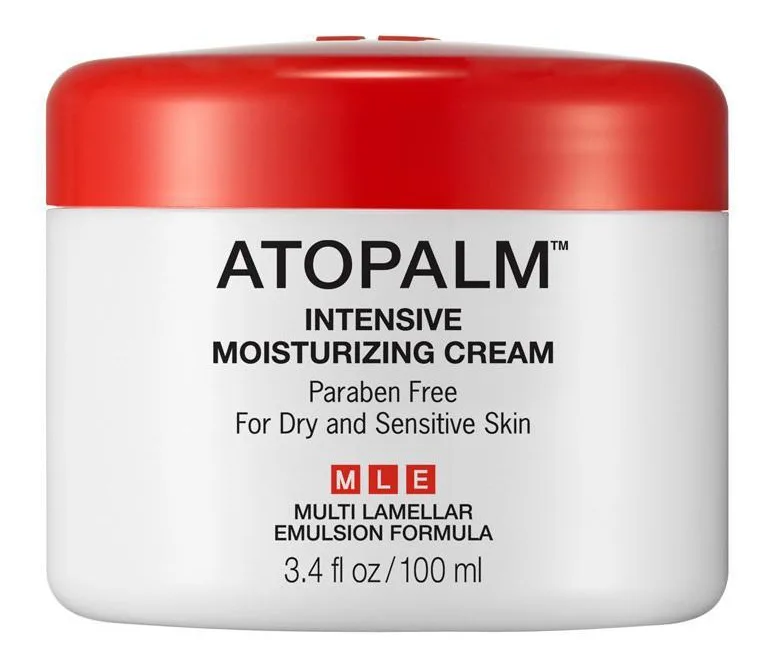
It takes Atopalm's patented MLE pseudoceramide and builds it into a richer, more occlusive cream cut with purslane, grape seed, and olive oils — a barrier cream deliberately formulated mild enough to be marketed for children as well as adults. The lamellar-lipid mechanism sets it apart from the usual heavy occlusive balms.
The richer sibling in Atopalm's barrier lineup, this cream wraps the brand's patented MLE pseudoceramide in purslane and plant oils for skin that needs more than a lotion. It's a genuinely soothing, family-friendly cream at a sensible price — just don't mistake its sensitive-skin pitch for fragrance-free, because there's added fragrance in here.
Good choicefor DrynessIn your profileYou chose · Ceramides is a reference standard by mechanism for dryness; this cream carries it.Moderate evidenceStandard tolerabilityNo reviews collected yet
The case for it
MLE Pseudoceramide has trial-supported standing for this concern.
It is plausibly present at a working level, though the concentration is not declared.
The formula carries no trigger this concern is sensitive to, with the cautions noted.
Cautions: fragrance.
What would change this: A declared concentration would move this to a firmer reading of the dose.
Same rule for everyone. “Good choice” is the verdict on 9,564 of 45,024 concern verdicts across the catalog; rule R5 decided 9,072 of them.
Unchanged since September 5, 2026, engine 5.1.1.
R5 — Trial-supported or guideline-supported active, adequately or plausibly dosed. · the full register
Carrying active
MLE Pseudoceramide
Standing
supported — its mechanism is established
Form
plausible
Tolerability
standard — fragrance load
Row checked
against its sources on July 17, 2026 (evidence table ev-2026.09-r228)
The studies behind the evidence row
Elias PM, Feingold KR (eds), Skin Barrier — stratum corneum ceramides are the principal intercellular lamellar lipid; their depletion is the biochemical signature of dry/xerotic skin — reference work
Good choicefor DehydrationIn your profileYou chose · Hyaluronic Acid is a reference standard by mechanism for dehydration; this cream carries it.Moderate evidenceStandard tolerabilityNo reviews collected yet
The case for it
Sodium Hyaluronate has trial-supported standing for this concern.
It is plausibly present at a working level, though the concentration is not declared.
The formula carries no trigger this concern is sensitive to, with the cautions noted.
What would change this: A declared concentration would move this to a firmer reading of the dose.
Same rule for everyone. “Good choice” is the verdict on 9,564 of 45,024 concern verdicts across the catalog; rule R5 decided 9,072 of them.
Unchanged since September 5, 2026, engine 5.1.1.
R5 — Trial-supported or guideline-supported active, adequately or plausibly dosed. · the full register
Carrying active
Sodium Hyaluronate
Standing
supported — its mechanism is established
Form
plausible — studied range 0.1%, from the trials on the row; needs leave-on contact; judge it after ~1 weeks
Tolerability
standard
Row checked
against its sources on July 17, 2026 (evidence table ev-2026.09-r228)
The studies behind the evidence row
Draelos ZD, Cosmetic Dermatology: Products and Procedures — hyaluronic acid classified as a humectant water-binding agent holding many times its weight in water — reference work
Avoidfor Compromised Skin BarrierIn your profileYou chose · This formula carries fragrance — a known trigger for compromised skin barrier — so it is not a fit however good its actives are.Moderate evidenceCarries a triggerNo reviews collected yet
The case for it
MLE Pseudoceramide has trial-supported standing for this concern.
It is plausibly present at a working level, though the concentration is not declared.
The formula carries a known trigger for this concern, which decides the verdict before any efficacy question.
What would change this: Removing the trigger named above would let the actives be judged on their own.
Same rule for everyone. “Avoid” is the verdict on 1,909 of 45,024 concern verdicts across the catalog; rule R1 decided 1,304 of them.
Unchanged since September 5, 2026, engine 5.1.1.
R1 — Safety outranks praise (MASTER-PLAN §1.7). A condition-weighted trigger (multiplier ≥ 2 in condition-fit-matrix) decides the verdict before any efficacy question. · the full register
Carrying active
MLE Pseudoceramide
Standing
supported — its mechanism is established
Form
plausible — studied range 0.5–1%, from the trials on the row; needs leave-on contact; judge it after ~4 weeks
Tolerability
harsh — fragrance load
Row checked
against its sources on July 17, 2026 (evidence table ev-2026.09-r228)
The studies behind the evidence row
Elias PM, Skin Barrier / Coderch et al., ceramides and skin barrier function — ceramides ~50% of SC intercellular lipid mass, essential to the permeability barrier — reference work
Avoidfor EczemaIn your profileYou chose · This formula carries fragrance — a known trigger for eczema — so it is not a fit however good its actives are.Moderate evidenceCarries a triggerNo reviews collected yet
The case for it
MLE Pseudoceramide has early or mechanistic evidence for this concern, not trial-backed standing.
It is plausibly present at a working level, though the concentration is not declared.
The formula carries a known trigger for this concern, which decides the verdict before any efficacy question.
What would change this: Removing the trigger named above would let the actives be judged on their own.
Same rule for everyone. “Avoid” is the verdict on 1,909 of 45,024 concern verdicts across the catalog; rule R1 decided 1,304 of them.
Unchanged since September 5, 2026, engine 5.1.1.
R1 — Safety outranks praise (MASTER-PLAN §1.7). A condition-weighted trigger (multiplier ≥ 2 in condition-fit-matrix) decides the verdict before any efficacy question. · the full register
Carrying active
MLE Pseudoceramide
Standing
plausible — trials support it
Form
plausible
Tolerability
harsh — fragrance load
Row checked
against its sources on July 17, 2026 (evidence table ev-2026.09-r228)
Emollients and moisturisers for eczema — Cochrane Database of Systematic Reviews — TIER 1, 77 RCTs / 6603 participants, GRADE; CLASS-level, does not name ceramides (2017), opened July 16, 2026
Supporting rolefor Winter SkinIn your profileYou chose · Nothing here targets winter skin directly; occlusive hydration is the recognised companion to treating it, and this cream does that without known triggers.Not yet assessedStandard tolerabilityNo reviews collected yet
The case for it
Portulaca Oleracea has no evidence row yet for this concern — it is in the research queue.
The formula carries no trigger this concern is sensitive to, with the cautions noted.
What would change this: A researched evidence row for the lead active would replace this with a verdict.
Same rule for everyone. “Supporting role” is the verdict on 8,197 of 45,024 concern verdicts across the catalog; rule R8 decided 4,250 of them.
Unchanged since September 5, 2026, engine 5.1.1.
R8 — The category's job (barrier care, humectant hydration, gentle cleansing, photoprotection) is the documented supportive role for this concern. This is the honest verdict for a moisturizer on an acne page. · the full register
Does the jobDoes what a moisturizer is for: draws in water, softens and smooths.
A verdict is DermApproved’s assessment of how well a product’s ingredients fit a concern — never a claim about what the product treats. Evidence dots and collected reviews sit beside it and are never blended in.
Rules 0.5.1 · evidence table ev-2026.09-r228 · how we decide
Assessment
Pros & Cons
Pros
✓ Patented MLE pseudoceramide sits high in the formula for a real dose
✓ Rich, cushioning texture that still absorbs without a greasy film
✓ Purslane and allantoin keep it soothing, not just occlusive
✓ Excellent for very dry and wintertime skin
✓ Gentle base marketed as suitable for the whole family
✓ Strong value at around $24 for 100ml
✓ Doubles effectively on dry body areas
Cons
✗ Contains added fragrance despite its sensitive-skin positioning
✗ Jar packaging is less hygienic and exposes oils to air
✗ Too rich for oily skin or hot-weather use
✗ Not suitable for those needing a truly fragrance-free cream
Review
Full Review
Here's a quirk you don't see often: a cream literally labeled "intensive" that's also marketed as gentle enough for a six-year-old. Atopalm's Intensive Moisturizing Cream lives in that slightly contradictory space on purpose. The whole brand grew out of NeoPharm's research into the skin's lamellar lipid barrier — the precisely stacked sheets of ceramides, cholesterol, and fatty acids that keep water in and irritants out — and the company's pitch has always been that the same patented pseudoceramide technology that calms an adult's eczema flare is gentle enough for a child's reactive skin. This cream is where that idea gets its richest expression: the MLE platform, but built into a more emollient, more occlusive base for skin that the everyday lotion simply can't satisfy.
The formula reads like a barrier cream that knows exactly what it's doing. Sitting fourth on the list, right after the humectants, is myristoyl/palmitoyl oxostearamide/arachamide MEA — the mouthful that is Atopalm's signature lamellar pseudoceramide. That high placement matters, because it means there's a meaningful dose of the one ingredient the brand is actually known for. Around it, the formula assembles the supporting cast a pseudoceramide needs to organize into real barrier sheets: phytosterols standing in for cholesterol, stearic acid and the plant oils supplying fatty acids. Speaking of which, this is where the cream diverges from the lighter lotion — grape seed oil, olive fruit oil, and jojoba give it genuine emollient heft, while purslane extract and allantoin keep things on the soothing side rather than just the greasy side. Glycerin, propanediol, and sodium hyaluronate handle the water-binding. It's a complete, sensibly built formula with no filler-heavy shortcuts.
In use, it behaves like a well-mannered rich cream. It's cushiony and melts down on contact, but it doesn't leave the heavy, waxy film you might brace for from something called "intensive." Dry, tight skin feels comforted immediately, and there's no stinging or adjustment period — you put it on, your skin relaxes, that's the experience. Over a week or two, the rough patches and flaking that plague dry skin tend to smooth out, and with consistent use across a month or more, skin that runs chronically dry simply holds its moisture better. It shines in cold weather and on the kind of skin that gets parched and reactive in winter, which is where a richer occlusive layer earns its place. It also doubles happily on dry body areas, so the jar tends to disappear faster than you'd expect if you're generous with it.
Now for the honest snag, and it's the same one that trips up the whole "gentle for the family" framing: there's fragrance in here. It sits low on the list, near tropolone at the very end, so the dose is small and the scent is a light, clean cosmetic note rather than anything heavy. For the vast majority of users, including kids, that's a complete non-issue. But it does mean this cream cannot honestly call itself fragrance-free, and if you're shopping for a barrier cream precisely because your skin — or your child's — flares at any added fragrance, this isn't the blank-canvas formula the sensitive-skin marketing might lead you to expect. That's not a dealbreaker so much as a label-reading reality check, and it's the single biggest reason this lands as a very good cream rather than a perfect one.
There's also the packaging to mention: it comes in a screw-top jar. Jars are pleasant to use and let you get every last scoop, but they're less hygienic than a tube or pump over the life of the product, so clean fingers (or a small spatula) are worth the habit, especially since the antioxidant plant oils prefer not to be repeatedly exposed to air and bacteria.
Value is where this cream quietly wins back any points. At around $24 for 100ml, you're getting a meaningful dose of patented lipid technology, a thoughtful supporting formula, and enough product to last a couple of months of facial use — all for less than many drugstore creams that offer far less interesting ingredient lists. The fact that it's been on the market for the better part of two decades, on a brand whose entire identity rests on one well-researched pseudoceramide system, gives the spend a reassuring solidity. You're not betting on a trend; you're buying a formula that has quietly kept dry-skinned families coming back for years.
What you end up with is a richer, cold-weather-friendly barrier cream that does its core job — replenishing lipids and calming dryness — genuinely well, with a price that flatters it and a fragrance asterisk that keeps it honest. For dry, eczema-prone, or wintertime skin that wants the MLE benefit in a more cushioned form, it's an easy recommendation; for the truly fragrance-intolerant, it's a near-miss worth knowing about before you buy.
Formula
Key Ingredients
The hero actives that drive this product's performance.
Atopalm's signature lamellar pseudoceramide, placed unusually high in this richer cream so it can rebuild the skin's layered lipid barrier; surrounded by phytosterols and stearic acid, it has the cholesterol- and fatty-acid partners it needs to organize into proper barrier sheets.
Established mechanismfor Dryness · established mechanism
A traditional anti-irritant botanical added to keep this intensive cream calming rather than just occlusive, pairing with allantoin to soothe the reactive, dry skin the formula targets.
A light, linoleic-acid-rich oil that supplies barrier-friendly fatty acids alongside the jojoba and olive oils, reinforcing the lipid matrix the pseudoceramide is rebuilding without a greasy slick.
The water-binding counterweight to all the lipids here, drawing moisture into the upper layers so the rich emollient base seals hydration in rather than just coating dry skin.
Established mechanismfor Dehydration · established mechanism
Ingredient standings describe the active at treatment-level doses and
vehicles; this product's own condition grades weigh its actual formula.
Because it's a richer cream, smooth it on as the last hydrating step before sunscreen in the morning, or as the final sealing layer at night over thinner serums.
Results Timeline
Dry, tight skin feels comforted right away; flaking and rough patches typically smooth out within one to two weeks; the deeper barrier resilience that reduces ongoing dryness develops over roughly four to eight weeks.
The mechanism that makes this cream interesting is barrier reassembly, not a single active. The stratum corneum's lipids organize into ordered lamellar sheets, and how intact that lamellar phase is determines water retention and resistance to irritants. Atopalm's pseudoceramide is engineered to reproduce that layered organization rather than just deposit loose lipids, and dermatology research has consistently shown that barrier repair works best when ceramide-type lipids are supplied alongside cholesterol and free fatty acids in balance — an incomplete mix can blunt or even delay recovery. This formula deliberately covers all three lipid classes: the pseudoceramide, phytosterols as a cholesterol analog, and fatty acids from stearic acid plus the grape seed, olive, and jojoba oils. The humectant layer rests on much older, well-established evidence: glycerin and hyaluronic acid are among the most thoroughly studied water-binding agents in skincare, drawing moisture into the upper epidermis that the lipid network then helps retain. Purslane (Portulaca oleracea) contributes antioxidant and anti-irritant activity supported by emerging research, while allantoin's soothing and keratolytic effects are well documented. The fair scientific summary is that the barrier-lipid strategy here is mechanism-driven and promising, built on a foundation of well-established humectant and emollient science.
Dermatologist Perspective
Rich, lipid-replenishing creams that combine ceramide-type ingredients with cholesterol analogs and fatty acids are central to how clinicians manage very dry, atopic, and barrier-compromised skin, and a pseudoceramide cream like this slots neatly into that category. Standard clinical guidance is to apply such creams generously and regularly — particularly after bathing and during cold, dry months — as the moisturizing foundation of an eczema-care routine rather than a standalone treatment. Because the formula is rich and occlusive, it's typically suggested for dry-to-very-dry skin and reserved or used sparingly on oily, acne-prone areas. The caveat a careful clinician would flag is the added fragrance: for patients with diagnosed fragrance contact allergy or actively inflamed atopic skin, fragrance-free formulations are generally the safer default, so patch testing is advisable before regular use on reactive skin.
Guidance
Usage & Recommendations
How to Use
Smooth a modest amount over clean skin, ideally while it's still slightly damp, to help seal in water. As a richer cream, it works best as the final hydrating step: layer it over thinner serums at night, or before sunscreen in the morning if your skin tolerates the weight. Use it generously on very dry or flaky areas and on the body wherever skin runs rough. Because it's a jar, scoop with clean fingers or a small spatula to keep the formula fresh and the plant oils from oxidizing. If your skin or your child's is highly reactive, patch test on the inner arm for a few days first, given the added fragrance.
Value Assessment
At about $24 for 100ml, this is priced like a mainstream cream while delivering a genuinely differentiated lipid technology, which makes it one of the better-value barrier creams in its class. The MLE pseudoceramide isn't a commodity ingredient, so you're paying for formulation substance rather than a brand premium. A 100ml jar lasts roughly two to three months of facial use, though heavy or full-body application shortens that. Atopalm offers the MLE base in lighter and larger formats, so if you go through this quickly, exploring other sizes can improve the per-milliliter cost. Coming from a legacy brand with two decades of history and real research behind its core platform, the price reflects proven, dependable quality rather than hype — a reassuring thing in a category full of overpriced jars.
Who Should Buy
This is for anyone with dry, very dry, or eczema-prone skin who wants Atopalm's pseudoceramide barrier repair in a richer, more cushioning cream — especially for cold weather or skin that a lighter lotion leaves wanting. Families looking for one soothing cream that adults and kids can share will find it a practical, well-priced pick.
Who Should Skip
Fragrance-intolerant skin is the clearest reason to pass here — whether the trigger is a diagnosed allergy, an active atopic flare, or simple preference, the added fragrance rules this cream out. Oily and acne-prone skin, or anyone in a hot, humid climate, will also likely find the rich texture heavier than necessary and be better served by a lighter barrier lotion.
Ready to try Atopalm Intensive Moisturizing Cream?
A cushiony medium-rich cream that melts down on contact and absorbs to a soft, non-tacky finish rather than a heavy film.
Scent
A light, clean cosmetic fragrance — pleasant but present, since fragrance is on the list.
Packaging
Comes in a screw-top jar, convenient but worth scooping with clean fingers to keep the cream fresh.
Finish
non-greasyvelvety
What to Expect on First Use
First use feels immediately comforting on dry, taut skin, with no stinging or breaking-in period. The fragrance is most noticeable on application and settles quickly.
How Long It Lasts
Roughly two to three months of daily facial use from the 100ml jar; less if you also apply it to the body.
Atopalm grew out of NeoPharm's research into the skin's lamellar lipid barrier, with the original line aimed at atopic, eczema-prone skin. This intensive cream is the brand's answer for skin that needs more than the everyday lotion can give — richer emollients wrapped around the same patented pseudoceramide core.
About Atopalm Legacy Brand (20+ years)
Atopalm is NeoPharm's flagship dermo-cosmetic line, founded on the company's patented MLE (Multi-Lamellar Emulsion) pseudoceramide research. The brand has roughly two decades of market history and positions this cream as gentle enough for sensitive skin across the whole family, including children.
Brand founded: 2002 · Product launched: 2004
Myth vs. Reality
Common Myths
Myth
An 'intensive' barrier cream this gentle must be completely fragrance-free.
Reality
It's paraben-free and built for sensitive skin, but the formula does include added fragrance, so it isn't a fragrance-free product despite its calming positioning.
FAQ
Frequently Asked Questions
Is the Atopalm Intensive Moisturizing Cream good for eczema-prone and very dry skin?
Yes — its MLE pseudoceramide base plus grape seed, olive, and jojoba oils make it a capable barrier cream for dry, eczema-prone skin. The main caveat is the added fragrance, which a minority of very reactive users prefer to avoid.
Can children use the Atopalm Intensive Moisturizing Cream?
Atopalm markets it as gentle enough for the whole family, including children, thanks to its paraben-free, soothing barrier formula. For broken or actively inflamed skin, patch testing first is sensible given the fragrance.
How is the Intensive Moisturizing Cream different from Atopalm's MLE Cream?
Both share the patented MLE pseudoceramide platform, but the Intensive Moisturizing Cream leans richer and more emollient with purslane and plant oils, geared toward very dry and wintertime skin rather than everyday use.
Does this Atopalm cream contain fragrance?
Yes, fragrance is listed near the end of the INCI. It gives the cream a light clean scent, so it's not a fragrance-free option despite being formulated for sensitive skin.
Is the Atopalm Intensive Moisturizing Cream too heavy for daytime use?
It's a medium-rich cream that absorbs well, so most dry-skinned users wear it comfortably under sunscreen and makeup. Oily or combination skin may find it more than they need in warm weather.
Is the Atopalm Intensive Moisturizing Cream safe during pregnancy?
Its core ingredients — pseudoceramides, hyaluronic acid, plant oils — pose no known pregnancy concerns. If you're avoiding added fragrance during pregnancy, factor that into your decision.
Reviews
What Reviewers Tend to Say
Recurring themes our editors read across retailer reviews of this product — summaries in our words, not quotations, and not a substitute for your own patch test.
Common Praise
Rich without feeling heavy or greasy
Reliable relief for dry, eczema-prone skin
Gentle enough for kids and the whole family
Common Complaints
Added fragrance disappoints those expecting unscented
Western sensitive skincare works by subtraction — remove the fragrance, remove the alcohol, shorten the list. Japan's answer adds a designed molecule back in, and one of the two bets has a trial literature.
The internet's favorite hydrator has a counterintuitive dark side — in dry air, a humectant with nothing to seal it can pull water out of your skin instead of into it.
A wrecked barrier is the most common self-inflicted skin condition and the one with the clearest fix — the difficulty is that the routine which caused it feels productive and the one that repairs it feels like giving up.
Products, answers, therapy guides, tools and articles in one search. Brand names,
slang and abbreviations all work — accutane finds isotretinoin, bacne finds truncal acne.