Industry & Trends News
Skin Flooding and the Great Barrier Obsession of 2026
Half a genuine correction to the acid-everything era, half a new excuse to sell you five products where two would do.
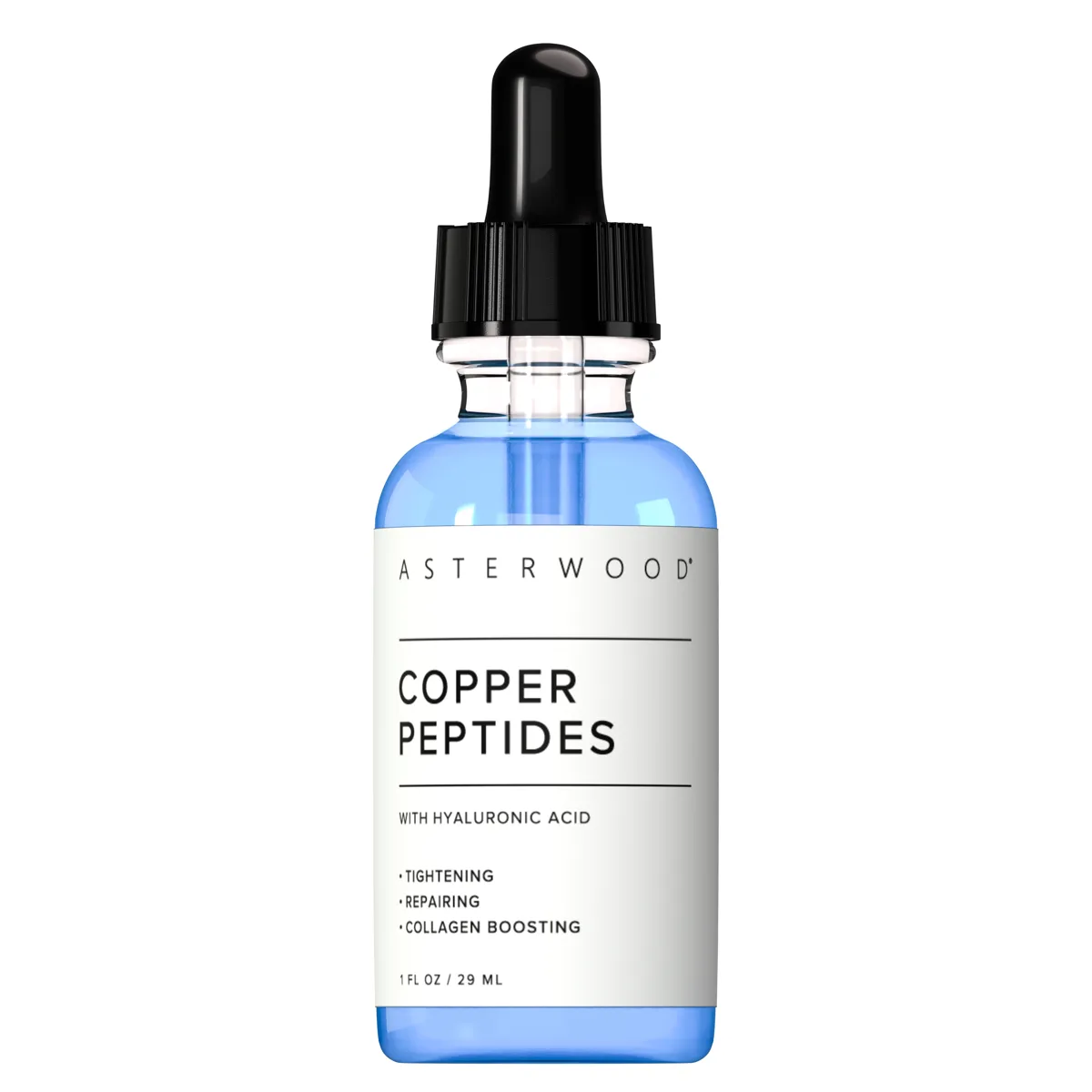
Six ingredients, two of them with declared percentages, and nothing else: no botanicals, no fragrance, no vitamin blend, no second peptide. Among budget copper peptide serums that alone is unusual, and it makes the product easy to reason about and easy to patch test, at the cost of any supporting actives that a richer formula would bring.
The cleanest way to try copper peptides at a sensible price: six ingredients, a declared 0.10 percent GHK-Cu, a generous 1.5 percent hyaluronate, and nothing to react to. It hydrates immediately and calms retinoid redness within weeks; firmness, if it comes, takes months and is subtle. The dose is modest and the evidence for cosmetic copper peptides is thinner than the hype, so buy it as a well-made experiment rather than a proven fix.
Around two years on sale and roughly fifteen hundred ratings across Amazon and the brand's site are enough to trust what reviewers say about tolerance and texture, but not to confirm what a 0.10 percent copper peptide does to firmness over the long term. This assessment leans on the disclosed formula, the GHK-Cu mechanism literature, and Asterwood's record with similarly minimal serums rather than on controlled results for this product.
The case for it
Same rule for everyone. “Good choice” is the verdict on 9,564 of 45,024 concern verdicts across the catalog; rule R5 decided 9,072 of them. As of September 25, 2026, engine 5.1.1.
Brand or formulator? Disclose a concentration or correct a fact →
The studies behind the evidence row
The case for it
What would change this: A researched evidence row for the lead active would replace this with a verdict.
Same rule for everyone. “Supporting role” is the verdict on 8,197 of 45,024 concern verdicts across the catalog; rule R8 decided 4,250 of them. As of September 25, 2026, engine 5.1.1.
Brand or formulator? Disclose a concentration or correct a fact →
Also listed for Aging and Post-Procedure — the actives here (Pentylene Glycol, Hyaluronic Acid, Copper Peptides) are in our research queue for those concerns; there is no verdict until their evidence rows are written. That is a gap in our table, not a mark against the product.
A verdict is DermApproved’s assessment of how well a product’s ingredients fit a concern — never a claim about what the product treats. Evidence dots and collected reviews sit beside it and are never blended in. Rules 0.5.1 · evidence table ev-2026.09-r228 · how we decide
Six ingredients. Water, a glycol, a preservative, hyaluronate at 1.5 percent, copper tripeptide-1 at 0.10 percent, and a pH adjuster. Asterwood's copper peptide serum is about as close to a single-active formula as skincare gets, and the brand treats that as the selling point: no fragrance, no botanicals, no vitamin blend, no second peptide, nothing that could dilute, mask or quietly take credit for whatever the copper does. It is an appealing kind of honesty, and it also sets up a fair test. With nothing else in the bottle, the serum is only as good as GHK-Cu at 0.10 percent, and that is the question the review has to answer.
Start with what is certain. The 1.5 percent sodium hyaluronate is a real dose, higher than many hyaluronic serums bother with, and it is why the blue liquid has slip, why skin looks plumper a minute after application, and why the serum is comfortable on dry faces despite having no oil or emollient at all. That is the part of the product every buyer will notice on day one. The copper tripeptide is the part that takes faith and time. GHK-Cu is a naturally occurring fragment of human plasma proteins that binds copper, and its biology is genuinely interesting: in cell culture and wound models it increases collagen and glycosaminoglycan synthesis, promotes the breakdown of damaged proteins, and dampens inflammation, and it has a long history in post-procedure and wound-care products. The catch is that most of that evidence is not from cosmetic serums on intact faces. Controlled facial trials are few, small and mostly older, and none tests this concentration in this base. So the honest description is a plausible, well-tolerated active with promising mechanisms and unproven cosmetic results, which is a very different thing from the collagen-rebuilding certainty the category's marketing conveys.
The dose is at the low end. Cosmetic copper peptide products range from around 0.05 to 1 percent or more, and 0.10 is modest. Asterwood's argument is that purity does the work: with no chelating acids, no competing metals and no colour-masking ingredients, the copper stays bound to the peptide and reaches skin intact. There is something to that, since GHK-Cu is easily disrupted by low pH and by other chelators, but a cleaner delivery of a small dose is still a small dose. It is a fair price for an experiment, not a reason to expect more than the concentration allows.
In use it is quietly pleasant. A few drops of cool, cornflower-blue liquid spread easily, sink in within a minute, and leave a faint tack that a moisturizer erases. There is no tingle, no scent and no adjustment period, and the review record has almost no reports of irritation, which for a two-year-old serum with thirteen hundred Amazon ratings is a meaningful signal. The earliest thing people notice beyond hydration is calmer skin: less redness the morning after a retinoid, quicker settling after microneedling once the surface has closed, a generally less reactive face. That is consistent with the peptide's anti-inflammatory profile and is probably the most reliable benefit it offers. Reports of firmer skin and softer lines arrive at the two-to-three-month mark, are described as subtle, and are hard to separate from the hyaluronate's plumping; that, too, is what the evidence would predict.
The usual copper peptide caveat applies. Low-pH L-ascorbic acid mixed in the same layer can reduce the copper and pull it off the peptide, so vitamin C belongs in the morning and this at night, or ten minutes apart. Direct acids get the same treatment. Over a retinoid it is fine, and it takes some of the sting out. The blue tint stains a white pillowcase if it has not dried, and the clear glass bottle, chosen so the colour shows, offers no light protection; a bathroom drawer is the right home.
Asterwood sells the 29ml at $21.99 direct, with 2 oz and 8 oz sizes for regular users, and it lasts six to eight weeks at a few drops twice a day. Amazon sellers often list the same bottle at double the brand's price, which makes buying direct the obvious move. At the direct price it is one of the cheaper ways to put a declared GHK-Cu concentration on a face, and the simplicity means it slots into any routine without interaction worries.
The recommendation is warm and bounded. For someone curious about copper peptides, with sensitive or retinoid-stressed skin that wants a calming, hydrating, fragrance-free layer at night, this is a good, honest place to start, and the thing to judge it on at three months is calmness and hydration first and firmness second. For someone expecting collagen to visibly rebuild, the science is not there yet at any cosmetic dose, and this bottle's 0.10 percent will not be the one to prove it.
The hero actives that drive this product's performance.
| Ingredient | Function | Evidence |
|---|---|---|
| Copper Tripeptide-1 (GHK-Cu) (0.10%) | The single active, declared at 0.10 percent, which gives the serum its unmistakable cornflower-blue colour. In this bare water-and-hyaluronate base with no other actives, the copper complex is delivered without competition or buffering, aimed at signalling fibroblasts to rebuild collagen and at calming inflammation; the dose is on the low side of the range cosmetic formulators use, and the brand's own guidance is that the blue tint is its proof of purity. | Not yet assessed |
| Sodium Hyaluronate (1.5%) | A declared 1.5 percent, which is generous for a hyaluronate and the reason the serum has slip and leaves skin plumper within minutes. It is the only other functional ingredient, and it doubles as the vehicle that keeps the copper peptide comfortable on dry skin. | Established mechanism for Dehydration · established mechanism |
| Pentylene Glycol | Second on the label, a humectant and mild antimicrobial glycol that, with phenylpropanol, forms the serum's preservative system without parabens or phenoxyethanol. It adds a little hydration and is one of the reasons the six-ingredient formula stays stable. | Not yet assessed |
Ingredient standings describe the active at treatment-level doses and vehicles; this product's own condition grades weigh its actual formula.
Water, Pentylene Glycol, Phenylpropanol, Sodium Hyaluronate, Copper Tripeptide-1, Sodium Hydroxide
serum
AM & PM
Apply to clean, dry skin before moisturizer, morning or night. Keep it away from strong direct acids and L-ascorbic acid in the same layer, since low pH and ascorbate can strip copper from the peptide; use vitamin C in the morning and this at night, or wait ten minutes between them. It pairs well over a retinoid, and it is a gentle choice on skin recovering from microneedling once the surface has closed.
Plumper, more hydrated skin within minutes from the 1.5 percent hyaluronate. Copper peptide effects on firmness, texture and redness are slow: eight to twelve weeks of consistent use is the honest window, and the change is modest and cumulative rather than dramatic.
Copper tripeptide-1, or GHK-Cu, is the copper complex of a glycyl-L-histidyl-L-lysine fragment first isolated from human plasma in 1973, and its biology is unusually well described for a cosmetic peptide. A 2008 review in the Journal of Biomaterials Science, Polymer Edition summarised three decades of work showing that GHK and its copper complex stimulate collagen, elastin and glycosaminoglycan synthesis in fibroblasts, promote the breakdown and clearance of damaged matrix proteins, recruit immune and endothelial cells, and accelerate wound healing in animal models, with a copper-binding affinity that lets the peptide deliver the metal to enzymes such as lysyl oxidase that cross-link collagen. A 2018 review in the International Journal of Molecular Sciences added gene-expression data indicating that GHK modulates the activity of a large number of human genes, including many involved in tissue remodelling, antioxidant defence and inflammation, and reiterated its anti-inflammatory and DNA-repair-supporting actions. What that literature does not contain is a body of well-controlled trials of low-concentration GHK-Cu serums on intact facial skin; the human cosmetic studies that exist are small, often older and frequently industry-funded, and report improvements in skin density, firmness and fine lines over two to three months without the sample sizes or blinding that would settle the question. Formulation chemistry matters for this ingredient more than for most. The copper is held to the peptide by coordination bonds that are disrupted at low pH and by stronger chelators, which is the basis for advising separation from L-ascorbic acid and direct acids, and it is why a six-ingredient base with no acids, botanicals or competing metals is a reasonable choice rather than a marketing affectation. The 1.5 percent sodium hyaluronate is a substantial dose for surface hydration and accounts for the immediate plumping; pentylene glycol and phenylpropanol form a mild preservative pair that also contributes humectancy. The blue colour is the copper complex itself, which absorbs in the red region of the spectrum at working concentrations. Taken together, the science supports GHK-Cu as a safe, anti-inflammatory, mechanistically promising active, supports this serum as a clean and stable way to deliver a modest dose, and stops short of supporting the collagen-rebuilding claims that surround the category.
Copper peptides sit in an interesting place clinically: GHK-Cu has a long and respectable history in wound care and post-procedure recovery, where its anti-inflammatory and matrix-remodelling actions are well documented, and a much shorter and thinner record as a cosmetic anti-ageing active. Dermatologists who use it tend to reach for it after microneedling, laser or peels, once re-epithelialisation is complete, and as a gentle option for patients whose skin will not tolerate retinoids; they are generally cautious about promising visible firming from a leave-on serum, since the controlled facial data are limited. Against that background, this product would be viewed as a sensible, low-risk formulation: fragrance-free, minimal, with a disclosed concentration and a stable base, and suitable for sensitive and retinoid-stressed skin. The usual counsel would be to keep it away from L-ascorbic acid and direct acids in the same application, to treat the hyaluronate as the source of the immediate benefit, and to give the peptide three months before judging. A clinician would also note that 0.10 percent is a modest dose and that retinoids and sunscreen remain the interventions with the strongest evidence for photoageing, with copper peptides as a well-tolerated adjunct rather than a replacement.
Apply to clean, dry skin morning or night, before moisturizer. Dispense three or four drops into the palm or directly onto the face, spread over the face and neck, and let it absorb for about a minute; the faint tack disappears under a cream. If vitamin C or an exfoliating acid is part of the routine, use those at a different time of day or leave ten minutes between them and this serum so the copper complex stays intact. It layers comfortably over a retinoid at night. After microneedling or a peel, wait until the skin surface has closed before starting it. Store the clear bottle out of direct light and finish it within about six months of opening. Wipe any drips off white fabric promptly, as the blue can stain.
At $21.99 direct for 29ml, and six to eight weeks of twice-daily use, the serum costs roughly eleven to fourteen dollars a month, which is mid-range for a peptide serum and cheap for one that declares a GHK-Cu percentage. Asterwood's 2 oz and 8 oz sizes bring the per-millilitre cost down sharply for committed users, and the brand's own site is consistently far cheaper than Amazon, where third-party pricing can double the figure. The formula is inexpensive to make, and the price reflects a small brand's margin on a trendy ingredient rather than any clinical backing, which Asterwood does not have. The value case rests on what the buyer wants: as a calming, hydrating, fragrance-free night serum with a copper peptide experiment built in, it is fairly priced; as a proven collagen treatment it is paying for a mechanism rather than a result.
People curious about copper peptides who want a minimal, fragrance-free, transparent formula at a fair direct price, particularly those with sensitive skin, retinoid-related redness or recovery after microneedling. It also suits anyone who wants a hydrating night serum with no botanicals or essential oils to react to.
Anyone expecting rapid or dramatic firming, since 0.10 percent GHK-Cu is a modest dose with limited cosmetic trial evidence, and anyone unwilling to separate it from L-ascorbic acid and direct acids in their routine. People who need a richer, emollient serum for very dry skin will find it too thin on its own.
Ready to try Asterwood Copper Peptides Serum?
Buy at Amazon ♥A thin, faintly viscous blue water-serum with a clean slip from the hyaluronate; it spreads easily and dries to a lightly tacky, then smooth, finish.
Nothing added and nothing detectable; the phenylpropanol preservative has a barely-there sweet note in the bottle.
A 29ml clear glass dropper bottle with a black bulb, showing off the blue serum; the clear glass is a choice for display over light protection, and the dropper dispenses the thin liquid a little too freely.
The first application is unremarkable in the best way: a cool, blue, slightly slippery liquid that sinks in within a minute and leaves skin looking a touch plumper. No tingle, no purging, no adjustment period. Redness from an evening retinoid often looks calmer the next morning, which is the earliest sign the copper is doing anything; firmness and texture are a matter of months.
Six to eight weeks for the 29ml bottle at a few drops twice daily, or three months used once a day.
All Year
Asterwood built its name on stripped-down hyaluronic acid and vitamin C serums sold through Amazon, and added copper peptides in mid-2024 as GHK-Cu went viral on TikTok as the next collagen ingredient after Matrixyl. The brand leaned into transparency, printing the 0.10 percent on the listing and publishing explainer pages about the blue colour, and the serum quickly became one of its most-reviewed products.
Asterwood is an Amazon-native American brand, founded around 2014, that built its following on very short ingredient lists, disclosed percentages and low prices rather than clinical research. It publishes no trials of its own products; its copper peptide serum, launched in 2024, is one of the few in its price bracket to state the GHK-Cu concentration on the label.
A deeper blue means a stronger copper peptide serum.
The blue comes from the copper complex and its intensity depends on concentration and on the absence of colour-masking ingredients, but a dye can produce the same shade. This serum's colour is consistent with its stated 0.10 percent; it says nothing about how much copper reaches the dermis.
Copper peptides cannot be used with vitamin C at all.
The concern is that low-pH L-ascorbic acid can reduce the copper and strip it from the peptide when the two are mixed in the same layer. Using vitamin C in the morning and this serum at night, or spacing them by ten minutes, avoids the problem entirely.
The wound-healing studies on GHK-Cu prove it rebuilds collagen in a cosmetic serum.
Most of that work is in cell culture, animal wounds or injectable and high-dose settings. Controlled facial trials at cosmetic concentrations are few and small, so the claim for a 0.10 percent serum is plausible mechanism, not demonstrated result.
Asterwood declares 0.10 percent copper tripeptide-1 alongside 1.5 percent sodium hyaluronate in a six-ingredient base. That is at the lower end of the range used in cosmetic copper peptide serums, and the brand argues the pure, unmasked formula makes the most of it.
Yes, but not in the same layer at the same time. Acidic L-ascorbic acid can strip copper from the peptide when mixed directly, so use a vitamin C serum in the morning and this at night, or wait about ten minutes between them. Stable vitamin C derivatives are less of a concern.
It is one of the least provocative serums in its category: no fragrance, no essential oils, no alcohol, no botanicals, and copper peptides themselves have a calming, anti-inflammatory reputation. Reviewers with reactive skin report no stinging, and the short list makes patch testing simple.
The copper ion bound to the GHK tripeptide absorbs red light, so a copper peptide solution is naturally blue at working concentrations. Asterwood adds no dye; the colour is the copper complex itself in a clear base.
Hydration and a plumper look come within minutes from the hyaluronate. Any effect on firmness, fine lines or redness from the copper peptide takes eight to twelve weeks of daily use, and reviewers describe it as subtle and gradual rather than dramatic.
Copper peptides are a common choice after microneedling because of their wound-healing profile, and this serum's short, fragrance-free formula suits recovering skin. Wait until the skin surface has closed, typically the next day, rather than applying immediately over open channels.
Recurring themes our editors read across retailer reviews of this product — summaries in our words, not quotations, and not a substitute for your own patch test.
Skin looks plumper and calmer within weeks
Fragrance-free with no sting
Simple formula with disclosed percentages
Helps redness after retinol or microneedling
Fair price for a copper peptide
Slight tackiness before moisturizer
Subtle results that take months
Blue tint can stain light fabrics
Dropper is fiddly
Amazon price often much higher than direct