


Shea Butter Is Doing a Different Job Than You Think
It is sold as deeply nourishing. What it measurably does is seal — and the difference decides whether you should apply it to damp skin or not at all.
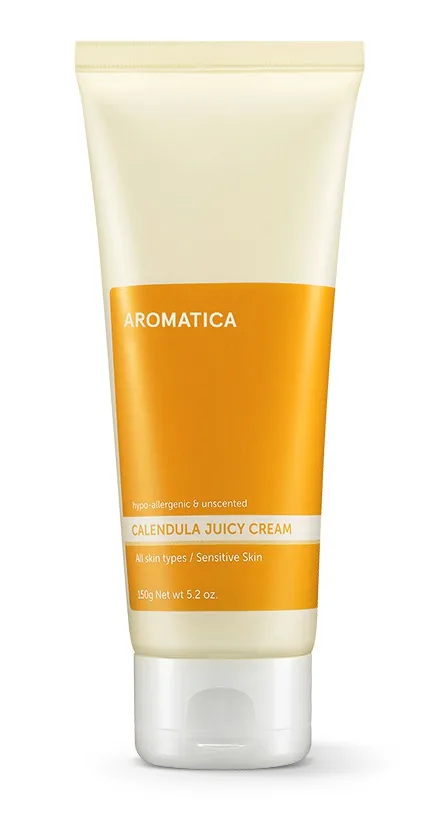
Most calendula moisturizers use the flower as a supporting ingredient — listed somewhere in the middle of the INCI behind water and the standard cream base. This cream lists calendula flower extract first, meaning it's the dominant ingredient by weight. The decoction processing method (a traditional slow water-extraction technique) extracts a broader spectrum of the flower's flavonoids and triterpenoids than standard infusion. The result is a calendula cream that genuinely behaves like calendula rather than a generic cream with a calendula label.
Aromatica's Calendula Juicy Cream is one of the rare calendula moisturizers where the flower is genuinely the dominant ingredient rather than a label flourish. The decoction processing, ceramide and shea butter pairing, and fragrance-free formulation make it a strong choice for dry, sensitive, or post-procedure skin. The coconut oil content is the only real disqualifier for acne-prone users.
The case for it
What would change this: A declared concentration would move this to a firmer reading of the dose.
Same rule for everyone. “Good choice” is the verdict on 9,564 of 45,024 concern verdicts across the catalog; rule R5 decided 9,072 of them. Unchanged since September 5, 2026, engine 5.1.1.
Brand or formulator? Disclose a concentration or correct a fact →
The studies behind the evidence row
The case for it
What would change this: A researched evidence row for the lead active would replace this with a verdict.
Same rule for everyone. “Good choice” is the verdict on 1,938 of 45,024 concern verdicts across the catalog; rule F2 decided 1,938 of them. Unchanged since September 5, 2026, engine 5.1.1.
Brand or formulator? Disclose a concentration or correct a fact →
The case for it
What would change this: A declared concentration would move this to a firmer reading of the dose.
Same rule for everyone. “Good choice” is the verdict on 9,564 of 45,024 concern verdicts across the catalog; rule R5 decided 9,072 of them. Unchanged since September 5, 2026, engine 5.1.1.
Brand or formulator? Disclose a concentration or correct a fact →
The studies behind the evidence row
The case for it
What would change this: A researched evidence row for the lead active would replace this with a verdict.
Same rule for everyone. “Supporting role” is the verdict on 8,197 of 45,024 concern verdicts across the catalog; rule R8 decided 4,250 of them. Unchanged since September 5, 2026, engine 5.1.1.
Brand or formulator? Disclose a concentration or correct a fact →
The case for it
What would change this: A declared concentration would move this to a firmer reading of the dose.
Same rule for everyone. “Supporting role” is the verdict on 8,197 of 45,024 concern verdicts across the catalog; rule R8a decided 1,489 of them. Unchanged since September 5, 2026, engine 5.1.1.
Brand or formulator? Disclose a concentration or correct a fact →
The studies behind the evidence row
The case for it
What would change this: A declared concentration would move this to a firmer reading of the dose.
Same rule for everyone. “Supporting role” is the verdict on 8,197 of 45,024 concern verdicts across the catalog; rule R8a decided 1,489 of them. Unchanged since September 5, 2026, engine 5.1.1.
Brand or formulator? Disclose a concentration or correct a fact →
The studies behind the evidence row
Does the jobDoes what a moisturizer is for: draws in water, softens and smooths.
A verdict is DermApproved’s assessment of how well a product’s ingredients fit a concern — never a claim about what the product treats. Evidence dots and collected reviews sit beside it and are never blended in. Rules 0.5.1 · evidence table ev-2026.09-r228 · how we decide
Decoction is a slow water-extraction technique that has been used in Korean traditional medicine for centuries. You take the dried flower, you submerge it in water, you hold the temperature at a controlled point below boiling, and you let time pull the flower's water-soluble bioactives — flavonoids, triterpenoids, carotenoids — into the liquid. The process is unhurried by modern industrial standards. It takes hours rather than the minutes a solvent extraction would require. It produces a more limited yield. And it preserves a broader spectrum of the plant's compounds than the faster modern alternatives.
Aromatica built its Calendula Decoction line around this processing method, and the Juicy Cream is the line's headline moisturizer. Whether the decoction technique produces a measurably superior cosmetic result is one of those claims that's hard to validate without a controlled comparison study, and one doesn't exist. What's verifiable is that calendula officinalis flower extract is listed first on this cream's INCI, meaning it's the dominant ingredient by weight — replacing water as the structural base of the formula. Most calendula moisturizers list calendula in the middle of the INCI as a supporting botanical at trace concentration. This one doesn't, and the difference shows up in how the cream feels and what it does.
Calendula's clinical credentials are real, which is worth saying because the flower has acquired a reputation as a decorative botanical — the kind of thing brands put on the front of a jar and nowhere meaningful inside it. Studies dating back to the 1970s have documented its anti-inflammatory effects, its support for wound healing in superficial epidermal injuries, and its general suitability for compromised skin. The mechanism is believed to involve triterpene saponins that modulate inflammatory cytokines alongside flavonoid antioxidants. Calendula is one of the rare botanicals that has crossed into mainstream dermatology recommendations for post-procedure skin and minor irritation. The catch has always been dose, and dose is precisely what this formula fixes.
The supporting cast is built for dry and sensitive skin specifically. Shea butter sits high on the INCI as the dominant emollient, contributing the rich texture and the oleic-stearic-linoleic fatty acid profile that supports barrier lipid composition. Ceramide 3 — the same molecule as ceramide NP — sits in the middle of the list and slots into the skin's natural lipid matrix to support barrier repair; it is the most clinically studied of the skin-identical ceramides and the one the clinical barrier-cream brands have built their reputations on. Aloe vera at the third position contributes humectant counterweight to the rich emollient base. Chamomile flower extract reinforces the calming positioning, with rosemary, verbena and tamarind seed polysaccharide filling out the tail. The formulation is fragrance-free, with a faint herbaceous note coming from the actual extracts rather than added perfume.
The texture earns its 'juicy' name in the K-beauty sense — rich but absorbed, like the inside of fresh fruit. On application the cream feels noticeably rich and slightly warm as the shea butter and emollients melt into the skin. It absorbs more slowly than a standard gel-cream — closer to one to two minutes — but leaves a soft satin finish rather than greasiness. Skin feels immediately more comfortable, the kind of relief that compromised or reactive skin recognizes within seconds. Press it in with the palms rather than rubbing; a cream this rich sits better when it isn't dragged across serums that haven't finished settling.
The honest catch is the coconut oil. It sits at the eighth position on the INCI, high enough to matter for acne-prone or fungal-acne-prone skin. Coconut oil is moderately comedogenic for many people — though comedogenicity is genuinely individual, and plenty of users tolerate it on the face without issue, so it is a reason for caution rather than an automatic disqualification. If your skin has told you before that coconut oil is a problem, believe it and pick the brand's lighter aloe cream instead. Otherwise, the formula is impressively clean for dry and sensitive skin: no fragrance, no essential oils, no alcohol, no parabens, vegan, and EWG Verified across the ingredient list.
The price is the second strong feature. At around thirty-two dollars for a hundred and fifty milliliters, this is excellent value for a calendula-first cream with ceramide and shea butter substance. A jar lasts four to five months with twice-daily face and neck use — roughly seven dollars a month, and meaningfully cheaper per milliliter than equivalent sensitive-skin creams from Western brands. The plastic jar is the one design compromise: a screw-top exposes ceramides and botanical actives to air every morning, so keep the lid on tight and use a spatula if you're fastidious.
The performance is consistent with what the formula promises. Skin feels calmer and more comfortable from the first application, flaking and tightness visibly ease within the first week, and the cumulative barrier improvement lands at three to four weeks. For eczema-prone skin between flares, it works as a daily maintenance moisturizer alongside any prescription treatment. For post-procedure recovery, the calendula-and-ceramide combination is genuinely soothing. For winter-dry normal skin, it's substantial enough as a night cream to handle the season without additional layering. Across several thousand reviews, that's the story people tell: it calms things down, it's rich without being greasy, and the coconut oil is the reason some of them had to stop.
The product knows what it is, does it well, and doesn't try to be everything.
The hero actives that drive this product's performance.
| Ingredient | Function | Evidence |
|---|---|---|
| Calendula Flower Extract (Decoction) | Listed first on the INCI as the dominant ingredient — meaning calendula is the structural base of this cream, not a label garnish. The decoction processing method extracts a broader spectrum of the flower's flavonoids, triterpenoids, and carotenoids than standard infusions. Calendula has documented anti-inflammatory and wound-healing effects that make this cream particularly suited to compromised or post-procedure skin. | Not yet assessed |
| Shea Butter | Sits high on the INCI as the main occlusive emollient. Shea butter contributes the rich texture this cream is known for and provides fatty acids — primarily oleic, stearic, and linoleic — that support the skin's lipid barrier. The combination with the calendula base creates a moisturizer that's both calming and substantively occlusive, unusual for a calendula-themed product. | Established mechanism for Dryness · established mechanism |
| Ceramide 3 (Ceramide NP) | Sits in the middle of the INCI as the formula's barrier-repairing active. Ceramide 3 (also known as ceramide NP) is the most clinically studied of the skin-identical ceramides, slotting into the lipid matrix between corneocytes to support natural barrier function. In this rich cream it adds the structural barrier work that calendula and shea butter alone don't deliver. | Established mechanism for Dryness · established mechanism |
| Coconut Oil | Contributes additional fatty acid content and the slightly tropical scent character of the cream. Coconut oil is well-tolerated for body and barrier-compromised facial use but is moderately comedogenic, which is why this cream is positioned for normal-to-dry rather than oily skin types. | Not yet assessed |
| Aloe Vera & Chamomile | Aloe sits at the third position on the INCI as a humectant counterweight to the heavy emollient base, while chamomile contributes bisabolol and apigenin for additional anti-inflammatory effect. Together they reinforce the calming positioning of the calendula and prevent the cream from feeling purely occlusive. | Limited for Post-Procedure |
Ingredient standings describe the active at treatment-level doses and vehicles; this product's own condition grades weigh its actual formula.
Calendula Officinalis Flower Extract, Caprylic/Capric Triglyceride, Aloe Barbadensis Leaf Extract, Butylene Glycol, Glycerin, Butyrospermum Parkii (Shea) Butter, Hydrogenated Lecithin, Cocos Nucifera (Coconut) Oil, Aqua (Water), Octyldodecanol, Coco-Caprylate/Caprate, 1,2-Hexanediol, Arachidyl Alcohol, Hydroxyethylcellulose, Palmitamide MEA, Propanediol, Behenyl Alcohol, Ethylhexylglycerin, Arachidyl Glucoside, Acrylates/C10-30 Alkyl Acrylate Crosspolymer, Arginine, Ceramide 3, Hydrogenated Olive Oil Unsaponifiables, Copernicia Cerifera (Carnauba) Wax, Chamomilla Recutita (Matricaria) Flower Extract, Rosmarinus Officinalis (Rosemary) Leaf Extract, Verbena Officinalis Extract, Tamarindus Indica Seed Polysaccharide
moisturizer
AM & PM
Apply as the final hydration step after serums and treatments. Particularly effective layered over a hydrating toner and serum on dry skin. For very dry winter conditions, can be used as a night cream and followed with a facial oil or balm.
Immediate softening and barrier comfort on first use. Visible reduction in flaking and tightness within the first week. Cumulative barrier improvement and reduced reactivity become noticeable at 3-4 weeks of consistent use.
Calendula officinalis has a long history of evidence-supported topical use. Clinical and laboratory studies have documented the flower's anti-inflammatory effects (mediated by triterpene saponins like faradiol monoester), wound-healing acceleration in superficial epidermal injuries, and general anti-irritant properties. The flavonoid content (including quercetin and isorhamnetin glycosides) provides additional antioxidant activity. Calendula extract is one of the more clinically validated botanical ingredients in cosmetic dermatology, and is sometimes recommended by dermatologists for post-procedure skin care alongside conventional emollients. Ceramide 3 (ceramide NP) is one of the most studied skin-identical ceramides, with peer-reviewed evidence supporting its role in barrier repair, transepidermal water loss reduction, and skin hydration in compromised barriers. Shea butter has documented emollient and fatty-acid-replenishing effects, and contains small amounts of cinnamic acid esters that contribute additional anti-inflammatory activity. The combination of calendula, ceramides, and shea butter in this formula represents a thoughtful application of established botanical and lipid dermatology — appropriate for the dry-and-sensitive skin demographic the cream targets.
Dermatologists generally view calendula favorably as a supporting ingredient for compromised skin, post-procedure recovery, and mild inflammatory conditions. In the dermatology community, calendula is one of the few botanical actives with a strong enough evidence base to recommend confidently in clinical settings. The ceramide 3 inclusion in this formula aligns with the standard dermatologist recommendation to use barrier-supporting ceramides for daily maintenance in compromised barriers. The most frequently flagged concern in clinical commentary on this product is the coconut oil content for acne-prone patients — dermatologists treating active acne typically recommend avoiding coconut oil in facial moisturizers regardless of brand. For patients with dry, sensitive, eczema-prone, or post-procedure skin, this cream is a reasonable daily-use option. It is not a substitute for prescription treatments in active inflammatory conditions but works as supportive maintenance.
Apply as the final hydration step in your morning and evening routines, after cleansing, toner, serum, and any treatment products. Take a pearl-to-almond-sized amount on your fingertips and warm slightly between palms before pressing into face and neck. Pat gently rather than rubbing — patting helps the rich cream absorb without disturbing underlying serums. Allow one to two minutes for the cream to settle before applying sunscreen or makeup in the morning. For very dry winter conditions, can be used as a night cream alone or layered with a facial oil for additional occlusion.
At around thirty-two dollars for one hundred and fifty milliliters, this cream offers strong value in the calendula moisturizer category and meaningfully better per-milliliter pricing than equivalent creams from Western sensitive-skin brands. A jar lasts four to five months at twice-daily face and neck use, which works out to under seven dollars per month — solid value for a calendula-first formula with real ceramide content and the EWG Verified certification. The single trade-off is the lack of a smaller travel-size format. For the target customer — dry, sensitive, or compromised-barrier skin types looking for an effective daily moisturizer — this is one of the better value options in the K-beauty category.
Users with dry, sensitive, or compromised-barrier skin looking for a calendula-first daily moisturizer with real ceramide content. Strong choice for post-procedure recovery support, eczema-prone skin between flares, and winter-weather use on normal-to-dry complexions. Buyers drawn to K-beauty value and EWG Verified certification.
Acne-prone or fungal-acne-prone skin — the coconut oil content is a meaningful concern. Oily skin types or anyone in warm humid climates who would find the rich texture oppressive. Users who prefer pump or tube packaging over jars for hygiene reasons. Sensitive skin reactive to coconut-derived ingredients beyond comedogenicity.
Ready to try Aromatica Calendula Juicy Cream?
Buy at Amazon ♥Rich whipped cream that absorbs to a soft satin finish in 1-2 minutes
Subtle herbaceous calendula and chamomile note, no added fragrance
Frosted plastic jar with screw cap
On application the cream feels noticeably rich and slightly warm as the shea butter and emollients melt into the skin. Absorbs more slowly than the brand's Aloe Aqua Cream — closer to one to two minutes — but leaves a soft satin finish rather than greasiness. Skin feels immediately calmer and more comfortable. There is no purging or adjustment period. First-week use should produce visible reduction in flaking and tightness on dry skin.
About 4-5 months per unit with twice-a-day use to face and neck
fall winter
Aromatica developed the Calendula Decoction line as part of a broader brand commitment to traditional plant processing methods. The decoction technique — slow water extraction at controlled temperature — has been used in Korean traditional medicine for centuries to extract flower bioactives, and the brand argues it preserves more of calendula's wound-healing compounds than the modern solvent-extraction shortcuts most cosmetic suppliers use. Whether the difference is clinically measurable is unproven, but the supply-chain commitment is real.
Aromatica was founded in South Korea in 2003 and has a long-standing reputation for EWG Verified clean formulation. The Calendula Juicy Cream is part of the brand's calendula-decoction line, sourced from organically grown calendula and processed via a traditional decoction method that the brand claims preserves more of the flower's bioactive compounds.
Calendula is just a marketing ingredient with no real skincare benefit.
Calendula has documented anti-inflammatory and wound-healing effects in clinical and laboratory studies, particularly for compromised skin and post-procedure recovery. The benefit depends on concentration — and this cream uses calendula as its dominant ingredient.
Coconut oil clogs all pores equally.
Comedogenicity is highly individual. Some users tolerate coconut oil on the face fine; others break out within days. The presence of coconut oil here is a meaningful consideration for acne-prone users but not an absolute disqualifier for everyone.
Yes. The calendula-first formulation, ceramide content, and absence of fragrance and essential oils make this one of the better K-beauty options for reactive, post-procedure, or compromised-barrier skin. The only consideration is the coconut oil content for users who break out from it.
Probably not. Coconut oil is the third-most prominent oil in the formula and is moderately comedogenic for many users. Acne-prone or fungal-acne-prone skin should choose Aromatica's Aloe Aqua Cream or a coconut-oil-free alternative instead.
The Aloe Aqua Cream is a lightweight gel-cream built around aloe for warm-weather and combination skin. The Calendula Juicy Cream is richer and more occlusive, built around calendula and shea butter for dry, sensitive, or winter skin. Different products for different skin and seasons.
Yes. All the ingredients in this formula — calendula, shea butter, ceramides, aloe, chamomile — are considered safe topically during pregnancy and breastfeeding. The fragrance-free formulation makes it particularly suitable for pregnancy-related skin sensitivity.
It can support eczema-prone skin between flares as a barrier-strengthening daily moisturizer — calendula has documented anti-inflammatory effects and ceramides support the compromised barrier. For active flares, prescription treatments from a dermatologist remain the primary approach.
The K-beauty term refers to a texture category — rich and substantial but absorbed to a non-greasy finish, like the inside of fresh fruit. Despite the name, this is not a watery gel. It's a rich cream that finishes lightly.
Approximately four to five months with twice-daily face and neck application. The 150ml size is generous for the price, which is part of why this cream is considered strong value in the K-beauty category.
Recurring themes our editors read across retailer reviews of this product — summaries in our words, not quotations, and not a substitute for your own patch test.
Genuinely calms reactive and post-procedure skin
Rich without feeling greasy
Calendula scent is gentle and herbaceous
Excellent value for the 150ml size
Coconut oil makes it inappropriate for acne-prone skin
Too rich for oily skin types in summer
Plastic jar packaging exposes the formula to air
Verified answers from our questions library — the nuance a product page cannot carry.