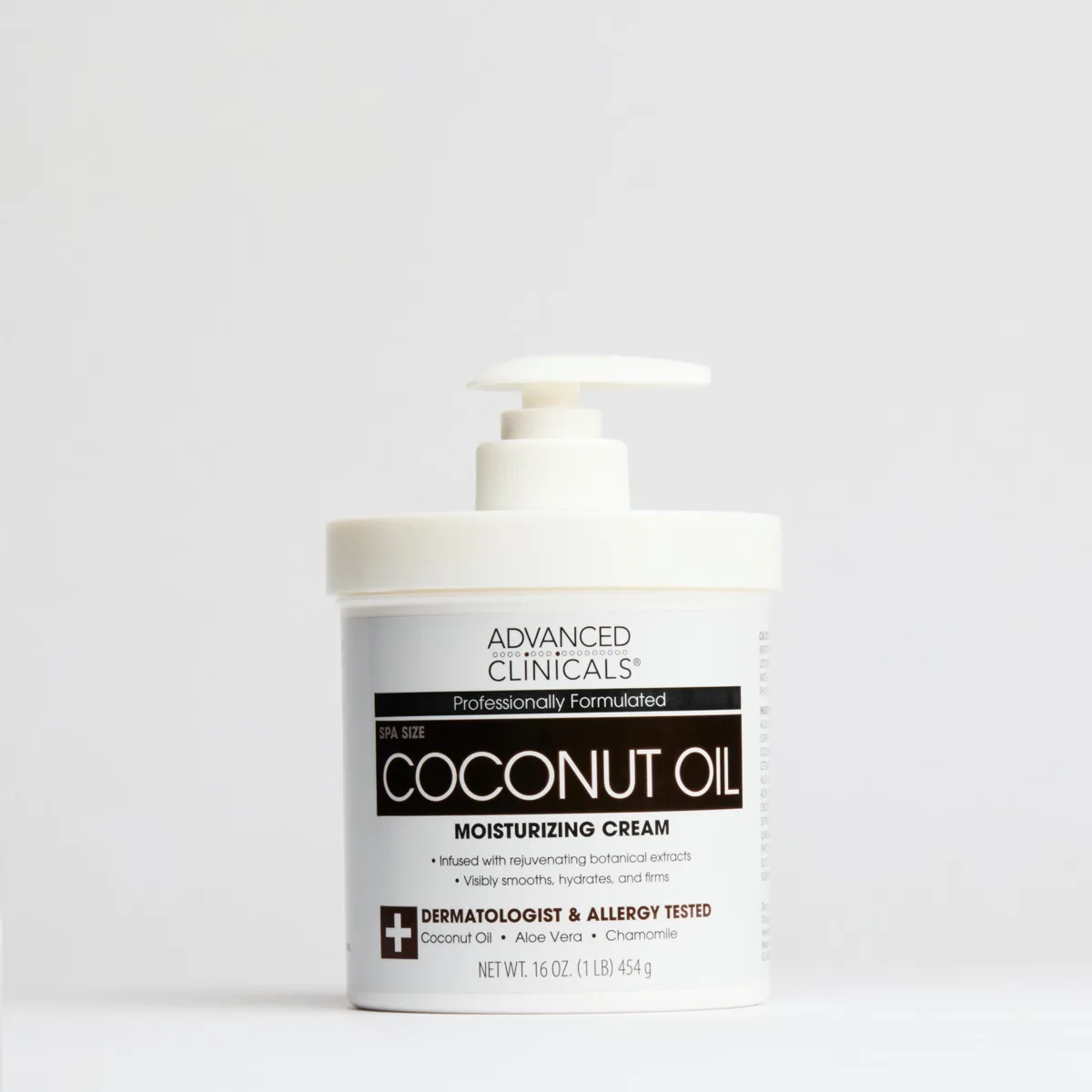
It is the jar that made the format: coconut oil placed sixth, high enough to share the occlusive work with mineral oil rather than merely decorate the label, in a shorter and simpler list than the brand's later creams, with aloe, chamomile and lavender as the only extras. Fifteen thousand ratings and a decade on sale make it the reference point for every other Advanced Clinicals body cream.
body carecreamdrugstoreParaben FreeCruelty FreeVegan
The original Advanced Clinicals jar, and still the most sensible: coconut oil high enough to share the occlusive work with mineral oil, a glycerin core, a short list and fifteen thousand ratings behind it. It moisturizes dry legs and arms well for about a dollar an ounce. Fragrance, lavender and two pore-cloggers near the top mean it is not for sensitive, eczema-prone or acne-prone skin, and the natural framing overstates what is a good conventional cream.
Strong choicefor DrynessIn your profileYou chose · Mineral Oil is an approved or monograph active for dryness; this cream carries it high in the ingredient list.Moderate evidenceStandard tolerabilityNo reviews collected yet
The case for it
Mineral Oil is a first-line active — approved, monograph-listed or named in current guidelines — for this concern.
It is present at an effective concentration, declared or high in the ingredient list.
The formula carries no trigger this concern is sensitive to, with the cautions noted.
Cautions: fragrance.
Same rule for everyone. “Strong choice” is the verdict on 1,459 of 45,024 concern verdicts across the catalog; rule R2 decided 892 of them.
As of September 25, 2026, engine 5.1.1.
Good choicefor DehydrationIn your profileYou chose · Glycerin is a reference standard by mechanism for dehydration; this cream carries it high in the ingredient list.Moderate evidenceStandard tolerabilityNo reviews collected yet
The case for it
Glycerin has trial-supported standing for this concern.
It is present at an effective concentration, declared or high in the ingredient list.
The formula carries no trigger this concern is sensitive to, with the cautions noted.
Same rule for everyone. “Good choice” is the verdict on 9,564 of 45,024 concern verdicts across the catalog; rule R5 decided 9,072 of them.
As of September 25, 2026, engine 5.1.1.
R5 — Trial-supported or guideline-supported active, adequately or plausibly dosed. · the full register
Carrying active
Glycerin
Standing
supported — its mechanism is established
Form
adequate — studied range 20%, from the trials on the row; needs leave-on contact; judge it after ~1 weeks
Tolerability
standard
Row checked
against its sources on July 17, 2026 (evidence table ev-2026.09-r228)
The studies behind the evidence row
USP glycerin monograph / Fluhr et al., glycerol and the skin (review) — glycerin is the reference humectant, drawing and holding water in the stratum corneum — reference work
Also listed for Rough Texture and Winter Skin — the actives here (Mineral Oil, Coconut Oil, Glycerin, Aloe Vera) are in our research queue for those concerns; there is no verdict until their evidence rows are written. That is a gap in our table, not a mark against the product.
As a body productNot judged: what a body product is for — real substance, not just slip, realistic to use daily — cannot yet be measured from the ingredient list (only fragrance load can).
A verdict is DermApproved’s assessment of how well a product’s ingredients fit a concern — never a claim about what the product treats. Evidence dots and collected reviews sit beside it and are never blended in.
Rules 0.5.1 · evidence table ev-2026.09-r228 · how we decide
Assessment
Pros & Cons
Pros
✓ Coconut oil placed sixth, high enough to share the occlusive role with mineral oil
✓ Glycerin humectant beneath two occlusives is a proven moisturizer structure
✓ Short twenty-ingredient list for a mass-market body cream
✓ Softens dry legs, arms and elbows within minutes and holds for a day
✓ About a dollar an ounce; a jar lasts three to four months
✓ Close to fifteen thousand Amazon ratings at four and a half stars
✓ Mild coconut-lavender scent that fades within an hour
Cons
✗ Coconut oil and isopropyl myristate near the top clog pores on acne-prone body skin
✗ Fragrance plus lavender and chamomile extracts rule it out for sensitive or eczema-prone skin
✗ Fragrance allergens are not itemised on the label
✗ Scent reported to vary between batches over the years
✗ No smaller retail size to trial before buying a pound
Review
Full Review
In 2004 a randomized, double-blind trial in the journal Dermatitis compared extra virgin coconut oil with mineral oil as a moisturizer for mild to moderate xerosis and found them about equally effective, with coconut oil slightly ahead on a couple of measures and equally safe. That result is worth holding in mind when reading this jar's ingredient list, because it contains both: mineral oil at third and coconut oil at sixth, over a glycerin core. The brand sells it on the coconut, and much of its audience buys it as a natural alternative to petroleum-based creams. What they are actually getting is a cream that uses two peer occlusives together, which is a better formulation decision than the marketing implies and a less pure one than the marketing suggests.
This is the jar that built the brand's body range. Advanced Clinicals, founded in 2004 and formulated in the Midwest, put this cream on Amazon around 2013, rode the coconut oil enthusiasm of that decade, and has since accumulated close to fifteen thousand ratings at four and a half stars, which makes it one of the most-reviewed body moisturizers sold anywhere. The later jars, honey, rose, aloe, green coffee, retinol, all share its backbone; this one stayed shortest. Water, cetearyl alcohol, mineral oil, glyceryl stearate, isopropyl myristate, coconut oil, glycerin, butylene glycol, an emulsifier, a triglyceride, aloe juice, a gelling polymer, chamomile, lavender, phytic acid, preservatives and a fragrance. Twenty ingredients, which for a mass-market body cream is restrained.
The structure is textbook. Glycerin at seventh draws water into the outer skin, and the two oils above it keep it there; a 2025 review in the International Journal of Dermatology on the mechanisms of basic emollients for xerosis explains why that humectant-under-occlusive design outperforms either component alone, and this cream has it in sensible proportion. Mineral oil brings the inert, non-comedogenic, long-tested seal described in a 2012 International Journal of Cosmetic Science review. Coconut oil brings lauric-rich fatty acids, a warmer feel and the trial evidence above. Aloe juice adds light humectancy. Chamomile and lavender add scent and the idea of soothing. That is the whole formula, and on dry legs, arms and elbows it works: softer within minutes, comfortable for most of a day, flaky patches gone within a fortnight.
In the hand it is a medium-rich cream with a smooth, slightly warm slip that spreads easily and absorbs over a minute or so to a soft, satin finish, not greasy once it has settled. The scent is a mild, clean coconut with a lavender edge, sweeter than raw coconut oil, gone within an hour. A number of long-term reviewers note the scent has shifted between batches over the years, which is worth knowing if a particular version won you over. Phytic acid, an unusual inclusion at fifteenth, is there as a chelating agent to keep the emulsion stable rather than as any kind of exfoliant, and the absence of hyaluronate, collagen or vitamin C is, in this jar, a virtue: there is nothing on the list pretending to be a treatment, which cannot be said of the brand's later body creams. The jar is the brand's usual sixteen-ounce wide-mouth tub, generous and slightly awkward, and it lasts three or four months of daily use.
The reservations are the ones the top of the list predicts. Coconut oil is among the more reliably pore-clogging plant oils, and isopropyl myristate at fifth is a known comedogen too; on acne-prone chests and backs the pair causes breakouts, and a visible strand of the reviews says so. Fragrance is listed without itemised allergens, and lavender and chamomile extracts are both recognised sensitisers, which together make this a poor choice for eczema-prone or fragrance-reactive skin even though the underlying base would suit it. None of this troubles the majority of users, who have dry, ordinary skin and simply want it softer; it does mean the natural framing invites the wrong buyers as well as the right ones.
The value case is strong. Sixteen dollars for a pound is about a dollar an ounce, cheaper than most drugstore lotions in pump bottles and a small fraction of what coconut-branded body butters cost at natural-beauty retailers. There is no smaller retail size on the brand's site, so a first purchase is the full jar, but at this price that is a modest risk, and the decade-long review record removes most of the uncertainty about what arrives.
The recommendation is simple. For dry or normal body skin that tolerates a light fragrance, this is a well-built, very cheap daily moisturizer with more coconut oil in it than most coconut-branded creams and the trial evidence to justify using it alongside mineral oil rather than instead of it. For acne-prone body skin, eczema, fragrance allergy or the face, it is the wrong jar, and the coconut on the lid should not persuade anyone otherwise. Buy it for the structure, enjoy the scent, and ignore the word natural.
Formula
Key Ingredients
The hero actives that drive this product's performance.
Sixth on the list, ahead of the glycerin, which is the highest any named hero sits in the brand's body range and high enough to matter. Coconut oil is a lauric-acid-rich emollient with a randomized trial showing it moisturizes mildly dry skin as well as mineral oil; here it shares the occlusive job with mineral oil at third, and it is the reason this jar has a slightly richer, warmer feel than its siblings.
Third, the inert occlusive that does most of the sealing work. Paired with the coconut oil three places below it, the cream carries two occlusives of different character, one petroleum-derived and one plant-derived, and the combination holds moisture reliably for a full day on dry legs and arms.
Regulator-approvedfor Dryness · established mechanism
Seventh, the humectant half of the formula, drawing water into the outer skin so the two oils have something to trap. A humectant beneath an occlusive is the whole science of a moisturizer, and this jar has both in sensible proportion.
Established mechanismfor Dryness · established mechanism
Eleventh, listed as juice rather than the powder in the brand's aloe jar, adding light humectancy and a mild soothing note for post-sun or post-shave skin. It is a supporting ingredient, not a structural one.
Two calming botanicals at thirteenth and fourteenth that support the brand's sensitive-skin positioning for this jar and contribute to its scent. Both are also Asteraceae and Lamiaceae allergens respectively, so the same extracts that reassure most users are a caution for the allergic minority.
Not yet assessed
Ingredient standings describe the active at treatment-level doses and
vehicles; this product's own condition grades weigh its actual formula.
An after-shower body cream for damp skin, rich enough for legs and arms year-round and for hands and feet in winter. Keep it off the face and off the chest and back if you break out, since coconut oil and isopropyl myristate are both pore-cloggers. It goes over urea or lactic acid body lotions without conflict, and it is fine under body sunscreen once absorbed.
Results Timeline
Skin feels softer immediately and stays comfortable for most of a day; the coconut-and-mineral-oil seal is doing that from the first use. Rough, flaky shins and elbows smooth out over one to two weeks of daily application. Nothing accumulates beyond maintained hydration, and stopping brings the dryness back within days, as with any moisturizer.
Pairs Well With
Urea or lactic acid body lotionsBody sunscreenGentle body washDry body brushing
Advanced Clinicals Coconut Oil Body Cream on damp skin
Body sunscreen on exposed areas
Sample PM Routine
Body wash
Lactic acid lotion on rough patches (optional)
Advanced Clinicals Coconut Oil Body Cream
Evidence
Science & Expert Perspective
The Science
The clearest evidence for this cream is the head-to-head trial of its two oils. Agero and Verallo-Rowell, in a 2004 randomized, double-blind controlled trial in Dermatitis, compared extra virgin coconut oil with mineral oil as moisturizers for mild to moderate xerosis over two weeks and found both effective and safe, with coconut oil producing equal or slightly better improvement in skin hydration and lipid levels, and neither causing adverse reactions. That result supports using coconut oil as a genuine emollient rather than a label ingredient, and it also undercuts any suggestion that mineral oil is the inferior partner; the 2012 review of mineral oil by Rawlings and Lombard in the International Journal of Cosmetic Science documents its inertness, non-comedogenicity in standard assays and low sensitisation rate. Placing both oils above the glycerin, as this formula does, simply gives the humectant two occlusives to work under, and a 2025 review in the International Journal of Dermatology on the mechanistic basis of basic emollients for xerosis cutis explains why that humectant-plus-occlusive arrangement restores hydration and barrier function more effectively than either element alone.
The cautions have their own literature. Coconut oil, whatever its moisturizing merit, scores among the more comedogenic plant oils in standard rabbit-ear and human assays, and isopropyl myristate is a classic comedogenic ester, which is the mechanistic basis for the truncal breakouts a minority of users report; the 2004 xerosis trial was conducted on limbs, not acne-prone skin, and does not speak to that risk. Lavender and chamomile extracts are documented contact allergens, lavender through linalool and its oxidation products and chamomile through sesquiterpene lactones, and the unlisted fragrance adds unspecified components, all of which support flagging the cream for eczema-prone and sensitised users despite its otherwise barrier-friendly base. Aloe juice at eleventh contributes modest humectancy; the coconut oil percentage, like every concentration in the brand's range, is undisclosed.
Coconut oil comes up often in consultations because patients have read that it is a natural moisturizer, and the clinical answer is nuanced: it is a reasonable emollient for dry limbs, with trial evidence roughly matching mineral oil, and it is a poor choice for acne-prone skin and for the face, where its comedogenicity is well recognised. A body cream that combines it with mineral oil and glycerin is, for ordinary dry skin, an unremarkable and acceptable moisturizer. The advice given alongside it would concern the fragrance and the lavender and chamomile extracts, which are among the more frequent botanical sensitisers seen in patch testing and which lead clinicians to recommend fragrance-free emollients for anyone with atopic or reactive skin. Patients with truncal acne would be steered away on account of the coconut oil and isopropyl myristate.
Guidance
Usage & Recommendations
How to Use
Straight out of the shower, with the skin still damp, scoop a modest amount with clean, dry fingers and smooth it over the body, massaging until the initial slip settles into a soft, satin finish; a little covers a lot. Concentrate on shins, elbows, knees and any rough areas, and reapply to hands as needed. Keep it off the face, and off the chest and back if you are prone to body breakouts. It sits well over a urea or lactic acid lotion applied first to thickened skin, and under body sunscreen once absorbed. Close the lid firmly and keep water out of the jar; a pound of cream should stay clean for the months it lasts.
Value Assessment
A dollar an ounce is about as cheap as a competently formulated body cream gets, and this jar has a decade of consistent sales and fifteen thousand ratings to reduce the risk of an unpleasant surprise. Compared with coconut-branded body butters from natural-beauty brands, which cost several times more per ounce and often contain less coconut oil relative to the base, the value is excellent. Advanced Clinicals is an established mass-market brand rather than a start-up, so the price reflects a volume business model rather than corner-cutting, though the absence of any product testing or disclosed percentages is the trade-off. The jar lasts three to four months of daily use, and there is no smaller size on the brand's site to trial first. Strong value for dry, tolerant skin; wasted on acne-prone or fragrance-reactive skin, however cheap.
Who Should Buy
People with dry or normal body skin who want a large, inexpensive, well-structured daily moisturizer with real coconut oil in it and a mild scent. Anyone who has used the brand's other jars and wants the simplest, most-reviewed one. Shoppers who value a short ingredient list and a proven track record over novelty.
Who Should Skip
People with acne-prone chests or backs, given coconut oil and isopropyl myristate near the top of the list. Those with eczema, fragrance allergy or sensitivity to lavender or chamomile. Anyone hoping for a fragrance-free or mineral-oil-free cream, or wanting to use it on the face.
Ready to try Advanced Clinicals Coconut Oil Body Cream?
A medium-rich white cream with a smooth, slightly warm slip that spreads easily, absorbs over a minute or so, and leaves a soft, lightly conditioned finish with a faint sheen.
Scent
A mild, clean coconut-and-lavender fragrance, sweeter than raw coconut oil, noticeable on application and fading within an hour; specific fragrance allergens are not itemised on the label.
Packaging
The brand's sixteen-ounce wide-mouth white jar with a screw lid; no smaller retail size is listed on the brand's own site, though multi-packs and bundles are sold on Amazon.
Finish
satinnon-greasynatural
What to Expect on First Use
Nothing to adjust to: the cream goes on rich, absorbs within a minute or two, and leaves skin softer through the day with a faint coconut scent. Users with acne-prone chests or backs sometimes see small bumps within the first couple of weeks, which is the coconut oil and isopropyl myristate; the rest simply notice softer legs.
How Long It Lasts
Three to four months of daily full-body use from the sixteen-ounce jar.
The Coconut Oil Body Cream is one of the earliest products in Advanced Clinicals' sixteen-ounce range, on Amazon since around 2013, and it rode the coconut oil wave of the mid-2010s into becoming the brand's most-reviewed body product. Its list has stayed short while later jars accumulated collagen, vitamin C and hyaluronate; it remains the plainest and, by rating volume, the best-established of the family.
About Advanced Clinicals Established Brand (5–20 years)
Advanced Clinicals has sold value skincare since 2004 from an in-house formulation team in the US Midwest, and its sixteen-ounce body creams are staples of TJX stores, Walmart and Amazon. Its authority is longevity and volume rather than research; it publishes no product trials and discloses no concentrations.
Brand founded: 2004 · Product launched: 2013
Myth vs. Reality
Common Myths
Myth
A coconut oil body cream is a natural alternative to a mineral oil one.
Reality
This cream contains both, with mineral oil at third and coconut oil at sixth. The randomized trial that compared the two found coconut oil moisturizes mildly dry skin about as well as mineral oil; the point is that they are peers, not that one is virtuous and the other suspect.
Myth
Coconut oil is safe for everyone because it is a food.
Reality
On skin it is one of the more reliably pore-clogging plant oils, and this jar pairs it with isopropyl myristate. Dry arms and legs are fine; acne-prone chests, backs and faces are not, and the many reviewers reporting body breakouts are describing exactly that.
FAQ
Frequently Asked Questions
Is the Advanced Clinicals Coconut Oil Body Cream made of coconut oil?
Coconut oil is the sixth ingredient, after water, fatty alcohol, mineral oil, an emulsifier and isopropyl myristate, and ahead of the glycerin. It is a genuine part of the emollient system rather than a label garnish, but the cream is a water-based emulsion with two oils in it, not coconut oil in a jar.
Will the Advanced Clinicals Coconut Oil Cream clog pores?
On the body it can, for acne-prone people. Coconut oil and isopropyl myristate are both recognised pore-cloggers, and reviewers with chest or back acne report breakouts. On dry legs, arms, hands and feet it is not a concern; keep it off the face and off acne-prone areas.
Does the Advanced Clinicals Coconut Oil Body Cream have fragrance?
Yes, a mild coconut-and-lavender scent from added fragrance plus lavender and chamomile extracts. The label lists fragrance without itemising allergens, so anyone with fragrance sensitivity should assume the usual risk and choose the brand's unscented retinol jar instead.
Is the Advanced Clinicals Coconut Oil Cream good for eczema?
Its mineral oil and glycerin base is eczema-friendly and coconut oil has some supportive data in atopic skin, but the fragrance and the lavender and chamomile extracts are common eczema triggers. A fragrance-free emollient is the safer choice; if you try this one, patch-test first.
How long does a jar of the Advanced Clinicals Coconut Oil Body Cream last?
Three to four months of daily full-body use, and much longer for legs and arms alone. At sixteen dollars for sixteen ounces, that is about a dollar an ounce.
Can I use the Advanced Clinicals Coconut Oil Body Cream on my face?
It is not recommended. Coconut oil, isopropyl myristate and fragrance are each a problem for facial skin prone to congestion or sensitivity, and together they make this a body-only product.
Reviews
What Reviewers Tend to Say
Recurring themes our editors read across retailer reviews of this product — summaries in our words, not quotations, and not a substitute for your own patch test.
Common Praise
Rich but absorbs without greasiness
Light, natural coconut scent
Enormous jar for the price
Softens dry legs and elbows fast
Common Complaints
Contains mineral oil and fragrance despite the natural framing
The burn trials are real and the skeptics who dismiss aloe as folklore are wrong — but the same substance has delayed healing in other wounds, and none of it says anything about what a soothing gel does to intact skin.
It beat mineral oil in a randomised eczema trial and it still breaks out a lot of faces. Both are true, and the usual explanation for the second one is wrong.
The strongest counterexample to blanket botanical scepticism is also one of the more common contact allergens — and holding both facts at once is the only honest way to read it.
Products, answers, therapy guides, tools and articles in one search. Brand names,
slang and abbreviations all work — accutane finds isotretinoin, bacne finds truncal acne.