Why Is My Face Red? Rosacea vs Seb Derm vs Perioral Dermatitis, Decoded
Three of the most common facial-redness conditions get mistaken for each other — and for acne — which sends people down months of treating the wrong thing with products that make it angrier.
Read the preview
From the DermApproved blog, in Skin Concerns: why is my face red? Three different conditions, one very common mistake — and months of treating the wrong thing to show for it. Here's the trap. Rosacea, seborrheic dermatitis, and perioral dermatitis all look a bit like each other, and a lot like acne — so people march to the acne aisle and reach for the exact products that pour fuel on the fire. One of the three has a twist that's almost cruel: the cream that seems to help is quietly making it worse, every single time you stop. There are three fingerprints that tell them apart — a location, a type of bump, and a flake — and one rescue plan they surprisingly share. Which red face is yours? We decode all three — at dermapproved.com/blog.
The redness that keeps getting misdiagnosed
A red, bumpy face sends most people to the acne aisle, and that reflex is the root of a lot of prolonged misery. Rosacea, seborrheic dermatitis, and perioral dermatitis are three separate conditions that share a habit of showing up as facial redness with small bumps — and because they resemble both each other and acne, they get treated with the wrong tools for months at a stretch. The frustrating irony is that many acne treatments actively worsen all three: the drying, exfoliating, barrier-stripping approach that clears a whitehead tends to inflame skin that's red because its barrier or immune balance is already off.
Getting the label right is the entire ballgame, because the correct treatment for each is specific and, in one case, involves stopping something you're already doing. The good news is that the three have distinguishing fingerprints — where they sit on the face, what the bumps look like, whether there's scale, and what sets them off. Learn those, and you can usually place your own redness into the right bucket, then treat it with something that calms rather than provokes. What follows is the field guide, condition by condition, followed by the plan they surprisingly share.
Rosacea: the cheeks-and-nose flusher
Rosacea plants itself on the central face — cheeks, nose, chin, forehead — and its hallmark is persistence: a background redness that doesn't fully settle, often with easy flushing and, over time, visible small blood vessels (telangiectasia) threading across the cheeks and nose. In its papulopustular form it also produces inflammatory papules and pustules, which is exactly why it gets mistaken for acne. The tell that separates it from acne is what's missing: rosacea does not produce comedones — no blackheads, no whiteheads. If your 'acne' has no clogged pores and lives on a permanently pink central face that flares with heat, sun, alcohol, spicy food, or stress, think rosacea.
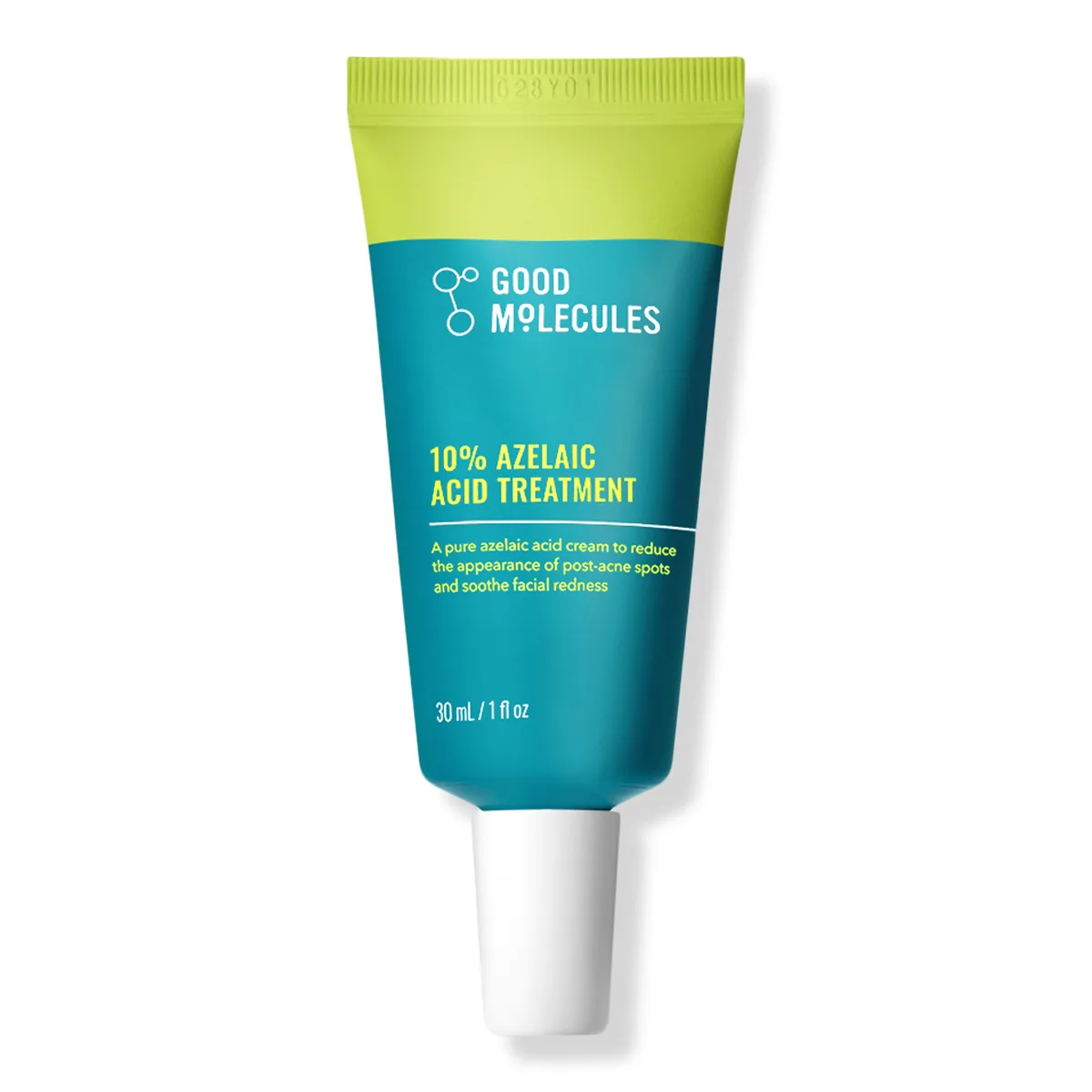
The mechanism is a mix of a dysregulated innate immune response, neurovascular over-reactivity (the flushing), and often an over-abundance of Demodex mites on the skin. Treatment leans on calming that inflammation and vascular reactivity rather than 'drying out' oil. Azelaic acid is a first-line topical here — anti-inflammatory and well tolerated — so a gentle option like Good Molecules 10% Azelaic Acid Treatment, or a soothing azelaic-and-hyaluronic formula such as Anua Azelaic Acid 10 Hyaluron Redness Soothing Serum, fits the brief. Because ultraviolet light is one of the most reliable rosacea triggers, daily sunscreen isn't optional; a fragrance-free, well-tolerated formula like La Roche-Posay Anthelios UV Clear SPF 50 is a rosacea-routine staple. Prescription metronidazole, ivermectin, and vascular treatments round out what a clinician can add.
Seborrheic dermatitis: the greasy-scale imposter
Seborrheic dermatitis overlaps with rosacea's territory — it also loves the central face — which is why the two get swapped and, tellingly, why they frequently occur together. A 2025 cohort study found that people with rosacea carry a markedly elevated risk of also having seborrheic dermatitis, so a red central face is sometimes both conditions layered on top of each other. But seb derm has a signature rosacea lacks: greasy, yellowish scale. It shows up as ill-defined pink patches topped with flaking in the oiliest zones — the creases beside the nose, the eyebrows and the skin between them, the hairline and behind the ears.
The driver is different too: seb derm is an inflammatory reaction to Malassezia, a yeast that metabolizes skin oils, rather than the vascular-immune picture of rosacea. That changes the treatment entirely — the lever is antifungal, not vascular. Ketoconazole, zinc pyrithione, and sulfur reduce the yeast load and the scale. A zinc-pyrithione cleansing bar such as Vanicream Z-Bar, used with a little contact time on the affected areas, is a simple over-the-counter anchor. The practical distinguishing question to ask yourself: is there flaky, greasy scale? Scale points to seb derm. Persistent redness with visible vessels and flushing but no scale points to rosacea. Both at once is common enough that treating one and ignoring the other often leaves you half-better and confused.
Perioral dermatitis: the mouth-framing rash with a steroid twist
Perioral dermatitis (more precisely periorificial dermatitis, since it can ring the nose and eyes too) is the most distinctive of the three once you know its pattern: clusters of small red papules and pustules, sometimes with fine scale, arranged around the mouth — but characteristically sparing a thin clear zone of skin right at the lip border. That spared rim is a genuinely useful clue. It often itches or burns rather than simply looking inflamed, and it skews toward younger women, though anyone can get it.
Here's the twist that makes this one notorious: topical steroids are a classic trigger. People often get perioral dermatitis initially, dab on a mild steroid cream (or get one prescribed), watch it improve, stop, and then rebound worse — a cycle that steadily entrenches the rash. The StatPearls dermatology reference lists topical corticosteroids among the well-recognized causes, alongside heavy occlusive facial creams and, in some cases, fluoridated toothpaste. The counterintuitive cornerstone of treatment is therefore 'zero therapy': stop the steroids and pare back the heavy creams and actives that may be feeding it, then treat with a topical antibiotic like metronidazole or a course of oral tetracyclines under a clinician's guidance. Screening a suspect product's ingredient list with the [ingredient-decoder] for occlusives and heavy botanicals can help you strip the routine back to the essentials while it heals.
What all three share — and when to get a real diagnosis
For three conditions with different drivers, the rescue principles converge to a striking degree. First: simplify. All three flare under aggressive, multi-active routines, so the move is to pare down to a gentle cleanser, a plain barrier-supporting moisturizer, and sunscreen, then add one targeted treatment rather than five. Second: protect the barrier and avoid the acne-fighting instinct — benzoyl peroxide, gritty scrubs, high-strength acids, and alcohol-heavy astringents tend to inflame red, reactive skin rather than calm it. Third, and most important: be extremely wary of long-term topical steroids on the face. They can trigger or entrench perioral dermatitis and produce a steroid-induced rosacea-like eruption, so what feels like a quick fix often deepens the problem. Introduce any new active slowly, and a [patch-test] first spares you from provoking already-irritable skin.
The honest limit of self-diagnosis is that these conditions overlap, co-occur, and can mimic other things — and getting it wrong costs months. If your redness is persistent, spreading, painful, involves the eyes, or simply hasn't responded to a sensible gentle routine, that's the signal to see a dermatologist, who can confirm the diagnosis and prescribe the targeted treatments — metronidazole, ivermectin, oral antibiotics, antifungals — that over-the-counter care can't match. Walking in prepared makes the visit far more useful: a short log of where the redness sits, what it looks like up close, what triggers it, and what you've already tried. A little derm-visit-prep turns a rushed appointment into an accurate answer, which is the thing that actually ends the cycle.
Products mentioned
Independently reviewed and scored — the real products behind this piece.


References
- Rosacea and seborrheic dermatitis: a retrospective cohort study — Proceedings (Baylor University Medical Center), 2025
- Seborrheic Dermatitis Revisited: Pathophysiology, Diagnosis, and Emerging Therapies—A Narrative Review — Journal of Clinical Medicine, 2025
- Perioral Dermatitis — StatPearls (NCBI Bookshelf), 2024
Every cited link is verified to resolve to the paper named. Where a source could not be independently confirmed, it is listed without a link rather than pointing you somewhere wrong.
Frequently asked
How do I know if my red face is rosacea or seborrheic dermatitis?
The quickest tell is scale. Seborrheic dermatitis produces greasy, yellowish flaking over pink skin in oily zones like the nose folds and brows. Rosacea instead shows persistent central-face redness, flushing, and visible small blood vessels without that scale. They also frequently coexist, so if redness lingers after the flaking clears, you may be dealing with both and should see a dermatologist to confirm.
Why did my facial rash get worse after I stopped using a steroid cream?
That rebound is a hallmark of perioral dermatitis, where topical steroids are a classic trigger. The cream improves things briefly, but stopping causes a flare, and repeated use entrenches the rash. The fix is usually 'zero therapy' — stopping the steroid and heavy creams — plus a prescribed topical or oral antibiotic. It often gets worse before it gets better, which is expected.
Why isn't my acne treatment working on my facial redness?
Because it may not be acne. Rosacea, seborrheic dermatitis, and perioral dermatitis all mimic acne but aren't driven by clogged pores, so benzoyl peroxide, scrubs, and drying actives tend to inflame them rather than clear them. A giveaway is the absence of blackheads and whiteheads. If your 'acne' has no comedones and lives on persistently red or flaky skin, you're likely treating the wrong condition.
Can you have rosacea and seborrheic dermatitis at the same time?
Yes, and it's common. A 2025 cohort study found rosacea patients have a substantially higher risk of also having seborrheic dermatitis, and the two overlap on the central face. That's why some people improve only partway when they treat one condition — the other is still active. If a red, flaky central face resists single-track treatment, both may be present.
When should I see a dermatologist about facial redness?
See one if the redness is persistent, spreading, painful, involves the eyes, or hasn't improved with a simplified, gentle routine and sunscreen. These conditions overlap and are easy to misdiagnose at home, and the most effective treatments — metronidazole, ivermectin, oral antibiotics, prescription antifungals — require a clinician. Bringing a short log of location, triggers, and what you've tried makes the diagnosis faster and more accurate.