The Pregnancy-Safe List Is Longer Than the Fear-Based One
"Stop everything" is easy advice to give and miserable advice to follow — especially when pregnancy is actively causing the melasma and acne you have been told to tolerate for nine months.
Read the preview
From the DermApproved blog, in Pregnancy and Postpartum: the standard advice is to stop everything. Easy to give, bleak to follow. Nearly four million births later, the data on the exposure everyone panics about is far calmer than the panic — and the list of what you can still use is longer than anyone admits. For the full breakdown, visit dermapproved.com/blog.
Elimination is the easiest advice to give and the worst to live with
Ask almost anyone what to use on your face while pregnant and you will get a subtraction: no retinoids, no acids, no actives, maybe nothing but a bland moisturiser until you deliver. It is defensible advice in the sense that nobody was ever harmed by a plain cream. It is also, for a lot of people, nine months of watching a face change and being told the correct response is patience.
That matters because pregnancy is not a neutral period for skin. It causes melasma in a large proportion of pregnancies, it commonly triggers or worsens acne, and it makes skin itchier and more reactive. Those are conditions with treatments, and blanket elimination removes the treatments along with the genuinely contraindicated drugs.
The better approach is to separate three categories properly: what is actually contraindicated and why, what the evidence says about accidental exposure to the things on that list, and what remains available — which is more than most people are told. Our pregnancy-safe tool checks a specific product against that framework, and the ingredient-decoder handles the INCI list when the marketing copy is unhelpful.
What is genuinely off the table
The unambiguous exclusions are systemic. Oral isotretinoin is a potent teratogen with a well-characterised pattern of malformations, which is why it is dispensed under a mandatory pregnancy prevention framework rather than left to judgement. Oral tetracyclines — doxycycline, minocycline, sarecycline — are avoided, particularly from the second trimester when fetal tooth and bone mineralisation is under way. Spironolactone is an antiandrogen and is not used in pregnancy. Oral tranexamic acid, increasingly popular for melasma, is a poor idea in a state that is already hypercoagulable.
Among topicals, hydroquinone is the standard exclusion, on the grounds that its percutaneous absorption is substantially higher than most topical agents and no safety data justifies the exposure. Topical retinoids are the fourth: adapalene, tretinoin, retinol and its cosmetic relatives are all advised against.
It is worth being precise about why that fourth exclusion exists, because it is different in kind from the others. It is precautionary reasoning by analogy — a systemic drug in this class is teratogenic, therefore avoid the topical form — and it was made in the absence of much data. That is entirely reasonable when the alternatives are good, and the alternatives are good. But precaution and evidence of harm are not the same thing, and the difference matters enormously to the person who used their retinoid for six weeks before they knew.
If you used a retinoid before you knew, read this part
This is the single most common panicked question in pregnancy skincare, and the data have improved sharply.
A population-based cohort study using nationwide registers across Denmark, Iceland, Norway and Sweden examined 3,869,586 infants born between 1996 and 2020. Around 0.86 per 1,000 had first-trimester exposure to a topical retinoid. Among those exposed, 3.3% had a major congenital malformation — 71 of 2,172 — compared with 3.0% among unexposed infants. The adjusted risk ratio was 1.1, with a 95% confidence interval of 0.87 to 1.38. Compared against a more like-for-like control group, infants exposed to topical azelaic acid or clindamycin, the figure was the same: 1.1, confidence interval 0.87 to 1.47. An earlier prospective cohort of first-trimester topical tretinoin exposure, published in the Lancet, pointed the same way.
A confidence interval that comfortably includes one is not proof of safety, and no register study can rule out a small effect. But it is a very large denominator, and it does not show the signal people are terrified of. The practical translation: stop when you find out, mention it at your next appointment, and do not spend the pregnancy convinced you have done damage. The same study noted that topical retinoid use among women of reproductive age in those countries more than tripled between 2006 and 2024 — from 8.7 to 28.5 per 1,000 — so this is a conversation an awful lot of people are having.
What stays, and it is a real routine
Now the useful half. Reviews of acne management in pregnancy consistently keep a substantial topical list available: azelaic acid, benzoyl peroxide, topical clindamycin, erythromycin, metronidazole, dapsone and — with sensible limits on quantity — salicylic acid. Add the cosmetic actives that were never in question: niacinamide, vitamin C, glycolic and lactic acid, hyaluronic acid, ceramides.
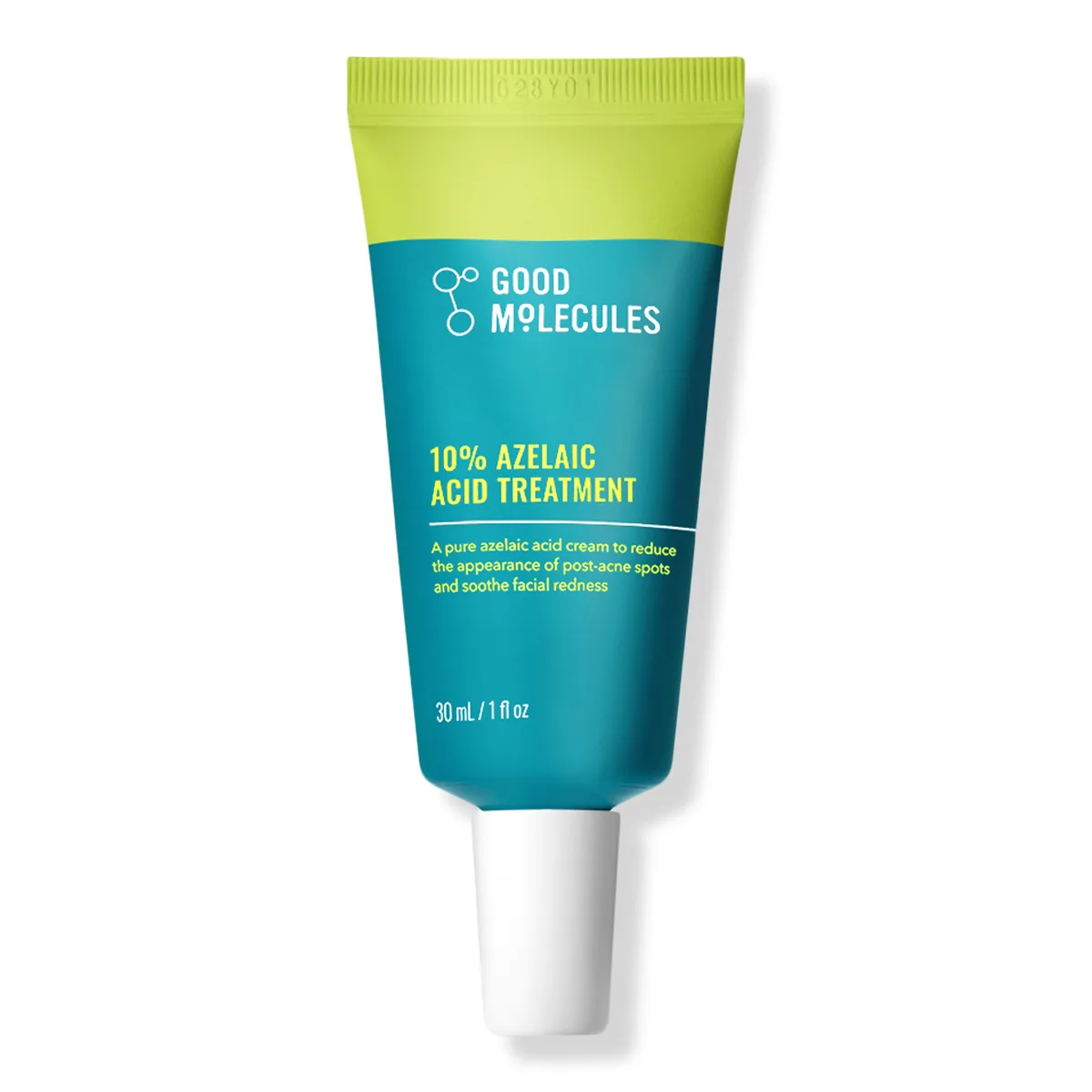
Azelaic acid is the one to build around, because it does an unusual amount at once: it is anticomedonal, antibacterial, and it inhibits tyrosinase, which means it treats pregnancy acne and pregnancy melasma with the same tube. Good Molecules 10% Azelaic Acid Treatment and SKIN1004 Azelaic Acid 10 Ampoule are both straightforward vehicles for it; azelaic acid as a molecule is the closest thing pregnancy has to a multi-tool.
For inflammatory acne, benzoyl peroxide remains available — a leave-on such as Neutrogena Stubborn Acne AM Treatment 2.5% at the lower strength that is better tolerated anyway. For pigment and general tone, The Ordinary Niacinamide 10% + Zinc 1% covers the niacinamide slot without complicating anything.
Assembled, that is a genuine routine, not a holding pattern. The pregnancy-safe routine lays out the general version and the pregnancy-safe acne routine the version for skin that is actively breaking out; the routine-finder will build either around your own answers. The specific question of what to do about a flare mid-pregnancy is covered in our answer on acne treatment during pregnancy.
Melasma is where the sunscreen argument gets technical
Melasma in pregnancy is common enough to have its own colloquial name, and it is the change most people find hardest. It is also the one where the routine advice — wear sunscreen — is right but incomplete in a way that matters.
Melasma is not driven by ultraviolet alone. Visible light contributes, particularly in deeper skin tones, and standard sunscreens are transparent to it by design. Zinc oxide and titanium dioxide at cosmetically acceptable particle sizes let visible light straight through; that is precisely why they no longer leave a white cast. The ingredient that blocks visible light is pigment, which in practice means iron oxides — the colourants in a tinted sunscreen. A review of tinted sunscreens in the dermatology literature makes the point directly: the tint is the active part of visible-light protection, not a cosmetic afterthought.
So for pregnancy melasma the specification is narrower than 'wear SPF'. It is a tinted, iron-oxide-containing sunscreen, reapplied, worn daily including indoors near windows. La Roche-Posay Anthelios Mineral Tinted SPF 50 and CeraVe Hydrating Mineral Sunscreen Sheer Tint both carry iron oxides alongside the mineral filters. Our pregnancy-safe sunscreen ranking covers the rest of the field.
One piece of realism: melasma acquired in pregnancy frequently fades in the months after delivery without aggressive intervention, and the treatments that would speed it up most are largely the ones you cannot use. Prevention is doing most of the work here, and it is worth doing well precisely because the corrective options are limited.
The sunscreen absorption question, in proportion
Many people switch to mineral sunscreen in pregnancy on the strength of headlines about organic filters entering the bloodstream. Those headlines came from real research, and the research says something narrower than the headlines did.
In a randomised trial run by the FDA's own clinical pharmacology group, 24 volunteers applied 2 mg of sunscreen per square centimetre to three quarters of their body surface, four times a day for four days — maximal-use conditions, well beyond ordinary application. Plasma concentrations of avobenzone reached geometric means in the region of 4 ng/mL, with oxybenzone, octocrylene and ecamsule also measurable. The threshold that matters here is regulatory: the FDA's guidance is that a sunscreen active absorbed above 0.5 ng/mL should undergo further nonclinical toxicology assessment, including developmental and reproductive studies.
That is a data-gap finding, not a harm finding. No adverse outcome was demonstrated; what was demonstrated is that the old assumption of negligible absorption was wrong, and that the testing needs to catch up. Choosing a mineral filter during pregnancy is a reasonable preference for the better-characterised option. It is not a rescue from a known danger, and it should not become a reason to wear less sunscreen — which, given melasma, would be the genuinely harmful choice.
Breastfeeding, and rebuilding afterwards
The rules change again after delivery, and not simply in the direction of relaxing. Lactation raises two different questions from pregnancy: whether a drug transfers into milk, and whether the infant makes direct contact with treated skin. Topical agents applied to the face pose little of either, and the reviews of acne treatment in lactation keep most topicals available. The practical constraints are about placement rather than molecules — nothing on the nipple or areola, nothing on the chest or hands that a mouth will reach, and anything applied nearby washed off before a feed.
Some systemic options reopen after delivery that were closed during pregnancy, and some remain closed. That is a conversation with whoever is prescribing rather than a decision to make from a blog post, and it is worth having early if acne has been building for nine months.
As for rebuilding: resist the urge to restart everything the week you stop breastfeeding. Postpartum skin is frequently drier, often more reactive, and running on very little sleep, which is the worst possible context for a retinoid ramp. Reintroduce one active at a time, twice weekly, over moisturiser — the same discipline as any reintroduction, and the reintroduction principles apply unchanged. Give the melasma a few months before judging it, because a good deal of it resolves on its own and treating impatiently is how people end up with irritation on top of pigment.
The honest summary is that the elimination advice is not wrong so much as lazy. Four systemic drugs and two topical categories are genuinely out. Everything else is a routine you can build, and the data on the exposure people panic about is more reassuring than the panic suggests.
Products mentioned
Independently reviewed and scored — the real products behind this piece.


- Routine Pregnancy-Safe Skincare Routine The general routine built from what remains available
- Routine Pregnancy-Safe Acne Routine Version for skin actively breaking out during pregnancy
- Ranked list Best Pregnancy-Safe Sunscreens Field of pregnancy-appropriate sunscreens beyond the two named
- Ingredient Azelaic Acid The molecule the pregnancy routine is built around
- Ingredient Niacinamide (Vitamin B3) Uncontroversial active that stays available throughout
- Question Which acne treatments are safe to use in pregnancy? Direct answer on treating a flare mid-pregnancy
- Question How do I reintroduce products without ruining the experiment? Reintroduction discipline for the postpartum rebuild
References
- Topical retinoid use in women of reproductive age and risk of major congenital malformations in exposed pregnancies: a Nordic cohort study — British Journal of Dermatology, 2026
- Safety of first-trimester exposure to topical tretinoin: prospective cohort study — The Lancet, 1997
- Management of Acne in Pregnancy — American Journal of Clinical Dermatology, 2024
- Treatment of Acne Vulgaris During Pregnancy and Lactation: A Narrative Review — Dermatology and Therapy, 2023
- Photoprotection beyond ultraviolet radiation: A review of tinted sunscreens — Journal of the American Academy of Dermatology, 2021
- Effect of Sunscreen Application Under Maximal Use Conditions on Plasma Concentration of Sunscreen Active Ingredients: A Randomized Clinical Trial — JAMA, 2019
Every cited link is verified to resolve to the paper named. Where a source could not be independently confirmed, it is listed without a link rather than pointing you somewhere wrong.
Frequently asked
I used retinol for weeks before I knew I was pregnant. How worried should I be?
The largest study to date, covering nearly 3.9 million Nordic infants, found major congenital malformations in 3.3% of those exposed to topical retinoids in the first trimester versus 3.0% of unexposed, with an adjusted risk ratio of 1.1 and a confidence interval crossing one. Stop now, mention it at your next appointment, and do not carry it as guilt.
Which acne treatments can I actually keep using while pregnant?
Azelaic acid, benzoyl peroxide and topical clindamycin are the mainstays, with erythromycin, metronidazole and dapsone also reviewed as options. Azelaic acid is the most useful single choice because it addresses comedones, inflammation and pigment at once — which matters when pregnancy is causing both acne and melasma.
Is mineral sunscreen genuinely necessary in pregnancy?
It is a reasonable preference rather than a necessity. FDA research under maximal-use conditions showed organic filters reaching plasma levels above the 0.5 ng/mL threshold that triggers additional toxicology testing — a data gap, not a demonstrated harm. What matters far more is that you wear sunscreen at all, and that it is tinted if you are managing melasma.
Why does my melasma need a tinted sunscreen specifically?
Because visible light contributes to melasma and modern mineral filters are transparent to it. Iron oxides — the pigments that make a sunscreen tinted — are what actually block that part of the spectrum. A clear zinc oxide sunscreen protects against ultraviolet while letting through the wavelengths that keep the pigment active.
When can I restart my retinoid after giving birth?
Once you are no longer pregnant and any breastfeeding arrangement has been discussed with your clinician, the molecule is available again — but postpartum skin is usually drier and more reactive, and sleep deprivation is a poor setting for a retinisation period. Restart at twice weekly over moisturiser, one active at a time, and give melasma a few months first since much of it fades on its own.