The 'Instant Tightening' Is a Film. That's Not Automatically a Cheat.
Critics call film formers fraud and marketers call them science. Both are wrong in interesting ways — a film has real optical and occlusive function. It just is not remodelling anything, and almost nothing on the label tells you which one you bought.
Read the preview
From the DermApproved blog, in Ingredient Science: the instant tightening is a film drying on your face. That is not automatically a cheat — silicone sheeting is first-line scar treatment, and it works by being a film. But nothing here changes the tissue underneath, and one three-second test at the sink tells you exactly which one you bought. For the full breakdown, visit dermapproved.com/blog.
Two camps, both wrong
There is a recurring argument about products that make skin look immediately smoother, and neither side of it is right.
The sceptical position is that film formers are a con — a polymer that dries into a temporary coating, producing an effect that washes off, sold at the price of a treatment. The marketing position is that the same ingredients constitute an advanced delivery technology that firms and lifts.
The first is wrong because films do real, mechanistically well-understood things, some of them clinically important. The second is wrong because none of those things involve changing the tissue underneath.
What makes this worth an article rather than a sentence is that the distinction is genuinely hard to make as a consumer, the label rarely helps, and the same ingredient can be doing honest infrastructure work in one product and carrying a misleading claim in the next. So: what a film actually does, which ingredients do it, how long it lasts, and how to tell at home.
What a film does — two mechanisms, both real
The optical one. Whether a fine line is visible depends less on its depth than on how light behaves at it. Skin has microrelief — a fine texture of ridges and furrows — and a line reads as a line because it casts a shadow with enough contrast against the surrounding surface. Lay a continuous film across that topography and two things change: the furrow is partially filled, reducing its effective depth, and the refractive index across the surface becomes more uniform, which lowers the contrast of the shadow.
Add particles that scatter light — silica, boron nitride, spherical polymer beads — and you diffuse specular reflection across the surface instead of letting it bounce off in a way that sharpens every edge. That is the 'soft focus' or blurring effect, and it is the same physics as a diffusion filter on a camera lens. Nothing has been repaired. The light has been changed, and you look different in a mirror and in a photograph — which is, for most buyers, the thing they wanted.
The occlusive one. A continuous film over the skin reduces transepidermal water loss. Less water escaping means the stratum corneum holds more, corneocytes swell, and fine lines genuinely become shallower and less visible. This is not a trick either — it is precisely the mechanism by which any decent moisturiser improves the look of fine lines within an hour, and work using terahertz imaging on stratum corneum samples has distinguished the occlusive behaviour of substances like lanolin from the hyperosmotic behaviour of glycerine, which are different routes to the same visible outcome.
And here is the strongest possible argument against dismissing films, which sceptics almost always miss. Silicone gel sheeting is the internationally recommended first-line treatment in scar management — the intervention with more clinical support than any alternative in that field. Its exact mechanism is still debated, but the leading explanation is that occlusion of the scar site and hydration of the wound bed suppress and normalise the overactivity of scar-related cells.
That is a film. Producing a clinical result. By being a film. Which means 'it's only forming a barrier on the surface' is a description, not a criticism — the question is always what the barrier is for.
The ingredients doing the work
Silicones. Dimethicone and its relatives — dimethicone crosspolymer, cyclopentasiloxane, various cross-linked elastomers — spread extremely thin, dry to a flexible and permeable film, blur optically, reduce water loss, and provide the slip that makes a primer feel like a primer. They are also the most-maligned and least-deserving-of-it ingredients in this category.
Synthetic polymers. PVP, VP/VA copolymer, acrylates copolymer, sodium polyacrylate, polyvinyl alcohol — the last being what makes a peel-off mask peel off in one piece.
Hydrocolloids and natural polymers. Xanthan gum, hydroxyethylcellulose, algin, and hydrolysed proteins, which form a film as the water evaporates and are the traditional route to a 'firming' sensation in a botanical-positioned product.
Silicates. Sodium silicate and magnesium aluminium silicate are the ones responsible for the most dramatic effect in the category. As a silicate solution dries, the film contracts, and that contraction produces a genuinely perceptible mechanical tightening across the skin. It is the sensation behind a large share of 'instant lift' ampoules and eye treatments, and it is a real physical event — it is just happening to the film rather than to you.
Powders. Silica, starches and boron nitride, doing mattifying and optical work.
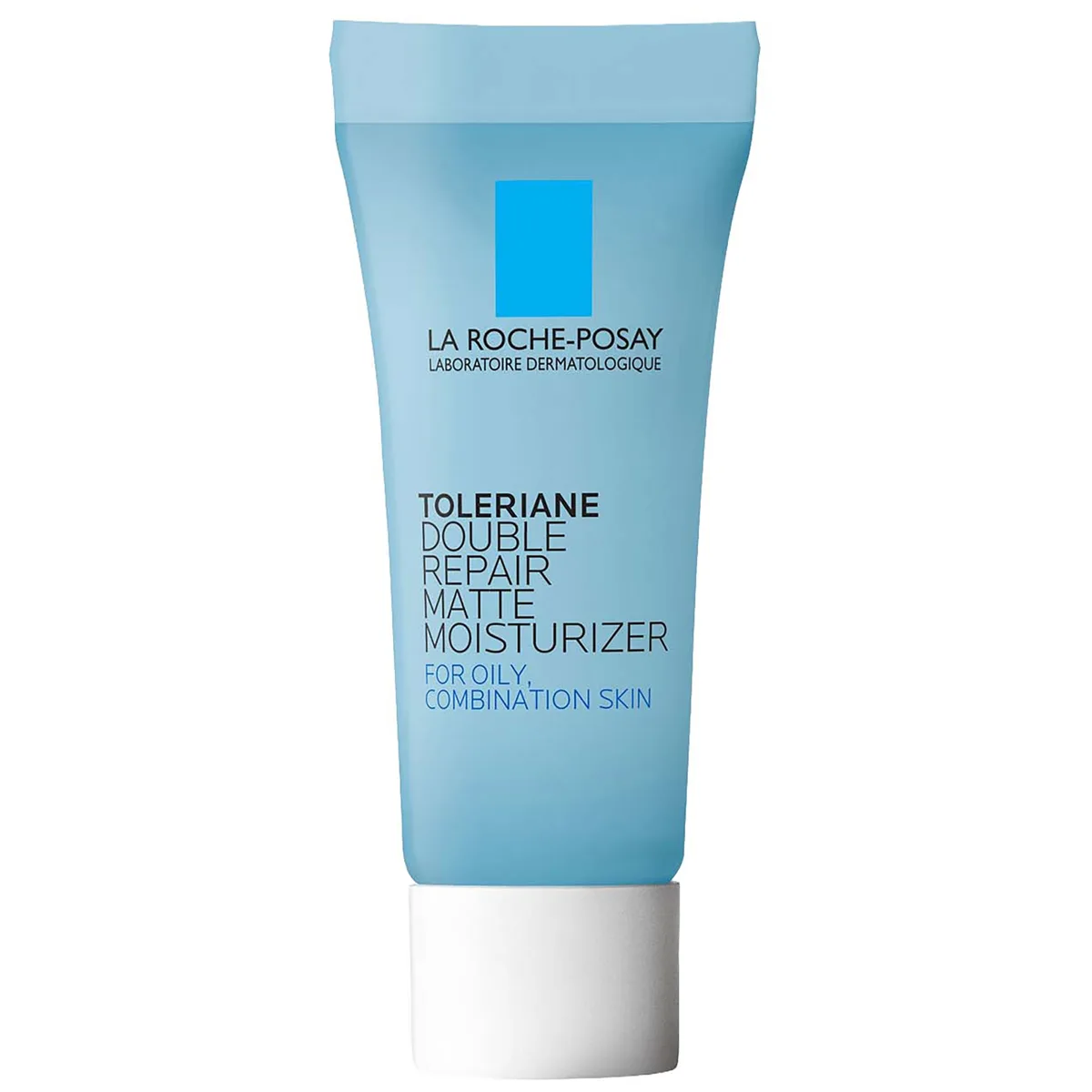
What is worth noticing is how ordinary the products containing these are. Eucerin Hyaluron-Filler Eye Cream uses film formers alongside hyaluronic acid; La Roche-Posay Toleriane Double Repair Matte and Effaclar Mat use silica and starches for shine control; CeraVe Ultra-Light Moisturizing Lotion SPF 30 and Bioderma Atoderm Intensive Gel-Cream use film formers as part of ordinary formulation architecture.
And films are load-bearing in medicated products too: La Roche-Posay Effaclar Adapalene Gel 0.1% and Neutrogena Stubborn Acne AM Treatment both use film-forming agents as part of how the active is held against the skin. This is not a trick category. It is infrastructure that occasionally gets sold as a headline.
How long each effect lasts
Duration is the most informative property here, because it maps exactly onto mechanism.
The silicate tightening sensation: minutes to a couple of hours. It fades as the film relaxes and disappears entirely on washing. This is the shortest-lived and most dramatic effect in the category, which is an unfortunate combination for consumer expectations.
The optical blur: as long as the film remains intact and continuous. In practice a working day, less if you sweat, touch your face repeatedly, or layer something over it that disrupts the surface.
The occlusive hydration effect: hours, with a modest tail. Because the stratum corneum genuinely rehydrates while occluded, some improvement persists after the film itself is gone — which is why a good moisturiser leaves skin looking better the following morning than an untreated night would have.
Cumulative change to the tissue: none. Not a small amount. None. No film former builds collagen, thickens dermis, alters pigment production or changes anything that persists once you stop.
That is not a scandal — a moisturiser is not expected to remodel dermis either. It is simply the fact that the pricing and the claim language frequently obscure. And it stands in stark contrast to the interventions that do change tissue, where results from microneedling or laser take weeks to months to appear, precisely because building new collagen is slow. Speed and permanence trade against each other in skin, almost without exception.
Where a claim crosses the line
There is a defensible standard here, and it is not 'never mention the immediate effect'.
Legitimate and descriptive: instantly smooths the appearance of fine lines. Blurs. Mattifies. Provides an immediate tightening sensation. Softens the look of texture. Every one of those describes an optical or sensory event accurately, and a buyer who reads them understands what they are getting.
Crossing over: lifts. Firms. Tightens — without 'sensation'. Rebuilds. Restores elasticity. Boosts collagen. Those describe changes to tissue, and a film former does not produce them. The word 'appearance' is doing enormous regulatory and ethical work in this category, and its presence or absence is the single most reliable tell on a package.
The compound offence is a before-and-after photograph taken twenty minutes apart, presented in the same breath as a long-term claim, with nothing indicating which mechanism produced the image. The photograph is honest about the film. The paragraph beside it is talking about collagen. The reader merges them, which is the intended outcome.
A practical tell when assessing any before-and-after: check the highlights. If the 'after' image is glossier — more specular reflection, wetter-looking, brighter catchlights on the cheekbone — you are looking at a film and a lighting choice rather than a change in skin. Consistent lighting and matte-to-matte comparison is a sign of good faith; it is also much rarer. The same scepticism you would apply to an SPF number versus independent testing belongs here, for the same reason: the manufacturer generated the evidence and chose the conditions.
The home test that settles it
Four checks, none of which require any equipment.
The clock test. Time the onset. Anything visible in under fifteen minutes is optical or occlusive — full stop. There is no mechanism by which dermal remodelling produces a same-session visible result, so an 'instant' claim is self-labelling as a surface effect whether or not the brand says so.
The wash test. Note the effect carefully, then cleanse thoroughly and look again. If the improvement leaves with the product, it was a film. This is the fastest single diagnostic available and almost nobody runs it.
The morning test. This is the one that actually matters. On day thirty, before you apply anything, is your skin better than it was on day one? That question — asked on bare, clean, unproducted skin — is the only thing separating a cumulative active from a cosmetic finish. Photograph it under the same light on day one so you are not arguing with your memory a month later.
The pilling test. Films pill into little rolls under a subsequent layer and crack visibly in expression lines by the afternoon. Both behaviours are diagnostic and both are why a product that photographs beautifully at 9 a.m. can look worse than bare skin at 4 p.m.
Then read the list — the ingredient decoder will resolve which entries are polymers, silicones or silicates and where they sit in the order.
And the conclusion is not 'don't buy it'. A product that makes you look better today, safely, at a fair price, is a completely legitimate thing to own — that is what makeup is, and nobody accuses a primer of fraud. Buy the film knowingly and you have bought a good product with a clear job.
The failure mode is narrower and more expensive than fraud. It is paying treatment prices for a cosmetic finish, and — considerably worse — spending a year believing you are treating something while you are covering it. The film is not the problem. The year is.
Products mentioned
Independently reviewed and scored — the real products behind this piece.



- Ingredient Film Formers & Texture Polymers The polymer category behind almost every 'instant' claim in skincare.
- Ingredient Silica (Silicon Dioxide) Light scattering and mattifying — the soft-focus half of the optical effect.
- Ingredient Dimethicone The most maligned and least deserving of it: blur, slip, and genuine reduction in water loss.
- Question When do microneedling or laser results actually appear? The contrast case: interventions that genuinely change tissue take weeks to months.
- Question Can I actually trust the SPF number printed on the label? The same scepticism about manufacturer-generated evidence, applied to a different number.
References
- The Use of Silicone Adhesives for Scar Reduction — Advances in Wound Care, 2015
- Visualization of moisturizer effects in stratum corneum in vitro using THz spectroscopic imaging — Applied Optics, 2019
- International clinical recommendations on scar management — Plastic and Reconstructive Surgery, 2002
Every cited link is verified to resolve to the paper named. Where a source could not be independently confirmed, it is listed without a link rather than pointing you somewhere wrong.
Frequently asked
Is an 'instant tightening' effect fake?
It is real and it is temporary. Silicate films contract as they dry, producing a genuine mechanical tightening you can feel — the event is happening to the film rather than to your tissue. It typically lasts minutes to a couple of hours and disappears on washing. Describing it as a tightening sensation is accurate; describing it as lifting or firming is not.
Are film formers just covering the problem?
Partly, and that is not automatically bad. A film reduces water loss, which genuinely rehydrates the stratum corneum and shallows fine lines, and it changes how light meets skin, which genuinely reduces the visibility of texture. Silicone gel sheeting — the first-line treatment in scar management — is thought to work largely through occlusion and hydration. Films can do real work.
How can I tell a film effect from a real active?
Three tests. Time it: anything visible in under fifteen minutes is optical or occlusive, because dermal remodelling cannot happen that fast. Wash it: if the improvement leaves with the product, it was a film. And on day thirty, look at clean, bare, unproducted skin and ask whether it is better than day one — that is the only question that separates cumulative from cosmetic.
Which word on a label tells me it is a surface effect?
'Appearance.' Claims like 'smooths the appearance of fine lines' describe an optical result honestly. Claims that drop it — 'firms', 'lifts', 'rebuilds', 'restores elasticity' — assert a change in tissue that a film former does not produce. The presence or absence of that one word is the most reliable tell on a package.
Should I avoid products with film formers?
No. They are ordinary formulation infrastructure, they appear in excellent moisturisers and sunscreens, and they are part of the delivery system in medicated products including prescription-strength retinoids and benzoyl peroxide. Buy the film knowingly and it is a good product with a clear job. The expensive mistake is paying treatment prices for a cosmetic finish, or spending a year covering something you meant to treat.