Rather than relying on a single humectant like hyaluronic acid, this serum replicates the skin's complete natural moisturizing factor with 12 amino acids at 17% concentration alongside 5% panthenol. It's essentially a biomimetic hydration formula — giving the skin back the exact moisture-retaining molecules it produces naturally but loses with age, washing, and environmental exposure.
A scientifically elegant hydrating serum that replenishes the exact moisture-retaining molecules your skin produces naturally but loses with age. It won't deliver dramatic visible results, but as the quiet infrastructure that makes your entire routine work better — especially if you use retinoids, acids, or live in dry climates — it's an under-$10 essential that punches well above its price.
Good choicefor DehydrationIn your profileYou chose · Betaine is a reference standard by mechanism for dehydration; this serum carries it high in the ingredient list.Moderate evidenceGentleNo reviews collected yet
The case for it
Betaine has trial-supported standing for this concern.
It is present at an effective concentration, declared or high in the ingredient list.
The formula carries none of the triggers this concern is sensitive to.
Same rule for everyone. “Good choice” is the verdict on 9,564 of 45,024 concern verdicts across the catalog; rule R5 decided 9,072 of them.
Unchanged since September 5, 2026, engine 5.1.1.
Supporting rolefor DrynessIn your profileYou chose · Nothing here targets dryness directly; humectant hydration is the recognised companion to treating it, and this serum does that without known triggers.Not yet assessedGentleNo reviews collected yet
The case for it
Betaine has no evidence row yet for this concern — it is in the research queue.
The formula carries none of the triggers this concern is sensitive to.
What would change this: A researched evidence row for the lead active would replace this with a verdict.
Same rule for everyone. “Supporting role” is the verdict on 8,197 of 45,024 concern verdicts across the catalog; rule R8 decided 4,250 of them.
Unchanged since September 5, 2026, engine 5.1.1.
R8 — The category's job (barrier care, humectant hydration, gentle cleansing, photoprotection) is the documented supportive role for this concern. This is the honest verdict for a moisturizer on an acne page. · the full register
Supporting rolefor Compromised Skin BarrierIn your profileYou chose · Nothing here targets compromised skin barrier directly; barrier support is the recognised companion to treating it, and this serum does that without known triggers.Not yet assessedGentleNo reviews collected yet
The case for it
Betaine has no evidence row yet for this concern — it is in the research queue.
The formula carries none of the triggers this concern is sensitive to.
What would change this: A researched evidence row for the lead active would replace this with a verdict.
Same rule for everyone. “Supporting role” is the verdict on 8,197 of 45,024 concern verdicts across the catalog; rule R8 decided 4,250 of them.
Unchanged since September 5, 2026, engine 5.1.1.
R8 — The category's job (barrier care, humectant hydration, gentle cleansing, photoprotection) is the documented supportive role for this concern. This is the honest verdict for a moisturizer on an acne page. · the full register
Good choicefor SensitivityIn your profileYou chose · No fragrance, drying alcohol, declarable allergens or sensitising preservatives in this serum — the profile sensitive skin looks for.Not yet assessedGentleNo reviews collected yet
The case for it
Betaine has no evidence row yet for this concern — it is in the research queue.
The formula carries none of the triggers this concern is sensitive to.
What would change this: A researched evidence row for the lead active would replace this with a verdict.
Same rule for everyone. “Good choice” is the verdict on 1,938 of 45,024 concern verdicts across the catalog; rule F2 decided 1,938 of them.
Unchanged since September 5, 2026, engine 5.1.1.
Promisingfor Post-ProcedureIn your profileYou chose · Panthenol (Vitamin B5) has trial-level evidence for post procedure but no guideline or regulatory standing yet — promising, short of a recommendation; the other actives here are not yet assessed for it.Moderate evidenceGentleNo reviews collected yet
The case for it
Panthenol has trial-level evidence for this concern but no guideline or regulatory standing yet.
It is present at an effective concentration, declared or high in the ingredient list.
The formula carries none of the triggers this concern is sensitive to.
What would change this: Guideline or regulatory standing for the active on this concern would move this from a promising bet to a recommendation.
Same rule for everyone. “Promising” is the verdict on 7,858 of 45,024 concern verdicts across the catalog; rule R9p decided 7,858 of them.
Unchanged since September 5, 2026, engine 5.1.1.
R9p — 0.5.0: 'Unproven' beside three filled dots read as one question answered twice with opposite words (7,018 rows). The chip measures standing, the dots measure trial volume; where the row carries at least one RCT or a tier-2 source (moderate dots) and the active is present at a working level, the honest word is Promising. Unproven is reserved for plausible-standing rows with limited or weak evidence, or an under-dosed form. Same rank as Unproven — a bet either way; the dots order them. · the full register
Carrying active
Panthenol
Standing
plausible — trials support it
Form
adequate (declared 5%) — studied range 0.5–2%, from the OTC monograph or label; needs leave-on contact
Tolerability
gentle
Row checked
against its sources on July 17, 2026 (evidence table ev-2026.09-r228)
Also listed for Dullness — the actives here (Betaine, Minerals & Salts, Sodium PCA, Panthenol (Vitamin B5) are in our research queue for that concern; there is no verdict until their evidence rows are written. That is a gap in our table, not a mark against the product.
Where our review and the verdict differ. The review below was written on the formulation and the published trials; the verdicts above apply the stricter standing test in our methodology — an active earns a recommendation only with guideline or regulatory standing for the concern. Where the two disagree, the verdict is DermApproved’s position.
A verdict is DermApproved’s assessment of how well a product’s ingredients fit a concern — never a claim about what the product treats. Evidence dots and collected reviews sit beside it and are never blended in.
Rules 0.5.1 · evidence table ev-2026.09-r228 · how we decide
Assessment
Pros & Cons
Pros
✓ Biomimetic formula with 12 amino acids at 17% mirroring skin's natural NMF profile
✓ Panthenol at clinically validated 5% concentration for barrier repair
✓ Ultra-lightweight texture absorbs instantly without residue or greasiness
✓ Zero known conflicts — compatible with every active ingredient
✓ Excellent hydration buffer for retinoid and exfoliant users
✓ pH within skin's natural range (4.8-5.3) minimizing disruption
✓ Fragrance-free, alcohol-free, oil-free, silicone-free formula
✓ Outstanding value at $9.20 for a multi-component hydrating serum
Cons
✗ Can feel sticky or tacky when more than 2-3 drops are applied
✗ Subtle, infrastructure-level results that lack dramatic visible impact
✗ Not safe for fungal-acne-prone skin due to amino acid content
✗ Small 30 mL bottle runs out quickly with twice-daily use
✗ Occasional pilling under certain foundations or sunscreens
Review
Full Review
There's a category of skincare product that doesn't get the attention it deserves: the hydrating support serum. It's not the star of the routine — that role goes to the retinol, the vitamin C, the exfoliant. But without proper hydration, those star ingredients perform worse, irritate more, and deliver less. The Ordinary's Amino Acids + B5 exists to be the infrastructure that makes everything else work.
The concept behind the formula is biomimicry. The stratum corneum retains water through a mixture of hygroscopic molecules collectively called the natural moisturizing factor, or NMF. Amino acids make up roughly 40% of it. Sodium PCA accounts for about 12%. Lactate, urea and assorted ions cover the rest. This serum carries twelve amino acids at 17% total concentration, plus sodium PCA, sodium lactate and 5% panthenol — essentially rebuilding the NMF profile your skin produces on its own, in quantities that start tapering after your mid-twenties.
Read the list and the intent is unmistakable. Arginine, PCA, aspartic acid, glycine, alanine, serine, threonine, valine, proline, isoleucine, lysine, histidine, phenylalanine, glutamic acid — that is not a marketing selection of impressive-sounding names. It is a roster assembled to resemble what is already in your skin. The philosophy stands in deliberate contrast to the single-humectant approach. Hyaluronic acid is a powerful molecule doing one job very well; this serum deploys a dozen compounds that each interact slightly differently with the lipid matrix and the protein structures around it. The hydration that results feels more integrated and less superficial — less like a wet blanket laid over the skin and more like the skin remembering how to hold water on its own.
Panthenol at 5% is the anchor. Pro-vitamin B5 carries one of the sturdier evidence bases in cosmetic dermatology: it penetrates the stratum corneum, converts to pantothenic acid, and feeds into lipid synthesis — helping the skin repair its barrier from the inside rather than merely coating the outside. Studies at this concentration have shown meaningful reductions in transepidermal water loss within thirty days, and further work supports its role in restoring barrier function after cosmetic procedures. It is the ingredient doing the most identifiable work in the bottle.
What surrounds all that is admirably restrained. Propanediol carries the actives and betaine adds a second osmolyte layer. Dimethyl isosorbide and a touch of polysorbate 20 handle solubility. Citric acid pulls the pH to 4.8–5.3, squarely inside skin's own comfortable range, and a hexanediol-caprylyl glycol pair does the preserving. There is no fragrance, no alcohol, no silicone, no oil, and no exfoliating acid at an active concentration. For anyone whose skin has been reacting to everything lately, that list is about as safe a bet as the category offers.
On skin, the serum is nearly a ghost. It's thinner than water, with just enough slip to spread evenly, and three to four drops disappear across the face within seconds. No scent, no residue, and — despite the label's warning about a possible mild tingle from the citric acid — usually no sensation at all. If you weren't paying attention, you might think you had applied nothing.
That invisibility is both the product's chief virtue and its marketing problem. In a market built on visible transformation and satisfying textures, a serum whose results you can only measure in what *doesn't* go wrong is a genuinely hard sell. But the effect is real, and it shows up in the negative space: the retinoid night that doesn't flake, the acid that doesn't sting, the four o'clock tightness that never arrives. Skip it for a week while running a retinoid and you will understand precisely what it had been doing.
The compatibility profile is close to universal, and it is the reason this bottle earns permanent shelf space. There are no known conflicts with any other ingredient, which means it slots in anywhere: before a retinoid as a buffer, after an exfoliant as a recovery step, mixed into another water-based serum to make it more comfortable to apply. It is the diplomatic middle child of a routine — friendly with everyone, and quietly the reason the household runs.
The limits are honest and predictable. It will not brighten a dark spot, soften a wrinkle, or clear a breakout. It produces no before-and-after worth photographing. Dosing is the one place people go wrong: two to three drops genuinely covers a face, and going past four is how the tackiness and the pilling-under-sunscreen complaints in the review base get generated. The glass dropper bottle makes that easy to control, though 30ml disappears quickly at twice-daily use — expect two to three months at most, less if you are generous. Immediate plumping arrives on day one; the flakiness and rough patches settle over a week or two; the more durable payoff, a barrier that simply stops overreacting, takes four to eight weeks.
One real exclusion: fungal acne. Amino acids can be metabolized by Malassezia, so a Malassezia-avoidant routine has to leave this one out, and the occasional breakout report scattered through several thousand reviews is worth reading in that light. Otherwise, at nine dollars and change, the argument against trying it is thin. For anyone running drying actives, or living where indoor heating and air conditioning strip the humidity out of the air, this is the under-ten-dollar support player that makes everything else in the routine sound better.
Formula
Key Ingredients
The hero actives that drive this product's performance.
The primary active humectant in this formula, panthenol penetrates the stratum corneum and converts to pantothenic acid, enhancing lipid synthesis and barrier repair. At 5%, it works synergistically with the amino acid complex to reduce transepidermal water loss — clinical studies have shown this concentration produces significant TEWL decreases within 30 days.
Established mechanismfor Dehydration · established mechanism
Twelve amino acids — glycine, alanine, serine, threonine, valine, proline, isoleucine, lysine, histidine, phenylalanine, aspartic acid, and glutamic acid — collectively mirror the amino acid profile of the skin's natural moisturizing factor (NMF). Together they provide building blocks for keratin synthesis and support the skin's moisture retention system, creating a biomimetic hydration reservoir that declines with age.
The sodium salt of pyrrolidone carboxylic acid, comprising approximately 12% of the skin's natural NMF. In this formula, it acts as a powerful humectant that draws moisture into the amino acid-rich environment, amplifying the hydrating effect of the combined NMF-mimicking ingredients.
Established mechanismfor Dehydration · established mechanism
A natural osmolyte derived from sugar beets that protects cells from osmotic stress and dehydration. In this water-based formula, it provides a secondary humectant layer that complements the NMF amino acids, helping the skin retain moisture even in low-humidity environments where traditional humectants can backfire.
Established mechanismfor Dehydration · established mechanism
A component of the skin's natural moisturizing factor that works as a humectant at this non-exfoliating concentration. It mirrors the lactate naturally present in the stratum corneum, reinforcing the NMF-mimicking strategy of the overall formula rather than providing any exfoliating activity.
Not yet assessed
Ingredient standings describe the active at treatment-level doses and
vehicles; this product's own condition grades weigh its actual formula.
Apply after water-based actives (vitamin C, niacinamide) and before heavier serums and moisturizers. Works beautifully as a hydration buffer applied before retinoids or after exfoliating acids. Can be mixed with other serums for simplified application.
Results Timeline
Immediate hydration and plumping on first application. Improved skin texture and reduced flakiness within 1-2 weeks. Strengthened moisture barrier and more resilient, less reactive skin after 4-8 weeks of consistent use.
Pairs Well With
Hyaluronic acidNiacinamideRetinol or retinoid treatmentsVitamin CAHAs and BHAsCeramide moisturizersPeptide serums
The science behind this formula centers on the skin's natural moisturizing factor (NMF) — the complex mixture of hygroscopic substances within the stratum corneum responsible for maintaining proper hydration. Amino acids constitute approximately 40% of NMF, making them the largest single component class. Work appearing in Biochimica et Biophysica Acta (2010) established that NMF levels directly correlate with stratum corneum water content and barrier function, and that depletion by surfactants, UV exposure, and aging leads to measurably drier, less functional skin.
A 2024 study in the Journal of Cosmetics, Dermatological Sciences and Applications found that six key NMF amino acids peak in concentration between ages 25-29 and decline thereafter. Topical replenishment with these amino acids improved skin hydration, texture, pore appearance, wrinkles, and dullness over an 8-week period — supporting the premise that exogenous NMF supplementation can meaningfully address age-related hydration decline.
Panthenol, the formula's anchor active at 5%, has particularly robust clinical evidence. A 2011 study in the Journal of Cosmetic Science demonstrated that panthenol formulations at 1% and 5% produced significant decreases in transepidermal water loss after 30 days, with the 5% concentration showing superior results. Mechanistically, panthenol penetrates the stratum corneum, is converted to pantothenic acid, and integrates into coenzyme A — a critical cofactor for lipid biosynthesis in the skin. This process enhances the production of barrier lipids from within, rather than merely coating the surface.
A comprehensive 2020 review in Pharmaceuticals confirmed dexpanthenol's (panthenol's) efficacy in upregulating genes critical for wound healing, accelerating re-epithelialization, and restoring skin barrier function after cosmetic and medical procedures. A 2009 study in the Journal of Dermatological Treatment further demonstrated anti-inflammatory effects, showing that dexpanthenol reduced irritation after sodium lauryl sulfate challenge — directly relevant to this product's use as a buffer against irritating actives.
Dermatologists recognize NMF replenishment as a legitimate strategy for managing dehydrated and barrier-compromised skin. Clinical dermatologists frequently recommend hydrating serums containing amino acids and panthenol as companion products for patients on retinoid therapy, noting that maintaining adequate stratum corneum hydration reduces the irritation and flaking that lead to treatment discontinuation. The 5% panthenol concentration in this formula aligns with the levels shown to be effective in clinical studies on barrier repair and TEWL reduction. Dermatologists also note that NMF-mimicking formulations may be particularly beneficial for patients with eczema-prone or atopic skin, where NMF levels are characteristically depleted.
Guidance
Usage & Recommendations
How to Use
Apply 3-4 drops to clean skin after water-based active serums and before heavier treatments and moisturizer. Can be used morning and evening. Works especially well when applied immediately before retinoid treatments to buffer potential irritation, or immediately after exfoliating acids to replenish stripped NMF. Can be mixed with other water-based serums for simplified application. Use sparingly — more than 3-4 drops can leave a tacky finish. Allow 15-30 seconds to absorb before layering the next product.
Value Assessment
At $9.20 for 30 mL, this is an exceptional value for a multi-component hydrating serum with clinically validated actives. Comparable NMF-replenishing serums from medical skincare brands typically cost $30-50. The formula contains 17% amino acids and 5% panthenol — concentrations that rival or exceed those in much more expensive products. Only one size is available, which means the per-milliliter cost can't be further reduced through bulk purchasing, but the base price is already remarkably low for what the formula delivers.
Who Should Buy
Anyone using retinoids, exfoliating acids, or other drying active treatments who needs hydration support without adding weight or complexity. Particularly valuable for dehydrated skin regardless of type, sensitive or reactive skin, and anyone over 30 whose NMF levels are naturally declining. An excellent choice for dry climate or indoor-heated environments.
Who Should Skip
Those prone to fungal acne — amino acids may feed Malassezia yeast. Users who prefer minimal routines and feel adequately hydrated from their moisturizer alone. Anyone looking for visible anti-aging or brightening results — this is support infrastructure, not a transformative treatment.
Ultra-thin, clear watery liquid with very slight viscosity. Feels almost like water on skin with a subtle slip. Absorbs quickly within seconds, leaving skin hydrated without visible residue.
Scent
Fragrance-free with no discernible scent. Completely neutral.
Packaging
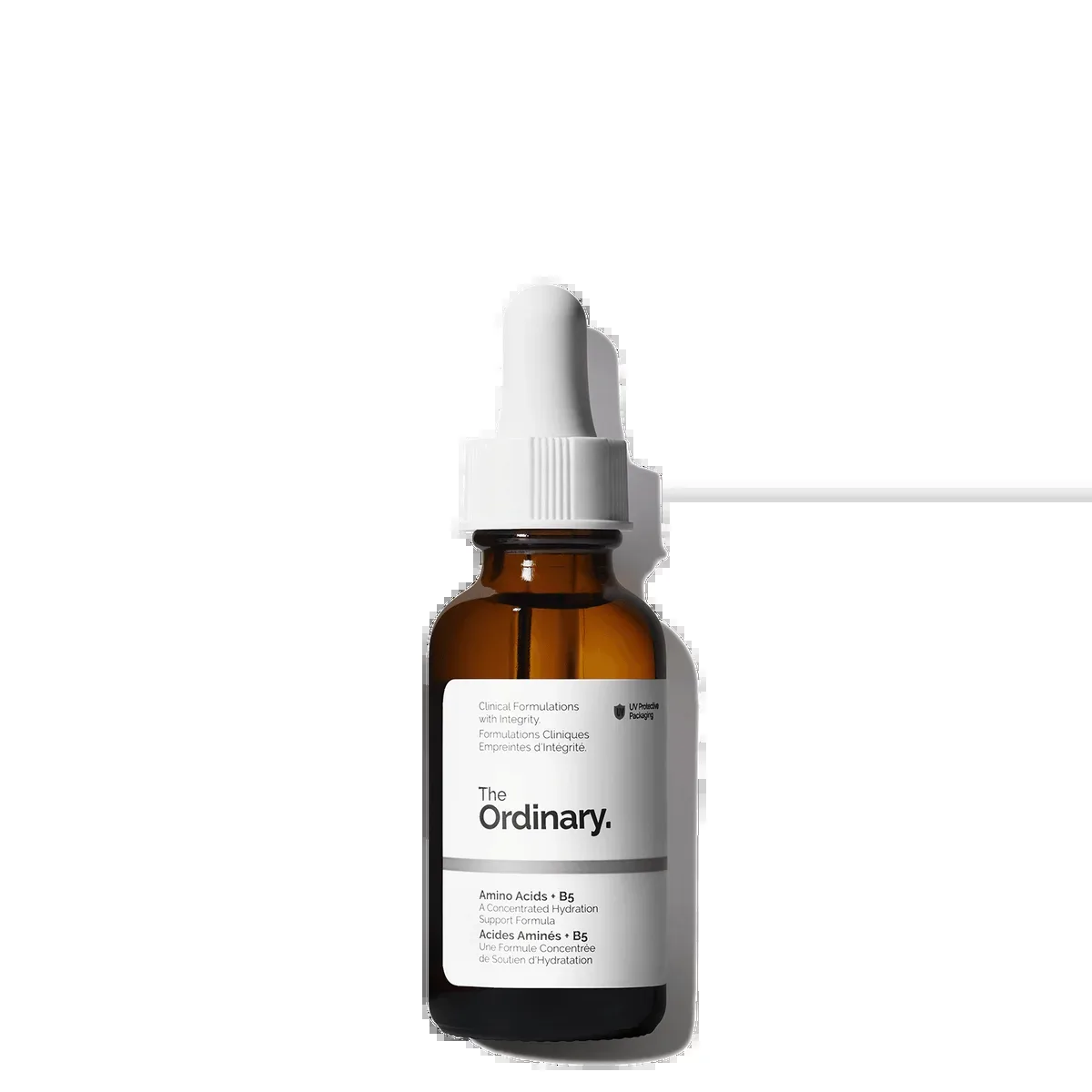
30 mL glass dropper bottle with standard The Ordinary minimalist white label. Recyclable materials.
Finish
lightweightnon-greasynatural
What to Expect on First Use
Immediate hydration and a noticeable plumping effect on first application. No tingling, burning, or adjustment period for most users. A mild tingling sensation may occur in some — this is noted on the product label and is attributed to the citric acid pH adjuster. Results are subtle but cumulative.
How Long It Lasts
2-3 months applied morning and evening full-face application (3-4 drops per use)
The skin's natural moisturizing factor — a complex of amino acids, PCA, lactate, urea, and other humectants — is responsible for keeping the stratum corneum hydrated and functional. NMF levels decline with age and are depleted by surfactants, low humidity, and UV exposure. The Ordinary designed this serum to replenish those losses directly, using a multi-amino-acid profile that mirrors the skin's own NMF composition rather than substituting a single synthetic humectant.
About The Ordinary Established Brand (5–20 years)
The Ordinary launched in 2016 under DECIEM and rapidly became one of the most recognized clinical skincare brands globally. Its ingredient-first, transparency-driven approach is backed by formulation science, though the brand does not conduct proprietary clinical trials on most products.
Brand founded: 2016 · Product launched: 2018
Myth vs. Reality
Common Myths
Myth
Amino acids in skincare are just a marketing gimmick — they can't actually hydrate skin.
Reality
Amino acids constitute approximately 40% of the skin's natural moisturizing factor and are directly responsible for water retention in the stratum corneum. A 2024 study found that six key NMF amino acids peak at age 25-29 then decline, and topical replenishment improved skin hydration, texture, and dullness over 8 weeks.
Myth
This serum is basically just a watered-down version of a regular moisturizer.
Reality
This product works through a fundamentally different mechanism than occlusive moisturizers. It replenishes the hygroscopic (water-attracting) molecules within the stratum corneum itself, while moisturizers primarily work by trapping moisture on the skin's surface. The two approaches are complementary, not redundant.
FAQ
Frequently Asked Questions
What does The Ordinary Amino Acids + B5 do for skin?
This serum replenishes the skin's natural moisturizing factor (NMF) — the cocktail of amino acids and humectants within the stratum corneum responsible for water retention. With 17% amino acids mirroring the skin's own NMF profile and 5% panthenol for barrier repair, it strengthens the skin's ability to hold moisture from within rather than just coating the surface.
Can I use The Ordinary Amino Acids + B5 with retinol?
Yes — this is one of its best uses. Applied before retinol or retinoid treatments, it acts as a hydration buffer that reduces the dryness, flaking, and irritation that retinoids commonly cause. The amino acids and panthenol support barrier function without interfering with retinoid activity.
Is The Ordinary Amino Acids + B5 the same as hyaluronic acid?
No. While both are hydrating serums, they work through different mechanisms. Hyaluronic acid is a single humectant molecule that draws water to the skin's surface. This serum contains twelve amino acids and multiple NMF components that integrate into the stratum corneum's own moisture-retention system. The two products are complementary and can be used together.
When should I apply The Ordinary Amino Acids + B5 in my routine?
Apply after cleansing and any water-based active serums (vitamin C, niacinamide, alpha arbutin), but before heavier serums, moisturizers, and oils. It works as a hydration layer that preps the skin for subsequent products. Use 3-4 drops and allow 15-30 seconds to absorb before the next step.
Is The Ordinary Amino Acids + B5 safe during pregnancy?
Yes. This serum contains amino acids and panthenol — both are naturally occurring in the body and have no known risks during pregnancy or breastfeeding. It appears on multiple pregnancy-safe skincare guides. Always confirm with your healthcare provider for individual guidance.
Why does The Ordinary Amino Acids + B5 feel sticky?
A slight tackiness can occur if too much product is applied. Use only 3-4 drops for the full face and allow 15-30 seconds for absorption before layering the next product. The amino acids and humectants create a hydration film that should become imperceptible once a moisturizer or sunscreen is applied on top.
Is The Ordinary Amino Acids + B5 fungal acne safe?
No. Some amino acids in this formula — particularly arginine — may be metabolized by Malassezia yeast in the presence of lipids, potentially exacerbating fungal acne. Those prone to Malassezia folliculitis should choose a different hydrating serum.
Reviews
What Reviewers Tend to Say
Recurring themes our editors read across retailer reviews of this product — summaries in our words, not quotations, and not a substitute for your own patch test.
Common Praise
Super hydrating — skin feels plump and moisturized immediately
Extremely lightweight formula that feels like water on skin
No conflicts with any other products — layers into any routine
Excellent buffer when used alongside retinoids or exfoliating acids
Great value at under $10 for a biomimetic hydrating serum
Suitable for even very sensitive and reactive skin types
Common Complaints
Can feel sticky or tacky if more than 2-3 drops are applied
Occasional pilling under makeup if too much product is used
Subtle results — some users feel it doesn't do anything noticeable
Small 30 mL bottle runs out quickly with twice-daily full-face use
The brand solved pricing and created a different problem: fifty-odd single actives presented without hierarchy. The missing piece was never the products — it's the editorial judgement the brand deliberately declines to supply.
The internet's favorite hydrator has a counterintuitive dark side — in dry air, a humectant with nothing to seal it can pull water out of your skin instead of into it.
Western sensitive skincare works by subtraction — remove the fragrance, remove the alcohol, shorten the list. Japan's answer adds a designed molecule back in, and one of the two bets has a trial literature.
Aug 28, 2026· 9 min
Questions people ask about sensitive skin
Verified answers from our questions library — the nuance a product page cannot carry.
Products, answers, therapy guides, tools and articles in one search. Brand names,
slang and abbreviations all work — accutane finds isotretinoin, bacne finds truncal acne.