
Hyaluronic Acid Can Actually Dehydrate Your Skin (Here's When)
The internet's favorite hydrator has a counterintuitive dark side — in dry air, a humectant with nothing to seal it can pull water out of your skin instead of into it.
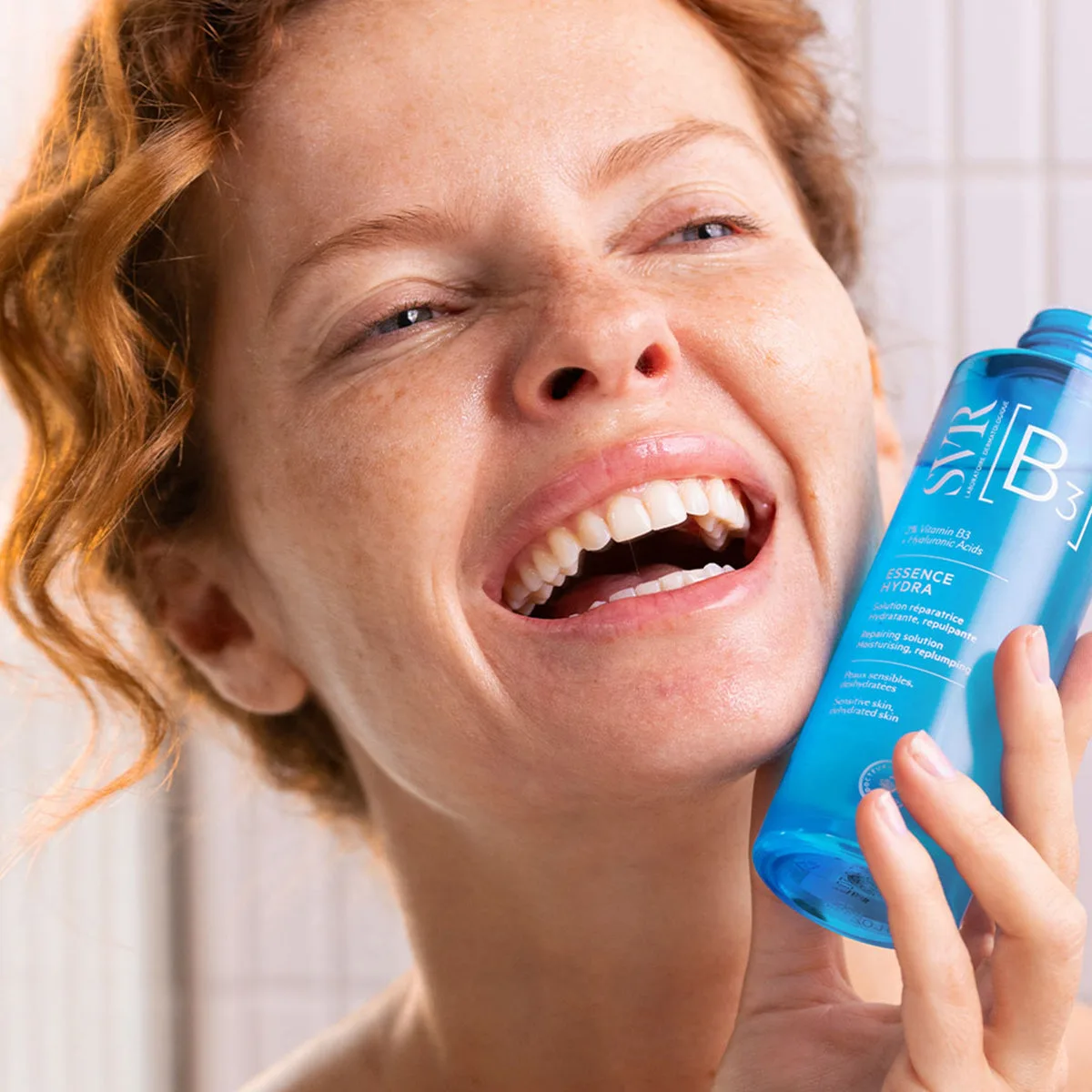
Most niacinamide hydrating essences pack their INCI with 20 to 30 ingredients to deliver multiple actives at once. This one strips back to 15 ingredients and focuses on doing two things well — barrier support with 2% niacinamide and plumping hydration with two molecular weights of hyaluronate, plus three humectant polyols and a single saccharide. The discipline of the short ingredient list is the formulation argument: fewer touchpoints for sensitive skin to react against, while still delivering the hydration claim with credible chemistry.
A disciplined 15-ingredient essence that does two things — barrier support with 2% niacinamide and plumping hydration with two molecular weights of hyaluronate — and does both well. Fragrance-free, alcohol-free, propylene-glycol-cautious, and at $32 for 150ml the value lands honestly. One of the better minimalist French pharmacy essences on the market.
The case for it
Same rule for everyone. “Good choice” is the verdict on 9,564 of 45,024 concern verdicts across the catalog; rule R5 decided 9,072 of them. Unchanged since September 5, 2026, engine 5.1.1.
Brand or formulator? Disclose a concentration or correct a fact →
The studies behind the evidence row
The case for it
Same rule for everyone. “Good choice” is the verdict on 9,564 of 45,024 concern verdicts across the catalog; rule R5 decided 9,072 of them. Unchanged since September 5, 2026, engine 5.1.1.
Brand or formulator? Disclose a concentration or correct a fact →
The studies behind the evidence row
The case for it
What would change this: A researched evidence row for the lead active would replace this with a verdict.
Same rule for everyone. “Good choice” is the verdict on 1,938 of 45,024 concern verdicts across the catalog; rule F2 decided 1,938 of them. Unchanged since September 5, 2026, engine 5.1.1.
Brand or formulator? Disclose a concentration or correct a fact →
The case for it
Same rule for everyone. “Good choice” is the verdict on 9,564 of 45,024 concern verdicts across the catalog; rule R5 decided 9,072 of them. Unchanged since September 5, 2026, engine 5.1.1.
Brand or formulator? Disclose a concentration or correct a fact →
The studies behind the evidence row
Does the jobDoes what a toner is for: not alcohol-driven, adds something real. Not measured from the label: restores skin pH, plays well with what follows.
A verdict is DermApproved’s assessment of how well a product’s ingredients fit a concern — never a claim about what the product treats. Evidence dots and collected reviews sit beside it and are never blended in. Rules 0.5.1 · evidence table ev-2026.09-r228 · how we decide
Pick up any trending hydrating essence in the K-beauty or French pharmacy aisle and the back-of-bottle INCI typically runs 25 to 40 ingredients deep. Multiple humectants, multiple actives, plant extracts for marketing, fermented something-or-other for buzz, a fragrance house's signature blend on top. SVR's B3 Hydra Essence runs in the opposite direction. The full INCI list is fifteen ingredients. No fragrance, no alcohol, no botanical extracts, no fermented anything. The headline actives are 2% niacinamide and two molecular weights of hyaluronate, supported by three humectant polyols, a single plant-derived saccharide, and a brief preservative system. The discipline is the formulation argument.
The chemistry holds up to closer inspection. That 2% niacinamide loading is deliberately conservative — the dose-floor at which niacinamide measurably supports barrier function and reduces transepidermal water loss, without the flushing reaction that 5 to 10% concentrations occasionally provoke in reactive skin. There's a persistent belief that 2% is a token amount, a number chosen so the word can appear on the front of the bottle. It isn't. The dose-response curve for barrier-related endpoints flattens above roughly 4%, which means the higher percentages buy marketing copy rather than measurable benefit, while adding a reactivity risk to precisely the skin least able to absorb it.
The dual-weight hyaluronate is the more interesting choice. Higher molecular weight sodium hyaluronate stays on the skin surface, forming a moisture-retaining film that reduces water loss and produces the immediate visible plumping. Medium molecular weight penetrates the upper epidermis to hydrate from slightly below. The combination gives a broader hydration profile than any single-weight HA formula and makes the brand's 24-hour claim something more than optimism.
Glycerin and diglycerin together provide the polyol humectant backbone — diglycerin being the slightly less-common choice that distributes hydration more evenly than glycerin alone. Saccharide isomerate is the genuinely interesting back-of-INCI ingredient: a plant-derived carbohydrate that mimics components of the skin's natural moisturizing factor and integrates more durably than synthetic humectants, particularly in dry ambient air. Sodium lactate, another NMF component, sits beside it. The overall effect is hydration that builds across hours rather than peaking in the first ten minutes and fading.
Texture is watery with a slight viscosity bump from the xanthan gum, sitting between a thin toner and a thicker serum. It absorbs in roughly thirty seconds with no tacky finish, no slip, no fragrance. The scentlessness is the right answer for sensitive skin and a real differentiator from competitors that load even their 'fragrance-free' essences with botanical aromas. Skin feels immediately plumper and slightly cooler; the visible plumping holds for about half an hour before settling into the absorbed-in look.
Apply it on damp skin, straight after cleansing. Two or three drops into a palm, fingertips in, pressed onto the cheeks and outward — patted rather than swiped, and certainly not dragged across the face on a cotton pad, which wastes half the bottle and abrades the barrier you're trying to support. Thirty seconds, then everything else on top. It buffers a retinoid, sits happily under vitamin C, and picks no fights with anything. That buffering role is the one clinicians actually reach for it: a niacinamide-and-HA layer between the cleanser and the active is one of the more reliable ways to make a prescription retinoid tolerable.
What holds it back is mostly mechanical. The bottle opening pours too generously, and most users end up either decanting into a dropper bottle or learning to tip slowly. The watery texture takes practice to apply without a rivulet down the neck. Propylene glycol sits second on the list, which concerns a small subset of users with documented sensitivity, though genuine allergic response at cosmetic concentrations is rare. And the effects are subtle. This is barrier-supportive infrastructure, not a transformational treatment. If you want brightening, anti-aging, or active correction from this step, you have bought the wrong bottle — and no amount of consistency will change that, because there is nothing in it that does those jobs.
Which is worth stating plainly, because 'essence' has become a suspicious word in some quarters, shorthand for a toner with a markup. The category does contain plenty of those. This one earns the designation honestly: 2% niacinamide and dual-weight hyaluronate is more active load than any toner carries, and less than a serum, which is exactly where an essence is supposed to sit.
Value-wise, $32 for 150ml is genuinely good for a French pharmacy essence. At twice-daily use the bottle lasts eight to ten weeks, putting the monthly cost near thirteen dollars. The 25% recycled, fully recyclable bottle is a meaningful detail. For sensitive, dehydrated, or post-procedure skin that needs a daily barrier-support layer beneath the rest of the routine — and for anyone with several documented sensitivities, where a fifteen-line INCI makes patch-testing tractable — this is one of the more thoughtful options on the European pharmacy market, from a house that has been formulating for pharmacists since 1962. The minimalism is the point; whether that fits your skin and your routine is the real question.
The hero actives that drive this product's performance.
| Ingredient | Function | Evidence |
|---|---|---|
| Niacinamide (2%) (2%) | Sits at a conservative but functional 2% — the dose-floor at which niacinamide measurably supports the skin barrier and reduces transepidermal water loss without the rare flushing reaction that higher concentrations occasionally produce in reactive skin. The choice signals a deliberate sensitive-skin formulation rather than a marketing concentration; the goal here is daily tolerability across the most reactive skin types, not the maximal-dose claim some niacinamide products chase. | Established mechanism for Compromised Skin Barrier · established mechanism |
| Sodium Hyaluronate (Medium + High Molecular Weight) | Two molecular weights of hyaluronate working at different skin depths — the higher-weight fraction forms a moisture-retaining film at the surface, the medium-weight fraction penetrates the upper epidermis to plump from underneath. The dual-weight approach is what gives the essence its immediate plumping effect along with the longer-acting hydration claim. | Established mechanism for Dehydration · established mechanism |
| Glycerin + Diglycerin | The polyol humectant pair driving the essence's water-binding work. Diglycerin specifically — chosen here over the more common glycerin-only approach — has been shown to offer slightly improved skin feel and more even hydration distribution across the stratum corneum. The pairing is the essence's hydration spine, with the hyaluronic acids contributing the surface-level plumping. | Established mechanism for Dehydration · established mechanism |
| Saccharide Isomerate | A plant-derived carbohydrate that binds to the natural moisturizing factor in the skin and provides a longer-lasting humectant effect than glycerin alone. The molecule mimics components of the skin's own NMF complex, which is why it integrates more durably than synthetic humectants — partly responsible for the essence's 24-hour hydration claim being more than marketing. | Not yet assessed |
Ingredient standings describe the active at treatment-level doses and vehicles; this product's own condition grades weigh its actual formula.
Aqua/Water/Eau, Propylene Glycol, Glycerin, Diglycerin, Isopentyldiol, Niacinamide, Saccharide Isomerate, Sodium Hyaluronate, 1,2-Hexanediol, Caprylyl Glycol, Citric Acid, Pentylene Glycol, Sodium Citrate, Sodium Lactate, Xanthan Gum
toner
AM & PM
Apply after cleansing on damp skin — the wet application improves the hydration absorption. Pat 2 to 3 drops into the face with your palms rather than swiping with a cotton pad, which wastes the formula and is rougher on the barrier. Layer serum, treatment, and moisturizer on top in your usual order. The essence can also be applied throughout the day as a quick hydration boost on flight days or in dry indoor environments.
Immediate plumping and soothed-skin sensation on first application from the dual-weight hyaluronate; visibly more supple skin texture within 1 week; barrier strengthening and reduced reactive flushing at 4 weeks of twice-daily use; sustained smoothness and fine-line buffering by week 8 to 12.
The hydration case for this essence rests on three converging mechanisms with strong dermatologic backing. Niacinamide at concentrations of 2 to 5 percent has been shown across multiple controlled trials to improve transepidermal water loss measurements, increase ceramide synthesis in the stratum corneum, and reduce barrier reactivity in sensitive-skin populations. The dose-response curve flattens above 4 percent for these barrier-related endpoints, which is why the 2 percent loading here represents an intentional sensitive-skin choice rather than under-dosing. Sodium hyaluronate's humectant mechanism is among the best-characterized in cosmetic chemistry — the molecule binds approximately 1000 times its weight in water and contributes both surface-level moisture retention and modest barrier-supportive effects. The dual molecular-weight approach exploits the fact that hyaluronate fractions of different sizes distribute differently in skin: higher molecular weight (typically above 1000 kDa) remains primarily at the surface, forming a moisture-binding film, while medium molecular weight (around 50 to 500 kDa) penetrates into the upper epidermis. Combining the two delivers broader hydration profile than either fraction alone. Saccharide isomerate is a more recent addition to the cosmetic humectant landscape, derived from plant-sourced glucose and characterized as a natural moisturizing factor mimetic. Comparative studies have shown saccharide isomerate to provide longer-duration hydration than glycerin alone, particularly in low-humidity ambient conditions. The polyol backbone of glycerin, diglycerin, and pentylene glycol contributes the foundational humectancy that the niacinamide, hyaluronate, and saccharide build on top of. The fragrance-free, alcohol-free formulation removes the two most common cosmetic-reactivity triggers, which is what enables the essence's post-procedure and sensitive-skin positioning.
Barrier-supportive hydrating essences occupy a useful role in modern dermatologic practice as a buffering step between cleansing and active treatments. Patients on prescription retinoids, benzoyl peroxide, hydroquinone, or chemical peel regimens consistently report better tolerability when a niacinamide-and-hyaluronic-acid hydrator sits between the cleansing step and the active application. This essence's 2% niacinamide loading is well-matched to that role — substantial enough to deliver measurable barrier support, not so concentrated that it adds reactivity to an already-active routine. The fragrance-free, alcohol-free formulation makes it appropriate for post-procedure use following microneedling, mild chemical peels, or laser treatments, where added fragrance is typically the first cosmetic-reactivity flag clinicians warn patients to avoid. Dermatologists treating compromised-barrier patients often recommend layering a niacinamide essence under a ceramide-rich moisturizer as the foundation routine; this product fits cleanly into that protocol. The minimal-ingredient list also makes patch-testing manageable in patients with multiple documented sensitivities.
Apply after cleansing while the skin is still slightly damp — the wet application boosts the hydration absorption. Pour 2 to 3 drops into the palm of one hand, dip the fingertips of your other hand into the pool, and press the essence onto the face starting at the cheeks and moving outward. Pat rather than rub. Wait 30 seconds for full absorption before layering your serum, treatment, and moisturizer in your usual order. The essence can be reapplied at any point during the day as a quick hydration refresh — particularly useful on long flights, in dry indoor environments, or as a midday pick-me-up under makeup with a fine-mist applicator.
$32 for 150ml positions this essence in the middle of the French pharmacy hydration category — competitive with Avène Eau Thermale and La Roche-Posay Hyalu B5 serum at comparable price points, though those products serve slightly different roles. At twice-daily use, expect 8 to 10 weeks per bottle, putting monthly cost at roughly $13 — fair for a daily barrier-supportive step from a pharmacist-formulated brand. The fragrance-free, minimal-INCI formulation is the differentiator that justifies the price tier; comparable products with longer ingredient lists at lower price points exist, but few match the discipline of the 15-ingredient formulation here. The 25% recycled bottle is a meaningful sustainability detail. For users on prescription regimens, post-procedure protocols, or with documented multiple-ingredient sensitivities, the formulation discipline is genuine value-add beyond the per-milliliter price.
Anyone with sensitive, dehydrated, or post-procedure skin wanting a minimalist barrier-supportive hydrator with no fragrance and no active gimmicks. The formulation particularly suits users on prescription retinoid, benzoyl peroxide, or hydroquinone protocols who need a calming buffer step between cleansing and their actives.
Skip if you're specifically looking for an essence with brightening, anti-aging, or active correction work built in — the formulation here is barrier hydration only, and a Beauty of Joseon Glow Replenishing Essence or COSRX Snail Mucin 96 essence delivers the multi-active job better. Users with documented propylene glycol sensitivity should also choose an alternative. Anyone uninterested in adding an essence step to their routine doesn't need to start now; this is an addition to a multi-step routine rather than a standalone solution.
Ready to try SVR B3 Hydra Essence?
Buy at Amazon ♥Watery liquid essence with a slight viscosity bump from the xanthan gum. Sits between a thin toner and a thicker serum; absorbs in roughly 30 seconds with no tacky finish.
Genuinely scentless — no fragrance, no perfume, no botanical aroma. The essence smells like nothing, which is the right answer for sensitive skin.
150ml white bottle in 25% recycled, 100% recyclable plastic with a screw-on cap. The pour opening is wider than ideal — most users transfer to a smaller dropper bottle or learn to pour slowly.
First application feels immediately cooling and plumping — the dual-weight hyaluronate creates a visible smoothing within 5 minutes. Expect no stinging, no tingling, no fragrance. Skin looks slightly dewier for the first 30 minutes; this fades into the absorbed-in look as the essence sets. No purging or breakout phase since the formula contains zero active exfoliants.
Roughly 8-10 weeks applied morning and evening face application — the 150ml size is generous for an essence and stretches further than the volume suggests.
All Year
SVR launched the B3 line around 2020 as a pivot toward minimal-ingredient formulations for sensitized and post-procedure skin — a category that French pharmacies had increasingly been asked about as more patients underwent retinoid prescriptions, chemical peels, and laser treatments. The essence was positioned as the foundation step for the line, anchoring barrier support with the brand's signature pharmacist-driven formulation discipline.
Laboratoire SVR was founded in 1962 in Ault, France by pharmacists Simone and Robert Véret. The brand's B3 line was developed around minimal-ingredient sensitive-skin formulations and represents the brand's pivot toward shorter INCI lists for reactive skin, building on six decades of pharmacy-channel reformulation experience.
Essences are just expensive toners with marketing on top.
Essences in the original Korean and increasingly French definitions are watery treatment products positioned between toner and serum — typically more concentrated in actives than a toner, less concentrated than a serum. This one earns the essence designation honestly with 2% niacinamide and dual-weight hyaluronate, both above what a standard toner would carry.
Niacinamide at 2% is too low to do anything meaningful.
Multiple controlled trials have shown 2% niacinamide to measurably improve transepidermal water loss, ceramide synthesis, and barrier function. The higher 5 to 10 percent concentrations get more marketing attention, but the dose-response curve for niacinamide flattens substantially above 4 percent for most barrier-related endpoints. 2% is the sensitive-skin-appropriate working dose.
It's an essence — a category between the two. Toners are typically thin liquids designed for prep work after cleansing. Serums are concentrated active treatments. Essences sit in the middle: watery enough to apply broadly across the face, concentrated enough to deliver meaningful active doses. Use it after cleansing and before your serums; it doesn't replace either step.
2% sits at the dose-floor where niacinamide measurably supports the skin barrier without the flushing reaction that higher concentrations occasionally trigger in reactive skin. The dose-response curve for niacinamide flattens above 4%, so jumping to 5 or 10% delivers diminishing returns while increasing tolerability risk. The 2% choice here is deliberate sensitive-skin formulation, not a cost-cutting move.
High molecular weight hyaluronate stays on the skin surface, forming a moisture-retaining film that reduces water loss and gives the immediate plumping effect. Medium molecular weight penetrates the upper epidermis to hydrate from slightly below the surface. The combination plumps the skin visibly at the surface while building moisture reserves underneath — broader effect than single-weight HA formulas deliver.
Yes — the essence is designed to layer underneath active serums and actively benefits routines with retinoids or vitamin C. The 2% niacinamide and dual-weight hyaluronate buffer the irritation those actives can cause and support the barrier they tend to deplete. Apply the essence on damp skin first, wait 30 seconds for absorption, then layer your vitamin C or retinol on top.
Propylene glycol is a common humectant and solvent in cosmetic formulations, generally well-tolerated and recognized as safe by regulatory bodies. A small subset of users with documented sensitivity may react, but allergic responses are rare at the concentrations used in this essence. For users avoiding propylene glycol specifically, an alternative niacinamide essence without it would be the right choice.
Yes — the formula contains no retinoids, salicylic acid, hydroquinone, or other ingredients on standard pregnancy-avoidance lists. Niacinamide is widely recommended as a safe alternative to vitamin A derivatives during pregnancy, and the hyaluronate and glycerin are also pregnancy-compatible. The fragrance-free formulation reduces the only common pregnancy-skin-care reactivity flag.
Both are hydrating essences in the fragrance-free K-beauty-style category, but with different active stacks. Beauty of Joseon leans on rice ferment and alpha-arbutin for brightening alongside hydration. SVR focuses purely on barrier support and hydration with 2% niacinamide and dual-weight hyaluronic acid. For dehydrated sensitive skin without pigment goals, SVR is the simpler match. For users wanting brightening built into the essence step, Beauty of Joseon is the better fit.
Recurring themes our editors read across retailer reviews of this product — summaries in our words, not quotations, and not a substitute for your own patch test.
Genuinely plumps skin immediately without stinging
Fragrance-free formulation works for reactive skin
Generous 150ml size justifies the price
Layers cleanly under any active serum
Watery texture takes practice to apply without dripping
Bottle opening dispenses too much per pour
Propylene glycol concerning to a small subset of users
Effect is subtle — not an overnight transformation
Verified answers from our questions library — the nuance a product page cannot carry.