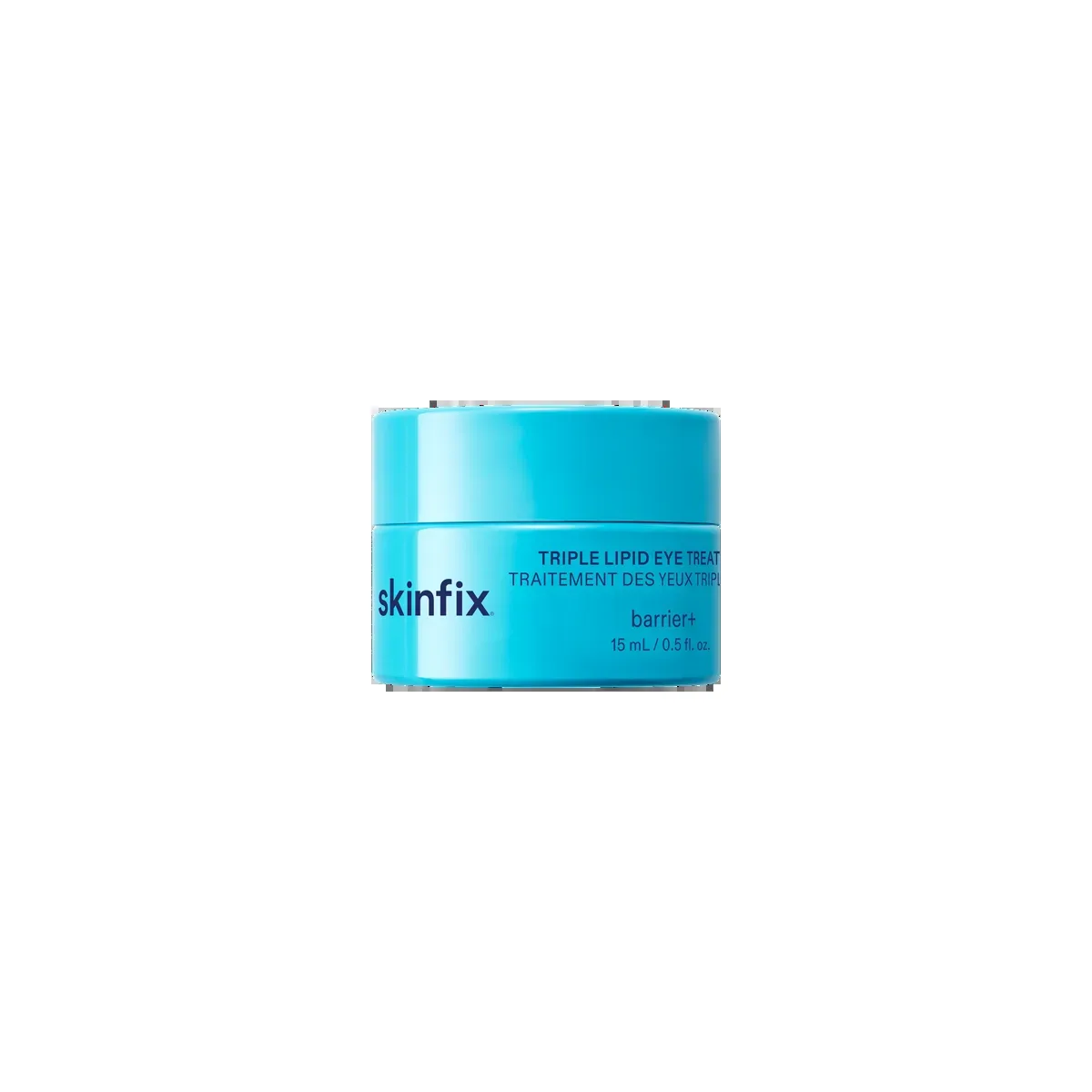
Most eye creams focus exclusively on either anti-aging peptides or depuffing caffeine. This formula is built around a genuine barrier repair system — three ceramides, cholesterol, phytosphingosine, and phytosterols in a physiologically relevant ratio — that addresses the root cause of why undereye skin looks worse with age: the barrier thins and loses lipid integrity. The peptides and caffeine are layered on top of that structural foundation.
A genuinely thoughtful eye cream that treats the undereye area like the structurally distinct skin it actually is. The triple ceramide-cholesterol-phytosterol foundation addresses the root cause of undereye aging — barrier thinning — while caffeine and peptides handle the visible symptoms. Worth the premium for anyone serious about the long game around their eyes.
Note: This formulation has been on market since 2023 and our assessment draws on moderate user feedback and a small clinical study of 35 subjects. Scoring reflects both ingredient analysis and available real-world data. We'll revisit this review as the product accumulates a larger body of independent reviews.
Verdicts
How well it fits each concern
Verdict by concern tap a concern for the case
Supporting rolefor Dark CirclesIn your profileYou chose · Nothing here targets dark circles directly; hydration of the periorbital area is the recognised companion to treating it, and this cream does that without known triggers.Moderate evidenceGentleNo reviews collected yet
The case for it
Niacinamide has early or mechanistic evidence for this concern, not trial-backed standing.
It is present below the studied range.
The formula carries none of the triggers this concern is sensitive to.
What would change this: A concentration inside the studied range would raise this a step.
Same rule for everyone. “Supporting role” is the verdict on 8,197 of 45,024 concern verdicts across the catalog; rule R8 decided 4,250 of them.
Unchanged since September 5, 2026, engine 5.1.1.
R8 — The category's job (barrier care, humectant hydration, gentle cleansing, photoprotection) is the documented supportive role for this concern. This is the honest verdict for a moisturizer on an acne page. · the full register
Carrying active
Niacinamide
Standing
plausible — trials support it
Form
sub threshold (declared 2%) — studied range 5%, from the OTC monograph or label; needs leave-on contact; judge it after ~8 weeks
Tolerability
gentle
Row checked
against its sources on July 17, 2026 (evidence table ev-2026.09-r228)
Promisingfor AgingIn your profileYou chose · Growth Factors (EGF) has trial-level evidence for aging but no guideline or regulatory standing yet — promising, short of a recommendation; the other actives here are not yet assessed for it.Moderate evidenceStandard tolerabilityNo reviews collected yet
The case for it
Growth Factor Peptide Complex has trial-level evidence for this concern but no guideline or regulatory standing yet.
It is present at an effective concentration, declared or high in the ingredient list.
The formula carries no trigger this concern is sensitive to, with the cautions noted.
Cautions: a photosensitising active — use sun protection.
What would change this: Guideline or regulatory standing for the active on this concern would move this from a promising bet to a recommendation.
Same rule for everyone. “Promising” is the verdict on 7,858 of 45,024 concern verdicts across the catalog; rule R9p decided 7,858 of them.
Unchanged since September 5, 2026, engine 5.1.1.
R9p — 0.5.0: 'Unproven' beside three filled dots read as one question answered twice with opposite words (7,018 rows). The chip measures standing, the dots measure trial volume; where the row carries at least one RCT or a tier-2 source (moderate dots) and the active is present at a working level, the honest word is Promising. Unproven is reserved for plausible-standing rows with limited or weak evidence, or an under-dosed form. Same rank as Unproven — a bet either way; the dots order them. · the full register
Carrying active
Growth Factor Peptide Complex
Standing
plausible — trials support it
Form
adequate (declared 1%)
Tolerability
standard — photosensitization
Row checked
against its sources on July 17, 2026 (evidence table ev-2026.09-r228)
Good choicefor DrynessIn your profileYou chose · Ceramides is a reference standard by mechanism for dryness; this cream carries it at 3%.Moderate evidenceGentleNo reviews collected yet
The case for it
Ceramides NP, AP, EOP has trial-supported standing for this concern.
It is present at an effective concentration, declared or high in the ingredient list.
The formula carries none of the triggers this concern is sensitive to.
Same rule for everyone. “Good choice” is the verdict on 9,564 of 45,024 concern verdicts across the catalog; rule R5 decided 9,072 of them.
Unchanged since September 5, 2026, engine 5.1.1.
R5 — Trial-supported or guideline-supported active, adequately or plausibly dosed. · the full register
Carrying active
Ceramides NP, AP, EOP
Standing
supported — its mechanism is established
Form
adequate (declared 3%)
Tolerability
gentle
Row checked
against its sources on July 17, 2026 (evidence table ev-2026.09-r228)
The studies behind the evidence row
Elias PM, Feingold KR (eds), Skin Barrier — stratum corneum ceramides are the principal intercellular lamellar lipid; their depletion is the biochemical signature of dry/xerotic skin — reference work
Good choicefor Compromised Skin BarrierIn your profileYou chose · Niacinamide is a reference standard by mechanism for compromised skin barrier; this cream carries it at 2%.Moderate evidenceGentleNo reviews collected yet
The case for it
Niacinamide has trial-supported standing for this concern.
It is present at an effective concentration, declared or high in the ingredient list.
The formula carries none of the triggers this concern is sensitive to.
Same rule for everyone. “Good choice” is the verdict on 9,564 of 45,024 concern verdicts across the catalog; rule R5 decided 9,072 of them.
Unchanged since September 5, 2026, engine 5.1.1.
Good choicefor SensitivityIn your profileYou chose · No fragrance, drying alcohol, declarable allergens or sensitising preservatives in this cream — the profile sensitive skin looks for.Not yet assessedGentleNo reviews collected yet
The case for it
Niacinamide has no evidence row yet for this concern — it is in the research queue.
The formula carries none of the triggers this concern is sensitive to.
What would change this: A researched evidence row for the lead active would replace this with a verdict.
Same rule for everyone. “Good choice” is the verdict on 1,938 of 45,024 concern verdicts across the catalog; rule F2 decided 1,938 of them.
Unchanged since September 5, 2026, engine 5.1.1.
Also listed for Dullness — the actives here (Niacinamide, Caffeine, Polyglutamic Acid, Cholesterol) are in our research queue for that concern; there is no verdict until their evidence rows are written. That is a gap in our table, not a mark against the product.
Does the jobDoes what a eye cream is for: safe for eye skin, targets a real eye concern. Not measured from the label: hydrates without heaviness, stays where it's put.
Where our review and the verdict differ. The review below was written on the formulation and the published trials; the verdicts above apply the stricter standing test in our methodology — an active earns a recommendation only with guideline or regulatory standing for the concern. Where the two disagree, the verdict is DermApproved’s position.
A verdict is DermApproved’s assessment of how well a product’s ingredients fit a concern — never a claim about what the product treats. Evidence dots and collected reviews sit beside it and are never blended in.
Rules 0.5.1 · evidence table ev-2026.09-r228 · how we decide
Assessment
Pros & Cons
Pros
✓ Genuine triple ceramide complex with cholesterol and phytosphingosine mimics skin's natural lipid ratio
✓ Visible depuffing within 10-15 minutes from well-dosed caffeine at 0.5%
✓ Doubles as an effective concealer primer with a smooth satin finish
✓ Fragrance-free, ophthalmologist-tested, and gentle enough for reactive eyes and contact lens wearers
✓ Five-peptide complex provides multi-pathway collagen and elastin signaling for long-term firmness
✓ Niacinamide at 2% brightens dark circles without risking periorbital irritation
✗ Jar packaging exposes ceramides and peptides to air degradation with each opening
✗ Premium $54 price for 0.5 oz may deter those uncertain about eye cream efficacy
✗ Gel-cream texture may feel insufficiently rich for severely dry undereye skin
✗ Peptide concentrations are modest — each of the five peptides is present at a fraction of 1%
✗ Small 35-subject clinical study limits the strength of efficacy claims
✗ Niacinamide at 2% works gradually — dark circle improvement requires patience
Review
Full Review
There is a particular cruelty in the fact that the skin around your eyes — the part of your face everyone looks at first — is also the thinnest, driest, and most structurally vulnerable skin on your entire body. It has fewer sebaceous glands, less collagen, and a barrier that degrades faster than anywhere else. Most eye creams respond to this reality by throwing peptides and retinol at fine lines, or caffeine at puffiness, without asking a more fundamental question: what if the barrier itself is the problem?
Skinfix asked that question. The Barrier+ Triple Lipid Brightening Eye Cream is built on the same philosophy that made the brand's face cream a cult favorite among dermatologists and barrier-repair obsessives — the idea that healthy skin starts with an intact lipid matrix. The formula delivers three ceramide types (NP, AP, and EOP), cholesterol, phytosterols, and phytosphingosine in a ratio that mirrors the skin's natural intercellular cement. This isn't decorative. These lipids slot into the gaps between corneocytes like mortar between bricks, physically reconstructing the barrier that time and environmental damage have been slowly dismantling.
What makes this formula interesting is what sits on top of that lipid foundation. A five-peptide complex — including the copper peptide analog Tripeptide-1 and the cellular-renewal signal Hexapeptide-11 — works the collagen and elastin angle. Niacinamide at 2% addresses the melanin transfer that darkens periorbital skin. Caffeine at 0.5% constricts the blood vessels responsible for morning puffiness. And polyglutamic acid forms a moisture-locking film that smooths crepey texture from the outside. Each ingredient has a clear job, and none of them are redundant.
The texture lands in an appealing middle ground. It is a gel-cream that feels bouncy and cool when you dot it around the orbital bone — not heavy enough to migrate into your eyes overnight, not so thin that it feels like you have applied nothing. It absorbs within about 30 seconds and leaves a satin finish that genuinely works as a concealer primer. In clinical testing on 35 subjects, 94% confirmed it prepped their undereyes for makeup. That is a small study, but the primer effect is one of those things you can verify yourself on the first morning.
The depuffing is the most immediately gratifying result. Caffeine is not a mystery ingredient — it constricts blood vessels and reduces fluid accumulation — but the speed here is notable. Within 10 to 15 minutes of application, there is a visible tightening effect, particularly if you apply it straight out of the fridge. Whether that short-term vasoconstriction translates to lasting change is the real question. Skinfix's clinical data says 97% of subjects saw sustained puffiness reduction averaging 31% after four weeks, which suggests the anti-inflammatory properties of the ceramide complex and the structural peptides are doing longer-term work beyond what caffeine alone delivers.
Brightening is subtler and slower. Niacinamide at 2% is a conservative concentration — effective enough for the sensitive periorbital area, but not the kind of dose that transforms dark circles in a week. Expect gradual improvement starting around the two to three week mark, with the most noticeable change coming from the barrier repair making the skin less translucent rather than the niacinamide directly bleaching pigment. If your dark circles are primarily vascular (bluish) rather than pigmented (brownish), the caffeine will actually do more for you here than the niacinamide.
The peptide complex represents a long-term investment. Five biomimetic growth factors sounds impressive on a label, and the inclusion of Tripeptide-1 (a well-studied collagen signal) lends some credibility. But peptide research in cosmeceuticals remains in the promising-but-not-conclusive category, and the 1% total concentration means each individual peptide is present at a fraction of a percent. These are not going to replace professional treatments for established crow's feet. They are, however, a reasonable addition to a formula that is already doing serious work with its lipid complex.
Skinfix has built a credible reputation as a brand that submits its products to independent dermatologist panels — not paid spokesderms, but unaffiliated physicians who evaluate formulations on merit. The Barrier+ line has earned Allure Best of Beauty recognition, and the brand's ophthalmologist testing for this eye cream provides an extra layer of confidence for contact lens wearers and those with reactive eyes. The fragrance-free, vegan, and silicone-free formulation reflects the clean-clinical ethos that defines the brand.
The honest limitation is the jar. At $54 for 0.5 ounces, this is a premium product, and exposing a ceramide-and-peptide formula to air and fingers with every use is not ideal for ingredient stability. An airless pump would better protect the actives that justify the price. The jar lasts roughly three to four months with disciplined twice-daily use, which brings the effective daily cost to around 45 cents — not unreasonable, but not pocket change for a product category where many people question whether eye creams work at all.
They do work when they are this well formulated. The Skinfix Barrier+ Triple Lipid Brightening Eye Cream is not a miracle product and it does not pretend to be one. It is a structurally intelligent formula that addresses the actual physiology of periorbital aging — barrier degradation, lipid loss, vascular congestion, and melanin accumulation — with ingredients that have evidence behind them. If you have been cycling through eye creams that provide temporary smoothing but never seem to change anything fundamentally, this barrier-first approach is worth the investment.
Formula
Key Ingredients
The hero actives that drive this product's performance.
Delivers three essential ceramide types alongside cholesterol and phytosterols to rebuild the exceptionally thin periorbital barrier. In this formula, the ceramides work in concert with phytosphingosine — a sphingoid base that fuels the skin's own ceramide synthesis — creating both an immediate lipid patch and a long-term barrier reinforcement loop.
Established mechanismfor Dryness · established mechanism
At 2%, niacinamide targets the melanin transfer that causes periorbital hyperpigmentation while supporting the ceramide complex's barrier-building work. The moderate concentration is deliberately chosen for the sensitive eye area — enough to brighten without risking the irritation that higher percentages can trigger around the eyes.
Established mechanismfor Compromised Skin Barrier · established mechanism
A five-peptide cocktail of biomimetic vegan growth factors designed to signal collagen and elastin production in the thin periorbital dermis. Tripeptide-1 (GHK) acts as a copper peptide analog to stimulate matrix repair, while Hexapeptide-11 supports cellular renewal — together addressing both the structural thinning and the laxity that make undereyes look tired.
Acts as a vasoconstrictor to reduce the fluid accumulation responsible for morning puffiness, while its phosphodiesterase-inhibiting properties help break down the lipid deposits that contribute to persistent undereye bags. Positioned high enough in the formula to work quickly, complementing the longer-term structural repairs from the peptides and ceramides.
A fermentation-derived humectant that holds up to five times more moisture than hyaluronic acid by weight, forming a hydrating film over the ceramide-reinforced barrier. In this formula, it works alongside sodium hyaluronate to provide both surface-level moisture retention and deeper hydration — smoothing crepey undereye texture from the outside in.
Completes the physiological lipid ratio alongside the three ceramides and phytosterols, mimicking the skin's natural intercellular cement. Without cholesterol, the ceramide complex would be structurally incomplete — this ingredient is what makes the Triple Lipid Complex function as a genuine barrier repair system rather than just a lipid-enriched moisturizer.
Not yet assessed
Ingredient standings describe the active at treatment-level doses and
vehicles; this product's own condition grades weigh its actual formula.
Apply after serums and before moisturizer. Pat gently around the orbital bone using your ring finger — never drag. In the AM, allow 60 seconds to absorb before applying concealer; the formula doubles as a smoothing primer base.
Results Timeline
Depuffing and smoother concealer application are noticeable from the first use. Visible brightening of dark circles emerges around weeks 2-3. Full barrier strengthening and reduction in fine lines typically develop over 4-8 weeks of consistent twice-daily use.
The foundation of this formula is the triple ceramide complex — Ceramides NP, AP, and EOP paired with cholesterol, phytosterols, and phytosphingosine. This combination intentionally mirrors the composition of the stratum corneum's intercellular lipid matrix. A landmark 2003 study by Chamlin et al. in the Journal of Investigative Dermatology demonstrated that topical application of ceramides, cholesterol, and free fatty acids in a physiological ratio (approximately 3:1:1) accelerated barrier repair significantly faster than any single lipid applied alone. The periorbital skin, with its reduced sebaceous gland density, is particularly vulnerable to lipid depletion, making this combination especially relevant for the eye area.
The caffeine component draws on well-established vasoconstriction and anti-inflammatory mechanisms. A 2015 study by Ahmadraji and Shatalebi published in the Journal of Research in Pharmacy Practice found that caffeine applied topically at concentrations as low as 0.5% significantly reduced periorbital puffiness through its phosphodiesterase-inhibiting properties. The mechanism is twofold: acute vasoconstriction reduces visible swelling, while sustained phosphodiesterase inhibition promotes lipolysis in the fat pads that contribute to chronic undereye puffiness.
A comprehensive 2024 review by Kelekci et al. published in the International Journal of Women's Dermatology (PMC11175953) examined the efficacy of popular eye cream ingredients including peptides, ceramides, caffeine, and niacinamide. The review concluded that while individual ingredients show promise, multi-ingredient formulations targeting multiple periorbital concerns simultaneously — barrier repair, brightening, depuffing, and collagen stimulation — represent the most evidence-supported approach. Notably, the combination of caffeine and peptides showed the highest efficacy rate (87.5%) for addressing puffiness in the studies reviewed.
Niacinamide's brightening mechanism operates through inhibition of melanosome transfer from melanocytes to keratinocytes, rather than suppressing melanin production directly. At 2%, the concentration is conservative but supported by clinical data showing periorbital brightening over 4-8 weeks without the irritation risk that higher concentrations can provoke in this sensitive area.
References
Barrier repair with physiological lipids in ceramide-deficient skin — Journal of Investigative Dermatology (2003)
Anti-puffiness and anti-dark circle effect of caffeine in topical formulations — Journal of Research in Pharmacy Practice (2015)
Dermatologists frequently recommend the Skinfix Barrier+ line for patients with compromised skin barriers and reactive skin. Working dermatologists frequently note that the triple ceramide approach — delivering NP, AP, and EOP alongside cholesterol and phytosphingosine — reflects the evidence-based lipid replacement therapy used in clinical settings for barrier disorders. For the eye area specifically, dermatologists appreciate that the formula avoids retinoids, fragrances, and essential oils, making it suitable for patients undergoing periorbital procedures, using prescription retinoids elsewhere on the face, or managing conditions like eczema that frequently affect the eyelids. The independent dermatologist panel that evaluates Skinfix formulations adds an unusual layer of clinical validation that most consumer eye creams lack.
Guidance
Usage & Recommendations
How to Use
Apply morning and evening after serums but before moisturizer. Using your ring finger (the gentlest pressure), dot a pea-sized amount along the orbital bone — from the inner corner beneath the eye, around to the outer corner, and up toward the brow bone. Pat gently until absorbed; never drag or pull. In the morning, allow 60 seconds for full absorption before applying concealer. For enhanced depuffing, store the jar in the refrigerator. Avoid applying directly to the lash line or eyelids unless directed by a physician.
Value Assessment
At $54 for 0.5 oz, this eye cream sits in the upper tier of prestige eye treatments. The ingredient density justifies much of that cost — disclosed concentrations of ceramides (3%), niacinamide (2%), peptides (1%), and caffeine (0.5%) represent genuine clinical actives, not label decoration. The jar lasts 3-4 months with twice-daily use, working out to roughly $0.45 per day. For context, medical-grade eye treatments from SkinCeuticals and SkinMedica run $75-100 for similar volumes. The main value concern is the jar packaging — an airless pump would better protect the ceramides and peptides that command the premium price. Skinfix's clinical testing and independent dermatologist evaluation provide confidence that the price reflects formulation quality rather than marketing spend.
Who Should Buy
Anyone dealing with dark circles, morning puffiness, and early fine lines who wants a barrier-repair approach rather than just symptom treatment. Particularly well-suited for sensitive skin, contact lens wearers, and those using retinol products elsewhere on their face who need a gentle but effective eye treatment.
Who Should Skip
Those with very oily undereye areas who prefer gel-only textures, or anyone on a strict budget who would rather invest in a strong retinol serum for overall anti-aging. If your primary concern is deep-set wrinkles rather than puffiness and dark circles, a retinoid-based eye treatment may deliver faster visible results.
Ready to try Skinfix Barrier+ Triple Lipid Brightening Eye Cream?
A bouncy, lightweight gel-cream that feels cool on contact and absorbs quickly into a smooth, non-tacky finish. More fluid than a traditional eye cream but not as watery as a serum — it sits in a satisfying middle ground.
Scent
No fragrance — completely unscented with a very faint neutral product smell that dissipates immediately.
Packaging
0.5 oz glass jar with a screw-top lid. Clean and minimal design consistent with the Barrier+ line aesthetic. The jar format allows easy access but lacks the hygienic advantages of an airless pump.
Finish
satinnon-greasyfast-absorbing
What to Expect on First Use
From the first application, the caffeine provides a visible tightening and depuffing effect within 10-15 minutes, making it particularly impressive as a morning product. The gel-cream melts on contact and leaves the undereye area smooth enough to apply concealer directly over without creasing. No tingling, stinging, or adjustment period — the formula is genuinely gentle enough for first-time eye cream users.
How Long It Lasts
3-4 months applied morning and evening to both eyes using a pea-sized amount per application
Skinfix's Barrier+ line emerged from Amy Gordinier's discovery of a 150-year-old healing balm recipe from Yorkshire, England. The eye treatment extends the line's barrier-first philosophy to the periorbital area, where the skin is roughly 40% thinner than the rest of the face. It evolved from the earlier Triple Lipid-Boost 360° Eye, with the current formulation adding a vegan growth factor peptide complex and refined ceramide delivery.
About Skinfix Established Brand (5–20 years)
Skinfix was relaunched in 2014 by Amy Gordinier, building on a healing balm recipe dating to 1870 Yorkshire. The brand positions itself as the first 'cleanical' skincare line — clean formulations backed by independent dermatologist testing and clinical trials. All products are evaluated by an unaffiliated dermatologist panel, and the Barrier+ line has earned Allure Best of Beauty recognition.
Brand founded: 2014 · Product launched: 2023
Myth vs. Reality
Common Myths
Myth
Eye creams are just overpriced face moisturizers in smaller jars.
Reality
The periorbital area has fewer sebaceous glands, thinner skin, and more frequent movement than the rest of the face. This formula's ceramide ratio, peptide selection, and caffeine concentration are specifically calibrated for that thinner, more fragile tissue — a face cream would be too heavy and wouldn't address the vascular puffiness that caffeine targets here.
Myth
Caffeine in eye creams only provides a temporary cosmetic effect.
Reality
While caffeine's vasoconstrictive depuffing is indeed most visible short-term, its phosphodiesterase inhibition also supports lipolysis and reduces chronic fluid retention with consistent use. The clinical trial behind this product showed 97% of subjects experienced sustained puffiness reduction after four weeks — beyond what a temporary effect would deliver.
FAQ
Frequently Asked Questions
Does the Skinfix Barrier+ Eye Cream actually help with dark circles?
Yes — the 2% niacinamide targets melanin transfer that causes periorbital hyperpigmentation, while the ceramide complex repairs the thin undereye barrier that can make dark circles look more prominent when compromised. Clinical testing showed 88% of subjects experienced brightening improvement. Most users report visible dark circle reduction starting around weeks 2-3.
Can I use this Skinfix eye cream with retinol?
Absolutely — in fact, the ceramide-rich barrier repair formula makes it an excellent companion for retinol use. Apply retinol first, then layer this eye cream over it. The triple lipid complex helps buffer potential retinol irritation around the delicate eye area while the caffeine and peptides address concerns that retinol alone doesn't target, like puffiness.
Is the Skinfix Barrier+ Eye Cream worth the $54 price tag?
The formula genuinely justifies much of the cost — three ceramides, a five-peptide complex, 2% niacinamide, and caffeine at disclosed concentrations is a dense ingredient profile for an eye cream. At roughly $3.60 per mL, it's competitive with other clinical-grade eye treatments. The 0.5 oz jar lasts 3-4 months with twice-daily use, which softens the upfront cost.
Is this eye cream safe for sensitive skin and contact lens wearers?
Yes to both. The formula is fragrance-free, ophthalmologist-tested, and hypoallergenic. It contains no essential oils, dyes, or common sensitizers. The ceramide and phytosphingosine base is specifically designed to strengthen rather than challenge a compromised barrier, making it one of the gentler clinical eye creams available.
How does this compare to the older Skinfix Triple Lipid-Boost 360° Eye?
The current Brightening Eye Cream is a reformulation that added the vegan growth factor peptide complex (five biomimetic peptides at 1%) and refined the ceramide delivery system. The caffeine and niacinamide concentrations remained similar. Users who loved the original generally find this version performs as well or better, with improved texture and faster absorption.
Can I use this as a concealer primer?
Yes — the gel-cream texture absorbs into a smooth, non-tacky finish that functions as an excellent concealer base. In clinical testing, 94% of subjects confirmed it worked as an effective makeup primer. The satin finish prevents concealer from creasing or caking into fine lines throughout the day.
Does this eye cream help with crow's feet and fine lines?
The five-peptide complex signals collagen and elastin production to address structural thinning over time, while the ceramide barrier repair prevents the transepidermal water loss that makes fine lines look more pronounced. Clinical data showed 72% improvement in crow's feet appearance after four weeks. For deeper wrinkles, pairing with a retinol product will yield better results.
Reviews
What Reviewers Tend to Say
Recurring themes our editors read across retailer reviews of this product — summaries in our words, not quotations, and not a substitute for your own patch test.
Common Praise
Visibly reduces morning puffiness within minutes
Works beautifully as a concealer primer
Lightweight gel-cream texture absorbs without greasiness
Noticeable brightening of dark circles over several weeks
Fragrance-free and non-irritating for sensitive eyes
Common Complaints
Premium price for a small 0.5 oz jar
Some users feel results plateau after initial improvement
Gel-cream texture may not feel rich enough for very dry undereyes
Jar packaging less hygienic than an airless pump
Notable Endorsements
Allure Best of Beauty winnerIndependent dermatologist panel recommended
The language of regenerative medicine has flooded the serum aisle — but most of these molecules are far too big to get through intact skin, and the fine print knows it.
'Barrier repair' is the most over-used phrase in skincare, usually printed on products that contain none of the lipids a barrier is actually built from.
The eye-area aisle sells the idea that your under-eyes need their own branch of dermatology. Sometimes that's true. A lot of the time you're paying for the jar.
Serums, masks, and peptide 'treatments' replaced the waxy balm this year. Some of it is real barrier science; some is a controlled irritant that stings your lips into looking fuller for an hour.
Sep 10, 2025· 4 min
Questions people ask about sensitive skin
Verified answers from our questions library — the nuance a product page cannot carry.
Products, answers, therapy guides, tools and articles in one search. Brand names,
slang and abbreviations all work — accutane finds isotretinoin, bacne finds truncal acne.