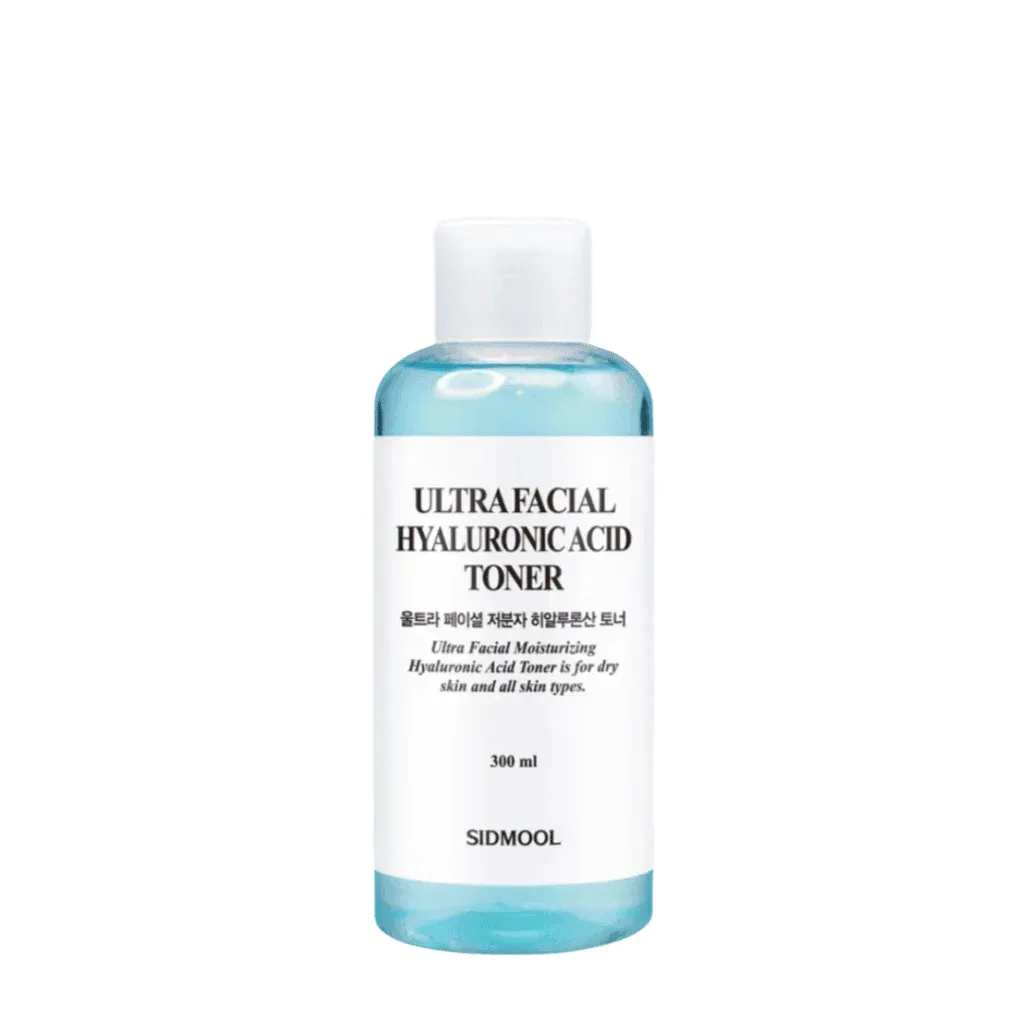
It is a seven-form hyaluronic toner with a declared 0.3 percent low-molecular fraction, glycerin second and no fragrance, alcohol, silicone or oil, sold in a 300 mL bottle for about twelve dollars, which puts it at a fraction of the price per millilitre of the K-beauty hydrating toners it most resembles. Sidmool's DIY-community roots show in the transparency of the list and the plainness of the bottle.
A fifteen-ingredient hyaluronic toner that declares its low-molecular fraction at 0.3 percent, puts glycerin second, leaves out fragrance, alcohol and oil, and sells 300 mL for about twelve dollars through K-beauty importers. It does the plain job of a hydrating toner very well and nothing beyond it, tolerates every skin type, and is one of the cheapest genuinely good bottles in the category, if you can find it.
Sidmool publishes no efficacy testing and the toner's reviews outside Korea are too few to draw on, so this assessment rests on the brand's own transparent ingredient list, including its declared 3,000 ppm of hydrolyzed hyaluronic acid, and on the well-established literature for glycerin, hyaluronates and polyglutamic acid; the product's launch date is undocumented, its Korean review base could not be accessed for this write-up, and importer pricing in the US is variable.
Verdicts
How well it fits each concern
Verdict by concern tap a concern for the case
Good choicefor DehydrationIn your profileYou chose · Glycerin is a reference standard by mechanism for dehydration; this liquid carries it high in the ingredient list.Moderate evidenceGentleNo reviews collected yet
The case for it
Glycerin with Butylene Glycol has trial-supported standing for this concern.
It is present at an effective concentration, declared or high in the ingredient list.
The formula carries none of the triggers this concern is sensitive to.
Same rule for everyone. “Good choice” is the verdict on 9,564 of 45,024 concern verdicts across the catalog; rule R5 decided 9,072 of them.
As of September 25, 2026, engine 5.1.1.
R5 — Trial-supported or guideline-supported active, adequately or plausibly dosed. · the full register
Carrying active
Glycerin with Butylene Glycol
Standing
supported — its mechanism is established
Form
adequate — studied range 20%, from the trials on the row; needs leave-on contact; judge it after ~1 weeks
Tolerability
gentle
Row checked
against its sources on July 17, 2026 (evidence table ev-2026.09-r228)
The studies behind the evidence row
USP glycerin monograph / Fluhr et al., glycerol and the skin (review) — glycerin is the reference humectant, drawing and holding water in the stratum corneum — reference work
Good choicefor DrynessIn your profileYou chose · Glycerin is a reference standard by mechanism for dryness; this liquid carries it high in the ingredient list.Moderate evidenceGentleNo reviews collected yet
The case for it
Glycerin with Butylene Glycol has trial-supported standing for this concern.
It is present at an effective concentration, declared or high in the ingredient list.
The formula carries none of the triggers this concern is sensitive to.
Same rule for everyone. “Good choice” is the verdict on 9,564 of 45,024 concern verdicts across the catalog; rule R5 decided 9,072 of them.
As of September 25, 2026, engine 5.1.1.
Good choicefor SensitivityIn your profileYou chose · No fragrance, drying alcohol, declarable allergens or sensitising preservatives in this liquid — the profile sensitive skin looks for.Not yet assessedGentleNo reviews collected yet
The case for it
Glycerin with Butylene Glycol has no evidence row yet for this concern — it is in the research queue.
The formula carries none of the triggers this concern is sensitive to.
What would change this: A researched evidence row for the lead active would replace this with a verdict.
Same rule for everyone. “Good choice” is the verdict on 1,938 of 45,024 concern verdicts across the catalog; rule F2 decided 1,938 of them.
As of September 25, 2026, engine 5.1.1.
Does the jobDoes what a toner is for: not alcohol-driven, adds something real. Not measured from the label: restores skin pH, plays well with what follows.
A verdict is DermApproved’s assessment of how well a product’s ingredients fit a concern — never a claim about what the product treats. Evidence dots and collected reviews sit beside it and are never blended in.
Rules 0.5.1 · evidence table ev-2026.09-r228 · how we decide
Assessment
Pros & Cons
Pros
✓ Hydrolyzed hyaluronic acid declared at 0.3 percent, a real dose for a toner
✓ Glycerin second on the list, so it hydrates in dry air as well as humid
✓ Fifteen ingredients with no fragrance, alcohol, oil or silicone
✓ Water-thin, non-sticky and ideal for multi-layer application
✓ Allantoin and skullcap add gentle soothing for reactive skin
✓ Three hundred millilitres for about twelve dollars, a fraction of the category's price per millilitre
✓ Layers under any active without conflict
Cons
✗ Hydrates and nothing else; no actives for tone, texture or oil
✗ Needs a moisturizer over it in dry weather, like every hyaluronic toner
✗ Only available in the US through K-beauty importers with variable pricing
✗ Open pour spout with no restrictor wastes product
✗ Sidmool publishes no testing and the Western review base is small
✗ Malachite extract is a marketing flourish at the end of the list
Review
Full Review
Hydrating toners are a category where the price has drifted far from the chemistry. A 150 mL bottle of glycols, glycerin, a few hyaluronate salts and a preservative can sell for thirty dollars with the right packaging, and most of the brands doing so decline to say how much of the headline ingredient is inside. Sidmool's Ultra Facial Hyaluronic Acid Toner is the opposite object. It is a 300 mL bottle of exactly those things, it declares its hydrolyzed hyaluronic acid at 3,000 ppm on the label, and through the importers that bring it out of Korea it costs eleven to thirteen dollars, roughly what it costs in Seoul. The plainness is not an accident. Sidmool came out of a Korean DIY-cosmetics community around 2000 and has spent two decades selling ingredient-forward formulas in bottles that look like they came from a lab supply catalogue, to customers who read lists and buy in bulk. The Ultra Facial toner is what that philosophy produces when it turns to the low-molecular hyaluronic acid trend.
The list is fifteen ingredients and every one of them is legible. Water, glycerin, butylene glycol, 1,2-hexanediol as the sole preservative, then the hydrolyzed hyaluronic acid at 0.3 percent, followed by six more forms: sodium hyaluronate, the free acid, a crosspolymer, the acetylated salt, potassium hyaluronate and hydrolyzed sodium hyaluronate. Then polyglutamic acid, allantoin, Chinese skullcap root extract and, last, malachite extract. No fragrance, no alcohol, no oil, no silicone, no thickener beyond what the polymers provide. The seven-form hyaluronic stack is the fashionable part and the least important: hyaluronic acid does not penetrate below the outer skin at any size, so the small fragments sit in the upper stratum corneum and the large ones film the surface, and spreading the load across seven of them produces a pleasant, layered water-binding rather than anything deeper. The important part is glycerin at position two, which holds water from the bottle rather than from the skin and is what keeps the toner working in dry air, and the polyglutamic acid at twelve, which lays a longer-lasting cushion over the top. Allantoin and skullcap are a modest soothing pair, and the malachite is a mineral flourish that Sidmool uses across the line for the story.
In use, it is the least sticky hyaluronic toner most people will have tried. It is water-thin, cool, and sets within a minute to a soft, dewy surface with none of the tackiness that seven hyaluronates usually bring, which makes it ideal for the Korean seven-skin method of patting on several thin layers; three layers leaves the skin visibly plumper and less tight, and a moisturizer over the top holds it there through the day. Sensitive and reactive skin gets the benefit of a list with nothing in it to react to; butylene glycol is the only ingredient with any irritation history, and a mild one. It sits under retinoids, acids and vitamin C without conflict and buffers their dryness, it can be decanted into a mist for the afternoon, and at the rate a single layer twice a day uses it, the bottle lasts four to six months.
The limits are the limits of the format and of the brand's reach. A hyaluronic toner hydrates; it does not brighten, exfoliate, calm inflammation beyond the mild comfort of allantoin, or change anything cumulative, and the dewy plumpness resets each day. In dry heated rooms it must be sealed with a cream or the humectants, glycerin included, will lose what they held to the air; that is true of every product in the category and is the usual reason a hydrating toner disappoints in winter. The bottle's open spout pours more than a cotton pad needs. And Sidmool has no US storefront, so availability depends on importers, whose prices wander and whose listings show a crossed-out thirty-five-dollar retail figure that has never been the real price anywhere; eleven to thirteen dollars is what the bottle costs, and anything near thirty is not a bargain but a markup.
Sidmool also publishes no testing, and the toner's review base outside Korea is small, so the assessment here is an ingredient one, made easier than usual by a brand that prints a ppm figure and a list short enough to check. The formula is simple rather than clever, and a buyer looking for niacinamide, peptides or a barrier-repair story will find none of them. What they will find is a fragrance-free, alcohol-free, seven-form hyaluronic toner with a real declared dose and glycerin where it belongs, in a quantity that would cost four or five times as much from a brand with a marketing budget. For dehydrated, dry, sensitive or simply thirsty skin that wants to layer hydration cheaply and often, it is one of the best bottles in the category, and the fact that it looks like nothing is the point.
Formula
Key Ingredients
The hero actives that drive this product's performance.
Declared at 3,000 ppm and placed fifth, directly after the preservative, the low-molecular-weight fragment is the toner's namesake and its one quantified active: small enough to sit in the upper stratum corneum rather than only on top of it, it is the form Sidmool leads with in the Korean name of the product, and 0.3 percent is a real dose for a toner rather than a trace.
Established mechanismfor Dehydration · established mechanism
Positions six through eleven are hyaluronic acid in six more forms, from the large surface-film sodium hyaluronate to the crosspolymer that holds water longest and the acetylated salt that binds to skin; the seven-form stack is the fashion in Korean hydrating toners and here it means the water-binding is spread across the surface and the outer layers rather than concentrated in one place.
Established mechanismfor Dehydration · established mechanism
Second and third, the two humectants are the bulk of the hydration whatever the label says about hyaluronic acid; glycerin in particular is the ingredient that keeps the toner effective in dry air, where hyaluronates alone can pull water from the skin rather than the room, and its high position is why this bottle works in winter as well as a humid summer.
Established mechanismfor Dehydration · established mechanism
Twelfth, the fermented peptide polymer that Korean brands pair with hyaluronic acid because it forms a larger, longer-lasting water-holding film on the surface; it is what gives the toner a faintly slick, cushioned feel as it dries and what keeps the plumped look going after the hyaluronates have done their quicker work.
A small soothing pair at thirteen and fourteen, allantoin for surface comfort and Chinese skullcap root for its baicalin anti-inflammatory content, which together with the absence of fragrance and alcohol are why the toner is pitched at sensitive and reactive skin and generally tolerated by it.
Not yet assessed
Malachite Extract
The last ingredient is a copper-carbonate mineral extract that Sidmool uses across its Ultra Facial line as a marketing signature for antioxidant support; at the end of the list it colours the story rather than the water and has no bearing on how the toner performs.
Not yet assessed
Ingredient standings describe the active at treatment-level doses and
vehicles; this product's own condition grades weigh its actual formula.
Pat it onto damp skin straight after cleansing, in one layer or in the several thin layers of the Korean seven-skin method, and follow with a moisturizer that seals the water in; in dry heated rooms it must have an occlusive over it or the hyaluronates will lose what they held. It sits under any active without conflict and makes a good buffer under retinoids and acids, and it can be decanted into a mist bottle for a mid-day top-up over makeup.
Results Timeline
Plumper, cooler, less tight skin within a minute of patting it in, lasting through the day when sealed; dehydration lines look softer within a few days of twice-daily use. The effect is hydration, repeatable and non-cumulative, and nothing about tone, texture or oil changes over time beyond what better-hydrated skin looks like.
Pairs Well With
Sidmool Ultra Facial Moisturizing Lotiona ceramide or occlusive cream in winterthe seven-skin layering method
The toner's chemistry is humectant chemistry, and the evidence is orderly. Glycerol's central role in skin hydration was reviewed in the British Journal of Dermatology in 2008, covering its origin in the skin's own lipid metabolism, its capacity to raise stratum corneum water content, and its support of barrier recovery and corneocyte maturation; at position two here it is the toner's principal humectant and the reason the formula does not rely on hyaluronic acid alone, which matters because hyaluronates bind ambient water and in very dry air have less to hold. The hyaluronic acid story is more nuanced than the seven-form label implies. A 2024 double-blind randomized controlled trial in Archives of Dermatological Research compared topical hyaluronic acid of different molecular weights for xerosis in elderly patients and found that lower molecular weight preparations improved hydration and dryness scores more than higher ones over the treatment period, consistent with the smaller fragments reaching the upper stratum corneum where the larger polymers cannot; this supports Sidmool's decision to lead with, and quantify, the hydrolyzed low-molecular fraction at 0.3 percent, while the higher-weight forms contribute surface water-binding and slip. A 2015 review in Molecular Pharmaceutics on the interactions of hyaluronic acid with the skin established that even low-molecular-weight hyaluronic acid does not pass beyond the epidermis in meaningful amounts, which is why the toner's effect, at any form or concentration, is confined to the outer layers and is temporary. Polyglutamic acid's contribution has laboratory support: a 2025 study in the International Journal of Molecular Sciences of poly-gamma-glutamic acid from a Bacillus subtilis strain showed enhanced moisture retention and barrier-related gene expression in keratinocytes and a reconstructed skin model, consistent with its role here as a longer-lasting surface film over the hyaluronates. Allantoin and Scutellaria baicalensis root extract have soothing and anti-inflammatory support at cosmetic concentrations; malachite extract has no meaningful dermatological literature at the position it occupies. The formula's science is that of a well-constructed humectant toner whose transparency about dose is unusual and whose ceiling is hydration.
A hydrating toner is optional in most clinical routines, and when patients ask which one, the guidance is simply to pick something fragrance-free, alcohol-free and humectant-led, to apply it to damp skin, and to seal it; this bottle satisfies every part of that advice and does so cheaply, which is why it is the sort of product a clinician is happy to see on a patient's shelf without having recommended it. Its value in practice is as a buffer: patients starting a retinoid, benzoyl peroxide or an acid who complain of tightness are often told to add a bland humectant layer underneath, and a fifteen-ingredient hyaluronic toner with glycerin and allantoin is a textbook example. The seven hyaluronic forms and the malachite are regarded as marketing, and the declared 0.3 percent is noted as a rare bit of honesty in the category. The one caution repeated for every hyaluronic product is the winter one: without a moisturizer over it, a humectant layer in dry indoor air can leave skin feeling drier, and patients who report that are usually skipping the cream. Nobody expects a toner to treat anything.
Guidance
Usage & Recommendations
How to Use
After cleansing, while the skin is still damp, pour a small amount into the palm, or dampen a cotton pad, and press it gently over the face and neck until it absorbs, which takes under a minute. For the seven-skin method, repeat with two to six further thin layers, letting each set before the next, until the skin looks dewy and feels plump; three layers is enough for most. Follow within a minute with serum and a moisturizer that contains an occlusive, especially in dry or heated air, so the water the humectants hold is sealed in. Use it morning and night. It can be decanted into a fine-mist bottle for a mid-day refresh over makeup, and it layers under retinoids, acids and vitamin C without conflict. Tip the bottle carefully, since the open spout pours freely, and close it tightly between uses.
Value Assessment
About twelve dollars for 300 mL is roughly four cents a millilitre, against fifteen to twenty-five cents for the K-beauty hydrating toners with comparable seven-form hyaluronic stacks and forty cents or more for their Western prestige equivalents, and a bottle lasts four to six months at ordinary use. The money buys a fragrance-free, alcohol-free formula with a declared active dose, glycerin placed where it works, gentle soothers and enough volume to layer freely or decant into a mist. It does not buy any active beyond hydration, a pump or restrictor, a US storefront, or published testing, and importer pricing can drift upward with shipping and listings that pretend a thirty-five-dollar retail price. At its normal importer price the value is among the best in the category; at anything near thirty dollars the advantage evaporates and a domestic alcohol-free toner is the smarter buy.
Who Should Buy
Dehydrated, dry, sensitive or reactive skin that wants a plain, fragrance-free, alcohol-free hydrating toner to use generously and often, followers of the seven-skin layering method who go through toner quickly, anyone buffering a retinoid or acid routine, and value-minded buyers tired of paying prestige prices for glycerin and hyaluronate.
Who Should Skip
Anyone looking for a toner that does more than hydrate, such as exfoliating, brightening, calming acne or controlling oil, which this one does not attempt; people who want a pump, a pretty bottle or a domestic retailer; and anyone who finds it listed at a price near thirty dollars, at which point its main advantage is gone.
Ready to try Sidmool Ultra Facial Hyaluronic Acid Toner?
A clear, water-thin fluid with just enough body from the polyglutamic acid and crosspolymer to feel faintly cushioned as it is patted in; it absorbs within a minute and leaves a soft, non-tacky, slightly dewy surface.
Scent
None; unfragranced, with no smell at all from the bottle.
Packaging
A tall, plain, translucent 300 mL plastic bottle with a screw cap and an open pour spout in Sidmool's no-frills house style; there is no pump or restrictor, so it dispenses generously.
Finish
dewylightweightfast-absorbing
What to Expect on First Use
The first application is a small pleasure for anyone used to tacky hyaluronic toners: it feels like water going on, cool and light, and sets to a soft, plump finish without the film. Patted in three thin layers it leaves skin visibly dewier and noticeably less tight, and it stays that way under a moisturizer. There is no sting, no fragrance and no adjustment period; the only thing to learn is that the open spout pours more than a cotton pad needs.
How Long It Lasts
Four to six months at twice-daily single-layer use; two to three months if used in multiple layers or as a mist.
Sidmool's Ultra Facial line began as the brand's answer to the low-molecular hyaluronic acid trend that swept Korean skincare in the late 2010s, pairing a serum, a cream and this 300 mL toner under a name that borrowed a familiar Western moisturizer's cadence. Like the rest of Sidmool's range it was priced for Korean shoppers buying in bulk from the brand's own site, and it reached Western buyers through K-beauty importers who pass on most of that saving.
About Sidmool Established Brand (5–20 years)
Sidmool grew out of a Korean DIY-cosmetics community around 2000 and has spent two decades selling plainly packaged, ingredient-dense formulas at prices that undercut most of K-beauty. It runs no clinical research programme and its products reach the US through importers rather than the brand, but its long catalogue and loyal following among Korean sensitive-skin users give it a track record most indie labels lack.
Brand founded: 2000
Myth vs. Reality
Common Myths
Myth
A toner with seven kinds of hyaluronic acid hydrates deeper than one with a single form.
Reality
Hyaluronic acid does not penetrate below the outer skin at any molecular weight; the smaller fragments sit in the upper stratum corneum and the larger ones film the surface. Seven forms spread the water-binding across those layers, which is pleasant, but the toner's hydration comes mostly from glycerin at position two and from sealing the water in with a moisturizer afterward.
Myth
Hyaluronic acid toners dry the skin out in winter.
Reality
Pure hyaluronate on bare skin in very dry air can draw water outward, but this toner puts glycerin second and butylene glycol third, humectants that hold water from the product itself, and the standard fix applies: pat it onto damp skin and seal it with a cream. Used that way it hydrates in any climate.
FAQ
Frequently Asked Questions
What is the concentration of hyaluronic acid in the Sidmool Ultra Facial toner?
Sidmool declares the hydrolyzed, low-molecular-weight hyaluronic acid at 3,000 ppm, which is 0.3 percent, and lists six further hyaluronate forms after it without percentages. For a toner that is a meaningful dose; most hydrating toners do not declare a figure at all, and 0.3 percent of the small fraction is above what many comparable products carry.
Is the Sidmool Ultra Facial Hyaluronic Acid Toner sticky?
Less than most hyaluronic toners. The low-molecular fraction and the glycol base keep it water-thin, and the polyglutamic acid and crosspolymer add only a faint cushion as it dries; patted in it sets to a soft, dewy, non-tacky finish within a minute. Applied in three or more layers it becomes slightly slicker, which is normal for the seven-skin method.
Is the Sidmool hyaluronic toner good for sensitive skin?
Yes, and it is one of the better choices in the category for it. The fifteen-ingredient list has no fragrance, alcohol, essential oils, silicones or oils, is preserved only with 1,2-hexanediol, and includes allantoin and skullcap root for soothing. Butylene glycol is the only ingredient with any irritation record, and it is a mild one.
How should I use the Sidmool toner in dry or winter weather?
Apply it to skin that is still damp from cleansing, in one or several thin layers, and follow within a minute with a moisturizer that contains an occlusive. The glycerin in the toner holds water from the bottle rather than from the skin, but in heated indoor air any humectant needs sealing; skipping the moisturizer is the usual reason a hyaluronic toner disappoints in winter.
Can I use the Sidmool Ultra Facial toner during pregnancy and with retinoids?
Yes to both. It contains nothing restricted in pregnancy, just humectants, hyaluronates, allantoin and two extracts, and it has no acids or actives to conflict with a retinoid, benzoyl peroxide or vitamin C; applied underneath, it buffers the dryness those treatments cause.
Where can I buy the Sidmool hyaluronic toner in the US and what should it cost?
Sidmool has no US storefront, so the toner comes through K-beauty importers such as Koreabe and StyleJolly, typically at eleven to thirteen dollars for the 300 mL bottle, close to its Korean price of under ten thousand won. Listings showing a thirty-five-dollar retail price crossed out are importer theatre; the discounted figure is the real one.
Reviews
What Reviewers Tend to Say
Recurring themes our editors read across retailer reviews of this product — summaries in our words, not quotations, and not a substitute for your own patch test.
Common Praise
Non-sticky for a hyaluronic toner
Huge bottle that lasts for months
No scent, no sting on reactive skin
Ideal for layering
Common Complaints
Plain packaging and a screw cap that pours too freely
The headline number that fuels every polyglutamic acid launch is real. Whether it means better-hydrated skin than a good hyaluronic acid serum is a much more interesting question.
The internet's favorite hydrator has a counterintuitive dark side — in dry air, a humectant with nothing to seal it can pull water out of your skin instead of into it.
The burn trials are real and the skeptics who dismiss aloe as folklore are wrong — but the same substance has delayed healing in other wounds, and none of it says anything about what a soothing gel does to intact skin.
Products, answers, therapy guides, tools and articles in one search. Brand names,
slang and abbreviations all work — accutane finds isotretinoin, bacne finds truncal acne.