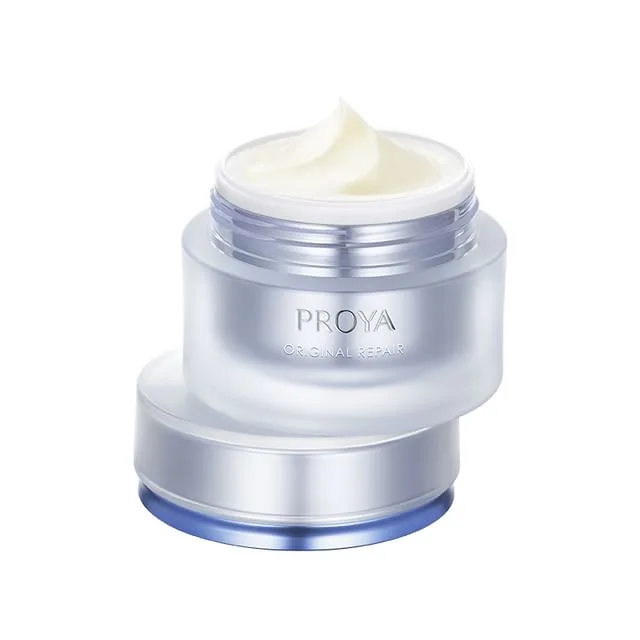
It is a ceramide barrier cream engineered for skin that finds ceramide creams too heavy: two ceramides with cholesterol and phytosterols in a water-forward gel-cream with trehalose and dipropylene glycol, fragrance-free, with panthenol high in the list. Most barrier creams choose between richness and lightness; this one keeps the lipid trio and drops the weight.
A fragrance-free ceramide gel-cream that keeps the barrier-lipid trio, two ceramides with cholesterol and phytosterols, but drops the weight, so oily and combination skin that flares under actives finally gets a repair cream it can wear under sunscreen. The recombinant collagen and fermented soy on the label are hydration and marketing rather than rebuilding, dairy proteins and a kava extract deserve a glance, and it is hard to buy at a stable price outside China.
What underpins this score is a fully disclosed reseller ingredient list and the published evidence on ceramide-containing moisturisers, not a record of the jar itself: Proya's site and its large domestic review base are out of reach from the West, and the 2.0 formula has under fifty ratings at the one overseas retailer that stocks it steadily, so the tolerability and results described here are inferences from the formula rather than a summary of documented use.
Verdicts
How well it fits each concern
Verdict by concern tap a concern for the case
Good choicefor Compromised Skin BarrierIn your profileYou chose · Ceramides is a reference standard by mechanism for compromised skin barrier; this gel cream carries it.Moderate evidenceGentleNo reviews collected yet
The case for it
Ceramide EOP, Ceramide NP has trial-supported standing for this concern.
It is plausibly present at a working level, though the concentration is not declared.
The formula carries none of the triggers this concern is sensitive to.
What would change this: A declared concentration would move this to a firmer reading of the dose.
Same rule for everyone. “Good choice” is the verdict on 9,564 of 45,024 concern verdicts across the catalog; rule R5 decided 9,072 of them.
As of September 25, 2026, engine 5.1.1.
R5 — Trial-supported or guideline-supported active, adequately or plausibly dosed. · the full register
Carrying active
Ceramide EOP, Ceramide NP
Standing
supported — its mechanism is established
Form
plausible — studied range 0.5–1%, from the trials on the row; needs leave-on contact; judge it after ~4 weeks
Tolerability
gentle
Row checked
against its sources on July 17, 2026 (evidence table ev-2026.09-r228)
The studies behind the evidence row
Elias PM, Skin Barrier / Coderch et al., ceramides and skin barrier function — ceramides ~50% of SC intercellular lipid mass, essential to the permeability barrier — reference work
Good choicefor SensitivityIn your profileYou chose · No fragrance, drying alcohol, declarable allergens or sensitising preservatives in this gel cream — the profile sensitive skin looks for.Not yet assessedGentleNo reviews collected yet
The case for it
Panthenol has no evidence row yet for this concern — it is in the research queue.
The formula carries none of the triggers this concern is sensitive to.
What would change this: A researched evidence row for the lead active would replace this with a verdict.
Same rule for everyone. “Good choice” is the verdict on 1,938 of 45,024 concern verdicts across the catalog; rule F2 decided 1,938 of them.
As of September 25, 2026, engine 5.1.1.
Good choicefor DehydrationIn your profileYou chose · Panthenol (Vitamin B5) is a reference standard by mechanism for dehydration; this gel cream carries it high in the ingredient list.Moderate evidenceGentleNo reviews collected yet
The case for it
Panthenol has trial-supported standing for this concern.
It is present at an effective concentration, declared or high in the ingredient list.
The formula carries none of the triggers this concern is sensitive to.
Same rule for everyone. “Good choice” is the verdict on 9,564 of 45,024 concern verdicts across the catalog; rule R5 decided 9,072 of them.
As of September 25, 2026, engine 5.1.1.
R5 — Trial-supported or guideline-supported active, adequately or plausibly dosed. · the full register
Carrying active
Panthenol
Standing
supported — its mechanism is established
Form
adequate — studied range 2.5%, from the trials on the row; needs leave-on contact
Tolerability
gentle
Row checked
against its sources on July 17, 2026 (evidence table ev-2026.09-r228)
The studies behind the evidence row
Cosmetic Ingredient Review assessment of panthenol / dexpanthenol — humectant and moisturizer that raises stratum-corneum water content — reference work
Does the jobDoes what a moisturizer is for: supplies barrier lipids, draws in water.
A verdict is DermApproved’s assessment of how well a product’s ingredients fit a concern — never a claim about what the product treats. Evidence dots and collected reviews sit beside it and are never blended in.
Rules 0.5.1 · evidence table ev-2026.09-r228 · how we decide
Assessment
Pros & Cons
Pros
✓ Ceramide EOP and NP with cholesterol and phytosterols: a genuine barrier-lipid trio
✓ Panthenol in ninth place plus allantoin and beta-glucan calm stinging fast
✓ Fragrance-free, alcohol-free, no essential oils
✓ Watery gel-cream texture suits oily and combination skin under sunscreen
✓ Full humectant phase of glycerin, trehalose and dipropylene glycol
✓ Buffers retinoid and acid routines without trapping heat
✓ A little goes far; 50 g lasts two to three months
Cons
✗ Recombinant collagen and ferment claims outrun the evidence
✗ Faint fermented smell from the unmasked soy ferment
✗ Whey protein and lactose are a flag for dairy-protein allergy
✗ Too light for very dry skin in cold weather
✗ No stable US retailer or verifiable dollar price
✗ Glass jar exposes lipids and proteins to air with every scoop
Review
Full Review
Proya did more than any company to make 'early C, late A' a household phrase in China, the routine of vitamin C in the morning and a retinoid at night that turned millions of ordinary skincare users into active-layering enthusiasts. It also, inevitably, created a lot of barrier-damaged faces. The Original Repair line, sold at home as Source Force, is the brand's answer to its own success, and the Light Cream 2.0 is the version of that answer made for the oily and combination skin that both loves actives and cannot stand the ceramide creams usually prescribed to recover from them.
Proya was founded in Hangzhou in 2003 and is now one of China's largest listed cosmetics companies, with its own research centres and a reputation for ingredient-forward marketing. Its official site does not load from the West and it has no stable US retailer, so this cream reaches English-speaking buyers through resellers, chiefly YesStyle, with a fully disclosed ingredient list but a price that floats with currency and discounting; in dollars it lands somewhere in the low-to-mid thirties for 50 grams. The 2.0 reformulation arrived in 2025 with the recombinant collagen and fermented soy complex the brand now leads with.
The formula is best read in two layers. The first is a barrier cream: ceramide EOP and ceramide NP sit mid-list with cholesterol and phytosterols and a pseudo-ceramide, which is the physiological lipid trio that the better repair creams use and most gel-creams skip. Around them is a comfort layer of panthenol, unusually high in ninth place, allantoin and beta-glucan, and a humectant phase of glycerin, dipropylene glycol, trehalose and butylene glycol. There is no fragrance, no drying alcohol and no essential oil. The second layer is the marketing: collagen, listed simply as such, whey protein, fibronectin and the Lactobacillus and soybean ferment, which together are the 'recombinant collagen' story on the jar. Read honestly, those are film-forming humectants and a skin-conditioning ferment; collagen does not cross the stratum corneum and become dermal collagen, and the brand's claim that it does is the one place the copy outruns the chemistry.
What makes the Light Cream worth singling out is the texture engineering. Most ceramide creams are built on shea, petrolatum or heavy esters and sit on oily skin like a blanket. This one is a translucent gel-cream with a watery slip that breaks into moisture on contact, absorbs in under a minute, and leaves a hydrated, non-greasy finish that sunscreen goes over cleanly. Skin that has been over-exfoliated stops stinging within minutes of the first application, which is the panthenol and allantoin, and feels comfortable by the next morning. Over two to four weeks the lipid trio does its slower work: less redness, fewer flaky patches, better tolerance when the retinoid comes back. On dry skin in winter it is not enough, and the line's richer cream with shea and beeswax exists for that.
In the jar it is faintly, distinctly yeasty. That is the fermented soy extract, unmasked because there is no fragrance to cover it, and Proya says so in its own copy; it fades on the skin within a minute and is not a sign of spoilage. Reviewers mention it more than anything else about the product except the texture. The other things a careful buyer should notice are small: whey protein and lactose low in the list, a consideration for anyone with a dairy-protein allergy; a kava extract that is unusual in a leave-on and has no obvious purpose here; octyldodecyl myristate, a mild comedogenic flag; and the esters and fatty alcohols that keep it off the fungal-acne-safe list.
The symmetric point deserves making. Western readers are inclined to discount a Chinese brand's science, and some of that discount is earned, since Proya's trials are internal and its collagen language is aspirational. But the barrier chemistry in this jar is exactly what a dermatologist would ask for, ceramides in a physiological ratio with cholesterol and sterols, and it is executed in a texture that Western ceramide creams have mostly failed to produce. The evidence base for ceramide-containing moisturisers restoring a compromised barrier is solid, and this cream sits inside it. The fair reading is not that the marketing is overblown, though it is, but that the formula underneath does not need it.
On value, the honest answer is that nobody in the US can be sure. At a reseller's discounted price it is a bargain for a fragrance-free two-ceramide cream; at full reseller price it is ordinary; at an importer's markup it is a poor buy against ceramide creams that can be bought in a pharmacy tomorrow. Fifty grams lasts two to three months at twice-daily use because so little is needed, which improves any of those calculations. There is one size and it comes in a glass jar, which is a pity for a formula with lipids and proteins in it.
So: oily, combination or normal skin recovering from actives, or simply wanting a light, fragrance-free ceramide cream that behaves under sunscreen, will find this one of the better options anywhere, provided it can be bought at a sensible price. Very dry skin should take the richer version. Dairy-allergic users should read the list twice. And anyone buying it for the collagen should know that the ceramides are doing the work.
Formula
Key Ingredients
The hero actives that drive this product's performance.
Two skin-identical ceramides sitting mid-list beside cholesterol, phytosterols and a pseudo-ceramide, which is the barrier-lipid trio a repair cream needs rather than a token ceramide for the label. In a light, water-forward gel-cream they are what lets the formula claim repair without the heaviness of the line's richer sibling.
Established mechanismfor Compromised Skin Barrier · established mechanism
Ninth on the list, high enough to be a real dose, and the ingredient doing the immediate soothing on the reactive, over-exfoliated skin this line is sold to. With allantoin and beta-glucan further down it forms a comfort layer that the ceramides then build on.
Established mechanismfor Dehydration · established mechanism
Thirteenth, the fermented soy extract Proya markets as its collagen-supporting complex, giving the cream the faint yeasty note that replaces fragrance. Its evidence is supplier and in-vitro data, so it is a plausible skin-conditioning agent rather than a proven collagen booster.
The headline 'recombinant collagen' of the marketing, listed simply as collagen after the pea extract. At any molecular weight it stays on the surface as a film-forming humectant that smooths and holds water; it does not become skin collagen, whatever the launch copy implies, and its real job here is hydration texture.
A sugar humectant placed twelfth, joining glycerin and dipropylene glycol in the water-binding phase that gives the cream its watery, fast-absorbing feel. It is part of why the texture suits oily and combination skin where a classic ceramide cream would sit heavy.
Not yet assessed
Ingredient standings describe the active at treatment-level doses and
vehicles; this product's own condition grades weigh its actual formula.
It is the last leave-on step and light enough to sit under sunscreen within a minute, and it pairs well over the line's toner and emulsion for skin that is genuinely flaring. Under a retinoid or acid routine it is the buffer, applied after the active has absorbed; very dry skin in winter may want the rich version or a facial oil over the top.
Results Timeline
Tightness and stinging ease immediately from the panthenol, allantoin and humectants, and skin looks calmer within a few days. The ceramide-cholesterol-phytosterol barrier work shows over two to four weeks as reduced redness, fewer flaky patches and better tolerance of actives; the collagen and firming language on the packaging describes surface hydration rather than a structural change.
Pairs Well With
Proya Original Repair Relieving TonerA retinoid or vitamin C serum it can bufferBroad-spectrum sunscreen
The formula's therapeutic logic is that of a physiological barrier-repair cream delivered in a low-lipid gel base. The stratum corneum's intercellular lipids are roughly equal parts ceramides, cholesterol and free fatty acids, and topical replacement works best when the three are supplied together rather than as ceramide alone; this cream lists ceramide EOP and ceramide NP with cholesterol, phytosterols, behenic acid and a pseudo-ceramide, cetyl-PG hydroxyethyl palmitamide, which satisfies that principle at an undeclared but plausible cosmetic dose. The evidence that ceramide-containing formulations restore barrier function on stressed skin is reasonably strong: a 2021 study in the Journal of Drugs in Dermatology assessed ceramide-containing products on skin whose surface barrier had been altered by ultraviolet exposure and reported improvements in barrier measures relative to untreated skin, adding to a literature that includes randomized trials of ceramide creams in atopic dermatitis and as adjuncts to acne therapy. Panthenol at ninth position and allantoin and beta-glucan further down provide the anti-irritant layer, with panthenol's effect on transepidermal water loss and erythema well documented. The humectant phase of glycerin, dipropylene glycol, trehalose and butylene glycol accounts for the watery texture and immediate hydration. The 'recombinant collagen' complex, listed as collagen, whey protein, fibronectin and a Lactobacillus/soybean ferment, is the weakest element scientifically: collagen and fibronectin are large proteins that remain on the surface as film-forming humectants, the ferment has supplier and in-vitro data only, and there is no independent evidence that any of them alter dermal collagen when applied topically. Dipalmitoyl hydroxyproline and acetyl dipeptide-1 cetyl ester add a light peptide note with limited clinical support. The formulation's tolerability profile is good, with no fragrance or alcohol, and its notable caveats are the dairy-derived proteins for allergic users, a kava extract of unclear purpose, and a lipid-and-ester base that is not suitable for Malassezia-prone skin.
For patients whose barrier has been compromised by over-use of retinoids, acids or vitamin C, dermatology's standard advice is to pause the actives and use a bland, fragrance-free moisturiser with physiological lipids, and a ceramide-cholesterol-sterol cream fits that prescription exactly. The distinctive feature here from a clinical standpoint is the texture: oily and combination patients frequently abandon the rich ceramide creams they are told to use, and a gel-cream carrying the same lipids solves an adherence problem rather than a formulation one. Clinicians would treat the recombinant collagen and fermented soy claims as marketing and would note two ingredient-level cautions, dairy-derived proteins for patients with a relevant allergy and a kava extract with no clear role, and the usual reminder that a repair cream buffers actives but does not license their overuse. As a maintenance moisturiser for sensitive, active-using skin it is a reasonable choice, and for atopic-prone skin its lack of fragrance is the right kind of restraint.
Guidance
Usage & Recommendations
How to Use
Once the toner and any serum or active have absorbed, scoop a pea-to-hazelnut amount with a clean fingertip or spatula and press it over the face and neck, working outward from the centre; it breaks into moisture on contact and needs little spreading. Allow a minute for it to sink in before sunscreen in the morning. Use twice daily, and on a flaring, over-exfoliated face apply a slightly thicker layer at night with actives paused. Very dry skin can add a facial oil on top in winter or switch to the line's richer cream. Keep the jar lid tightly closed between uses, and patch test first if dairy proteins have caused reactions.
Value Assessment
No US retailer holds a stable price for this cream, which makes the value judgement conditional. At the reseller price that converts to the low-to-mid thirties in dollars before discounts, a fragrance-free two-ceramide cream with cholesterol, phytosterols and a real panthenol dose is good value and competitive with pharmacy ceramide creams that lack the light texture. At an importer's markup it becomes ordinary, and buyers should weigh it against barrier creams they can find on a shelf. The 50 g jar is the only size and lasts two to three months at twice-daily use because the gel-cream spreads far, which improves the per-month cost in every scenario; the glass jar is the one packaging choice that works against a formula with air-sensitive lipids and proteins.
Who Should Buy
Oily, combination or normal skin, particularly the sensitised kind that uses retinoids, acids or vitamin C and needs a fragrance-free ceramide cream light enough to wear under sunscreen. It suits anyone who has abandoned heavier barrier creams for feeling greasy, and anyone who can source it at or near its reseller price.
Who Should Skip
Very dry or mature skin in cold weather will want the richer version or a heavier cream, and anyone with a dairy-protein allergy should note the whey and lactose. Malassezia-prone skin should avoid the ester base, buyers expecting the collagen to firm or rebuild skin will be disappointed, and anyone who can only find it at a doubled import price has better-documented ceramide creams within reach.
Ready to try Proya Original Repair Light Cream 2.0?
A translucent, ivory gel-cream with a watery slip that breaks into moisture on contact, spreads thin and sinks in within a minute to a soft, hydrated, non-greasy finish.
Scent
No fragrance; a faint, yeasty, fermented note from the soy ferment extract that fades on the skin.
Packaging
A 50 g frosted glass jar with a silver screw lid and a blue base ring, scooped rather than pumped.
Finish
dewyfast-absorbingnon-greasy
What to Expect on First Use
The first application is cool and watery, absorbs almost like a serum, and stops any stinging within minutes; skin that had been tight from over-exfoliation feels comfortable by the next morning. The only surprise is the faint fermented smell, which the brand explains as the price of leaving fragrance out.
How Long It Lasts
About two to three months of twice-daily use, since the light texture spreads far.
Proya's Original Repair line, sold in China under the Source Force name, is the brand's answer to the barrier-damaged skin left behind by the retinoid-and-acid enthusiasm its own 'early C late A' marketing helped create. The Light Cream is the oily-and-combination texture of the line's moisturiser, and the 2.0 reformulation of 2025 added the recombinant collagen and fermented soy complex the brand now leads with.
About Proya Established Brand (5–20 years)
Proya, founded in Hangzhou in 2003, is one of China's largest listed cosmetics companies and the domestic brand most associated with ingredient-led, 'early C late A' style formulation. It runs its own R&D centres and publishes some instrumental testing, but its trials are internal, its official site is unreachable from much of the West, and its products reach the US mainly through resellers with inconsistent English names.
Brand founded: 2003 · Product launched: 2025
Myth vs. Reality
Common Myths
Myth
The recombinant collagen in this cream rebuilds the skin's own collagen.
Reality
Collagen of any origin is a large protein that stays on the surface of the skin, where it forms a hydrating film. It cannot cross the stratum corneum or be incorporated into the dermis; the smoothing it produces is real but cosmetic. The barrier repair in this jar comes from the ceramides, cholesterol and phytosterols, not the collagen.
Myth
A fermented, unscented cream smelling slightly off means it has spoiled.
Reality
The faint yeasty note is the Lactobacillus and soybean ferment extract, present from the first opening, and Proya says as much in its own copy. Spoilage would show as separation, a sharp sour smell or a colour change; a consistent mild fermented scent in a fragrance-free formula is the ingredient, not a fault.
FAQ
Frequently Asked Questions
What is the difference between Proya Original Repair Light Cream 2.0 and the regular cream?
Same line, different texture. The Light Cream is a water-forward gel-cream with trehalose and dipropylene glycol for oily, combination and normal skin, while the richer version adds shea butter and beeswax for dry skin. Both carry ceramides, cholesterol and the fermented soy complex; the 2.0 versions added recombinant collagen.
Is Proya Original Repair Light Cream fragrance-free?
Yes. There is no fragrance on the ingredient list, and the faint fermented smell some users notice is the Lactobacillus and soybean ferment extract, which Proya says it leaves unmasked deliberately so the formula suits sensitive skin.
Is the Proya Light Cream good for oily or acne-prone skin?
It is the texture in the line built for oily and combination skin, absorbing like a serum with no greasy film. It is not fungal-acne safe because of the esters and fatty alcohols, and octyldodecyl myristate is a mild comedogenic flag, so acne-prone users should patch a cheek first.
How much does Proya Original Repair Light Cream 2.0 cost in the US?
There is no stable US retailer to quote. YesStyle lists the 50 g jar in local currency at a price that converts to roughly the low-to-mid thirties in dollars before its frequent discounts, and other importers vary widely. Proya's own site does not ship to or load from the US.
Can I use the Proya Light Cream with retinol or acids?
That is what it is designed for. Panthenol, allantoin, beta-glucan and the ceramide-cholesterol trio make it a good buffer over a retinoid or acid once the active has absorbed, and its light texture does not trap heat on skin that is already irritated.
Does Proya Original Repair Light Cream contain dairy?
It lists whey protein and lactose low in the formula, alongside collagen and fibronectin as part of its 'recombinant' complex. Anyone with a dairy-protein allergy should treat it with caution, though topical reactions to these ingredients are uncommon.
Reviews
What Reviewers Tend to Say
Recurring themes our editors read across retailer reviews of this product — summaries in our words, not quotations, and not a substitute for your own patch test.
Common Praise
Watery, fast-absorbing texture that suits oily skin
Topically, the molecule the argument tells you to avoid is one the stratum corneum is structurally built from — and in acne-prone skin the documented finding is a shortage of it.
Western sensitive skincare works by subtraction — remove the fragrance, remove the alcohol, shorten the list. Japan's answer adds a designed molecule back in, and one of the two bets has a trial literature.
A wrecked barrier is the most common self-inflicted skin condition and the one with the clearest fix — the difficulty is that the routine which caused it feels productive and the one that repairs it feels like giving up.
'Barrier damage' has become the internet's all-purpose diagnosis. It's also a real, specific condition with a specific and slightly boring cure: mostly, stop doing things.
May 15, 2026· 5 min
Questions people ask about sensitive skin
Verified answers from our questions library — the nuance a product page cannot carry.
Products, answers, therapy guides, tools and articles in one search. Brand names,
slang and abbreviations all work — accutane finds isotretinoin, bacne finds truncal acne.