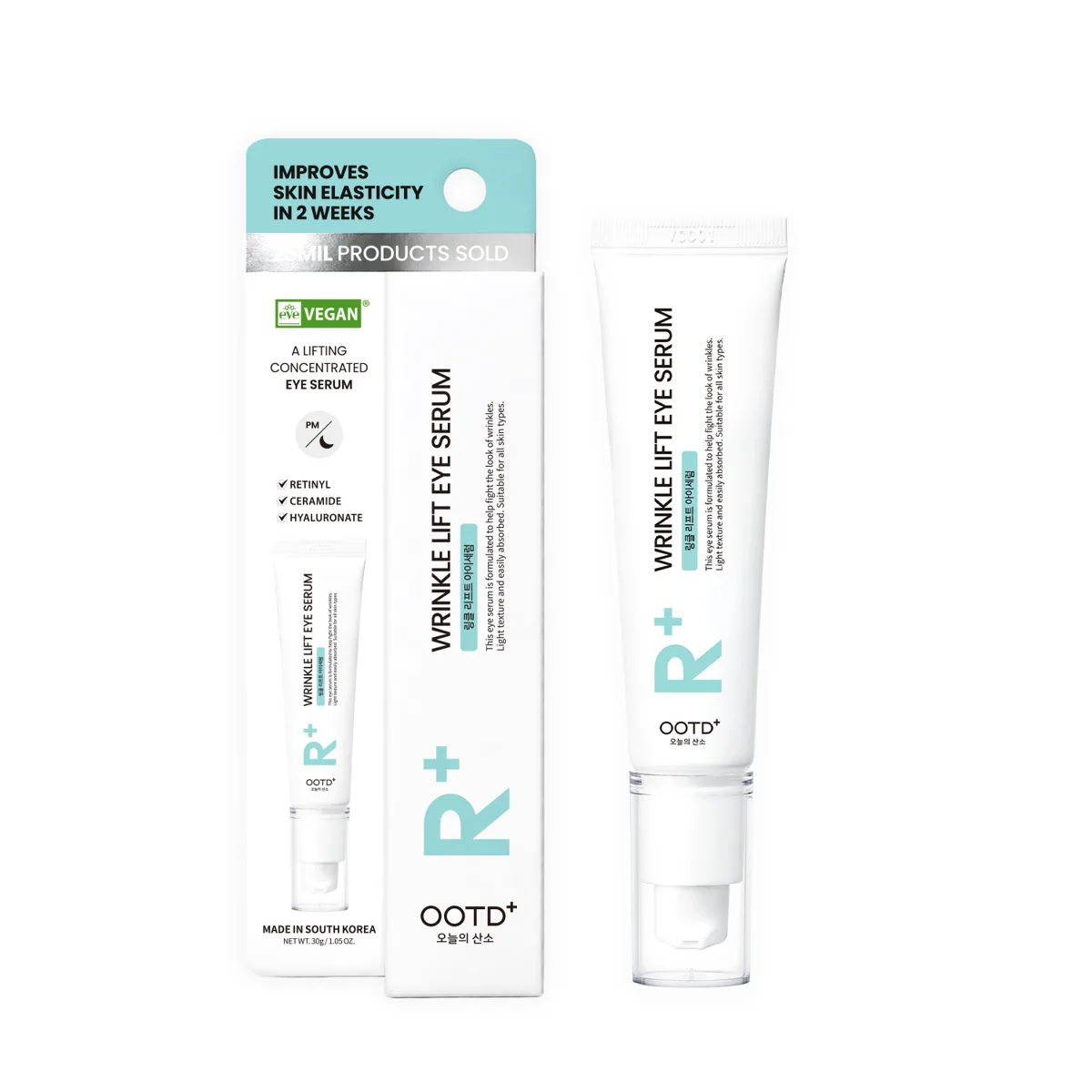
It pairs retinyl palmitate — the mildest retinol ester — with ceramide NP and hyaluronate in a light lotion base shared across OOTD's eye-serum range, making it a very gentle first step into retinoids for the eye area.
A gentle, very affordable eye serum that pairs the mildest retinol ester with ceramide and hyaluronate in a light, pleasant lotion. It hydrates well and is easy on the eye area, but retinyl palmitate is a weak retinoid, the formula is fragranced and it contains peanut oil — a sensible first step for fine lines rather than a powerful treatment.
Around 89 Amazon ratings since 2022 form the user record for this serum, and the brand's two-week claims are self-reported. Our assessment is based mainly on its ingredient list and the published evidence on retinyl palmitate and hydrating ingredients.
Verdicts
How well it fits each concern
Verdict by concern tap a concern for the case
Good choicefor DehydrationIn your profileYou chose · Glycerin is a reference standard by mechanism for dehydration; this serum carries it high in the ingredient list.Moderate evidenceStandard tolerabilityNo reviews collected yet
The case for it
Glycerin & Sodium Hyaluronate has trial-supported standing for this concern.
It is present at an effective concentration, declared or high in the ingredient list.
The formula carries no trigger this concern is sensitive to, with the cautions noted.
Same rule for everyone. “Good choice” is the verdict on 9,564 of 45,024 concern verdicts across the catalog; rule R5 decided 9,072 of them.
As of September 25, 2026, engine 5.1.1.
R5 — Trial-supported or guideline-supported active, adequately or plausibly dosed. · the full register
Carrying active
Glycerin & Sodium Hyaluronate
Standing
supported — its mechanism is established
Form
adequate — studied range 20%, from the trials on the row; needs leave-on contact; judge it after ~1 weeks
Tolerability
standard
Row checked
against its sources on July 17, 2026 (evidence table ev-2026.09-r228)
The studies behind the evidence row
USP glycerin monograph / Fluhr et al., glycerol and the skin (review) — glycerin is the reference humectant, drawing and holding water in the stratum corneum — reference work
Also listed for Aging — the actives here (Glycerin, Emollient Esters, Allantoin, Ceramides) are in our research queue for that concern; there is no verdict until their evidence rows are written. That is a gap in our table, not a mark against the product.
Does the jobDoes what a eye cream is for: safe for eye skin, targets a real eye concern. Not measured from the label: hydrates without heaviness, stays where it's put.
A verdict is DermApproved’s assessment of how well a product’s ingredients fit a concern — never a claim about what the product treats. Evidence dots and collected reviews sit beside it and are never blended in.
Rules 0.5.1 · evidence table ev-2026.09-r228 · how we decide
Assessment
Pros & Cons
Pros
✓ Retinyl palmitate is a very gentle retinoid for the eye area
✓ Ceramide NP and hyaluronate support hydration and the barrier
✓ Light, fast-absorbing texture sits well under concealer
✓ Very affordable for a 30g tube
✓ Low irritation potential compared with stronger retinoids
✓ Tube nozzle dispenses a small, controllable dose
Cons
✗ Retinyl palmitate is far less potent than retinol
✗ Contains peanut oil, a concern for nut allergies
✗ Added fragrance near sensitive eyes
✗ Results on wrinkles are slow and subtle
✗ Not suitable during pregnancy
Review
Full Review
The front of the box says R+, and the side lists retinol alongside ceramide and hyaluronate. Look at the ingredient list, though, and the retinoid is retinyl palmitate. That distinction matters more than it might seem, because retinoids are not a single ingredient but a family, and they vary enormously in strength. Understanding where retinyl palmitate sits in that family is the key to setting fair expectations for this eye serum.
The only retinoid that acts directly on skin cells is retinoic acid, the prescription drug tretinoin. Everything else sold over the counter has to be converted into retinoic acid inside the skin. Retinal, or retinaldehyde, needs one step. Retinol needs two. Retinyl palmitate, an ester of retinol and palmitic acid, needs three: first it is broken down into retinol, then retinal, then retinoic acid. Each step loses some of the dose, which is why retinyl palmitate is generally regarded as the gentlest and least potent retinoid in skincare. Its main advantage is tolerability, and around the eyes, where skin is thin and easily irritated, that is not a small advantage.
So the honest picture is this: OOTD's Wrinkle Lift Eye Serum is a mild retinoid eye product. It is unlikely to cause the redness, peeling and stinging that stronger retinoids can bring to the under-eye area, and it is also unlikely to produce dramatic changes in wrinkles. For someone new to retinoids, or with skin that has reacted badly to them before, that trade-off can be the right one.
The retinyl palmitate sits near the end of the list, carried with a little peanut oil. That peanut oil is worth flagging clearly: anyone with a peanut allergy should avoid this product, and it is not something you would expect in an eye serum.
The rest of the formula is a light, well-behaved emulsion. After water, glycerin and propylene glycol come hydrogenated polydecene and cetyl ethylhexanoate, lightweight emollients that give the serum its silky feel, and a pair of olive-derived emulsifiers. A little dimethicone adds slip. Ceramide NP helps support the under-eye barrier, and sodium hyaluronate and glycerin plump the surface, so fine dehydration lines look softer within minutes. Allantoin and tocopherol round it out.
That base is shared across OOTD's eye serums: the Dark Circle and Depuff versions use almost exactly the same emulsion and swap in different actives near the end. This is a sensible, cost-efficient approach, and it is why all three feel the same on the skin — light, milky and quick to absorb, with no greasy residue under concealer. It also means that much of the immediate benefit you notice is the hydrating base rather than the headline active. That is not a criticism so much as a useful piece of information when choosing between them. If your main concern is fine lines, the retinyl palmitate makes this the logical pick of the three; if it is shadows or puffiness, the other two target those more directly. None of them should be expected to do the others' jobs, and layering several eye serums at once mostly adds more of the same base rather than more benefit. A single, well-chosen product used consistently every night will do more than a rotating collection used occasionally, and consistency is where an inexpensive, pleasant formula like this one earns its keep. The tube's nozzle dispenses a small, controllable amount, which helps: a rice-grain portion is all the under-eye area needs.
The formula contains fragrance, which is the main reason sensitive eyes should be careful. Propylene glycol can also bother a minority of people. For most, the serum is comfortable, but anyone prone to eyelid dermatitis should patch-test or choose a fragrance-free option.
Because it contains a retinoid, it is best used at night, and it should be paired with daily sunscreen, since retinoids can make skin more sensitive to the sun. It is also a product to avoid during pregnancy, as retinoids generally are, even gentle esters.
On Amazon US, around 89 buyers have rated it an average of 4.0 stars since it launched around 2022. Reviewers like the light texture and gentleness and find it good value; the main complaint is that results on wrinkles are subtle. That is exactly what the chemistry would predict.
At about sixteen dollars for 30g, it is very inexpensive for an eye serum, and a tube lasts several months with the small amount needed each night. You are paying for a pleasant, gentle hydrating base with a mild retinoid, not for a potent treatment, and the price reflects that fairly.
Who should buy it? People in their twenties and thirties looking for a gentle introduction to retinoids around the eyes, or anyone whose eye area has reacted to stronger products and who wants hydration with a light touch of active. Those with established crow's feet who want visible change should look for a retinol or retinal eye product, used carefully. Anyone with a peanut allergy, fragrance-sensitive eyes or who is pregnant should skip it. The R+ on the box is real — it is just the gentlest R there is.
Formula
Key Ingredients
The hero actives that drive this product's performance.
The 'retinol' on the box: a gentle retinol ester that must be converted in the skin before it acts, carried in a little peanut oil near the end of the list — mild enough for the eye area, but also far weaker than retinol itself.
Tap a rice-grain amount along the orbital bone at night after serum and before moisturiser; keep it off the lids and lash line.
Results Timeline
The under-eye looks smoother and more hydrated within minutes. Any effect of the retinyl palmitate on fine lines is slow and subtle, needing two to three months of consistent nightly use.
Topical retinoids work by binding nuclear retinoic acid receptors, but only retinoic acid does so directly. Over-the-counter retinoids must be converted in the skin: retinyl esters such as retinyl palmitate are hydrolysed to retinol, oxidised to retinal and then to retinoic acid. Each step is limited by enzyme activity, so retinyl palmitate delivers considerably less active retinoid than an equivalent amount of retinol or retinal. Studies of retinyl palmitate for photoageing have produced mixed and generally modest results; its principal advantage is lower irritation, which is relevant for the thin periorbital skin.
The base provides most of the immediate benefit. Glycerin and sodium hyaluronate are humectants that increase stratum corneum hydration, reducing the visibility of fine dehydration lines within minutes. Hydrogenated polydecene and cetyl ethylhexanoate are lightweight emollients that smooth the surface and reduce water loss. Ceramide NP is a skin-identical lipid that supports barrier function, useful alongside a retinoid.
Retinoids can increase photosensitivity and are generally avoided during pregnancy as a precaution, including topical esters, because of the known teratogenic effects of systemic retinoids.
Arachis hypogaea (peanut) oil is used here in small amounts, likely as a carrier for the retinoid. Refined peanut oil is thought to carry a low risk of reactions, but people with peanut allergy are generally advised to avoid products containing it. Fragrance and propylene glycol are the other components most likely to cause irritation, particularly in sensitive eyes or those prone to eyelid dermatitis.
Dermatologist Perspective
Retinoids are among the few topical ingredients with strong evidence for improving photoageing, but the periorbital skin is prone to irritation, so dermatologists often introduce them gently. Retinyl palmitate is at the mild end of the spectrum: well tolerated but relatively weak, which suits patients who cannot tolerate stronger retinoids or want a cautious start. For more noticeable improvement in crow's feet, a retinol or retinal eye formulation used carefully, or prescription tretinoin, is usually more effective. The added fragrance and peanut oil are cautions for patients with allergies or eyelid dermatitis. Retinoids should be avoided in pregnancy. As with any anti-ageing regimen, daily sunscreen and sunglasses do more for the eye area than any serum.
Guidance
Usage & Recommendations
How to Use
Use at night after cleansing, toning and any face serum. Dispense a rice-grain amount for both eyes onto your ring finger and tap it gently along the orbital bone beneath the eye and at the outer corners, avoiding the lids and lash line. Let it absorb before applying moisturiser. Start every other night for the first week, then use nightly if well tolerated. Wear sunscreen and sunglasses during the day. Do not use if you are pregnant or have a peanut allergy.
Value Assessment
At $15.69 for 30g on Amazon US, this is excellent value in price terms — a large tube that lasts several months. The value as an anti-ageing treatment is more modest, since retinyl palmitate is a weak retinoid and much of the visible benefit comes from the hydrating base. For someone wanting a gentle, affordable eye serum, it is a good buy; for someone seeking noticeable wrinkle reduction, a stronger retinoid product would offer better value despite a higher price.
Who Should Buy
People looking for a gentle, budget-friendly first retinoid for the eye area, especially those with early fine lines or eyes that have reacted to stronger products.
Who Should Skip
Anyone with a peanut allergy, fragrance-sensitive eyes, or who is pregnant should avoid it. Those with established wrinkles wanting visible change will need a stronger retinoid.
OOTD launched its trio of concern-specific eye serums around 2022 — Wrinkle Lift for fine lines, Dark Circle for brightening and Depuff for puffiness — each built on the same light emulsion with a different set of actives.
About OOTD Emerging Brand (2–5 years)
OOTD is an emerging Korean brand founded around 2021 and sold mainly through Amazon, Olive Young Global and its own site, specialising in low-cost, single-concern formulas. Its '2 weeks' claims come from brand-commissioned testing rather than published studies.
Brand founded: 2021 · Product launched: 2022
Myth vs. Reality
Common Myths
Myth
A 'retinol' eye serum is as strong as retinol.
Reality
This formula uses retinyl palmitate, an ester that must be converted twice in the skin to become active; it is much gentler and much less potent than retinol.
Myth
Retinoids should never be used around the eyes.
Reality
Gentle retinoids can be used on the under-eye area with care; mild esters like this one are among the least irritating options.
Myth
An eye serum can lift sagging eyelids.
Reality
Topical products can soften fine lines and improve hydration, but they cannot correct lid laxity or volume loss.
FAQ
Frequently Asked Questions
What kind of retinol is in the OOTD Wrinkle Lift Eye Serum?
It contains retinyl palmitate, a gentle retinol ester, rather than retinol itself. That makes it mild but less potent.
Does the OOTD Wrinkle Lift Eye Serum contain peanut oil?
Yes. Arachis hypogaea (peanut) oil appears near the end of the list, so anyone with a peanut allergy should avoid it.
Can I use OOTD's Wrinkle Lift Eye Serum in the morning?
It's best used at night because retinoids can increase sun sensitivity. If you use it in the morning, always follow with sunscreen.
Is the OOTD Wrinkle Lift Eye Serum safe during pregnancy?
It contains a retinoid (retinyl palmitate), and retinoids are generally avoided in pregnancy as a precaution. Choose a retinoid-free eye product instead.
How is the Wrinkle Lift Eye Serum different from OOTD's Dark Circle Eye Serum?
Both share the same light base. Wrinkle Lift adds retinyl palmitate and ceramide for fine lines; Dark Circle uses niacinamide, vitamin C and ceramide for brightening.
Is the OOTD Wrinkle Lift Eye Serum good for sensitive eyes?
The retinoid is mild, but the serum contains fragrance and propylene glycol, so very sensitive eyes should patch-test first.
Reviews
What Reviewers Tend to Say
Recurring themes our editors read across retailer reviews of this product — summaries in our words, not quotations, and not a substitute for your own patch test.
Western sensitive skincare works by subtraction — remove the fragrance, remove the alcohol, shorten the list. Japan's answer adds a designed molecule back in, and one of the two bets has a trial literature.
A wrecked barrier is the most common self-inflicted skin condition and the one with the clearest fix — the difficulty is that the routine which caused it feels productive and the one that repairs it feels like giving up.
Eczema care has quietly split into two worlds: the ceramide-and-occlusion basics that manage most cases, and a new class of drugs rewriting what's possible for severe disease. Knowing which world you're in changes the whole plan.
Products, answers, therapy guides, tools and articles in one search. Brand names,
slang and abbreviations all work — accutane finds isotretinoin, bacne finds truncal acne.