You Can Mix L-Ascorbic Acid at Home. Keeping It Alive Is the Hard Part.
The one home formulation with a genuinely coherent case, taken apart on its own terms: the pH window, the oxidation clock, and what a browning serum has actually become.
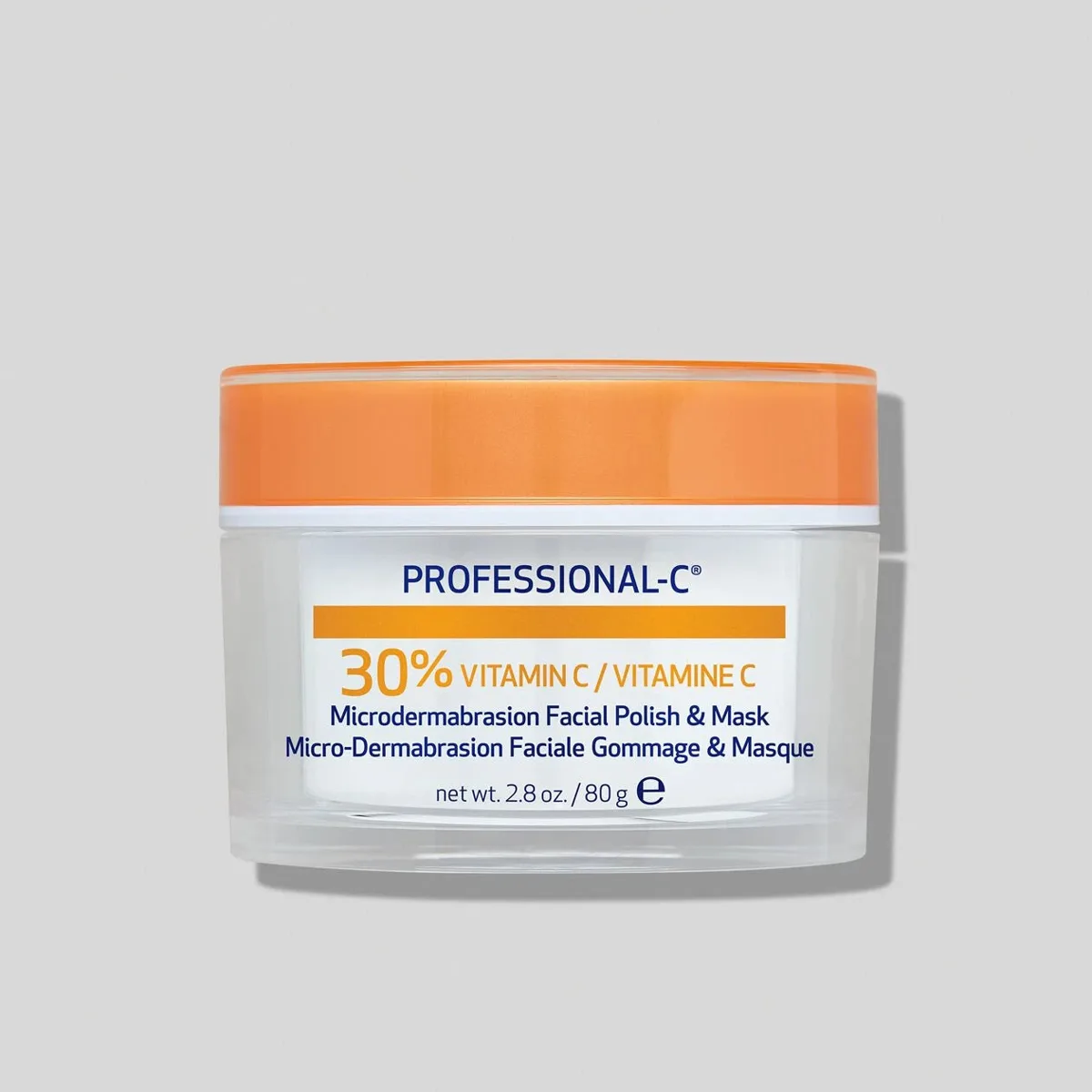
It solves the vitamin C stability problem by leaving water out entirely, suspending thirty percent pure L-ascorbic acid as a powder in soybean and sunflower wax so the crystals act as both the antioxidant and part of the grit, alongside silica and the aluminium oxide used in clinic microdermabrasion. It is a mask and scrub in one jar from a physician-dispensed brand, and there are few anhydrous ascorbic acid exfoliants at all, let alone at this concentration.
An ingenious idea in an unfriendly jar: thirty percent L-ascorbic acid kept stable in wax and used as its own grit, delivering a real polished glow in one fifteen-minute sitting. The paste is a chore to spread, the alumina crystals punish a heavy hand, the fragrance is a needless irritant on freshly buffed skin, and ninety-five dollars for a rinse-off is a price the brand's own 3.7-star reviewers are visibly arguing with.
The case for it
What would change this: Guideline or regulatory standing for the active on this concern would move this from a promising bet to a recommendation.
Same rule for everyone. “Promising” is the verdict on 7,858 of 45,024 concern verdicts across the catalog; rule R9p decided 7,858 of them. As of September 25, 2026, engine 5.1.1.
Brand or formulator? Disclose a concentration or correct a fact →
The studies behind the evidence row
The case for it
What would change this: Guideline or regulatory standing for the active on this concern would move this from a promising bet to a recommendation.
Same rule for everyone. “Promising” is the verdict on 7,858 of 45,024 concern verdicts across the catalog; rule R9p decided 7,858 of them. As of September 25, 2026, engine 5.1.1.
Brand or formulator? Disclose a concentration or correct a fact →
The studies behind the evidence row
The case for it
What would change this: Guideline or regulatory standing for the active on this concern would move this from a promising bet to a recommendation.
Same rule for everyone. “Promising” is the verdict on 7,858 of 45,024 concern verdicts across the catalog; rule R9p decided 7,858 of them. As of September 25, 2026, engine 5.1.1.
Brand or formulator? Disclose a concentration or correct a fact →
The studies behind the evidence row
Also listed for Dullness and Rough Texture — the actives here (Vitamin C, Soybean (Glycine Soja) are in our research queue for those concerns; there is no verdict until their evidence rows are written. That is a gap in our table, not a mark against the product.
A verdict is DermApproved’s assessment of how well a product’s ingredients fit a concern — never a claim about what the product treats. Evidence dots and collected reviews sit beside it and are never blended in. Rules 0.5.1 · evidence table ev-2026.09-r228 · how we decide
L-ascorbic acid is the best-evidenced form of vitamin C and the most exasperating to formulate, because it oxidises in water within weeks and needs an acidic pH to get into skin at all. Most brands accept those constraints and sell a serum with a short shelf life. Obagi, a physician-dispensed brand that built its Professional-C range on exactly those serums, took a different route with this product in 2019: leave the water out entirely, suspend thirty percent pure ascorbic acid as a powder in soybean and sunflower wax, and let the crystals themselves be part of the grit. The vitamin C cannot oxidise because there is nothing to oxidise it in, it only dissolves when it meets damp skin, and the exfoliant and the active become the same particle. It is a genuinely smart piece of formulation, and it produced one of the more divisive products the brand sells.
The ingredient list is twelve items long, which is unusual for a mask and refreshing. Ascorbic acid leads. Hydrogenated soybean oil, polyhydroxystearic acid, lauryl laurate and sunflower seed wax build the anhydrous base, silica and alumina supply the mineral grit, polyglyceryl-3 laurate and soy polyglycerides help the wax release on rinsing, sea buckthorn fruit oil adds its orange colour and a little antioxidant company, an alkane thins the mixture, and fragrance closes it. No water, no preservative, no silicone, and none of the botanical padding that usually fills out a ninety-five-dollar jar. The alumina is worth a pause: aluminium oxide is the crystal used in clinic microdermabrasion machines, which is where the name comes from, and it is a harder abrasive than silica or dissolving sugar.
What the formula can and cannot do follows from those choices. The polish, applied with light pressure to damp skin and left ten to fifteen minutes, removes surface dead cells efficiently and leaves the face smooth and bright, which is the luminous glow that eighty-eight percent of Obagi's three-week panel reported after a single use; that part of the claim is honest and reproducible. The vitamin C part is more limited than the number suggests. The classic percutaneous absorption work on L-ascorbic acid found uptake rising with concentration only up to about twenty percent and then declining, and it found that the acid needs to be in solution at a low pH to cross the stratum corneum at all. In this mask the ascorbic acid dissolves only where the skin is damp, has ten to fifteen minutes rather than a day, and is then rinsed away with the wax. The thirty percent, in other words, is about surviving in a jar and providing grit, and the antioxidant and brightening benefit per use is real but modest, well below what a daily leave-on serum at half the concentration delivers over weeks.
The experience is where the product loses people. The paste is as firm as cold butter and drags unless the skin is properly wet, the crystals feel sandy underneath the fingers, and the acid begins to tingle within a minute and can burn on thin or reactive skin. Rinsing takes a warm washcloth and a second pass, because the wax leaves an orange-tinted oily film. Skin comes out smooth, glowing and often pink for an hour; anyone who pressed hard, or has a low tolerance for either acid or grit, will see redness into the next morning. The reviews on Obagi's own site, around ninety of them at 3.7 stars, split cleanly along that line, with the happy users praising the glow and the unhappy ones describing a harsh, hard-to-use product that stung and cost too much. Both groups are describing the same jar accurately.
The fragrance deserves its own sentence. There is no formulation reason to perfume an anhydrous mask that already smells pleasantly of nutty wax and sea buckthorn, and adding a fragrance to a product that is applied to freshly abraded skin and contains thirty percent acid is the one decision here that looks careless rather than clever. Sensitive, rosacea-prone, eczema-prone and barrier-damaged skin should not be using this mask on the acid and alumina alone, and the fragrance closes the door.
At ninety-five dollars for 2.8 ounces, the price is the second thing the unhappy reviewers argue with, and they have a case. The jar lasts about four months at twice-weekly use, so the annual cost is not absurd, but what the money buys is a twelve-ingredient rinse-off whose main active spends most of its life in a jar rather than on the face; a daily leave-on vitamin C serum at half the price would deliver more ascorbic acid over a month, and a gentle exfoliant at a quarter of the price would smooth the surface with fewer casualties. The brand's four decades in dermatology offices and its clinical habit around vitamin C serums are real, and the panel study is the brand's own, three weeks long and about appearance.
This mask is for tolerant, normal-to-dry skin that wants a fortnightly physician-brand ritual, understands that light pressure and damp skin are non-negotiable, and values the glow over the vitamin C. It is not for sensitive or reactive skin, not for anyone with active acne, and not for anyone hoping thirty percent means thirty percent more results. The idea is better than the product, and the product is better than its worst reviews, which is roughly where a 3.7-star rating leaves it.
The hero actives that drive this product's performance.
| Ingredient | Function | Evidence |
|---|---|---|
| Ascorbic Acid (30%) | Listed first, ahead of every oil and wax, which is where thirty percent has to sit: pure L-ascorbic acid suspended as a powder in an anhydrous base, so it cannot oxidise the way it does in water and has no pH to worry about until it meets damp skin. The crystals are also part of the grit, so the exfoliant and the active are the same particle, which is the formula's one genuinely clever idea. | Limited for Hyperpigmentation |
| Silica | The first of two mineral abrasives, a soft amorphous silica that polishes without the sharp fracture edges of a shell scrub; in a waxy anhydrous base it stays suspended evenly rather than settling, and it is the milder half of the microdermabrasion claim. | Not yet assessed |
| Alumina | Aluminium oxide crystals, the same abrasive used in clinic microdermabrasion machines, are the harder half of the grit and the reason the brand can borrow the word; at home, in a wax that resists spreading, they demand light pressure and damp skin, because the pressure is what turns a polish into a scrape. | Not yet assessed |
| Hydrogenated Soybean Oil | The waxy soybean fraction that makes up the bulk of the anhydrous base, holding the ascorbic acid dry and stable and giving the product its firm, balm-like resistance; with sunflower wax and soy polyglycerides it is why the mask feels like cold butter until warmed and why it leaves an oily film that needs a proper rinse. | Not yet assessed |
| Hippophae Rhamnoides Fruit Oil | Sea buckthorn fruit oil, deep orange and rich in palmitoleic acid and carotenoids, adds antioxidant company to the vitamin C and most of the mask's colour; it is a small emollient contribution that softens the abrasion and stains a white washcloth, and it is the only ingredient here with any claim to conditioning the skin. | Not yet assessed |
Ascorbic Acid, Hydrogenated Soybean Oil, Polyhydroxystearic Acid, Lauryl Laurate, Silica, Alumina, Helianthus Annuus (Sunflower) Seed Wax, Polyglyceryl-3 Laurate, Hydrogenated Soy Polyglycerides, Hippophae Rhamnoides Fruit Oil, C15-23 Alkane, Fragrance (Parfum)
treatment
PM
Use two or three evenings a week on cleansed, damp skin as a ten-to-fifteen-minute mask, rinse thoroughly, then go straight to a hydrating serum and moisturiser; skip retinoids, acids and any other vitamin C that night, since thirty percent ascorbic acid plus mineral grit is the week's exfoliation and antioxidant dose in one. Not for use the morning of sun exposure.
The glow the brand's panel measured after a single use is real and immediate, a polished, slightly flushed brightness that lasts a day; skin texture reads finer after two to three weeks at twice-weekly use, and any effect on pigment or fine lines from the vitamin C accrues over eight to twelve weeks and is modest for a rinse-off, since the acid has minutes rather than hours on the skin.
Two well-studied facts about L-ascorbic acid explain both the cleverness and the limits of this product. The first is stability: ascorbic acid oxidises rapidly in aqueous solution, especially above pH 3.5 and in the presence of light and metal ions, which is why leave-on serums brown within weeks and why anhydrous suspensions, where the crystals never dissolve until they meet skin moisture, are the most reliable way to store it at high concentration. The second is absorption, and the reference study is Pinnell and colleagues' percutaneous absorption work published in Dermatologic Surgery in 2001, which established that topical L-ascorbic acid penetrates skin only when formulated at a pH below 3.5, that skin levels rise with concentration up to about twenty percent, and that concentrations above twenty percent produce lower, not higher, skin levels. Those findings frame the thirty percent on this label: in the jar the number is meaningful because the acid is stable, but on the face the acid dissolves only in the surface moisture, acts for ten to fifteen minutes, and is rinsed off with the wax, so the effective dose delivered per use is far below that of a daily leave-on at fifteen or twenty percent.
The exfoliation half of the formula is mechanical and its evidence is straightforward. Alumina, aluminium oxide, is the abrasive used in crystal microdermabrasion, where controlled flow and suction produce a uniform removal of the outer stratum corneum with documented improvements in texture and radiance and transient increases in transepidermal water loss; in a hand-applied wax the same crystal exfoliates unevenly and its effect scales with pressure, which is why user outcomes range from polish to abrasion. Silica is a softer, rounder abrasive that moderates the alumina, and the ascorbic acid crystals contribute a third, dissolving grit. The base of hydrogenated soybean oil, sunflower wax and polyglyceryl esters serves stability and release rather than skin benefit, leaving an occlusive film that briefly reduces water loss after exfoliation and then needs removing. Sea buckthorn oil contributes carotenoids and palmitoleic acid with modest antioxidant and barrier evidence in leave-on use, minimal in a rinse-off. The single-use luminosity reported by the brand's panel is consistent with what mechanical exfoliation and a brief acid exposure do to surface light reflection and blood flow, and it does not speak to the longer-term photoprotective or collagen effects that the vitamin C literature attributes to sustained topical exposure.
Dermatology practices that dispense Obagi tend to recommend this polish selectively, as an occasional glow treatment for tolerant, non-inflamed skin rather than as a core vitamin C step, and the reasoning is the same as the chemistry: a rinse-off delivers far less ascorbic acid than a daily serum, so the mask is prescribed for its polish and its ritual, with a leave-on Professional-C serum doing the antioxidant work. The cautions clinicians attach are consistent. Aluminium oxide is a genuine abrasive, so light pressure and damp skin are instructions rather than suggestions, and the product is kept away from active acne, rosacea, eczema, freshly treated skin and anyone on isotretinoin or recovering from a peel or laser, where any mechanical exfoliation is contraindicated. The added fragrance is a recurring objection in clinic for a product applied to abraded skin. Sunscreen the following mornings is emphasised, since even brief exfoliation increases UV sensitivity. For patients who tolerate it, the usual advice is twice weekly at most, on nights free of retinoids and acids, and a stop at the first sign of persistent redness.
Cleanse, then leave the face thoroughly damp, because the paste will not spread and the vitamin C will not dissolve on dry skin. Take a small amount, warm it between the fingertips until it softens, and press and lightly massage a thin layer over the face, avoiding the eyes, nostrils, mouth and lips, using no more pressure than it takes to move the paste; the alumina crystals do the polishing without help. Leave it for ten to fifteen minutes, then wipe away with a warm, wet washcloth and rinse until no oily film remains. Follow with a hydrating serum and moisturiser, and skip retinoids, acids and other vitamin C that evening. Use two or three times a week at most, never on broken, sunburnt or freshly treated skin, and wear sunscreen every morning while it is in the routine. Keep the jar at room temperature so the wax stays workable.
Ninety-five dollars for 2.8 ounces places this among the more expensive rinse-off exfoliants on the market, and the small deluxe sample size is a taster rather than a cheaper route in. The jar lasts about four months at a thin layer two or three times a week, so the running cost is moderate, but the question is what the money buys: a twelve-ingredient anhydrous paste whose headline thirty percent vitamin C is mostly a stability figure, delivering less ascorbic acid to the skin per month than a daily leave-on serum at half the price, plus a mineral polish that a gentle exfoliant a quarter of the price replicates with less risk. Obagi's four decades in dermatology offices and its documented history with L-ascorbic acid serums are genuine, and the anhydrous idea is real innovation, but the finished product is priced for the physician-brand shelf rather than for what it does, and the brand's own reviewers say as much.
Tolerant, normal-to-dry, non-reactive skin that wants an occasional physician-brand polish with an immediate glow, understands that light pressure and damp skin are part of the technique, and already uses a leave-on vitamin C for the daily antioxidant work. It suits Obagi loyalists building a full Professional-C routine and people who prefer a fortnightly ritual to a daily step.
Skin that is sensitive, rosacea-prone, eczema-prone or barrier-compromised should stay away, as should anyone with active acne or skin recovering from a peel, laser or retinoid start, since alumina grit, thirty percent acid and fragrance are three irritants in one paste. Anyone expecting thirty percent vitamin C to outperform a serum, and anyone counting value, will find a daily leave-on and a gentler exfoliant do more for less.
Ready to try Obagi 30% Vitamin C Microdermabrasion Facial Polish & Mask?
Buy at Amazon ♥A firm, orange-tinted waxy paste, dense as cold butter in the jar, that has to be warmed and pressed onto damp skin; the crystals give it a gritty, sandy drag, and it softens to an oily film as it warms and rinses away with some effort.
A light, sweet citrus-floral fragrance layered over the faintly nutty smell of soybean wax and sea buckthorn oil, noticeable while the mask is on and gone after rinsing.
A wide, squat clear jar with an orange screw lid in the Professional-C livery, sold in 2.8 oz with a small deluxe sample size available; the jar suits a waxy paste but invites wet fingers, and the product hardens further if stored somewhere cold.
The first use is a small wrestling match: the paste is far firmer than expected, drags across the face unless the skin is properly damp, and feels sandy with the alumina crystals underneath. A tingle from the ascorbic acid starts within a minute and can become a mild burn on thin or reactive skin, and the mask leaves an orange-tinted oily film that takes a warm washcloth to remove. What is left is genuinely glowy and smooth, and often a little pink for an hour; anyone who pressed hard will see that pinkness last into the next morning.
About four months at a thin layer two or three times a week; the paste is dense and a small amount covers the face.
All Year
Obagi's Professional-C line was built on L-ascorbic acid serums at ten, fifteen and twenty percent, sold through dermatology offices, and the Microdermabrasion Polish + Mask arrived in 2019 as the range's answer to two questions at once: how to offer a home version of the clinic's alumina-crystal treatment, and how to push ascorbic acid past twenty percent without it oxidising. The anhydrous wax format answered both, and the product has stayed in the range unchanged since, picking up a jar redesign but no reformulation.
Obagi was founded in 1988 by dermatologist Zein Obagi and has been dispensed through physician offices for nearly four decades, with a clinical-study habit that is strongest around its Nu-Derm and vitamin C lines. This polish belongs to the Professional-C range and is supported by a brand-run three-week usage study rather than independent peer-reviewed work.
Thirty percent vitamin C means it works better than a twenty percent serum.
Absorption of L-ascorbic acid peaks around twenty percent in the classic percutaneous studies and falls off above it, and a rinse-off mask gives the acid ten to fifteen minutes rather than all day; the thirty percent here is about surviving in a wax base and providing grit, not about delivering more vitamin C to the skin than a well-made serum does.
Because it is called microdermabrasion, it replicates the in-office treatment.
The alumina crystals are the same material, but clinic microdermabrasion uses controlled suction and a set number of passes; a jar of crystals in wax exfoliates only as evenly and gently as the hand applying it, which is why the results range from a soft polish to a scraped, red face depending on pressure.
On clean, damp skin, warm a small amount between the fingers and press and lightly scrub a thin layer over the face, avoiding the eyes, nose, mouth and lips; leave it for ten to fifteen minutes, then wipe off with a warm washcloth and rinse. Obagi recommends two or three times a week, and light pressure matters because the grit includes aluminium oxide.
The formula is anhydrous, a waxy base of hydrogenated soybean oil and sunflower wax that keeps thirty percent ascorbic acid stable by excluding water; the trade-off is a paste as firm as cold butter, which spreads only once it is warmed in the hands and applied to properly damp skin, where the water begins to dissolve the vitamin C crystals.
A tingle from the ascorbic acid is normal within a minute and can become a mild burn on thin or reactive skin, and pinkness for an hour after rinsing is common; lasting redness usually means too much pressure on the alumina crystals or too long a leave-on time, and sensitive or rosacea-prone skin should not use it.
Not in the way a leave-on would be. The mask is on the skin for ten to fifteen minutes and rinsed, and L-ascorbic acid absorption plateaus around twenty percent anyway; the high concentration serves stability and grit more than potency, and the practical risk is irritation from the acid and abrasive together rather than from the vitamin C dose alone.
Not on the same night. Thirty percent ascorbic acid plus mineral exfoliation is a strong evening on its own, so keep retinoids, acids and benzoyl peroxide to other nights and use the mask two or three times a week at most, with sunscreen every morning.
Yes, parfum is the final ingredient, a light citrus-floral note over the soybean wax and sea buckthorn oil; on skin that has just been exfoliated it can sting, and fragrance-sensitive users should factor it in alongside the acid and abrasive.
Recurring themes our editors read across retailer reviews of this product — summaries in our words, not quotations, and not a substitute for your own patch test.
Immediate polished glow after one use
Skin feels remarkably smooth after rinsing
Vitamin C stays potent because there is no water
Doubles as scrub and mask in one step
A little goes a long way
Hard, waxy texture is difficult to spread
Alumina grit feels harsh and can leave redness
Ninety-five dollars for a twice-weekly rinse-off
Oily residue needs a second cleanse
Fragrance stings on freshly exfoliated skin