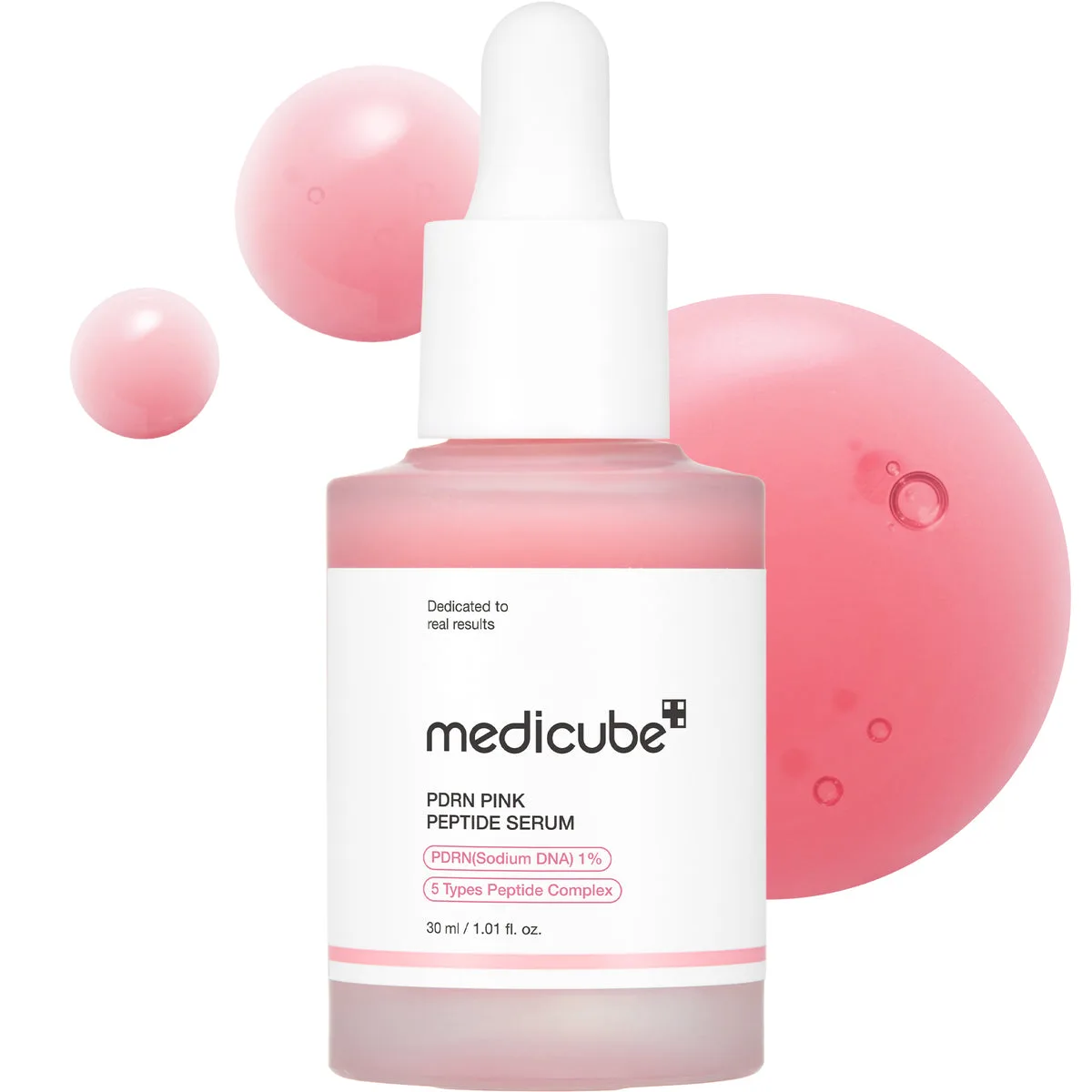
10,000 ppm salmon PDRN concentration at K-beauty mid-tier pricing — most salmon PDRN serums at this concentration sit at 50-80+ dollars. Combined with 5-peptide complex (Argireline, Matrixyl, copper tripeptide) plus niacinamide for layered anti-aging at exceptional value.
Medicube's PDRN Pink Peptide Serum delivers 10,000 ppm salmon PDRN plus 5-peptide complex plus niacinamide plus multi-form HA at 26 dollars for 30ml. Exceptional K-beauty value for the salmon-PDRN tier formulation depth — most salmon-PDRN serums at this concentration retail at 50-100+ dollars.
Promisingfor AgingIn your profileYou chose · Niacinamide has trial-level evidence for aging but no guideline or regulatory standing yet — promising, short of a recommendation; the other actives here are not yet assessed for it.Moderate evidenceGentleNo reviews collected yet
The case for it
Niacinamide has trial-level evidence for this concern but no guideline or regulatory standing yet.
It is plausibly present at a working level, though the concentration is not declared.
The formula carries none of the triggers this concern is sensitive to.
What would change this: A declared concentration would move this to a firmer reading of the dose.
Same rule for everyone. “Promising” is the verdict on 7,858 of 45,024 concern verdicts across the catalog; rule R9p decided 7,858 of them.
Unchanged since September 5, 2026, engine 5.1.1.
R9p — 0.5.0: 'Unproven' beside three filled dots read as one question answered twice with opposite words (7,018 rows). The chip measures standing, the dots measure trial volume; where the row carries at least one RCT or a tier-2 source (moderate dots) and the active is present at a working level, the honest word is Promising. Unproven is reserved for plausible-standing rows with limited or weak evidence, or an under-dosed form. Same rank as Unproven — a bet either way; the dots order them. · the full register
Carrying active
Niacinamide
Standing
plausible — trials support it
Form
plausible — studied range 4–5%, from the trials on the row; needs leave-on contact; judge it after ~8 weeks
Tolerability
gentle
Row checked
against its sources on July 17, 2026 (evidence table ev-2026.09-r228)
Good choicefor Compromised Skin BarrierIn your profileYou chose · Niacinamide is a reference standard by mechanism for compromised skin barrier; this serum carries it high in the ingredient list.Moderate evidenceGentleNo reviews collected yet
The case for it
Niacinamide has trial-supported standing for this concern.
It is present at an effective concentration, declared or high in the ingredient list.
The formula carries none of the triggers this concern is sensitive to.
Same rule for everyone. “Good choice” is the verdict on 9,564 of 45,024 concern verdicts across the catalog; rule R5 decided 9,072 of them.
Unchanged since September 5, 2026, engine 5.1.1.
Supporting rolefor DehydrationIn your profileYou chose · Nothing here targets dehydration directly; humectant hydration is the recognised companion to treating it, and this serum does that without known triggers.Not yet assessedGentleNo reviews collected yet
The case for it
Salmon PDRN has no evidence row yet for this concern — it is in the research queue.
The formula carries none of the triggers this concern is sensitive to.
What would change this: A researched evidence row for the lead active would replace this with a verdict.
Same rule for everyone. “Supporting role” is the verdict on 8,197 of 45,024 concern verdicts across the catalog; rule R8 decided 4,250 of them.
Unchanged since September 5, 2026, engine 5.1.1.
R8 — The category's job (barrier care, humectant hydration, gentle cleansing, photoprotection) is the documented supportive role for this concern. This is the honest verdict for a moisturizer on an acne page. · the full register
Also listed for Dullness — the actives here (PDRN (Polydeoxyribonucleotide) are in our research queue for that concern; there is no verdict until their evidence rows are written. That is a gap in our table, not a mark against the product.
A verdict is DermApproved’s assessment of how well a product’s ingredients fit a concern — never a claim about what the product treats. Evidence dots and collected reviews sit beside it and are never blended in.
Rules 0.5.1 · evidence table ev-2026.09-r228 · how we decide
Assessment
Pros & Cons
Pros
✓ 10,000 ppm salmon PDRN at meaningful concentration
✗ Pink-tinted product may not suit all aesthetic preferences
Review
Full Review
Salmon PDRN spent the last few years as Korean skincare's prestige flex — the ingredient you paid a premium for, with most meaningful-concentration serums parked somewhere between fifty and well over a hundred dollars, and the more affordable tier quietly substituting plant-derived sodium DNA instead. Medicube's PDRN Pink Peptide Serum is what happens when manufacturing scale gets pointed at that pricing structure: actual salmon PDRN at a declared 10,000 ppm, in a 30ml bottle that costs twenty-six dollars. The accessible salmon-PDRN serum wasn't supposed to exist yet, and here it is.
What makes salmon PDRN worth the fuss is that, among PDRN sources, it carries the most-developed clinical research — the polynucleotide fragments have a real body of literature behind them, most famously through injectable applications, with topical cosmetic use accumulating supportive evidence for cellular renewal and skin function. It's genuinely a different beast from the plant-derived sodium DNA that fills cheaper serums. At 10,000 ppm (one percent), Medicube isn't dabbling; that's a meaningful concentration, and it's the headline the whole product is built around. But the smart part of this formula is that the PDRN doesn't carry the load alone.
The supporting cast reads like a much pricier serum. There's a five-peptide complex spanning real categories of function: acetyl hexapeptide-8 (Argireline) for muscle-relaxing wrinkle softening, palmitoyl pentapeptide-4 and palmitoyl tripeptide-1 in the Matrixyl class for collagen support, copper tripeptide-1 (the well-studied GHK-Cu) for wound-healing and repair signaling, and acetyl tetrapeptide-2 for additional peptide activity. These are well-established actives, not novelties. Niacinamide sits high enough in the ingredient list to suggest a concentration that genuinely contributes to tone evenness and barrier function rather than a token dusting. Multi-form hyaluronic acid plus soluble and hydrolyzed collagen handle hydration and surface plumping, while Tulsi (holy basil) adds a traditional anti-inflammatory, adaptogenic accent. That's a lot of validated machinery aimed at anti-aging from several angles at once. It's the kind of ingredient deck where you keep expecting to find the catch — the moment where the impressive-sounding actives turn out to be present in trace amounts — and instead the concentrations that are disclosed actually hold up, which is rarer than it should be at this price.
Medicube, for its part, is a K-beauty brand owned by APR Co. and best known for its Zero Pore franchise, and the PDRN Pink line was its deliberate move into the salmon-PDRN trend. The brand has built a track record on accessible, formulation-forward products, and this serum reads as the entry-tier anchor of that line rather than a one-off gimmick. That context matters when you're weighing whether to trust a sub-thirty-dollar serum carrying a headline active that usually signals a premium price — this isn't a no-name dropshipper riding a trend, it's an established brand using scale to undercut the category.
The sensory experience is easy to live with. It's a lightweight, pink-tinted fluid that blends clear on contact and absorbs in well under a minute to a satin finish, and it's fully fragrance-free — a genuine plus for anyone whose skin objects to perfume in a leave-on. The immediate payoff is visible plumping and a dewier look from the PDRN-and-HA hydration plus the surface collagen, while the firming and fine-line softening that the peptides and PDRN promise are the slower story, building over roughly eight to twelve weeks of consistent twice-daily use. Set expectations accordingly: this isn't an overnight transformation, and no single PDRN serum is.
The limitations are few and mostly specific rather than fundamental. The most important is allergen-related: salmon PDRN means anyone with a documented fish or salmon-protein allergy should avoid this product outright. There's isopropyl myristate in the formula, which nudges it out of strictly fungal-acne-safe territory, so Malassezia-prone skin should be cautious. The pink tint, while it blends away, strikes some people as cosmetically odd next to a clear serum. And it's worth keeping a level head about PDRN marketing across K-beauty generally — the category leans hype-prone, and you should judge any of these serums on the formulation rather than the breathless claims. Treat the PDRN as a meaningful, evidence-backed contributor rather than a miracle, and you'll be calibrated correctly. None of these caveats undercut the core proposition; they just sketch the edges of who it isn't for and what it can't promise.
Value is where this genuinely shines, and the score reflects it. Twenty-six dollars for 30ml works out to roughly eighty-seven cents per milliliter, which is among the strongest deals in the salmon-PDRN category by a wide margin. The formulation depth — meaningful salmon PDRN, five real peptides, a working dose of niacinamide, multi-weight HA — competes with K-beauty serums at two to four times the price, and the savings come from APR Co's manufacturing scale and Medicube's accessible-pricing strategy rather than from cutting ingredient corners. For a K-beauty enthusiast curious about salmon PDRN without the premium-tier commitment, an anti-aging shopper roughly in the thirty-to-fifty range, or anyone hunting an affordable peptide-and-PDRN serum, this is an easy and genuinely well-priced recommendation. Skip it only if you have a fish allergy, you're managing fungal acne, or you came expecting a single serum to rewrite your face — temper that, and it delivers a remarkable amount for the money.
Formula
Key Ingredients
The hero actives that drive this product's performance.
Salmon-derived PDRN (polynucleotide fragments) at 10,000 ppm (1 percent) concentration. Salmon PDRN has the most-developed clinical research support in the PDRN category — different mechanism than plant-derived sodium DNA. Position 8 in INCI for the active concentration.
Multi-form hyaluronic acid for hydration; soluble and hydrolyzed collagen for surface plumping; Tulsi (Holy basil) for traditional anti-inflammatory and adaptogenic function. Supportive cast for the PDRN and peptide actives.
Not yet assessed
Ingredient standings describe the active at treatment-level doses and
vehicles; this product's own condition grades weigh its actual formula.
Salmon-derived PDRN (polynucleotide fragments) has the most-developed clinical research support in the PDRN category — particularly through Rejuran injectable applications. Topical salmon PDRN at meaningful concentrations has accumulating cosmetic research support for cellular renewal and skin function. Cosmetic peptides at the concentrations included have substantial research support — copper tripeptide-1, Matrixyl 3000 components (palmitoyl tripeptide-1 plus palmitoyl pentapeptide-4 in this product), and Argireline (acetyl hexapeptide-8) for muscle-relaxing wrinkle reduction. Niacinamide at meaningful concentrations provides validated tone evenness and barrier function. The combination addresses anti-aging through multiple validated mechanisms at exceptional value pricing.
References
Polynucleotides in skin rejuvenation: Evidence and clinical experience — Journal of Cosmetic Dermatology (2022)
Salmon-PDRN serums with peptide and niacinamide supporting cast provide reasonable anti-aging intervention with accumulating clinical research support. The Medicube PDRN Pink Peptide Serum delivers comparable formulation depth to premium K-beauty alternatives at substantially better value. Frequently recommended through K-beauty channels for value-priority anti-aging shoppers. Fish-allergic patients require alternative formulations.
Guidance
Usage & Recommendations
How to Use
Apply morning and evening after cleansing and toning on damp skin. Dispense 3-4 drops onto fingertips, warm between hands, and press into face and neck. Follow with moisturizer. Daily SPF essential in AM. Use consistently for 8-12 weeks to see cumulative anti-aging benefits.
Value Assessment
At 26 dollars for 30ml, per-ml cost is around 87 cents — exceptional value within the salmon-PDRN serum category. Comparable premium K-beauty salmon-PDRN serums run 60-150 dollars. Western brand PDRN alternatives at Sephora typically run 50-80 dollars. The Medicube pricing is among the strongest values for the formulation depth.
Who Should Buy
Value-priority shoppers wanting accessible salmon PDRN entry. K-beauty enthusiasts. Combination, normal, dry, or sensitive skin in 30-50 age range with anti-aging priorities. Anyone wanting affordable multi-mechanism anti-aging serum.
Lightweight pink-tinted serum that absorbs to a satin finish.
Scent
Fragrance-free.
Packaging
30ml dropper bottle. Pink Medicube aesthetic.
Finish
dewylightweight
What to Expect on First Use
First application feels lightweight and absorbs quickly. The slight pink tint blends in clear on the skin. Skin looks immediately more plumper and dewier from the immediate PDRN and HA hydration.
How Long It Lasts
Approximately 2-3 months at twice a day face application.
Medicube entered the PDRN trend with the Pink franchise — leveraging the brand's K-beauty manufacturing relationships to deliver salmon PDRN at substantially lower prices than premium Korean alternatives. The PDRN Pink Peptide Serum is the entry-tier product in the line.
About Medicube Established Brand (5–20 years)
Medicube is a K-beauty brand owned by APR Co. Ltd. — known for the Zero Pore franchise. The PDRN Pink franchise launched the brand into the salmon-PDRN trend with 10,000 ppm PDRN concentration plus 5-peptide complex, niacinamide, and Tulsi/holy basil. Accessible K-beauty PDRN serum at mid-tier pricing.
Brand founded: 2018 · Product launched: 2024
Myth vs. Reality
Common Myths
Myth
Affordable PDRN serums use plant-derived PDRN, not real salmon PDRN.
Reality
Medicube uses actual salmon-derived PDRN at 10,000 ppm in the Pink Peptide Serum. The brand's value positioning comes from manufacturing scale rather than ingredient compromise. Salmon PDRN at this concentration in this price tier is genuinely unusual.
FAQ
Frequently Asked Questions
What is the PDRN in Medicube Pink Serum?
Salmon-derived PDRN (polynucleotide fragments) at 10,000 ppm — the most-validated PDRN source with substantial clinical research support. Different and more researched than plant-derived sodium DNA alternatives.
Is this safe for fish-allergic users?
Caution — contains salmon-derived PDRN. Fish-allergic users should avoid or consult their physician. Plant-based PDRN alternatives may serve fish-allergic users better.
Is the Medicube PDRN Pink Serum pregnancy-safe?
Yes — PDRN, peptides, niacinamide, and the supportive cast are pregnancy-safe at cosmetic concentrations.
How does this compare to other K-beauty PDRN serums?
10,000 ppm salmon PDRN at 26 dollars is among the most accessible salmon-PDRN options. Comparable Korean salmon-PDRN serums (Rejuran, premium brands) typically run 60-150 dollars. Plant-PDRN alternatives (Abib Vitamin Drop) run lower-priced but with different active source.
Can I use this with retinol?
Yes — apply this AM, retinol PM. The PDRN, peptides, and niacinamide complement retinol's pathway through different mechanisms.
Reviews
What Reviewers Tend to Say
Recurring themes our editors read across retailer reviews of this product — summaries in our words, not quotations, and not a substitute for your own patch test.
Common Praise
10,000 ppm salmon PDRN is meaningful concentration
Five-peptide complex unusual at this price tier
Affordable K-beauty PDRN entry
Visible plumping over 4-8 weeks
Common Complaints
Fish-allergic users should avoid salmon PDRN products
Five brands that own the feed, judged on their ingredient lists rather than their view counts — including the one active all five suddenly added at once, and what that tells you.
The language of regenerative medicine has flooded the serum aisle — but most of these molecules are far too big to get through intact skin, and the fine print knows it.
'Peptides' is one word standing in for a dozen unrelated molecules with wildly different evidence — most serums are hope in a bottle, but a few classes earn their place.
Products, answers, therapy guides, tools and articles in one search. Brand names,
slang and abbreviations all work — accutane finds isotretinoin, bacne finds truncal acne.