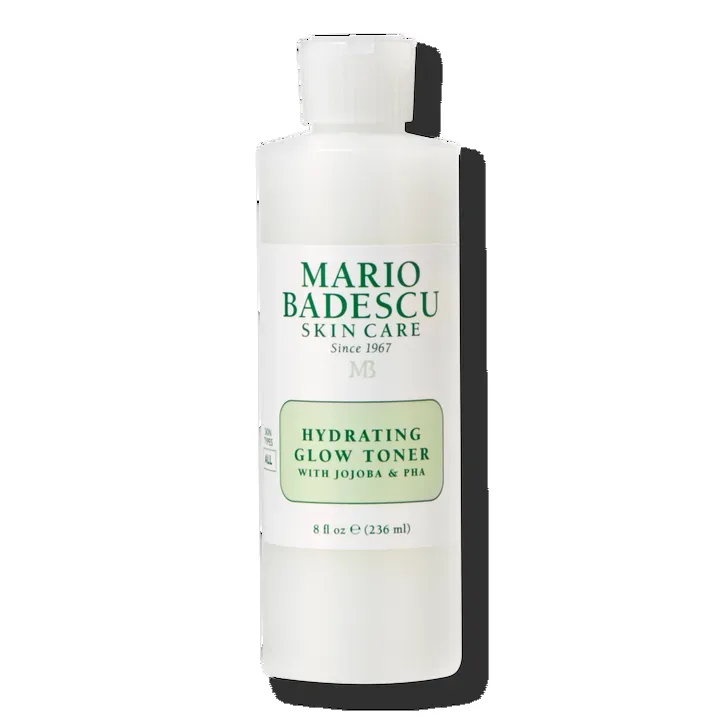
Combines a humectant base (propanediol, glycerin, sodium hyaluronate) with jojoba oil emulsified in to create a hybrid toner-serum that delivers immediate glow plus PHA exfoliation. The jojoba-PHA pairing is unusual at this price tier.
Mario Badescu's hybrid toner-serum delivers jojoba oil glow, PHA exfoliation, and a peptide in one bottle at 18 dollars. Generous 8oz size and visible immediate effect make it a strong drugstore pick — but the fragrance is a real consideration for sensitive skin. Better suited to the user who wants luminosity than the user who needs hypoallergenic minimalism.
On shelves since 2023, this toner-serum hybrid has gathered roughly 540 reviews across Ulta, Macy's, and Amazon, enough to gauge texture and tolerance. The rating reflects that moderate feedback plus its jojoba-PHA-peptide makeup, though the fragrance content polarizes response.
Verdicts
How well it fits each concern
Verdict by concern tap a concern for the case
Good choicefor DehydrationIn your profileYou chose · Hyaluronic Acid is a reference standard by mechanism for dehydration; this liquid carries it.Moderate evidenceStandard tolerability176 reviews collected
The case for it
Sodium Hyaluronate + Glycerin + Propanediol has trial-supported standing for this concern.
It is plausibly present at a working level, though the concentration is not declared.
The formula carries no trigger this concern is sensitive to, with the cautions noted.
What would change this: A declared concentration would move this to a firmer reading of the dose.
Same rule for everyone. “Good choice” is the verdict on 9,564 of 45,024 concern verdicts across the catalog; rule R5 decided 9,072 of them.
Unchanged since September 5, 2026, engine 5.1.1.
R5 — Trial-supported or guideline-supported active, adequately or plausibly dosed. · the full register
Carrying active
Sodium Hyaluronate + Glycerin + Propanediol
Standing
supported — its mechanism is established
Form
plausible — studied range 0.1%, from the trials on the row; needs leave-on contact; judge it after ~1 weeks
Tolerability
standard
Row checked
against its sources on July 17, 2026 (evidence table ev-2026.09-r228)
The studies behind the evidence row
Draelos ZD, Cosmetic Dermatology: Products and Procedures — hyaluronic acid classified as a humectant water-binding agent holding many times its weight in water — reference work
Promisingfor DullnessIn your profileYou chose · Hyaluronic Acid has trial-level evidence for dullness but no guideline or regulatory standing yet — promising, short of a recommendation; the other actives here are not yet assessed for it.Moderate evidenceStandard tolerability176 reviews collected
The case for it
Sodium Hyaluronate + Glycerin + Propanediol has trial-level evidence for this concern but no guideline or regulatory standing yet.
It is plausibly present at a working level, though the concentration is not declared.
The formula carries no trigger this concern is sensitive to, with the cautions noted.
What would change this: A declared concentration would move this to a firmer reading of the dose.
Same rule for everyone. “Promising” is the verdict on 7,858 of 45,024 concern verdicts across the catalog; rule R9p decided 7,858 of them.
Unchanged since September 5, 2026, engine 5.1.1.
R9p — 0.5.0: 'Unproven' beside three filled dots read as one question answered twice with opposite words (7,018 rows). The chip measures standing, the dots measure trial volume; where the row carries at least one RCT or a tier-2 source (moderate dots) and the active is present at a working level, the honest word is Promising. Unproven is reserved for plausible-standing rows with limited or weak evidence, or an under-dosed form. Same rank as Unproven — a bet either way; the dots order them. · the full register
Carrying active
Sodium Hyaluronate + Glycerin + Propanediol
Standing
plausible — trials support it
Form
plausible
Tolerability
standard
Row checked
against its sources on July 17, 2026 (evidence table ev-2026.09-r228)
Promisingfor AgingIn your profileYou chose · Peptides has trial-level evidence for aging but no guideline or regulatory standing yet — promising, short of a recommendation; the other actives here are not yet assessed for it.Moderate evidenceStandard tolerability176 reviews collected
The case for it
Palmitoyl Tetrapeptide-10 has trial-level evidence for this concern but no guideline or regulatory standing yet.
It is plausibly present at a working level, though the concentration is not declared.
The formula carries no trigger this concern is sensitive to, with the cautions noted.
What would change this: A declared concentration would move this to a firmer reading of the dose.
Same rule for everyone. “Promising” is the verdict on 7,858 of 45,024 concern verdicts across the catalog; rule R9p decided 7,858 of them.
Unchanged since September 5, 2026, engine 5.1.1.
R9p — 0.5.0: 'Unproven' beside three filled dots read as one question answered twice with opposite words (7,018 rows). The chip measures standing, the dots measure trial volume; where the row carries at least one RCT or a tier-2 source (moderate dots) and the active is present at a working level, the honest word is Promising. Unproven is reserved for plausible-standing rows with limited or weak evidence, or an under-dosed form. Same rank as Unproven — a bet either way; the dots order them. · the full register
Carrying active
Palmitoyl Tetrapeptide-10
Standing
plausible — trials support it
Form
plausible — studied range 0.0003%, from the trials on the row; needs leave-on contact
Tolerability
standard
Row checked
against its sources on July 17, 2026 (evidence table ev-2026.09-r228)
Also listed for Rough Texture — the actives here (Hyaluronic Acid, Peptides, Gluconolactone, Jojoba Oil) are in our research queue for that concern; there is no verdict until their evidence rows are written. That is a gap in our table, not a mark against the product.
Does the jobDoes what a toner is for: adds something real, not alcohol-driven. Not measured from the label: restores skin pH, plays well with what follows.
A verdict is DermApproved’s assessment of how well a product’s ingredients fit a concern — never a claim about what the product treats. Evidence dots and collected reviews sit beside it and are never blended in.
Rules 0.5.1 · evidence table ev-2026.09-r228 · how we decide
Assessment
Pros & Cons
Pros
✓ Jojoba oil for immediate visible glow
✓ Gentle PHA exfoliation without irritation for most users
✓ Calming peptide for barrier comfort
✓ Hybrid toner-serum convenience
✓ Strong value at 18 dollars for 8oz
✓ Generous size lasts 3-4 months
Cons
✗ Distinct floral fragrance is a real consideration for sensitive skin
✗ Plastic packaging is functional, not luxe
✗ Not fragrance-free option in brand range
✗ Some users find scent too strong for an everyday toner
Review
Full Review
The toner aisle has quietly split into two rival camps over the past few years, and which one a product belongs to tells you almost everything about who it is for. One camp is the minimalist hydrating toner, all water and glycerin and maybe a soothing extract, built to add a layer of moisture before serum and to respect the growing preference for fragrance-free routines. The other is the hybrid toner-serum, multifunctional and often loaded with actual actives, designed for the person who wants the toner step to accomplish something beyond pre-dampening the skin. Mario Badescu's Hydrating Glow Toner plants its flag firmly in the second camp, and your tolerance for the choices that come with that territory will decide whether it earns a place on your shelf.
The formulation rewards a closer look. Water leads, trailed by propanediol and glycerin in the familiar humectant scaffold, with sodium hyaluronate adding depth further down. The interesting move is jojoba seed oil at roughly position six, emulsified into the watery base, and it is the engine behind the glow the name promises. Jojoba is the most sebum-mimetic plant oil available, structurally a liquid wax rather than a true oil, which gives it the unusual ability to support barrier function across all skin types, oily skin included, without typically triggering breakouts. Gluconolactone, a polyhydroxy acid, sits near the end of the list to provide gentle surface exfoliation, working through the same broad mechanism as the alpha hydroxy acids but with a larger molecule that penetrates less deeply, which is exactly why it tends to sit better on sensitive skin. Palmitoyl tetrapeptide-10 closes things out as a calming peptide aimed at barrier comfort rather than collagen production. And then, unmistakably, there is fragrance.
That fragrance is the load-bearing controversy of the whole product. It is a real, perceptible floral-fresh scent that fades within a few minutes but announces itself clearly during application. For anyone who enjoys fragranced skincare or is simply indifferent to it, this is a complete non-issue and you can stop worrying about it. For anyone who avoids fragrance for sensitivity or barrier reasons, this is the entire conversation, and Mario Badescu's own fragrance-free options in their range are the smarter pick. The brand made a deliberate category-positioning decision to scent this toner, and whether that decision suits you depends entirely on your relationship with scented products. There is no neutral way to split the difference, so it is best to be clear-eyed about it before buying.
Application itself is satisfying in a way that justifies the toner-serum framing. The texture is slightly milky and mildly viscous thanks to the emulsified jojoba, heavier than a watery toner but lighter than a serum, and it absorbs in roughly thirty seconds to a visible satin glow with no tackiness left behind. That immediate luminosity is the strongest selling point, and it is largely the jojoba layer catching and reflecting light off the skin's surface, so it shows up within a minute. The polyhydroxy acid does its quieter work in the background, gently smoothing surface texture over four to six weeks of consistent use, while the peptide contributes a barrier comfort that probably matters most to anyone stepping down from a heavier exfoliation routine or trying to coax a stressed barrier back to calm.
The practical case here is the person who wants immediate glow plus a little subtle treatment folded into a single step. At eighteen dollars for eight ounces, the per-ounce cost competes genuinely well against the Korean glow toners that often run far higher, and the generous size lasts roughly three to four months at twice-daily use. The packaging is honest functional plastic, nothing remotely luxe, and that is reflected in the price rather than hidden by it. For a Mario Badescu loyalist already comfortable with the brand's habit of subtle scenting, this slots cleanly into an existing routine, backed by the brand's long lineage of toner formulation stretching across decades. The data confidence here is medium rather than high, with a few hundred reviews behind it, so treat the texture-refinement claim as a reasonable expectation rather than an ironclad guarantee.
Where it lands is as a strong, fairly-priced glow toner for normal, dry, and combination skin that wants luminosity and gentle exfoliation in one bottle and does not mind, or actively enjoys, a noticeable scent. It is decidedly not the choice for anyone seeking hypoallergenic minimalism, and the fragrance-sensitive should look to the brand's unscented options or to fragrance-free alternatives elsewhere. Judged on its own terms, as a luminosity-first hybrid for the scent-tolerant, it delivers exactly what it sets out to, and at a price that makes the experiment low-risk. For best results, treat it as the hydrating-treatment step it is rather than as a wipe-off astringent: press it into clean, slightly damp skin with your palms instead of dragging it around on a cotton pad, which wastes product and undercuts the glow, then follow with your serum and moisturizer while the skin is still receptive. Used that way morning and night, it earns its keep as a pleasant, multitasking middle step that brightens the surface today and quietly refines the texture over the weeks that follow.
Formula
Key Ingredients
The hero actives that drive this product's performance.
Sebum-mimetic liquid wax that supports barrier function and provides emollient feel. In this toner, sits at position 6 and gives the hybrid toner-serum its signature satin finish.
Polyhydroxy acid for gentle surface exfoliation; gluconolactone also has secondary antioxidant function. Suits sensitive skin better than glycolic or salicylic at equivalent doses.
Anti-inflammatory peptide that supports the skin's natural calming response. Less collagen-stimulating than Matrixyl peptides; more focused on barrier comfort.
Multi-humectant scaffold — propanediol position 2, glycerin position 3, sodium hyaluronate later. Provides the hydration depth that the toner-serum format requires.
Established mechanismfor Dehydration · established mechanism
Ingredient standings describe the active at treatment-level doses and
vehicles; this product's own condition grades weigh its actual formula.
Jojoba seed oil is structurally a liquid wax rather than a true oil, and its molecular similarity to human sebum gives it the unique property of supporting barrier function across all skin types including oily. PHA (gluconolactone) provides gentle surface exfoliation through the same mechanism as AHAs but with lower penetration depth — the larger molecular size limits sensitization while maintaining surface keratinocyte turnover effect. Polyhydroxy acids have substantial dermatologic literature support for sensitive skin tolerance. Palmitoyl tetrapeptide-10 is positioned as a calming peptide in cosmetic literature; the specific clinical data is less developed than for Matrixyl 3000, but the mechanism of soothing skin response support is plausible at cosmetic concentrations. The combination targets glow (jojoba), texture (PHA), and barrier comfort (peptide) through parallel mechanisms.
Polyhydroxy Acids: A Comprehensive Review — Journal of Cosmetic Dermatology (2019)
Dermatologist Perspective
Dermatologists often recommend PHAs over AHAs and BHAs for sensitive skin tolerance — gluconolactone provides surface exfoliation with significantly lower sensitization risk. Jojoba oil is widely accepted as suitable across skin types due to its sebum-mimetic structure. The Mario Badescu formulation provides a reasonable entry-level PHA toner with the glow benefit added through the jojoba content. The fragrance inclusion is the primary clinical caveat — patients with rosacea, eczema, or contact dermatitis history are typically steered toward fragrance-free alternatives for daily-use products. For patients without fragrance reactivity seeking a multi-functional toner, this formulation offers reasonable value.
Guidance
Usage & Recommendations
How to Use
After cleansing, apply to damp skin with hands by patting in or with a cotton pad by sweeping outward. Use morning and evening. Follow with serum and moisturizer; daily SPF essential due to PHA content. For sensitive skin, start every other day for the first week. The 8oz bottle benefits from being used as a generous body toner on chest and back if desired — the formulation is gentle enough for body application.
Value Assessment
At 18 dollars for 8 fl oz, the per-ounce cost lands around 2.25 dollars — exceptional value against Korean glow toners with comparable jojoba-PHA combinations at 30-40 dollars for 6oz. The generous size is genuinely cost-effective for users who can tolerate the fragrance. The trade-off is real: the fragrance-free price-equivalent options (like Cosrx PHA Mildly Toner) sacrifice the jojoba glow effect but suit fragrance-sensitive users better. For the right user, this is a strong value play.
Who Should Buy
Users wanting immediate glow plus subtle PHA exfoliation in a single toner step. Fragrance-tolerant skin types. Mario Badescu fans expanding beyond the classic line. Combination, dry, and normal skin types looking for hybrid toner-serum convenience at a drugstore price.
Who Should Skip
Fragrance-sensitive, rosacea-prone, or eczema-managed users should choose Mario Badescu's Aloe Vera Toner or another fragrance-free option. Anyone with documented PHA reactivity. Users wanting stronger exfoliation (AHA/BHA) should look to different toners. Skin in active barrier compromise.
Slightly milky, mildly viscous toner-serum hybrid that absorbs in under a minute.
Scent
Distinct floral-fresh fragrance — noticeable but not overpowering. Dissipates within minutes.
Packaging
8oz / 236ml plastic bottle with screw cap. Generous size for the price.
Finish
dewysatinglowy
What to Expect on First Use
First use feels cool and lightly hydrating with a noticeable scent. Skin looks immediately more luminous due to the jojoba oil layer. PHA gives subtle smoothness without sting.
How Long It Lasts
Approximately 3-4 months applied morning and evening face and neck application.
Mario Badescu added this toner to compete in the trending glow-toner category, alongside their long-running Aloe Vera and Glycolic Acid toners. The hybrid format reflects current consumer preference for multi-functional toner steps.
About Mario Badescu Legacy Brand (20+ years)
Mario Badescu's Hydrating Glow Toner combines jojoba oil, PHA (gluconolactone), and palmitoyl tetrapeptide-10 in a toner-serum hybrid format. The brand has 58 years of toner-formulation experience anchored by their long-running Aloe Vera and Glycolic Acid toners.
Brand founded: 1967 · Product launched: 2023
Myth vs. Reality
Common Myths
Myth
Toners with oil cannot work for oily skin.
Reality
Jojoba oil is sebum-mimetic and balances rather than exacerbates oil production. Oily skin can tolerate it well when emulsified in a watery toner base.
FAQ
Frequently Asked Questions
Is the Mario Badescu Hydrating Glow Toner good for oily skin?
Yes — the jojoba oil is sebum-mimetic and tends to balance rather than aggravate oil production. The watery emulsified base prevents the toner from feeling heavy.
Does the fragrance cause irritation?
Most users tolerate it without issue, but fragrance-sensitive skin should patch test. Mario Badescu's fragrance-free Aloe Vera Toner is a better choice for fragrance avoidance.
How does this compare to glycolic acid toners?
PHA (gluconolactone) is significantly gentler than glycolic acid — less penetration depth means less sensitization risk. Glycolic acid toners are stronger but harder to tolerate.
Can I use this with vitamin C?
Yes — PHA and vitamin C layer compatibly. Apply this toner first, then vitamin C serum.
Is the Hydrating Glow Toner considered pregnancy-friendly?
Yes — all active ingredients (jojoba, PHA, peptide, HA) are considered pregnancy-safe.
Reviews
What Reviewers Tend to Say
Recurring themes our editors read across retailer reviews of this product — summaries in our words, not quotations, and not a substitute for your own patch test.
Common Praise
Visible glow effect after use
Hybrid toner-serum convenience
PHA without irritation for most users
Pleasant scent
Common Complaints
Fragrance is divisive — some users find it strong
Not ideal for fragrance-sensitive skin
8oz size in plastic bottle is functional but not luxe
Notable Endorsements
Featured in toner roundups as accessible PHA option
Polyhydroxy acids get filed under 'beginner exfoliant,' as if gentle meant weak. The truth is stranger: their bulk is exactly why they work for the skin everything else sets on fire.
More products claim to fix dullness than any other concern, which is a strong hint the word means nothing — it is at least four separate mechanisms, and the one nobody sells for is the blood.
Glow isn't a vibe or a filter. It's light bouncing off smooth, hydrated, evenly-toned skin, which means you can reverse-engineer it into a checklist instead of chasing it with a highlighter.
Products, answers, therapy guides, tools and articles in one search. Brand names,
slang and abbreviations all work — accutane finds isotretinoin, bacne finds truncal acne.