One Active at a Time: How to Add a Treatment Without Wrecking Six Weeks of Skin
The most common self-inflicted skincare injury is not a bad product. It is three good ones started in the same fortnight, leaving nobody able to name the culprit.
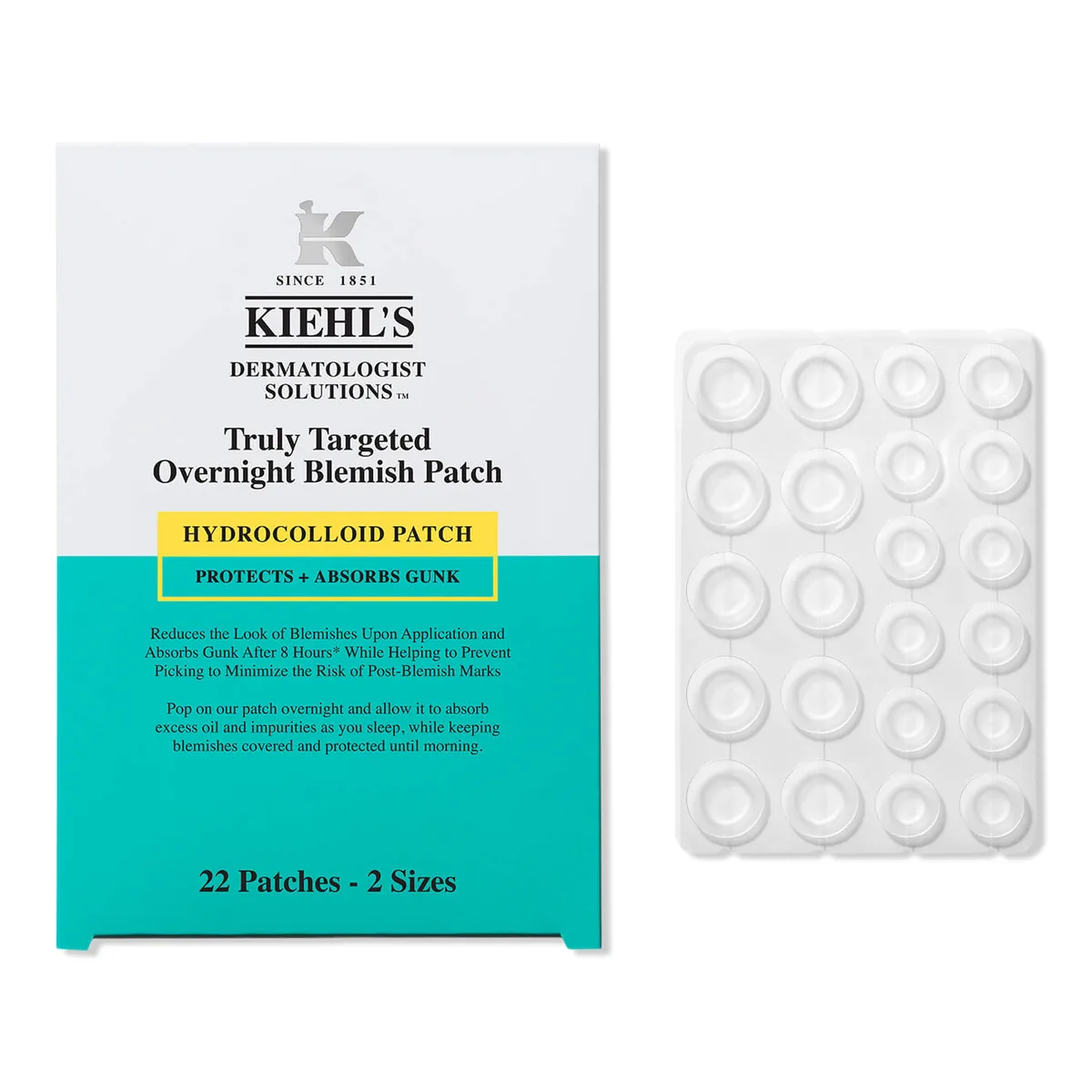
Very little in the patch and quite a lot on the box: this is a five-ingredient medical-grade hydrocolloid with no added actives, made the way the category leaders make theirs, sold under Kiehl's 1851 name as the overnight half of its Truly Targeted acne pair. Its mix of ten large and twelve small patches and its thin tapered edge are the practical differences; the price is the impractical one.
A perfectly good, entirely ordinary hydrocolloid patch with an apothecary label: five ingredients, no actives, a thin tapered edge and a sensible mix of large and small sizes. It does what every hydrocolloid patch does, flattening a spot that has come to a head and stopping you picking it, and it charges about double per patch for the privilege. Buy it to complete the Truly Targeted pair; otherwise the category leaders do the same job for less.
This patch reached Kiehl's range in 2026 and is still listed as new and online-only at its main retailer, with no reviews to speak of, so nothing here reflects how its adhesion and edge hold up across many nights and many faces. The assessment rests on the well-documented behaviour of hydrocolloid dressings, on the patch's five-ingredient composition, which matches the category standard, and on Kiehl's own eight-hour consumer figures, which come without a published sample size.
Listed for Acne — the actives here (adhesive polymers, Mineral Oil, hydrocolloid) are in our research queue for that concern; there is no verdict until their evidence rows are written. That is a gap in our table, not a mark against the product.
A verdict is DermApproved’s assessment of how well a product’s ingredients fit a concern — never a claim about what the product treats. Evidence dots and collected reviews sit beside it and are never blended in. Rules 0.5.1 · evidence table ev-2026.09-r228 · how we decide
Hydrocolloid is not a skincare invention. It is a wound dressing, developed in the 1980s for ulcers and burns, that absorbs exudate into a gel while keeping the wound moist and sealed, and Korean manufacturers noticed some years ago that a small disc of it does the same thing to a pimple that has come to a head. The category that followed is one of the most crowded in skincare, and almost every entry in it is the same five-ingredient dressing cut into circles. So when Kiehl's, a brand that has traded on its 1851 apothecary heritage for longer than hydrocolloid has existed, adds a patch to its Truly Targeted acne line, the fair question is what a luxury name can bring to a product whose mechanism was settled before the brand's current owners bought it.
The answer, on the ingredient list, is nothing, and that is not a criticism. Hydrogenated polyolefin and a styrene-butadiene copolymer form the adhesive, cellulose gum is the hydrocolloid, mineral oil keeps the matrix flexible and an antioxidant protects it: five ingredients, the same five, in the same order, that the market leaders list. There are no added actives, no salicylic acid, no tea tree, no centella, which for a hydrocolloid patch is the right decision, since anything dissolved in the adhesive either does not reach the skin or stings when it does. Kiehl's makes no special-formula claim and the label is honest about being a physical patch that absorbs oil gunk, in the brand's phrase, and prevents picking.
In use, it behaves like a well-made example of the type. The disc is thin, with a tapered edge that sits nearly flush and does not catch on a pillowcase, and it grips clean, dry skin at once. On a spot that has come to a head it turns cloudy white within a few hours as the gum swells with fluid, and in the morning it peels away without residue, leaving the pimple flatter, drier and less red, and, more importantly, unpicked. Kiehl's reports fluid absorption inside three hours and that 96 percent of its testers found the spot less visible after eight, which is what the category reliably delivers. On a closed, deep or cystic bump nothing happens, because there is no fluid to draw, and the patch becomes an expensive cover; the brand's own salicylic acid liquid is the right tool for those, and the two products are clearly designed as a pair, liquid by day, patch by night.
The practical details are thoughtful. The box holds ten large patches and twelve small, which is a better ratio for most faces than the all-small sheets some brands sell, and the backing sheets keep the adhesive clean. Made in Korea like nearly all of the category, the dressing itself is medical-grade and hypoallergenic in the ordinary sense: nothing in it leaves the adhesive, so it suits sensitive, pregnant, retinoid-using and every other kind of skin, and it is one of the few acne products that can honestly be called safe for everyone. The one thing it cannot tolerate is product underneath; a serum or moisturiser on the spot stops it sticking, which is the cause of most patch complaints across every brand. Timing is the other skill. Applied to a bump that has not yet opened, the patch stays clear all night and comes off with nothing to show, and the temptation is to blame the patch rather than the pimple; the trick is to wait until the spot has a visible head, or to use the salicylic liquid first and the patch a night later, which is the sequence the two-product line is built around.
Which leaves the price. Sixteen dollars for twenty-two patches is around seventy cents each, roughly double the per-patch cost of the biggest names in the category, whose boxes hold thirty-six or forty, and several times the cost of the drugstore and Korean-import options that use identical dressings. What the premium buys is the Kiehl's name, the teal box, a nicely tapered edge and the satisfaction of a matching pair with the Truly Targeted liquid. Those are real things to some buyers, and a well-cut thin patch is not nothing when the alternative lifts at the edge by three in the morning. They are not things that make a hydrocolloid patch work better, and Kiehl's, to its credit, does not pretend they are. The patch arrived in 2026, is listed as new and online-only at its main retailer, and has essentially no review record yet; its behaviour is the behaviour of the dressing, which is well understood.
So the recommendation writes itself in two lines. If you already use the Truly Targeted liquid, like the brand, and want the overnight step in the same design language, this is a good patch and you will be happy with it. If you simply want hydrocolloid patches that flatten a spot and keep your fingers off it, the market leaders sell the same thing for half the price per patch, and a dressing does not know, or care, whose name is on the box.
The hero actives that drive this product's performance.
| Ingredient | Function | Evidence |
|---|---|---|
| Hydrocolloid (Cellulose Gum) | The carboxymethylcellulose particles suspended through the adhesive that give the patch its purpose: on contact with the fluid from a spot that has come to a head they swell into a soft gel, drawing exudate out and turning the patch cloudy white, while keeping the lesion moist and sealed from fingers and bacteria. Every hydrocolloid patch on the market works this way, and this one adds nothing to the mechanism, which is a fair choice. | Not yet assessed |
| Hydrogenated Poly(C6-20 Olefin) & Styrene/Butadiene Copolymer Adhesive | The rubbery adhesive matrix that holds the cellulose gum, listed first and third, which determines how well the patch grips through a night of pillow contact and how cleanly it peels in the morning. A tackifier-and-elastomer base of this kind is the standard for medical-grade hydrocolloid dressings and is why the patch stays put without a rim of residue. | Not yet assessed |
| Mineral Oil | A plasticiser that keeps the adhesive matrix flexible enough to conform to the curve of a chin or nose rather than lifting at the edge, and that softens the peel so the patch does not take skin with it. It sits inside the adhesive, not on the skin, so the usual debates about mineral oil in leave-on skincare do not apply here. | Not yet assessed |
Ingredient standings describe the active at treatment-level doses and vehicles; this product's own condition grades weigh its actual formula.
Hydrogenated Poly(C6-20 Olefin), Cellulose Gum, Hydrogenated Styrene/Butadiene Copolymer, Mineral Oil, Pentaerythrityl Tetra-Di-T-Butyl Hydroxyhydrocinnamate
treatment
PM
Press a patch onto a clean, completely dry spot that has come to a head as the very last step at night, before or after moisturiser as long as the skin under the patch is bare and dry, and peel it off on waking; a serum or spot liquid applied under the patch stops it sticking, so choose one or the other.
The patch turns cloudy as it absorbs fluid within a few hours and the spot looks flatter and less angry on removal in the morning. It does nothing for closed, deep or cystic bumps and does not prevent the next breakout; its longer-term benefit is the picking it stops, which is what reduces marks.
Hydrocolloid dressings have a wound-care literature going back four decades, and everything a pimple patch does is borrowed from it. The dressing is a dispersion of hydrophilic particles, here carboxymethylcellulose listed as cellulose gum, in a hydrophobic adhesive matrix of hydrogenated polyolefin and styrene-butadiene rubber, plasticised with mineral oil. On contact with fluid the cellulose particles swell into a gel, absorbing exudate and turning the dressing opaque, while the matrix maintains a sealed, moist environment over the lesion. Moist wound healing under occlusion is well documented to speed re-epithelialisation and reduce scarring compared with air-dried wounds, and occlusion also excludes bacteria and, in the case of acne, fingers. Applied to a pustule that has ruptured or come to a head, the patch absorbs the exudate over a few hours and reduces the lesion's height and redness by morning, which is consistent with Kiehl's reported three-hour absorption and eight-hour visibility figures.
The evidence specific to acne is thinner than the wound-care base but consistent. A small randomised trial of hydrocolloid dressings on inflammatory acne lesions reported reduced redness, oiliness and lesion severity over a week compared with tape, and the mechanism most likely to matter over time is behavioural: covering a lesion prevents the manipulation that converts a pustule into an excoriation and a post-inflammatory mark. The patch has no effect on closed comedones, papules without exudate or nodulocystic lesions, which contain no accessible fluid; on those it is an inert cover.
The composition here is the industry standard. Hydrogenated poly(C6-20 olefin) and hydrogenated styrene/butadiene copolymer are the tackifier and elastomer of a typical hot-melt pressure-sensitive adhesive; mineral oil is the plasticiser that governs conformability and peel force; pentaerythrityl tetra-di-t-butyl hydroxyhydrocinnamate is an antioxidant that prevents the rubber from oxidising. None of these components migrates meaningfully into skin, which is why hydrocolloid patches are among the least reactive acne products available and are compatible with pregnancy, retinoids and sensitive skin. Patches that add salicylic acid or botanicals to the adhesive have not been shown to outperform plain hydrocolloid and can irritate; this patch's decision to omit them is supported by the evidence. Kiehl's consumer figures come from its own eight-hour testing without a published sample size, and no independent study of this patch exists.
Dermatologists generally like hydrocolloid patches for one reason above all: they stop patients picking. A pustule that is covered overnight is a pustule that does not become an excoriation, and excoriation is the route by which ordinary acne turns into the marks and small scars that patients later spend far more money trying to fade. Clinicians would frame this patch as exactly what it is, a medical-grade dressing cut small, safe for every skin type including during pregnancy and isotretinoin, and appropriate for a spot that has come to a head, with no expectation that it treats the acne beneath. They would also be clear about its limits: a patch does nothing for a closed comedone, a deep papule or a cyst, and a patient reaching for patches several times a week has an acne problem that needs a retinoid, benzoyl peroxide or a prescription across the whole face rather than a sticker on each spot. On the brand question, most dermatologists would say plainly that hydrocolloid is hydrocolloid, that the dressing's thickness and edge matter more than the name, and that the money saved on cheaper patches is better spent on sunscreen for the marks.
At night, cleanse and dry the face thoroughly, then, before applying anything else to the spot, peel a patch from the sheet, choosing a large disc for a raised pustule and a small one for a minor spot, and press it firmly over a pimple that has come to a head, holding for a few seconds so the tapered edge seals. Apply your serum and moisturiser around the patch rather than under it. Leave it on for six to eight hours or overnight; it will turn cloudy white as it absorbs fluid. In the morning, peel it off gently from one edge, discard it, and cleanse as usual before sunscreen. Use a fresh patch each night until the spot has flattened. Do not use it on closed or deep bumps, which contain no fluid for it to absorb, and do not apply it over a spot treatment, which will stop it sticking.
At $16 for 22 patches, about 73 cents each, this is one of the more expensive hydrocolloid patches on the market, roughly double the per-patch price of the category's best-selling boxes and several times that of drugstore and Korean-import equivalents made from the same five ingredients. The premium buys the Kiehl's name, a well-cut thin patch, a good large-to-small ratio and a matching partner to the Truly Targeted liquid; it does not buy any difference in how the dressing works. For someone who gets a few spots a month and already shops the brand, the box lasts about a month and the cost is tolerable. For anyone using patches regularly, or simply wanting the mechanism, the value is poor and the alternatives are obvious. There is one box size and no subscription discount worth the name.
People who already use Kiehl's Truly Targeted liquid by day and want the matching overnight patch, and anyone who values the brand's design and a thin, well-cut hydrocolloid enough to pay a premium for it. It suits every skin type, including sensitive skin and anyone pregnant or on a retinoid, for spots that have come to a head.
Frequent patch users and anyone buying on price, since the same five-ingredient dressing costs half as much per patch from the category leaders. It also offers nothing for closed, deep or cystic acne, and anyone breaking out several times a week needs a full-face treatment rather than a sticker.
Ready to try Kiehl's Truly Targeted Overnight Blemish Patch?
Buy at Amazon ♥A thin, flexible, translucent hydrocolloid disc with a tapered edge that sits nearly flush on skin and turns opaque white where it has absorbed fluid.
None.
A small teal-and-white card box holding sheets of patches, ten large and twelve small, in Kiehl's Truly Targeted livery; the sheets keep the adhesive clean between uses.
The patch grips at once on clean, dry skin and is barely felt overnight. By morning it has usually turned cloudy over the spot and peels off without residue, leaving the pimple flatter and drier; on a closed bump nothing visible happens, which is the sign it was applied too early.
About a month for someone who gets a few spots a week; a box of twenty-two patches is small compared with the thirty-six to forty-count boxes most of the category sells.
All Year
Kiehl's launched its Truly Targeted acne line in 2024 with a liquid pimple patch as the daytime treatment and added this hydrocolloid sticker in 2026 as the overnight companion, completing a two-step it had until then left to other brands. Hydrocolloid patches came to skincare from wound dressings via Korean manufacturers, and Kiehl's version is made in Korea like most of the category.
Kiehl's has a 175-year apothecary heritage and has belonged to L'Oréal since 2000, which supplies its testing resources and, for a hydrocolloid patch, access to the contract manufacturers that make most of the category. The brand's claims are supported by its own consumer and dermatologist testing rather than published trials, and a plain hydrocolloid patch draws its evidence from the wound-dressing literature rather than from any brand.
A hydrocolloid patch draws the infection out of any pimple.
The patch absorbs fluid from a spot that has already come to a head and shields it from picking. On a closed, deep or cystic bump there is no fluid to draw and the patch does nothing but cover it; those need a salicylic acid or benzoyl peroxide treatment, or a dermatologist.
A patch from a luxury brand works better than a drugstore one.
This patch lists the same five-ingredient hydrocolloid adhesive the category leaders use, with no added actives. Hydrocolloid performance depends on the dressing's thickness, edge and adhesive, not on the brand, and Kiehl's makes no claim of a special formula.
Five ingredients: a hydrogenated polyolefin and a styrene-butadiene copolymer that form the adhesive, cellulose gum as the hydrocolloid that absorbs fluid, mineral oil as a plasticiser and an antioxidant. There are no actives, no fragrance and nothing that leaves the adhesive to enter the skin.
Use the patch overnight on a spot that has come to a head and would otherwise be picked; use the salicylic acid liquid by day on red, closed bumps and on the mark afterwards. The two are designed as a pair and should not be layered on the same spot at the same time.
Overnight, six to eight hours, or until it has turned cloudy white over the spot. Kiehl's reports that it absorbs fluid within three hours and that 96 percent of testers found the spot less visible after eight.
Hydrocolloid needs bare, completely dry skin. Any serum, moisturiser or spot liquid under the patch will stop it adhering, so cleanse, dry the area and apply the patch before anything else goes on that spot.
It is a well-made but generic hydrocolloid at roughly seventy cents a patch, about double the per-patch cost of the category's biggest names. Buyers who like Kiehl's and want the matching overnight step to the liquid may find it worth it; anyone just wanting patches will do as well for less.
It is thin with a tapered edge and can be worn by day, but it is designed for overnight use and shows once it turns white. For daytime, Kiehl's positions its invisible liquid as the patch alternative.
Recurring themes our editors read across retailer reviews of this product — summaries in our words, not quotations, and not a substitute for your own patch test.
Too few reviews to establish patterns; early buyers mention a thin edge and clean overnight adhesion
Too few reviews to establish patterns; the price per patch is the first thing raised