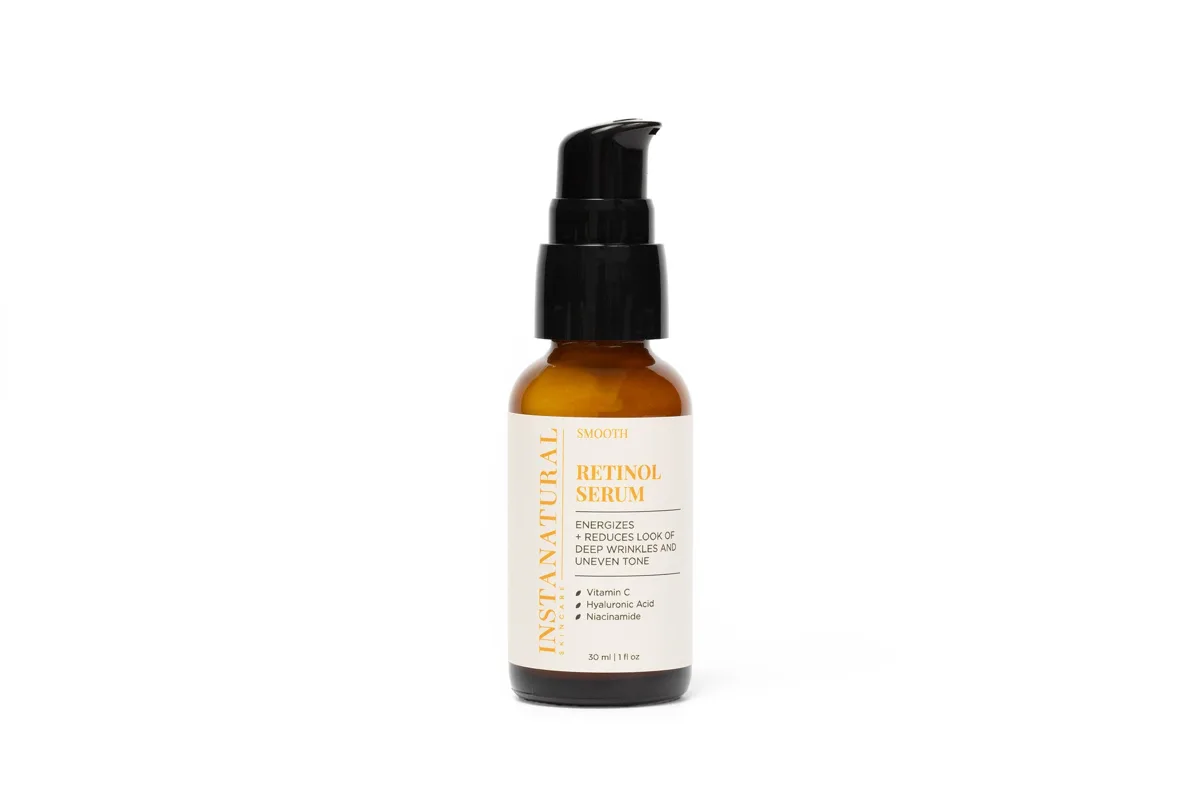
It bundles a low-dose retinol with a genuine sodium ascorbyl phosphate dose and niacinamide in one emollient, botanical-heavy lotion — a 'do everything gently' approach aimed squarely at retinol beginners, at a price under most single-active retinol serums. The catch is that the brand's description still lists licorice and astaxanthin that the current formula does not contain, a sign the copy has not kept up with the reformulations.
A gentle, emollient starter retinol with a real vitamin C derivative doing quiet work beside it, priced under most single-active retinols. The retinol itself is low on the list and undisclosed, the fragrance is unnecessary, and the description still names ingredients that left the formula in a reformulation. Good for a first retinol; not the deep-wrinkle serum the box promises.
Good choicefor AgingIn your profileYou chose · Retinol is a trial-supported active for aging; this serum carries it, though the concentration is not declared.Moderate evidenceStandard tolerabilityNo reviews collected yet
The case for it
Retinol has trial-supported standing for this concern.
It is plausibly present at a working level, though the concentration is not declared.
The formula carries no trigger this concern is sensitive to, with the cautions noted.
What would change this: A declared concentration would move this to a firmer reading of the dose.
Same rule for everyone. “Good choice” is the verdict on 9,564 of 45,024 concern verdicts across the catalog; rule R5 decided 9,072 of them.
As of September 25, 2026, engine 5.1.1.
Good choicefor HyperpigmentationIn your profileYou chose · Niacinamide is a trial-supported active for hyperpigmentation; this serum carries it, though the concentration is not declared.Moderate evidenceStandard tolerabilityNo reviews collected yet
The case for it
Niacinamide has trial-supported standing for this concern.
It is plausibly present at a working level, though the concentration is not declared.
The formula carries no trigger this concern is sensitive to, with the cautions noted.
What would change this: A declared concentration would move this to a firmer reading of the dose.
Same rule for everyone. “Good choice” is the verdict on 9,564 of 45,024 concern verdicts across the catalog; rule R5 decided 9,072 of them.
As of September 25, 2026, engine 5.1.1.
Also listed for Dullness and Rough Texture — the actives here (Vitamin C, Niacinamide, Antioxidants, Retinol) are in our research queue for those concerns; there is no verdict until their evidence rows are written. That is a gap in our table, not a mark against the product.
A verdict is DermApproved’s assessment of how well a product’s ingredients fit a concern — never a claim about what the product treats. Evidence dots and collected reviews sit beside it and are never blended in.
Rules 0.5.1 · evidence table ev-2026.09-r228 · how we decide
Assessment
Pros & Cons
Pros
✓ Emollient meadowfoam-and-triglyceride base makes it one of the gentler first retinols
✓ Sodium ascorbyl phosphate at ninth position is a real, stable vitamin C dose
✓ Niacinamide and a broad antioxidant deck help tolerance and protect the retinol
✓ Light lotion texture sinks in fast with no tackiness
✓ Amber glass pump bottle protects the retinol from light and air
✓ Around $20 for 30ml undercuts most single-active retinol serums
✓ Long Amazon history with thousands of ratings
Cons
✗ Retinol is twenty-second on the list with no stated percentage — a low starter dose
✗ 'Reduces deep wrinkles' claim exceeds what this dose can deliver
✗ Description names licorice and astaxanthin that the current formula does not contain
✗ Added fragrance in a product aimed at cautious, retinol-new skin
✗ Emulsion separates and must be shaken before each use
✗ Amazon reviews span several reformulations and may not describe this version
Review
Full Review
Count down the InstaNatural Retinol Serum's ingredient list and you reach the retinol at twenty-two — after the water and glycerin and aloe, after two oils and a vitamin C derivative, after the preservative and the fragrance and the niacinamide, after pomegranate and acai and chamomile and geranium and cucumber. The brand does not say what percentage that is, and the position says it for them: this is a low dose, the kind that introduces skin to retinol rather than the kind that changes it. That is not a criticism so much as a classification, and once you accept it, the serum turns out to be a pleasant, sensible product for the job it can actually do.
What that job looks like is a gentle first retinol for someone who has heard the word and is nervous about it. The base is a light emulsion — water, glycerin and aloe carrying meadowfoam seed oil, a caprylic triglyceride and a little soybean oil — that goes on like a thin lotion, sinks in within a minute, and leaves the skin comfortable rather than tight. That cushioning matters with retinol, and it is the reason the first two weeks with this serum are milder than most people brace for: a little warmth, perhaps a patch of flaking beside the nose, and for many users simply softer skin in the morning. Anyone who has used a 0.5 percent retinol will notice the step down at once. Anyone who has never used one will notice only that the horror stories did not arrive.
The more interesting active is ninth on the list, not twenty-second. Sodium ascorbyl phosphate is a stable, water-soluble vitamin C derivative that does not need the low pH pure ascorbic acid does, which means it can sit in the same bottle as retinol without a fight, and it has trial evidence of its own: a placebo-controlled study of a 5 percent SAP emulgel found it reduced crow's-feet wrinkle depth and improved elasticity to the same extent as ascorbic acid. Ninth position in a lotion is consistent with a meaningful dose, and it is the reason this serum brightens as well as smooths over the first couple of months — the retinol's contribution to tone at this level is modest, and SAP is doing a good share of the work the box attributes to retinol. Niacinamide follows at fourteenth, low but useful, adding a little barrier support and helping the skin tolerate the whole thing.
Then there is a long botanical tail — hesperidin, pomegranate, acai, chamomile, geranium, cucumber, centella, hibiscus, green tea, rosemary — which reads as InstaNatural's house style and functions as a low-dose antioxidant cluster that mostly protects the retinol in the bottle and adds a soothing note on the skin. None of it is at a level to act alone, and none of it is harmful. What is odd is the brand's own description, which promises licorice extract and astaxanthin; neither is on the list. The serum has been reformulated at least once since its 2014 launch, most recently with a late-2024 relaunch, and the copy appears to belong to an older version. It is a small thing and a telling one — read the list, not the paragraph above it — and the same applies to the Amazon review history, which spans every version and cannot be assumed to describe this one.
Used as directed — a pump at night, every other night to start, sunscreen every morning — the serum does what a low-dose retinol with a vitamin C derivative should. By week four the texture is smoother and the tone fresher; by week twelve fine lines are a little softer and old post-blemish marks have faded. Deep wrinkles do not move, and the box's promise that they will is the one claim I would strike. The retinol evidence for wrinkles comes from concentrations around 0.4 percent and above used for months, and this is not that. It is a starter, and a good one.
The limitations beyond the dose are few. The added fragrance is unnecessary in a retinol product aimed at cautious skin, and a fragrance-sensitive reader should note it. The emulsion separates slightly on standing, hence the instruction to shake, which is harmless but reads as cheap. And the product name, shared with the brand's stronger 2.5% Retinol Bakuchiol Serum on some retailer pages, invites confusion about which one you are buying.
On the brand: InstaNatural is an affordable American label that rose on Amazon around 2013 with vitamin C and retinol serums, sells on a 'natural' positioning, and validates its products with consumer-perception panels — the 26-day survey on this page, in which most users reported softer, more hydrated skin, is exactly that kind of data and should be read as satisfaction, not efficacy. The company's habit of reformulating without updating its copy is the main reason to keep an eye on the list.
So: if you want a comfortable, inexpensive first retinol that will not make you flake, with a real vitamin C derivative and a little niacinamide riding along, this is a fair choice at about $20 for 30ml, and a sensible bridge to something stronger in six months. If you want visible wrinkle reduction, you already tolerate retinol, or you prefer your actives unscented, look to a stated-strength serum instead — including, ironically, the brand's own 2.5 percent retinol-bakuchiol product.
Formula
Key Ingredients
The hero actives that drive this product's performance.
Twenty-second of twenty-eight ingredients, after the cucumber extract and before the hyaluronate — a position that puts the retinol well below the 0.3 to 1 percent range of a serious retinol serum, and the brand does not state a figure. That makes this a gentle, beginner-level dose: enough to nudge cell turnover and cause mild dryness in the first weeks, not enough to deliver the wrinkle-depth changes retinol is famous for at clinical strength.
Ninth on the list, ahead of the preservative — a real dose of a stable, water-soluble vitamin C derivative that has its own trial evidence for wrinkles and elasticity at 5 percent, and that pairs with retinol without the pH conflict pure ascorbic acid would create. In this serum it is arguably the more substantial active.
Fourteenth, just after the preservative and fragrance — a low dose that lends a little barrier support and tone-evening to the mix, and helps buffer the retinol's irritation. The brand's description leads with it; its position does not.
The emollient pair that gives the serum its lotion-like slip and makes it a comfortable first retinol for dry skin: a stable, non-greasy plant oil and a light triglyceride, both high on the list, that cushion the retinol and reduce the tightness a water-gel serum would produce.
A citrus flavonoid mid-list, followed by pomegranate, acai, chamomile, green tea and rosemary — a broad low-dose antioxidant cluster that helps protect the retinol from oxidation in the bottle and adds a soothing note on the skin. None is at a level to act on its own.
Not yet assessed
Ingredient standings describe the active at treatment-level doses and
vehicles; this product's own condition grades weigh its actual formula.
Night only, on dry skin after cleansing, before moisturizer. Beginners: every other night for two weeks, then nightly. Skip exfoliating acids on retinol nights for the first month; a vitamin C serum belongs in the morning routine, not stacked on top. Sunscreen every morning is non-negotiable.
Results Timeline
First two weeks: possible mild dryness, flaking or a warm flush as skin adjusts, usually milder than with a stronger retinol. Four to six weeks: smoother texture and a fresher tone from the turnover and the vitamin C derivative. Twelve weeks and beyond: modest softening of fine lines; deep wrinkles, despite the box, are beyond what this dose can reach.
Retinol's evidence is among the strongest in cosmetic dermatology, and it is dose-dependent, which is the crux of assessing this serum. Kafi and colleagues, in the Archives of Dermatology in 2007, ran a randomised, double-blind, vehicle-controlled trial of 0.4 percent retinol lotion applied up to three times a week for 24 weeks to naturally aged skin in elderly subjects, and found significant improvement in fine wrinkling versus vehicle, with biopsies showing increased glycosaminoglycan expression and procollagen I production — the biochemical basis for retinol's plumping and smoothing. That is the kind of concentration and duration behind the phrase 'reduces wrinkles', and it is worth holding in mind that the retinol here sits twenty-second of twenty-eight ingredients, after several botanical extracts, with no declared percentage. At that position the retinol is plausibly in the range that accelerates turnover and improves texture with mild irritation, and implausibly in the range the trial used.
The serum's second active has a smaller but relevant literature. Mohammadi and colleagues, in the Journal of Cosmetic Dermatology in 2021, prepared emulgels containing 5 percent sodium ascorbyl phosphate or 5 percent ascorbic acid, tested their stability by HPLC, and ran a two-sided blind, placebo-controlled comparison on the crow's-feet area of healthy volunteers; both actives significantly reduced wrinkle depth and improved elasticity, with no statistically significant difference between them, and both required added antioxidants for shelf stability. SAP is ninth on this list, ahead of the preservative, which is consistent with a functional dose, and its neutral-pH compatibility with retinol makes it a sensible partner. Niacinamide at fourteenth contributes barrier support and mild tone benefit at a low level. The botanical antioxidants — hesperidin, pomegranate, acai, green tea, rosemary — are consistent with the stabilising role the SAP study describes as necessary, and are otherwise present below active levels. The licorice and astaxanthin named in the product description are absent from the ingredient list and cannot be assessed.
Low-dose over-the-counter retinol has a legitimate role in clinical advice as the on-ramp to retinoid therapy: it teaches the skin to tolerate the class, produces modest texture and tone benefit, and lets a patient move to a stated 0.5 or 1 percent retinol or to prescription tretinoin or adapalene with less trouble later. This serum fits that role — the emollient vehicle and the niacinamide are appropriate for retinol-naive or drier skin, and the vitamin C derivative is a reasonable companion. The reservations clinicians would raise are the ones the ingredient list raises: an undisclosed and evidently low retinol concentration cannot be expected to change established wrinkles, the added fragrance is an avoidable irritant in a product aimed at cautious users, and marketing that describes ingredients no longer in the formula is a reason to read labels rather than copy. Standard retinoid counselling applies — night use, daily broad-spectrum sunscreen, avoidance in pregnancy and breastfeeding as a precaution, and a pause during any procedure or active dermatitis. Patients with rosacea or eczema should patch-test and expect to build up slowly.
Guidance
Usage & Recommendations
How to Use
Shake the bottle, then at night — after cleansing and once the skin is fully dry — dispense one to two pumps onto the fingertips and press over the face and neck, avoiding the eyelids and the corners of the nose and mouth where retinol stings. Follow with a plain moisturizer; a ceramide cream is ideal for the first weeks. Start every other night for two weeks, then nightly if there is no persistent flaking, and drop back if there is. Keep exfoliating acids and benzoyl peroxide off retinol nights for the first month. Wear a broad-spectrum sunscreen every morning without exception. Store the amber bottle away from heat and light; the light emulsion will separate a little between uses, and a shake fixes it. Stop and switch to a retinol-free product if pregnant, breastfeeding or trying to conceive.
Value Assessment
About $20 for 30ml is inexpensive for a retinol serum, and cheaper still when the bottle is judged as retinol plus a real sodium ascorbyl phosphate dose plus niacinamide — three actives in one emollient base for the price of one budget retinol. The value holds for the reader it suits: a beginner who wants a gentle, comfortable first retinol and does not mind fragrance. It weakens for anyone seeking a stated strength, since the low, undisclosed retinol means the money is buying tolerance rather than potency, and a serum with a declared 0.3 to 0.5 percent at a similar price would deliver more change per dollar for skin that can handle it. A 2oz size exists on some retailers at a better unit price. InstaNatural's evidence is consumer perception rather than trials, which the price honestly reflects, and its unchanged copy across reformulations is a reason to check the list before each repurchase.
Who Should Buy
Anyone new to retinol — especially normal, dry or combination skin that wants texture and tone improvement without peeling — who would like a vitamin C derivative and niacinamide included, at a price that makes the experiment cheap. It is a sensible six-month bridge before moving to a stated-strength retinol.
Who Should Skip
People who already tolerate a 0.5 percent or stronger retinol and want visible wrinkle change — this is a step down — and anyone who prefers fragrance-free actives or a declared percentage. It is not suitable in pregnancy or breastfeeding, and rosacea-prone or eczema-prone skin should patch-test and expect to build up slowly.
A thin, pale-yellow lotion-serum with a faint natural tint from the botanicals — closer to a light milk than a gel — that spreads easily, sinks in within a minute and leaves a soft, slightly emollient finish rather than a tacky one.
Scent
A light, sweet, faintly citrus-floral added fragrance over an earthy botanical base; noticeable on application, gone within minutes.
Packaging
A 30ml amber glass bottle with a black treatment pump and a cream-coloured label in InstaNatural's plain house style. Amber glass protects the retinol from light and the pump keeps air and fingers out, which suits a retinol better than a dropper would; the brand's instruction to shake before use hints at a light emulsion that can separate.
Finish
satinlightweightnon-greasy
What to Expect on First Use
Milder than most people expect from a retinol: a little warmth on the first few nights, a hint of dryness or flaking around the nose and chin by the end of week one for some, and for many nothing beyond softer skin in the morning. That gentleness is the emollient base and the low dose working together. Anyone who has used a 0.5 percent retinol will find this a step down; anyone who has never used one will find it a comfortable first step.
How Long It Lasts
About two months at one to two pumps nightly; three months every other night.
InstaNatural's retinol serum was one of the products that made the brand on Amazon around 2014, riding the first wave of affordable 'natural' actives. It has been reformulated at least once since, most recently with a late-2024 relaunch that pairs the retinol with sodium ascorbyl phosphate and a botanical antioxidant deck; the Amazon listing and its review history span all versions.
About InstaNatural Established Brand (5–20 years)
InstaNatural is an affordable US brand founded around 2013 that built its name on Amazon-popular vitamin C and retinol serums. It runs consumer-perception panels rather than clinical trials, and its retinol serum has been reformulated since the original 2014 launch — the current list reads differently from the marketing copy that still describes it.
Brand founded: 2013 · Product launched: 2014
Myth vs. Reality
Common Myths
Myth
It contains licorice extract and astaxanthin, as the brand's description says.
Reality
Neither appears on the current ingredient list, which has hesperidin, pomegranate, acai, chamomile, green tea and rosemary instead. The description appears to date from an earlier formula. What the serum actually contains for brightening is sodium ascorbyl phosphate at a real dose and a small amount of niacinamide.
Myth
Any retinol serum 'reduces deep wrinkles'.
Reality
The clinical evidence for retinol and wrinkles comes from concentrations around 0.4 percent and above, used for months. With retinol twenty-second on this list and no stated percentage, this serum is a low-dose starter that improves texture and tone; deep wrinkles need a stronger retinol or a prescription retinoid.
FAQ
Frequently Asked Questions
What percentage of retinol is in the InstaNatural Retinol Serum?
InstaNatural does not state it. Retinol is the twenty-second of twenty-eight ingredients, after the cucumber extract, which points to a low, beginner-level dose well below the 0.3 to 1 percent of stronger retinol serums. The brand's separate 2.5% Retinol Bakuchiol Serum is the higher-strength option.
Is the InstaNatural Retinol Serum good for beginners?
Yes — that is its best use. The low retinol dose, the emollient meadowfoam and triglyceride base, and the niacinamide make it one of the gentler first retinols, with mild dryness rather than peeling for most people. Start every other night and build up.
Can I use this retinol serum with vitamin C?
It already contains a vitamin C derivative — sodium ascorbyl phosphate, ninth on the list — which sits comfortably with retinol. Use a separate vitamin C serum in the morning if you like; there is no need to layer one on top of this at night.
Does the InstaNatural Retinol Serum contain licorice or astaxanthin?
Not according to the current ingredient list, despite the product description mentioning both. The formula has been reformulated and the copy has not caught up; its brightening ingredients are sodium ascorbyl phosphate and niacinamide.
Is this serum safe to use while pregnant?
Retinol is generally avoided in pregnancy and breastfeeding as a precaution, regardless of dose, and this serum contains it. Choose a retinol-free alternative — the brand's own vitamin C or niacinamide serums, for example — until after.
Why does the bottle say to shake before use?
The serum is a light emulsion — water, glycerin and aloe carrying meadowfoam oil, a triglyceride and soybean oil — and the oil phase can separate slightly on standing. A shake recombines it; it does not indicate the product has spoiled.
Reviews
What Reviewers Tend to Say
Recurring themes our editors read across retailer reviews of this product — summaries in our words, not quotations, and not a substitute for your own patch test.
Common Praise
Gentle enough for retinol beginners
Skin feels softer and smoother within weeks
Lightweight lotion texture, no greasiness
Good value for the size
Pleasant light scent
Common Complaints
Retinol strength not stated and results are mild
Fragrance — some prefer unscented actives
Formula and packaging have changed over the years
Breakouts or dryness in the first weeks for some
Notable Endorsements
Amazon listing since 2014iHerb and Walmart stockist
The standard product post opens with a percentage rather than a lifestyle photo, and the regulator makes brands publish their evidence. Both of those are ahead of the West. The metric they created is the problem.
The one home formulation with a genuinely coherent case, taken apart on its own terms: the pH window, the oxidation clock, and what a browning serum has actually become.
Pure vitamin C is the most-studied form and the hardest to keep alive in a bottle. The alphabet soup of derivatives isn't a downgrade — it's a series of trades, and some of them are the smarter buy.
It's a legitimately useful antioxidant with real anti-aging data — but 'nature's retinol' oversells a thin evidence base, and it isn't a retinoid at all.
May 6, 2026· 5 min
Questions people ask about Hyperpigmentation
Verified answers from our questions library — the nuance a product page cannot carry.
Products, answers, therapy guides, tools and articles in one search. Brand names,
slang and abbreviations all work — accutane finds isotretinoin, bacne finds truncal acne.