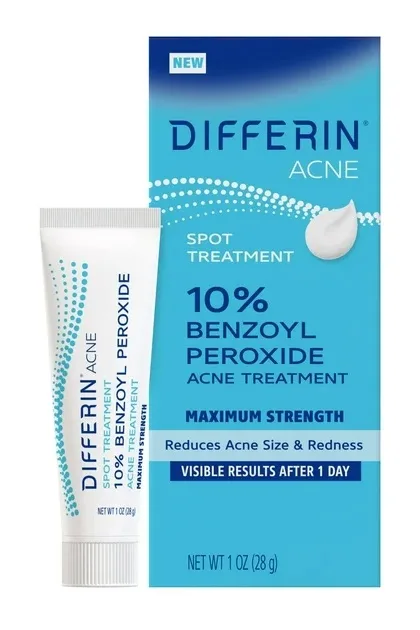
It's the maximum 10% over-the-counter benzoyl peroxide in a leave-on, targeted format — so unlike a wash-off cleanser, the active stays on the blemish for hours of sustained contact. The silica-mattifying gel base is built to dry down nearly invisibly and sit under makeup, making it a practical daytime spot fix rather than a messy ointment.
An effective, no-frills pimple zapper delivering the strongest over-the-counter benzoyl peroxide in a targeted leave-on gel. It calms individual blemishes within a day or two and dries down nearly invisibly under makeup. Just treat it as a spot fix, not an all-over solution: at 10% it's drying, it bleaches fabric, and it works on existing spots rather than preventing new ones.
Strong choicefor AcneIn your profileYou chose · Benzoyl Peroxide is an approved or monograph active for acne; this gel carries it at 10%.Strong evidenceGentleNo reviews collected yet
The case for it
Benzoyl Peroxide 10% is a first-line active — approved, monograph-listed or named in current guidelines — for this concern.
It is present at an effective concentration, declared or high in the ingredient list.
The formula carries none of the triggers this concern is sensitive to.
Same rule for everyone. “Strong choice” is the verdict on 1,459 of 45,024 concern verdicts across the catalog; rule R2 decided 892 of them.
Unchanged since September 5, 2026, engine 5.1.1.
R2 — A regulator- or guideline-recognised first-line active, declared at an effective strength, in a form the claim supports. · the full register
Carrying active
Benzoyl Peroxide 10%
Standing
first line — a regulator recognises it for this use; trials support it · per 21 CFR § 333.310 - Acne active ingredients. (US Code of Federal Regulations (Legal Information Institute, Cornell Law School)), opened July 27, 2026
Form
adequate (declared 10%) — studied range 2.5–10%, from the OTC monograph or label; judge it after ~6 weeks
Tolerability
gentle
Row checked
against its sources on July 27, 2026 (evidence table ev-2026.09-r228)
Also listed for Blackheads — the actives here (Benzoyl Peroxide, Glycerin, Silica) are in our research queue for that concern; there is no verdict until their evidence rows are written. That is a gap in our table, not a mark against the product.
A verdict is DermApproved’s assessment of how well a product’s ingredients fit a concern — never a claim about what the product treats. Evidence dots and collected reviews sit beside it and are never blended in.
Rules 0.5.1 · evidence table ev-2026.09-r228 · how we decide
Assessment
Pros & Cons
Pros
✓ Maximum OTC benzoyl peroxide calms pimples fast
✓ Leave-on format gives the active sustained contact time
✓ Silica finish dries nearly invisible and sits under makeup
✓ Targeted use limits all-over dryness
✓ Fragrance-free, alcohol-free, and inexpensive
✓ A tube lasts months thanks to sparing spot application
Cons
✗ Dries out the treated spot and nearby skin
✗ Too strong for sensitive, dry, or rosacea-prone skin
✗ Bleaches towels, pillowcases, and clothing
✗ Treats existing pimples but doesn't prevent new ones
✗ Can clash with retinoids and vitamin C if layered
Review
Full Review
Everyone knows the specific dread of the overnight pimple: the one that wasn't there yesterday and is now throbbing, red, and impossible to ignore before an event. That single-blemish emergency is exactly the problem Differin's 10% Benzoyl Peroxide Spot Treatment is built to solve. It's not trying to be a whole-face acne system or a daily routine staple. It's a targeted intervention — the strongest over-the-counter dose of a proven active, in a format designed to sit on one spot and work — and judged on that narrow brief, it's a competent little product.
The active is benzoyl peroxide at 10%, the maximum concentration the FDA allows without a prescription. What separates this from Differin's foaming wash isn't the strength — both hit 10% — but the contact time. A cleanser rinses off in seconds; this gel stays on the blemish for hours, giving the benzoyl peroxide a sustained window to do its bactericidal, pore-clearing work directly on the lesion. For an active that benefits from contact time, leave-on application on a target spot is the more potent delivery, which is why a spot treatment can visibly calm a pimple faster than a wash treats the same spot.
The formula around the active is sensible for the job. There's glycerin and propylene glycol as humectants to take some of the sting out of a leave-on 10% dose, an acrylates film-former and carbomer to keep the gel where you put it, and — the genuinely smart inclusion — silica, which gives the gel a mattifying, slightly oil-absorbing finish. That silica is why this dries down to a nearly invisible matte layer instead of a greasy shine, and why it behaves under makeup. It's fragrance-free, alcohol-free, and short on anything extraneous, which is appropriate for a targeted treatment you're dabbing onto compromised skin.
In use, it does what it says. Apply a thin layer to a fresh blemish and, more often than not, the spot looks noticeably calmer within twenty-four to forty-eight hours, continuing to flatten over the following days. The mattifying finish means you can wear it during the day without an obvious shiny patch. For knocking down an individual pimple quickly, it's reliable, and the price — around thirteen dollars for a tube that lasts months because you use so little — makes it an easy keep-on-hand product.
But the limitations are real, and they all trace back to the same fact: this is the maximum OTC strength of a famously drying active. Even with the humectants, a leave-on 10% benzoyl peroxide will dry out the treated spot and a small ring of skin around it, often with visible flaking after a few days. That's the active working, but it's also why precision matters — keep it on the pimple, not the surrounding clear skin, or you'll trade one problem for a patch of irritated dryness. People with sensitive, dry, eczema-prone, or rosacea-prone skin should be cautious or skip it entirely, because even spot use can provoke a reaction on reactive skin.
Then there are the practical hazards that come with all benzoyl peroxide. It bleaches fabric on contact — pillowcases, towels, the collar of a dark shirt — so let it dry fully and mind what it touches. It can oxidize vitamin C and shouldn't be layered on the same spot as a retinoid in the same session, where it risks both inactivation and over-irritation. And pregnancy is a sensible time to check with a doctor before reaching for the maximum strength. None of these are dealbreakers, but they're the kind of details that separate a good outcome from an irritated, bleach-spotted one.
The most important framing, though, is conceptual. This is a treatment for pimples that already exist, not a strategy for preventing new ones. Spot-treating after a blemish erupts does nothing to stop the next one; genuine acne control comes from a consistent routine applied across the whole affected area — a cleanser, a leave-on active like adapalene or a lower-strength benzoyl peroxide, and the discipline to use them daily. This product is the patch, not the plan. Used as an adjunct to a real routine, or as an occasional rescue for the rare breakout on otherwise clear skin, it's perfect. Used as someone's entire acne approach, it will disappoint, because that's not the job it's designed for.
On value, it's a fair, practical buy. You're paying a modest price for the maximum OTC dose of a thoroughly proven active in a well-made, makeup-friendly gel, and a single small tube outlasts most products because spot use is so sparing. Differin's acne credibility is real, even if it rests more on adapalene than on this particular item, and there's no hype premium baked into the price. The smart-shopper caveat is the same as with all 10% benzoyl peroxide: many spots respond just as well to gentler strengths, so the maximum dose is best reserved for stubborn blemishes or resilient skin.
The honest bottom line: as a targeted pimple treatment, this delivers exactly what it promises — fast, effective spot relief from the strongest benzoyl peroxide you can buy without a prescription, in a format that stays put and disappears under makeup. Respect what it is (a spot fix, not a routine), keep it off clear skin and white linens, pair it with moisturizer, and it's a genuinely useful thing to have in the cabinet for the next overnight surprise.
Formula
Key Ingredients
The hero actives that drive this product's performance.
The maximum OTC dose of benzoyl peroxide, left on the skin as a targeted spot treatment so a single blemish gets a concentrated, sustained antibacterial hit. Unlike the wash-off version, leave-on contact lets it work on the pimple over hours rather than seconds.
Humectants included to soften the drying blow of a leave-on 10% benzoyl peroxide. They help the gel stay tolerable on a single spot, though they can't fully prevent the dryness that comes with the strongest OTC dose.
Lends the gel a slightly mattifying, oil-absorbing finish so a treated spot doesn't look greasy and sits better under makeup. It's a practical texturizer that suits the targeted, daytime-friendly intent of a spot product.
Not yet assessed
Ingredient standings describe the active at treatment-level doses and
vehicles; this product's own condition grades weigh its actual formula.
Dab a thin layer only on the blemish after cleansing, before moisturizer. Keep it off surrounding clear skin to limit dryness, and don't apply a retinoid or vitamin C directly over the same spot in the same session.
Results Timeline
An active pimple often looks calmer within 24-48 hours of targeted use, with continued flattening over several days. It treats existing spots quickly but isn't a whole-face acne strategy on its own.
Benzoyl peroxide's anti-acne credentials are among the strongest in dermatology, which anchors this spot treatment's effectiveness. It acts by releasing reactive oxygen that is bactericidal against Cutibacterium acnes, exerts mild comedolytic activity, and notably does not promote bacterial resistance, a key advantage over topical antibiotics. The factor most relevant to this specific format is contact time: as a leave-on product it maintains prolonged exposure on the targeted lesion, which is mechanistically more favorable for a single blemish than a brief rinse-off, and explains the quick visible calming users report. The concentration nuance from the broader literature still applies — comparative studies have found 2.5% and 5% benzoyl peroxide can match 10% in efficacy with less irritation, since the active's benefit plateaus while dryness rises with strength — so the maximum dose is most defensible for stubborn spots or oilier, resilient skin rather than as a universal default. The humectants (glycerin, propylene glycol) and the absence of fragrance are reasonable, evidence-aligned choices to improve tolerability of a high-strength leave-on. As benzoyl peroxide increases photosensitivity and is drying, daily sun protection and restrained, targeted application are the supported best practices, and it should not be combined with ingredients it can oxidize.
Dermatologist Perspective
In clinical acne management, benzoyl peroxide is a foundational topical, and spot treatment is recognized as a useful adjunct for individual inflammatory lesions rather than a stand-alone regimen. Practitioners commonly emphasize that consistent, whole-area treatment is what controls acne, while a leave-on spot product is best understood as targeted relief for a blemish that has already formed. The strength consideration is frequently raised: because lower concentrations often perform comparably with less irritation, a maximum 10% formula tends to be reserved for resilient skin or persistent spots. Standard guidance includes applying it precisely to the lesion to spare surrounding skin, moisturizing to counter dryness, using sun protection, avoiding combination with easily oxidized actives in the same step, and seeking individualized advice for sensitive, rosacea-prone, or pregnant patients.
Guidance
Usage & Recommendations
How to Use
Use it only on individual blemishes, not all over. After cleansing, dab a thin layer directly onto the pimple and let it dry down before applying moisturizer; keep it off surrounding clear skin to minimize dryness. It can be used morning or night, though if you wear it in the day, follow with sunscreen since benzoyl peroxide raises sun sensitivity. Don't apply a retinoid or vitamin C over the same spot in the same session. Let it dry fully before contact with fabric, since it bleaches towels, pillowcases, and clothing. Pregnant users should check with a doctor before use.
Value Assessment
At around thirteen dollars for a one-ounce tube, this is a reasonable, practical buy, and its real value lies in longevity: because you apply only a dab to individual blemishes, a single tube lasts months. You're paying a modest price for the maximum OTC dose of a well-proven active in a tidy, makeup-friendly gel, with no luxury markup attached to Differin's acne reputation. The sensible caveat mirrors all 10% benzoyl peroxide products — many pimples respond just as well to gentler 2.5% or 5% strengths with less dryness — so the maximum dose is best value for stubborn spots or oilier skin. As an occasional rescue product rather than a daily staple, the cost-per-use is genuinely low.
Who Should Buy
People with oily, combination, or resilient skin who want a fast, targeted fix for the occasional angry pimple and already have a consistent acne routine in place. It's ideal as a rescue product for stubborn individual blemishes rather than as a primary, whole-face treatment.
Who Should Skip
Those with sensitive, dry, eczema-prone, or rosacea-prone skin should skip it, since even spot use of a 10% leave-on benzoyl peroxide can irritate. Anyone whose spots clear with a gentler strength, or who needs a preventive whole-area acne strategy rather than a spot fix, will be better served elsewhere. Pregnant users should consult a doctor first.
Ready to try Differin Acne Spot Treatment 10% Benzoyl Peroxide?
A clear, lightweight gel that spreads thin and dries down to a slightly matte, almost invisible film thanks to the silica.
Scent
Fragrance-free, with only the faint characteristic note of benzoyl peroxide.
Packaging
Small squeeze tube sized for occasional spot use; benzoyl peroxide can bleach fabric, so keep it off colored linens.
Finish
matteinvisiblenon-greasy
What to Expect on First Use
Dabbed on a blemish, it dries quickly to a near-invisible matte layer and gets to work within a day. Expect the treated spot and a small ring around it to feel dry and possibly flake over the following days — a normal sign of the active working, and the reason it's meant for the pimple itself, not the whole face.
How Long It Lasts
Several months, since a spot treatment is used sparingly on individual blemishes rather than all over.
It rounds out Differin's benzoyl peroxide lineup at the most targeted end: where the foaming wash treats acne-prone areas broadly, this concentrates the maximum OTC strength on a single emerging pimple. The leave-on gel format is the point, giving the active the prolonged contact time a quick rinse-off can't.
About Differin Established Brand (5–20 years)
Differin earned its standing by bringing prescription-strength adapalene to the over-the-counter aisle, and its acne expertise is genuine. This spot treatment delivers benzoyl peroxide, an OTC monograph drug with decades of clinical evidence, so the science underpinning it is well established even if the formula itself is straightforward.
Brand founded: 1996 · Product launched: 2023
Myth vs. Reality
Common Myths
Myth
A spot treatment can be slathered over the whole face for faster results.
Reality
This is a targeted, leave-on 10% benzoyl peroxide meant for individual blemishes. Applying it all over would cause widespread dryness and irritation without added benefit — use a wash or lower-strength leave-on for full-face coverage.
Myth
Spot treatments prevent future breakouts.
Reality
A spot treatment addresses pimples that have already formed. Preventing new acne requires a consistent routine across the whole affected area, not dabbing product on spots after they appear.
FAQ
Frequently Asked Questions
How fast does the Differin 10% benzoyl peroxide spot treatment work?
Applied to a fresh blemish, it often looks noticeably calmer within 24 to 48 hours and continues to flatten over the following days. The leave-on format gives the active sustained contact time on the spot.
Can I use this spot treatment all over my face?
No. It's a targeted, leave-on 10% benzoyl peroxide meant for individual pimples. Applying it all over would cause widespread dryness and irritation. Use a wash or lower-strength leave-on for full-face coverage.
Does this benzoyl peroxide spot treatment prevent breakouts?
No, it treats pimples that have already formed. Preventing new acne requires a consistent routine across the whole affected area, so think of this as a rescue product rather than your primary acne strategy.
Will the spot treatment dry out my skin?
Yes, somewhat. A leave-on 10% benzoyl peroxide dries the treated spot and a ring around it, sometimes with flaking. Apply it only to the blemish and follow your routine with a good moisturizer.
Does this spot treatment bleach fabric?
Yes. Benzoyl peroxide bleaches towels, pillowcases, and clothing, so let it dry completely before contact with fabric and be mindful of what it touches after application.
Is the Differin benzoyl peroxide spot treatment safe during pregnancy?
Benzoyl peroxide is often considered acceptable in pregnancy, but at maximum strength it's best to confirm with your doctor before using it, since individual circumstances and clinical guidance can vary.
Reviews
What Reviewers Tend to Say
Recurring themes our editors read across retailer reviews of this product — summaries in our words, not quotations, and not a substitute for your own patch test.
Common Praise
Shrinks individual pimples fast
Targeted application limits all-over dryness
Doesn't pill under makeup thanks to the mattifying finish
Affordable and long-lasting as a spot product
Common Complaints
Dries out the spot and surrounding skin
Too strong for sensitive skin
Bleaches fabric on contact
Only treats existing spots, not prevention
Notable Endorsements
Maximum benzoyl peroxide strength available over the counter
Independent testing showed benzoyl peroxide can degrade into benzene, a carcinogen — especially when it gets hot. Here's the real risk, the real recall, and what to do with the tube in your cabinet.
The strongest counterexample to blanket botanical scepticism is also one of the more common contact allergens — and holding both facts at once is the only honest way to read it.
Five brands that own the feed, judged on their ingredient lists rather than their view counts — including the one active all five suddenly added at once, and what that tells you.
Products, answers, therapy guides, tools and articles in one search. Brand names,
slang and abbreviations all work — accutane finds isotretinoin, bacne finds truncal acne.