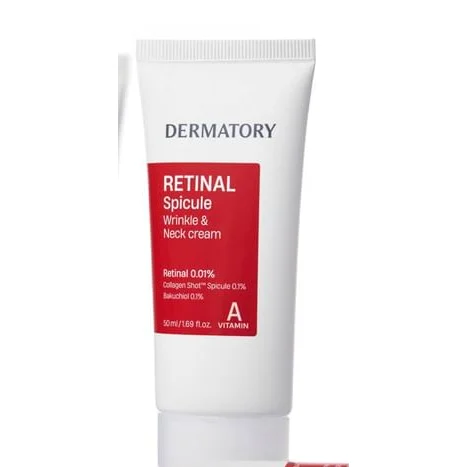
It combines a gentle 0.01 percent retinal with sponge spicules, bakuchiol and niacinamide in a rich cream, dispensed through a stainless-steel massage tip so the neck gets both actives and a lymphatic-style massage in one step.
A rich, pleasant neck cream that pairs a gentle 0.01 percent retinal with spicules, niacinamide and bakuchiol, dispensed through a cooling steel massage tip. It softens crepey, dry neck skin nicely, but the retinoid dose is modest, the spicules and fragrance can irritate, and the price per millilitre is high for what it delivers.
Verified reviews for this neck cream are limited, so the assessment is built mainly on its declared retinal, spicule and bakuchiol doses and published research on each. Evidence for spicule-enhanced delivery is still emerging, and results on neck skin specifically have not been independently tested.
Verdicts
How well it fits each concern
Verdict by concern tap a concern for the case
Supporting rolefor AgingIn your profileYou chose · Niacinamide has early evidence for aging, and hydration and barrier support is the recognised companion to treating it — a reasonable supporting choice, short of a recommendation.Moderate evidenceStandard tolerabilityNo reviews collected yet
The case for it
Niacinamide has early or mechanistic evidence for this concern, not trial-backed standing.
It is plausibly present at a working level, though the concentration is not declared.
The formula carries no trigger this concern is sensitive to, with the cautions noted.
What would change this: A declared concentration would move this to a firmer reading of the dose.
Same rule for everyone. “Supporting role” is the verdict on 8,197 of 45,024 concern verdicts across the catalog; rule R8a decided 1,489 of them.
As of September 25, 2026, engine 5.1.1.
R8a — A plausible-tier active in a category with a supportive job: the sentence names the active instead of saying nothing targets the concern (the AmLactin / CeraVe SA case for keratosis pilaris, where no guideline and single trials leave the keratolytics at early evidence). · the full register
Carrying active
Niacinamide
Standing
plausible — trials support it
Form
plausible — studied range 4–5%, from the trials on the row; needs leave-on contact; judge it after ~8 weeks
Tolerability
standard
Row checked
against its sources on July 17, 2026 (evidence table ev-2026.09-r228)
Supporting rolefor DrynessIn your profileYou chose · Nothing here targets dryness directly; humectant and occlusive hydration is the recognised companion to treating it, and this cream does that without known triggers.Not yet assessedStandard tolerabilityNo reviews collected yet
The case for it
Macadamia & Coconut Oils has no evidence row yet for this concern — it is in the research queue.
The formula carries no trigger this concern is sensitive to, with the cautions noted.
Cautions: fragrance.
What would change this: A researched evidence row for the lead active would replace this with a verdict.
Same rule for everyone. “Supporting role” is the verdict on 8,197 of 45,024 concern verdicts across the catalog; rule R8 decided 4,250 of them.
As of September 25, 2026, engine 5.1.1.
R8 — The category's job (barrier care, humectant hydration, gentle cleansing, photoprotection) is the documented supportive role for this concern. This is the honest verdict for a moisturizer on an acne page. · the full register
Also listed for Rough Texture — the actives here (Coconut Oil, Niacinamide, Physical Exfoliants, Retinal (Retinaldehyde) are in our research queue for that concern; there is no verdict until their evidence rows are written. That is a gap in our table, not a mark against the product.
Does the jobDoes what a moisturizer is for: draws in water, softens and smooths.
A verdict is DermApproved’s assessment of how well a product’s ingredients fit a concern — never a claim about what the product treats. Evidence dots and collected reviews sit beside it and are never blended in.
Rules 0.5.1 · evidence table ev-2026.09-r228 · how we decide
✓ Stainless-steel tip makes upward massage easy and cooling
✓ Rich base with barrier lipids softens crepey, dry skin
✓ Niacinamide and bakuchiol support the anti-aging claim
✓ Soothing panthenol, allantoin and licorice derivative
✓ Tube packaging protects the retinoid
Cons
✗ Spicules can prickle and irritate sensitive skin
✗ Contains fragrance and coconut oil
✗ Retinal dose is modest for visible wrinkle change
✗ High regular price per millilitre
✗ Not suitable for acne-prone or fungal-acne-prone skin
✗ Avoid during pregnancy because of retinoids
Review
Full Review
The first thing you notice about the Dermatory Retinal Spicule Wrinkle and Neck Cream is not the cream but the tip. The tube ends in a smooth stainless-steel applicator shaped for gliding along the neck, cool to the touch and designed to encourage upward, massage-like strokes. It turns a quick moisturizing step into a small ritual, and for a part of the body that most people forget in their routines, that ritual has real value. The question is what the cream itself adds, and whether the neck actually needs a separate product.
The neck is different from the face in a few ways. The skin is thinner, has fewer oil glands and is constantly folded and stretched, which is why it often shows crepiness, horizontal lines and dryness before the face does. It also tends to be more reactive to strong actives. A neck cream therefore needs to balance gentle anti-aging ingredients with enough richness to comfort dry skin. On paper, this formula does that.
The retinoid is retinal, declared on the tube at 0.01 percent, or 112ppm, and encapsulated in liposomes. Retinal is converted to retinoic acid in a single step, making it more potent than retinol at similar concentrations, but 0.01 percent is a gentle dose, suited to beginners and to the thinner skin of the neck. A trace of retinol also appears near the end of the list. Bakuchiol, a plant compound often described as a retinol alternative, is included at 0.1 percent, and niacinamide appears eighth, offering barrier support and tone-evening benefits.
The spicules are the most distinctive and debatable ingredient. Listed as hydrolyzed sponge at 1,008ppm, they are microscopic needle-shaped structures from marine sponges that lodge in the upper skin and create tiny channels. Brands use them to boost absorption of actives, and some people enjoy the prickling sensation as a sign that the product is working. The evidence for meaningful benefit is limited, and spicules can increase redness and irritation, particularly when combined with retinoids. On a thin, reactive area like the neck, that combination deserves caution.
The base is rich. Glycerin is second, followed by caprylic/capric triglyceride, coconut oil and macadamia seed oil, then silicones and a plant-derived dimer ester that mimics skin lipids. Cholesterol and rapeseed sterols add further barrier support, and panthenol, allantoin and dipotassium glycyrrhizate provide soothing. The result is a cushiony cream that leaves dry, crepey skin soft and supple, which, frankly, is the most noticeable benefit in the short term. Coconut oil makes it a poor choice for acne-prone facial skin and for anyone with fungal acne, and fragrance is added at the end of the list.
In use, the cream glides out through the steel tip, which spreads it smoothly and feels cool against the skin. Upward strokes from the collarbone toward the jaw are pleasant and may temporarily reduce puffiness, though no applicator can tighten sagging skin. The first few uses often bring a mild prickle from the spicules; most people adapt, but sensitive skin may redden. Starting every other night, then increasing, is sensible, and exfoliating acids should be kept to different nights.
The realistic expectations are modest. At 0.01 percent retinal, visible improvements in fine lines and crepiness develop slowly over two to three months, if at all, and are less pronounced than with stronger retinoids. The immediate benefit is hydration and softness. Daily sunscreen on the neck and chest is essential, since photoaging is a major driver of neck changes and retinoids increase sun sensitivity.
There is a practical sequencing question too. Because the cream is rich, it works best as the final step at night rather than under other products. Anyone already using a stronger retinoid on the face can apply that to the face and use this cream on the neck and chest, which gives the more delicate skin a gentler dose. On nights when the neck feels tight or irritated, skipping the cream in favour of a plain barrier moisturizer is a sensible break. And because the spicules can leave the skin slightly more permeable for a few hours, it is wise not to follow with fragranced body lotions or perfume applied to the neck on the same evening.
The applicator deserves a practical note as well. Stainless steel is easy to wipe clean, and it should be, since the tip touches the skin every night. A quick wipe with a tissue or an alcohol pad after use keeps the tip hygienic and prevents the cream from drying and clogging the opening.
It is also fair to ask whether a separate neck cream is necessary. Many dermatologists would say a well-formulated face product, extended down the neck, does the job. What this product adds is a gentler retinoid dose appropriate for the neck, a richer texture and the applicator. For people who struggle to remember their neck, the dedicated product and ritual may be exactly what builds the habit.
Verified reviews are limited, though the feedback available praises the applicator and rich texture while noting the spicule prickle and fragrance. That matches the formula.
Value is the weakest point. At around thirty-nine dollars regular price for 50ml, it costs more per millilitre than many good retinoid creams, although sales bring it down considerably. The applicator and spicule technology add cost more than proven benefit.
For normal to dry skin that wants a gentle, pleasant retinoid step for the neck, especially people who like tools and rituals, it is a reasonable choice. Sensitive, rosacea-prone or acne-prone skin, anyone pregnant, and value-focused shoppers may be better served by extending a simpler, fragrance-free retinoid moisturizer down the neck.
Formula
Key Ingredients
The hero actives that drive this product's performance.
The labelled 0.01 percent retinaldehyde, liposome-encapsulated, gives this neck cream a gentle retinoid dose suited to the thinner, more reactive skin of the neck.
Microscopic sponge spicules create tiny channels in the surface to help actives penetrate; they also produce a prickling sensation and can raise irritation on sensitive skin.
Use at night as the final step on the neck and face, massaging upward with the metal applicator tip. Avoid layering with exfoliating acids on the same night, and wear sunscreen on the neck and chest during the day.
Results Timeline
Skin feels softer and smoother immediately. Gradual improvements in crepiness and fine lines may appear after eight to twelve weeks of regular use.
Retinal (retinaldehyde) is converted to retinoic acid in the skin in a single enzymatic step and has shown anti-aging benefits in clinical studies at around 0.05 to 0.1 percent, with better tolerability than tretinoin. At 0.01 percent, this cream's dose is on the gentle end, which suits the thinner, more reactive skin of the neck but also means slower and more modest results. Liposomal encapsulation may improve stability and moderate release.
Sponge spicules, from species such as Haliclona, are microscopic silica needles used in cosmetics to enhance penetration. Studies suggest they can increase skin permeability by creating microchannels, but they also increase transepidermal water loss and can cause redness and irritation, especially when used with retinoids.
Bakuchiol has shown retinol-like gene expression effects and, in a small randomised trial, improvements in wrinkles and pigmentation comparable to retinol with less irritation. Niacinamide improves barrier function, reduces redness and supports even tone.
The neck's skin has fewer sebaceous glands and a thinner dermis than the face, which contributes to earlier crepiness and greater sensitivity. Photoaging is a major factor in neck lines and poikiloderma, so consistent sunscreen use on the neck and chest is fundamental.
Rich emollients such as coconut and macadamia oils, combined with cholesterol and plant sterols, support barrier function and reduce dryness, though coconut oil is often cited as potentially comedogenic on the face.
Dermatologist Perspective
Dermatologists often recommend extending face products, including retinoids and sunscreen, down onto the neck and chest, where photoaging is common. A dedicated neck cream with a low retinal dose is a reasonable, gentle option for patients whose neck skin is more sensitive than their face. Clinicians would be cautious about spicules on thin neck skin, particularly combined with retinoids, and would advise gradual introduction. They would also note the fragrance and coconut oil as potential issues for sensitive or acne-prone patients. Daily broad-spectrum sunscreen on the neck is considered essential, and retinoids are avoided during pregnancy. Gradual introduction and patch testing are sensible.
Guidance
Usage & Recommendations
How to Use
In the evening after serums, squeeze a pea-to-almond-sized amount onto the steel tip. Glide it upward from the collarbone to the jawline in gentle strokes, then smooth any remaining cream over the neck and face with the fingertips. Start every other night to let skin adjust to the spicules and retinal, then increase to nightly if comfortable. Avoid using exfoliating acids or benzoyl peroxide on the same night, and apply sunscreen to the neck and chest every morning.
Value Assessment
At a regular price of around thirty-nine dollars for 50ml, the cream is relatively expensive per millilitre, especially given its modest 0.01 percent retinal dose. Frequent sales improve the value considerably. The price reflects the stainless-steel applicator and spicule technology more than a high concentration of proven actives. Dermatory's dermo-cosmetic positioning adds some credibility, but there is no published clinical testing for this cream. It is sold in a single 50ml tube. Buying during promotions narrows the gap considerably.
Who Should Buy
Normal to dry skin looking for a gentle retinal step dedicated to the neck, especially people who enjoy massage tools and want a nightly ritual that helps them remember to treat the neck and décolletage regularly alongside consistent daily sunscreen use.
Who Should Skip
Sensitive, rosacea-prone, eczema-prone or acne-prone skin may react to the spicules, fragrance and coconut oil. Anyone pregnant or breastfeeding should avoid retinoids entirely, and value-focused shoppers can get similar results by extending a simpler, fragrance-free retinoid moisturizer down onto the neck.
Ready to try Dermatory Retinal Spicule Wrinkle and Neck Cream?
Dermatory created the cream to extend its retinal line to the neck, an area often neglected in routines, adding a metal applicator to encourage upward massage.
About Dermatory Established Brand (5–20 years)
Dermatory is a Korean dermo-cosmetic brand from the CLIO group, focused on sensitive-skin formulas made with Cosmax. This neck cream, launched around 2024, declares its retinal and spicule doses on the tube but has no published clinical testing.
Brand founded: 2018 · Product launched: 2024
Myth vs. Reality
Common Myths
Myth
The metal applicator lifts sagging neck skin.
Reality
Massage can reduce puffiness temporarily and make application pleasant, but it cannot tighten lax skin or change neck contours.
Myth
Spicules deliver retinal deep into the skin.
Reality
Spicules create micro-channels in the surface and may modestly enhance penetration, but evidence is limited and they add irritation potential.
FAQ
Frequently Asked Questions
How much retinal is in the Dermatory Retinal Spicule Neck Cream?
The tube declares 0.01 percent retinal (112ppm), a gentle dose, alongside 0.1 percent collagen spicules and 0.1 percent bakuchiol. A trace of retinol is also listed.
Why does the Dermatory neck cream prickle?
The hydrolyzed sponge spicules create tiny channels in the skin's surface, causing a prickling sensation. It usually fades with use; stop if it becomes painful.
Can I use the neck cream on my face?
Yes, it can be used on the face as well as the neck, though the rich texture and coconut oil may not suit oily or acne-prone facial skin.
Is the Retinal Spicule cream safe during pregnancy?
It contains retinal and retinol, which are generally avoided during pregnancy. Consult a clinician for pregnancy-safe alternatives.
How should I use the metal applicator?
Squeeze a small amount and glide the steel tip upward from the collarbone to the jaw in gentle strokes, then massage in any remaining cream with the fingers.
Does this Dermatory cream contain fragrance?
Yes, fragrance is listed at the end of the formula. People with fragrance sensitivity should patch test first.
Reviews
What Reviewers Tend to Say
Recurring themes our editors read across retailer reviews of this product — summaries in our words, not quotations, and not a substitute for your own patch test.
Common Praise
Metal tip applicator feels cooling and easy to use
Five brands that own the feed, judged on their ingredient lists rather than their view counts — including the one active all five suddenly added at once, and what that tells you.
One is a single conversion step from prescription retinoic acid. The marketing turns that into '11x stronger.' The evidence tells a subtler — and more useful — story.
It's a legitimately useful antioxidant with real anti-aging data — but 'nature's retinol' oversells a thin evidence base, and it isn't a retinoid at all.
Cutting a beard hair takes about a twentieth of a newton. You press with two and stretch your skin by a fifth — which is why almost every shaving problem is a technique problem wearing a hardware costume.
Products, answers, therapy guides, tools and articles in one search. Brand names,
slang and abbreviations all work — accutane finds isotretinoin, bacne finds truncal acne.