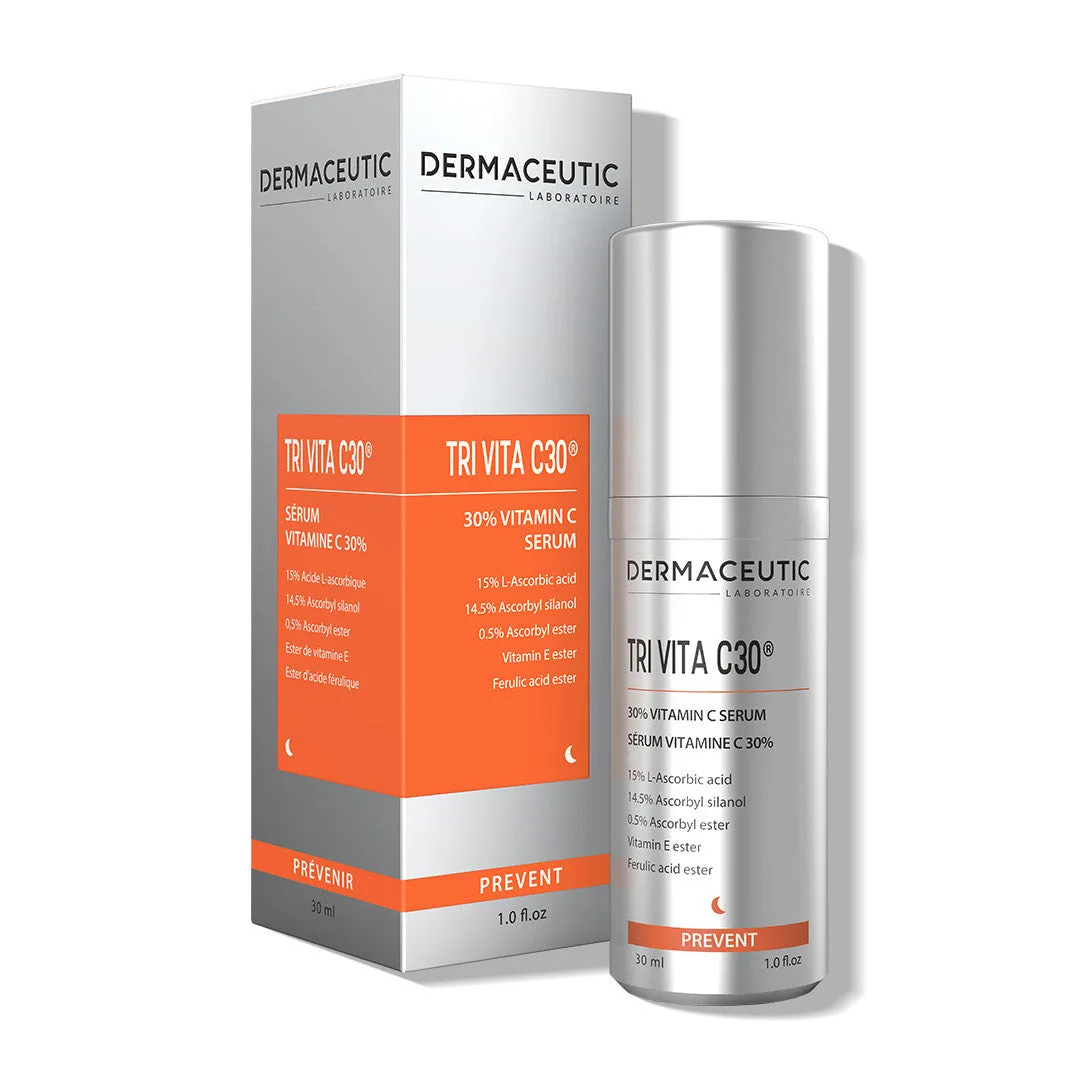
It stacks three vitamin C forms to a combined 30% — pure L-ascorbic acid plus a stabilized silanol form and an oil-soluble ester — with the full ferulic-and-vitamin-E antioxidant system, in an airless pump: a professional-channel serum aimed at maximum antioxidant potency rather than gentle daily comfort.
Dermaceutic's Tri Vita C30 is a serious, professional-channel vitamin C serum that stacks three forms of the vitamin to a combined 30% alongside the full ferulic-and-vitamin-E antioxidant system. For resilient skin chasing maximum brightening and antioxidant power, it delivers — but denatured alcohol, camphor and that sheer potency make it prone to irritation, and at $97 it asks a lot for benefits a gentler serum often largely matches.
Dermaceutic is an established professional brand selling mainly through clinics since the early 2000s, and while its consumer review base is modest, the triple-vitamin-C-plus-ferulic-and-E system is well-supported by antioxidant research. This assessment therefore leans on that ingredient evidence and the brand's practitioner-channel reputation rather than a large body of independent consumer data or published trials of the finished formula.
Verdicts
How well it fits each concern
Verdict by concern tap a concern for the case
Promisingfor AgingIn your profileYou chose · Vitamin C has trial-level evidence for aging but no guideline or regulatory standing yet — promising, short of a recommendation; the other actives here are not yet assessed for it.Moderate evidenceGentleNo reviews collected yet
The case for it
Triple Vitamin C Complex has trial-level evidence for this concern but no guideline or regulatory standing yet.
It is present at an effective concentration, declared or high in the ingredient list.
The formula carries none of the triggers this concern is sensitive to.
What would change this: Guideline or regulatory standing for the active on this concern would move this from a promising bet to a recommendation.
Same rule for everyone. “Promising” is the verdict on 7,858 of 45,024 concern verdicts across the catalog; rule R9p decided 7,858 of them.
Unchanged since September 5, 2026, engine 5.1.1.
R9p — 0.5.0: 'Unproven' beside three filled dots read as one question answered twice with opposite words (7,018 rows). The chip measures standing, the dots measure trial volume; where the row carries at least one RCT or a tier-2 source (moderate dots) and the active is present at a working level, the honest word is Promising. Unproven is reserved for plausible-standing rows with limited or weak evidence, or an under-dosed form. Same rank as Unproven — a bet either way; the dots order them. · the full register
Carrying active
Triple Vitamin C Complex
Standing
plausible — trials support it
Form
adequate (declared 30%) — studied range 5%, from the trials on the row; needs leave-on contact; judge it after ~12 weeks
Tolerability
gentle
Row checked
against its sources on July 17, 2026 (evidence table ev-2026.09-r228)
Promisingfor HyperpigmentationIn your profileYou chose · Vitamin C has trial-level evidence for hyperpigmentation but no guideline or regulatory standing yet — promising, short of a recommendation; the other actives here are not yet assessed for it.Moderate evidenceStandard tolerabilityNo reviews collected yet
The case for it
Triple Vitamin C Complex has trial-level evidence for this concern but no guideline or regulatory standing yet.
It is present at an effective concentration, declared or high in the ingredient list.
The formula carries no trigger this concern is sensitive to, with the cautions noted.
Cautions: known irritants.
What would change this: Guideline or regulatory standing for the active on this concern would move this from a promising bet to a recommendation.
Same rule for everyone. “Promising” is the verdict on 7,858 of 45,024 concern verdicts across the catalog; rule R9p decided 7,858 of them.
Unchanged since September 5, 2026, engine 5.1.1.
R9p — 0.5.0: 'Unproven' beside three filled dots read as one question answered twice with opposite words (7,018 rows). The chip measures standing, the dots measure trial volume; where the row carries at least one RCT or a tier-2 source (moderate dots) and the active is present at a working level, the honest word is Promising. Unproven is reserved for plausible-standing rows with limited or weak evidence, or an under-dosed form. Same rank as Unproven — a bet either way; the dots order them. · the full register
Carrying active
Triple Vitamin C Complex
Standing
plausible — trials support it
Form
adequate (declared 30%) — studied range 5–6%, from the trials on the row; needs leave-on contact; judge it after ~12 weeks
Tolerability
standard — irritant load
Row checked
against its sources on July 17, 2026 (evidence table ev-2026.09-r228)
Promisingfor Sun DamageIn your profileYou chose · Vitamin C has trial-level evidence for sun damage but no guideline or regulatory standing yet — promising, short of a recommendation; the other actives here are not yet assessed for it.Moderate evidenceGentleNo reviews collected yet
The case for it
Triple Vitamin C Complex has trial-level evidence for this concern but no guideline or regulatory standing yet.
It is present at an effective concentration, declared or high in the ingredient list.
The formula carries none of the triggers this concern is sensitive to.
What would change this: Guideline or regulatory standing for the active on this concern would move this from a promising bet to a recommendation.
Same rule for everyone. “Promising” is the verdict on 7,858 of 45,024 concern verdicts across the catalog; rule R9p decided 7,858 of them.
Unchanged since September 5, 2026, engine 5.1.1.
R9p — 0.5.0: 'Unproven' beside three filled dots read as one question answered twice with opposite words (7,018 rows). The chip measures standing, the dots measure trial volume; where the row carries at least one RCT or a tier-2 source (moderate dots) and the active is present at a working level, the honest word is Promising. Unproven is reserved for plausible-standing rows with limited or weak evidence, or an under-dosed form. Same rank as Unproven — a bet either way; the dots order them. · the full register
Carrying active
Triple Vitamin C Complex
Standing
plausible — trials support it
Form
adequate (declared 30%)
Tolerability
gentle
Row checked
against its sources on July 17, 2026 (evidence table ev-2026.09-r228)
The studies behind the evidence row
Use of topical ascorbic acid and its effects on photodamaged skin topography — Archives of Otolaryngology–Head & Neck Surgery — PubMed type includes 'Randomized Controlled Trial'; n=19 evaluable; active AND vehicle supplied by Cellex-C International; private facial plastic surgery practice (1999), opened July 16, 2026
Promisingfor Dark SpotsIn your profileYou chose · Vitamin C has trial-level evidence for dark spots but no guideline or regulatory standing yet — promising, short of a recommendation; the other actives here are not yet assessed for it.Moderate evidenceGentleNo reviews collected yet
The case for it
Triple Vitamin C Complex has trial-level evidence for this concern but no guideline or regulatory standing yet.
It is present at an effective concentration, declared or high in the ingredient list.
The formula carries none of the triggers this concern is sensitive to.
What would change this: Guideline or regulatory standing for the active on this concern would move this from a promising bet to a recommendation.
Same rule for everyone. “Promising” is the verdict on 7,858 of 45,024 concern verdicts across the catalog; rule R9p decided 7,858 of them.
Unchanged since September 5, 2026, engine 5.1.1.
R9p — 0.5.0: 'Unproven' beside three filled dots read as one question answered twice with opposite words (7,018 rows). The chip measures standing, the dots measure trial volume; where the row carries at least one RCT or a tier-2 source (moderate dots) and the active is present at a working level, the honest word is Promising. Unproven is reserved for plausible-standing rows with limited or weak evidence, or an under-dosed form. Same rank as Unproven — a bet either way; the dots order them. · the full register
Carrying active
Triple Vitamin C Complex
Standing
plausible — trials support it
Form
adequate (declared 30%) — studied range 1–28%, from the trials on the row; needs leave-on contact; judge it after ~12 weeks
Tolerability
gentle
Row checked
against its sources on July 17, 2026 (evidence table ev-2026.09-r228)
Also listed for Dullness — the actives here (Ferulic Acid, Phospholipids, Sodium PCA, Vitamin C) are in our research queue for that concern; there is no verdict until their evidence rows are written. That is a gap in our table, not a mark against the product.
Where our review and the verdict differ. The review below was written on the formulation and the published trials; the verdicts above apply the stricter standing test in our methodology — an active earns a recommendation only with guideline or regulatory standing for the concern. Where the two disagree, the verdict is DermApproved’s position.
A verdict is DermApproved’s assessment of how well a product’s ingredients fit a concern — never a claim about what the product treats. Evidence dots and collected reviews sit beside it and are never blended in.
Rules 0.5.1 · evidence table ev-2026.09-r228 · how we decide
Assessment
Pros & Cons
Pros
✓ Potent triple vitamin C at a combined 30%
✓ Complete C-ferulic-E antioxidant system
✓ Multi-form delivery across skin layers
✓ Fragrance-free, in a protective airless pump
✓ Visible brightening and tone improvement for tolerant skin
✓ Professional, clinically-oriented formulation
Cons
✗ High potency frequently stings or irritates
✗ Contains denatured alcohol and camphor
✗ Not for sensitive, rosacea-prone or compromised skin
✗ Diminishing returns above ~20% vitamin C
✗ Expensive at $97 for 30ml
✗ Shouldn't be layered with retinoids or acids
Review
Full Review
There's an arms race in vitamin C serums, and Tri Vita C30 is near the top of it. While most serums settle around 10 to 20% of a single vitamin C form, Dermaceutic stacks three forms to a combined 30%: 15% pure L-ascorbic acid, 14.5% of a stabilized ascorbyl silanol, and a touch of an oil-soluble ester. It's a maximalist, professional-channel approach, and the honest review of it has to wrestle with one question above all — does more vitamin C actually mean better skin? The answer is a qualified, carefully-bounded yes.
First, the genuine strengths, because there are real ones. The multi-form strategy is clever: pure L-ascorbic acid is the most potent and best-studied vitamin C but is unstable and water-soluble, so pairing it with a stabilized silanol form and an oil-soluble ester theoretically extends delivery across different skin layers and improves staying power. More importantly, Dermaceutic includes the complete antioxidant system that vitamin C science actually supports — ferulic acid (and ethyl ferulate) plus vitamin E. This C-E-ferulic triad is the configuration shown to stabilize vitamin C and amplify photoprotective, free-radical-quenching power well beyond what any single antioxidant achieves. There's also a PCA mineral complex and some barrier lipids to soften the blow. As a piece of antioxidant formulation, this is legitimately high-caliber, clinic-grade work.
In use, it's a light, silicone-based fluid in a sensible airless pump (vitamin C hates light and air), absorbing fast to a smooth, dry finish. Resilient skin that tolerates it can see real brightening within a few weeks and firmer, more even-looking skin with pigmentation fading over a couple of months of consistent morning use, always under sunscreen.
Now the part the marketing won't lead with. Vitamin C has a well-documented diminishing-returns curve: above roughly 20%, adding more L-ascorbic acid buys little extra benefit while steadily increasing irritation. So a meaningful chunk of that 30% headline is doing more for the label than for your skin. On top of the inherent sting of high-dose acid, this formula contains denatured alcohol high in the list and camphor — both common irritants. The result is a serum that frequently tingles or stings, especially early on, and that is genuinely not suitable for sensitive, rosacea-prone or barrier-compromised skin. It also shouldn't be stacked with retinoids or exfoliating acids in the same routine, and you should ease in two to three times a week rather than going daily from day one. This is a potent tool that demands respect and resilient skin.
It helps to place this in the context of how it's meant to be sold. Dermaceutic products are dispensed through clinics and skin professionals, often as part of a supervised regimen or after a treatment, and Tri Vita C30 makes more sense in that setting than as a blind online buy. A practitioner can judge whether your skin can take 30% vitamin C with alcohol and camphor, slot it correctly against any retinoids or acids you're using, and steer you to a gentler option if it's too much. Bought without that guidance, it's easy to overreach — to use it too often, too soon, on skin that would have been happier at half the strength.
If you do tolerate it, there's a real reward on the table. The complete C-E-ferulic system at this concentration is about as much daytime antioxidant firepower as a topical serum offers, and for resilient skin focused on photoaging and pigmentation, that potency translates into visible glow and gradually firmer, more even skin. The trick is respecting it: ease in, never stack it with other strong actives in the same routine, and pair it religiously with sunscreen. Treated as the specialist, high-ceiling tool it is rather than an everyday default, it can be genuinely impressive — just rarely necessary.
The value question follows directly. At $97 for 30ml, Tri Vita C30 is firmly premium, and you're paying for the multi-form delivery, the professional-brand pedigree and the maximal concentration. For someone with tolerant skin who specifically wants the strongest, most complete antioxidant serum they can get and has found gentler options underwhelming, it can justify the spend. But for most people — and certainly for anyone whose skin stings at the thought of acids — a well-formulated 10 to 15% vitamin C with ferulic and E delivers most of the real-world benefit with far less irritation and often a fraction of the price. The smart way to read this serum is as a specialist, high-strength option rather than a default recommendation: excellent at what it does, but more product than many skins need or can comfortably take. Match it to resilient skin and realistic expectations, and it performs; reach for it because the number on the bottle is biggest, and you may just buy yourself a stinging, expensive lesson in diminishing returns.
Formula
Key Ingredients
The hero actives that drive this product's performance.
The serum's headline: three vitamin C forms at a combined 30%, pairing potent pure L-ascorbic acid with a stabilized silanol form and an oil-soluble ester so the antioxidant and collagen-stimulating action reaches different skin layers — a far higher and more layered dose than typical serums.
Antioxidant partners that stabilize the high vitamin C load and amplify photoprotective free-radical defense — the classic vitamin C and ferulic pairing, here supporting an unusually concentrated dose.
Completes the C-E-ferulic antioxidant triad, regenerating vitamin C and extending lipid-phase protection so the trio defends against oxidative and UV-related damage more effectively than any single antioxidant.
A mineral-bound humectant and cofactor blend that adds hydration and trace minerals, helping offset the dryness a high-acid, alcohol-containing vitamin C serum can otherwise cause.
Barrier-supporting lipids included to soften the impact of such a strong serum on the skin surface, lending a little resilience to counter the formula's potency.
Not yet assessed
Ingredient standings describe the active at treatment-level doses and
vehicles; this product's own condition grades weigh its actual formula.
Apply a few drops to clean, dry skin in the morning before moisturizer, then always follow with sunscreen. Start two to three times a week to build tolerance to the high vitamin C concentration.
Results Timeline
Brighter, more radiant skin within a few weeks; firmer-looking texture and fading of pigmentation build over eight to twelve weeks of consistent morning use.
Tri Vita C30 is built on sound antioxidant science taken to an aggressive concentration. The most robust evidence in vitamin C skincare supports L-ascorbic acid combined with vitamin E and ferulic acid: this triad stabilizes ascorbic acid, regenerates it after it quenches free radicals, and meaningfully boosts photoprotection — and Dermaceutic includes all three components. Using multiple vitamin C forms (L-ascorbic acid plus ascorbyl methylsilanol pectinate and ascorbyl tetraisopalmitate) is a delivery strategy intended to combine the potency of pure ascorbic acid with the stability and lipophilicity of derivatives, though the comparative clinical evidence for multi-form blends over optimized single-form serums is limited. The crucial nuance is concentration: studies indicate L-ascorbic acid absorption and benefit plateau around 20%, beyond which additional acid offers diminishing returns while irritation rises, so the 30% total figure is partly a marketing-forward number rather than a proportional efficacy gain. The formula's irritation profile is elevated by denatured alcohol (high in the list, aiding penetration and a dry finish) and camphor, both recognized irritants; the included sphingolipids, phospholipids and PCA minerals provide some hydration and barrier buffering but do not neutralize the potency. Net: a legitimately high-performance antioxidant serum whose effectiveness is real for tolerant skin, but whose concentration and excipients place it firmly in the high-irritation-risk category and limit its suitability.
Dermatologist Perspective
Dermatologists regard the combination of vitamin C with vitamin E and ferulic acid as the best-evidenced antioxidant configuration for daytime photoprotection and brightening, and Tri Vita C30 delivers that system. Clinicians also commonly note that vitamin C benefits plateau at higher concentrations and that very high percentages, particularly with denatured alcohol, increase the likelihood of stinging and irritation — which is why high-strength serums like this are typically suggested for resilient skin and introduced gradually. Dermatologists generally advise against pairing potent vitamin C with retinoids or exfoliating acids in the same application and steer sensitive, rosacea-prone or barrier-compromised patients toward gentler, lower-concentration formulas. Used in the morning under sunscreen, by skin that tolerates it, the serum aligns with professional antioxidant guidance, with the standard caveat that more concentration is not automatically more benefit.
Guidance
Usage & Recommendations
How to Use
Use it in the morning. After cleansing, apply a few drops to dry skin, allow it to absorb, then layer moisturizer and a broad-spectrum sunscreen — vitamin C works as a daytime antioxidant that enhances sun protection. Because it's a high-strength 30% formula with alcohol and camphor, start two to three times a week to build tolerance, and only increase frequency if your skin handles it comfortably. Avoid using it in the same routine as retinoids or exfoliating acids, which raises irritation risk. Discontinue if you get persistent stinging or redness, and keep the airless pump closed and away from heat to preserve potency.
Value Assessment
At $97 for 30ml, Tri Vita C30 sits at the premium, professional end of the vitamin C market, and the price reflects the multi-form 30% concentration, the complete antioxidant system and the brand's clinic-channel positioning. For tolerant skin specifically seeking the strongest, most complete antioxidant serum available, the formulation quality can justify the cost. For most users, however, the value proposition is weak relative to a well-made 10-15% vitamin C with ferulic and E, which delivers much of the real-world brightening and protection with less irritation and often a fraction of the price — especially given the diminishing returns above 20%. It's a specialist purchase, best value only for those who genuinely need and tolerate its potency.
Who Should Buy
Resilient, non-sensitive skin that specifically wants a maximum-strength, professional-grade vitamin C antioxidant serum and has found gentler options underwhelming. It suits those targeting dullness, pigmentation and photoaging who can tolerate a potent formula and will commit to daily sunscreen.
Who Should Skip
Sensitive, rosacea-prone, dry or barrier-compromised skin should skip it given the 30% acid load, denatured alcohol and camphor. Anyone new to vitamin C, on a budget, or already happy with a 10-15% serum will get most of the benefit elsewhere with far less irritation, and those managing fungal acne should avoid it.
Lightweight silicone-fluid serum that absorbs quickly to a smooth, dry finish
Scent
Faint camphor-tinged note; no added perfume
Packaging
Airless pump bottle to protect the vitamin C from light and air
Finish
lightweightfast-absorbingsmooth
What to Expect on First Use
A light, silky fluid that sinks in fast. At 30% vitamin C with alcohol and camphor, expect a noticeable tingle or mild sting on application, especially early on — a sign to build up use slowly rather than dive into daily application.
Dermaceutic formulates for the professional skincare channel, and Tri Vita C30 reflects that brief: rather than a mild consumer-friendly vitamin C, it pushes concentration and multi-form delivery to a clinical level, designed to be recommended and dispensed by skin professionals for visible antioxidant results.
About Dermaceutic Established Brand (5–20 years)
Dermaceutic is a French professional skincare laboratory founded in 2002 and sold largely through dermatologists, aesthetic clinics and skin professionals. Its clinic-channel positioning and two decades of formulating high-strength actives give it solid professional credibility, though it markets through practitioners rather than mass retail.
Brand founded: 2002 · Product launched: 2017
Myth vs. Reality
Common Myths
Myth
A higher vitamin C percentage is always better for your skin.
Reality
Above roughly 20%, added L-ascorbic acid yields diminishing returns and rising irritation. This 30% serum can be highly effective for resilient skin, but for many people a well-formulated 10-15% vitamin C delivers most of the benefit with far less sting — more isn't automatically better.
FAQ
Frequently Asked Questions
How strong is Tri Vita C30 compared to other vitamin C serums?
Very strong — it combines three forms of vitamin C to a total of 30%, including 15% pure L-ascorbic acid, where most consumer serums use 10-20% of a single form. That makes it potent but also more likely to tingle or irritate, so it's pitched at resilient skin and professional recommendation.
Will Tri Vita C30 irritate my skin?
It can. At 30% vitamin C plus denatured alcohol and camphor, a tingle or mild sting on application is common, especially early on. Start two to three times a week and build up, and avoid it if your skin is sensitive, rosacea-prone or has a compromised barrier.
When and how should I use this serum?
Use it in the morning on clean, dry skin, a few drops before moisturizer, and always follow with sunscreen — vitamin C is a daytime antioxidant that boosts sun protection. Because it's potent, ease in gradually and avoid layering it with retinoids or exfoliating acids in the same routine.
Is a 30% vitamin C serum worth it over a 15% one?
Not necessarily for everyone. Above about 20%, extra L-ascorbic acid brings diminishing returns and more irritation. Resilient skin chasing maximum antioxidant potency may benefit, but many people get most of the brightening from a gentler 10-15% serum with far less sting and lower cost.
Does Tri Vita C30 help with dark spots and aging?
Yes — the triple vitamin C with ferulic acid and vitamin E targets dullness, uneven tone, pigmentation and photoaging, with brightening in a few weeks and firmer, more even-looking skin over eight to twelve weeks. Daily sunscreen is essential for these results to hold.
Why does it contain alcohol and camphor?
Denatured alcohol helps deliver and stabilize the high vitamin C load and gives a fast, dry finish, while camphor adds a cooling sensory note. Both can be drying or irritating, which is part of why this serum suits resilient rather than sensitive skin.
Reviews
What Reviewers Tend to Say
Recurring themes our editors read across retailer reviews of this product — summaries in our words, not quotations, and not a substitute for your own patch test.
Common Praise
Visible brightening and glow
Potent, professional-grade vitamin C
Improves tone and radiance
Fast-absorbing finish
Common Complaints
Can sting or irritate
Contains drying alcohol and camphor
Expensive
Too strong for sensitive skin
Notable Endorsements
Sold through dermatologists and skin clinics30% triple vitamin C with C-E-ferulic systemFrench professional laboratory
The famous 15/1/0.5 trio isn't marketing folklore — it traces to a specific Duke experiment. But 'the studied combination' and 'any serum with all three names on the label' are not the same thing.
The one home formulation with a genuinely coherent case, taken apart on its own terms: the pH window, the oxidation clock, and what a browning serum has actually become.
Products, answers, therapy guides, tools and articles in one search. Brand names,
slang and abbreviations all work — accutane finds isotretinoin, bacne finds truncal acne.