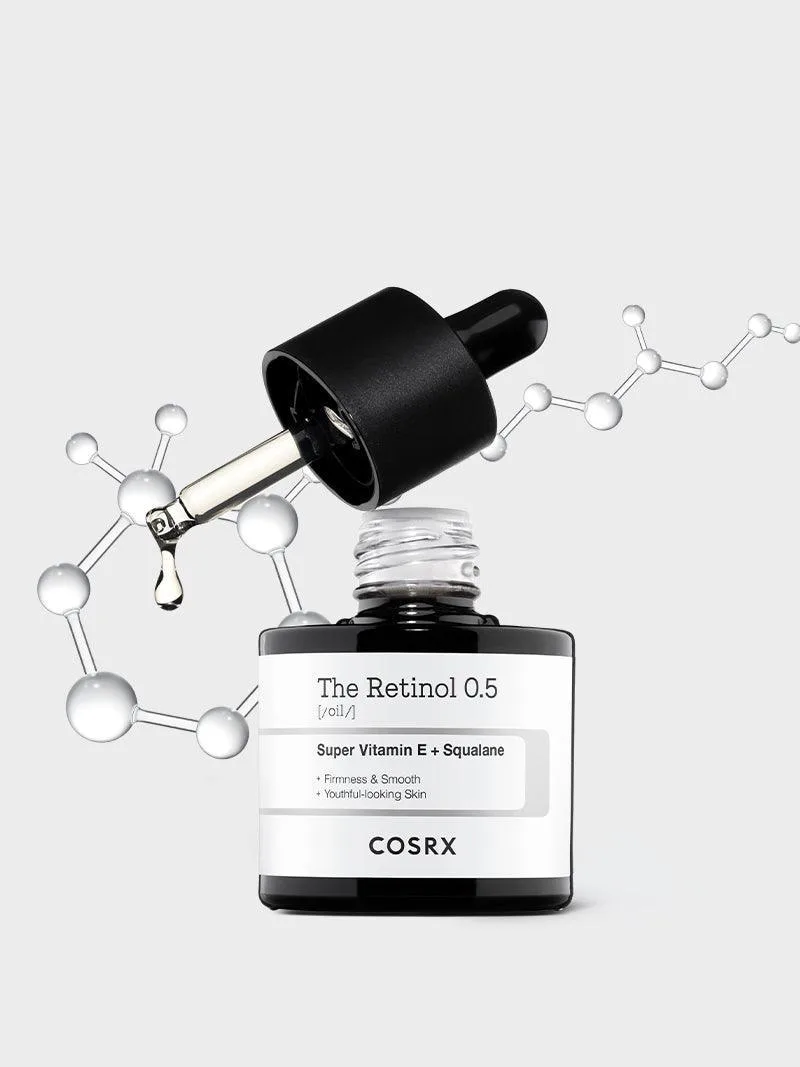
The anhydrous squalane oil base is the key differentiator from the cream versions. Retinol degrades rapidly in water — by using an oil vehicle, COSRX achieves significantly better retinol stability at 0.5%, the highest concentration in their range. The formula appears to be a hybrid of a pure oil phase (squalane + retinol + antioxidants) with an encapsulated cream component (containing the five HAs, panthenol, and additional retinol). This dual-phase approach is more technically sophisticated than either a pure oil or a pure cream would be.
The final boss of COSRX's retinol trilogy. A 0.5% pure retinol dissolved in squalane for maximum stability, wrapped in the same antioxidant and hydration system as the cream versions. It delivers the most visible anti-aging results of the three — but the oil texture, 3-month shelf life, and narrower audience make it a specialist tool rather than a universal recommendation.
Good choicefor AgingIn your profileYou chose · Retinol is a trial-supported active for aging; this oil carries it at 0.5%.Moderate evidenceGentleNo reviews collected yet
The case for it
Retinol has trial-supported standing for this concern.
It is present at an effective concentration, declared or high in the ingredient list.
The formula carries none of the triggers this concern is sensitive to.
Same rule for everyone. “Good choice” is the verdict on 9,564 of 45,024 concern verdicts across the catalog; rule R5 decided 9,072 of them.
Unchanged since September 5, 2026, engine 5.1.1.
Promisingfor DullnessIn your profileYou chose · Hyaluronic Acid has trial-level evidence for dullness but no guideline or regulatory standing yet — promising, short of a recommendation; the other actives here are not yet assessed for it.Moderate evidenceGentleNo reviews collected yet
The case for it
Five Types of Hyaluronic Acid has trial-level evidence for this concern but no guideline or regulatory standing yet.
It is plausibly present at a working level, though the concentration is not declared.
The formula carries none of the triggers this concern is sensitive to.
What would change this: A declared concentration would move this to a firmer reading of the dose.
Same rule for everyone. “Promising” is the verdict on 7,858 of 45,024 concern verdicts across the catalog; rule R9p decided 7,858 of them.
Unchanged since September 5, 2026, engine 5.1.1.
R9p — 0.5.0: 'Unproven' beside three filled dots read as one question answered twice with opposite words (7,018 rows). The chip measures standing, the dots measure trial volume; where the row carries at least one RCT or a tier-2 source (moderate dots) and the active is present at a working level, the honest word is Promising. Unproven is reserved for plausible-standing rows with limited or weak evidence, or an under-dosed form. Same rank as Unproven — a bet either way; the dots order them. · the full register
Carrying active
Five Types of Hyaluronic Acid
Standing
plausible — trials support it
Form
plausible
Tolerability
gentle
Row checked
against its sources on July 17, 2026 (evidence table ev-2026.09-r228)
Unprovenfor Dark SpotsIn your profileYou chose · Retinol has early or mechanistic evidence for dark spots — a reasonable bet, not a recommendation; the other actives here are not yet assessed for it.Limited evidenceGentleNo reviews collected yet
The case for it
Retinol has early or mechanistic evidence for this concern, not trial-backed standing.
It is present at an effective concentration, declared or high in the ingredient list.
The formula carries none of the triggers this concern is sensitive to.
What would change this: Trial evidence for the active on this concern would move this from a bet to a recommendation.
Same rule for everyone. “Unproven” is the verdict on 1,111 of 45,024 concern verdicts across the catalog; rule R9 decided 1,111 of them.
Unchanged since September 5, 2026, engine 5.1.1.
R9 — Plausible-tier actives alone do not earn a recommendation, and 'not for this' would overstate the case against them. 'Unproven' with the evidence dots lets the reader judge the bet (added 0.2.0 after the first shadow run put a 10% niacinamide serum at 'not for this' for hyperpigmentation). 0.5.0: the closing clause reads the other heroes — "nothing else here addresses it" only when every other active has a researched 'none' row; "not yet assessed" when that is the truth. Rows whose dots read moderate or better now reach R9p first. · the full register
Carrying active
Retinol
Standing
plausible — trials support it
Form
adequate (declared 0.5%) — studied range 0.1–0.5%, from the OTC monograph or label; needs leave-on contact; judge it after ~12 weeks
Tolerability
gentle
Row checked
against its sources on July 17, 2026 (evidence table ev-2026.09-r228)
Promisingfor Large PoresIn your profileYou chose · Retinol has trial-level evidence for large pores but no guideline or regulatory standing yet — promising, short of a recommendation; the other actives here are not yet assessed for it.Moderate evidenceGentleNo reviews collected yet
The case for it
Retinol has trial-level evidence for this concern but no guideline or regulatory standing yet.
It is present at an effective concentration, declared or high in the ingredient list.
The formula carries none of the triggers this concern is sensitive to.
What would change this: Guideline or regulatory standing for the active on this concern would move this from a promising bet to a recommendation.
Same rule for everyone. “Promising” is the verdict on 7,858 of 45,024 concern verdicts across the catalog; rule R9p decided 7,858 of them.
Unchanged since September 5, 2026, engine 5.1.1.
R9p — 0.5.0: 'Unproven' beside three filled dots read as one question answered twice with opposite words (7,018 rows). The chip measures standing, the dots measure trial volume; where the row carries at least one RCT or a tier-2 source (moderate dots) and the active is present at a working level, the honest word is Promising. Unproven is reserved for plausible-standing rows with limited or weak evidence, or an under-dosed form. Same rank as Unproven — a bet either way; the dots order them. · the full register
Carrying active
Retinol
Standing
plausible — trials support it
Form
adequate (declared 0.5%) — studied range 0.1–1%, from the OTC monograph or label; needs leave-on contact; judge it after ~12 weeks
Tolerability
gentle
Row checked
against its sources on July 17, 2026 (evidence table ev-2026.09-r228)
Also listed for Rough Texture — the actives here (Squalane, Retinol, Vitamin E, Glutathione) are in our research queue for that concern; there is no verdict until their evidence rows are written. That is a gap in our table, not a mark against the product.
Where our review and the verdict differ. The review below was written on the formulation and the published trials; the verdicts above apply the stricter standing test in our methodology — an active earns a recommendation only with guideline or regulatory standing for the concern. Where the two disagree, the verdict is DermApproved’s position.
A verdict is DermApproved’s assessment of how well a product’s ingredients fit a concern — never a claim about what the product treats. Evidence dots and collected reviews sit beside it and are never blended in.
Rules 0.5.1 · evidence table ev-2026.09-r228 · how we decide
Assessment
Pros & Cons
Pros
✓ Anhydrous squalane base provides superior retinol stability compared to water-based formulations
✓ 0.5% pure retinol — the strongest OTC concentration in COSRX's graduated system
✓ Clinical testing showed 22% wrinkle reduction and 45% pore improvement in 2-4 weeks
✓ Dual-phase formulation delivers both oil-phase stability and water-phase hydration benefits
✓ Only 1-2 drops per application — extremely efficient product usage
✓ Squalane provides built-in occlusive protection against retinol-induced dryness
✓ Same seven-antioxidant system and five-HA complex as the cream versions
Cons
✗ 3-month PAO means you'll likely waste product — bottle contains 4-5 months of supply
✗ Oil texture with 10-20 minute absorption window isn't practical for everyone
✗ Too heavy and oily for oily and acne-prone skin types
✗ Glass dropper exposes formula to air and light with each use — undermines the stability advantage
✗ Not pregnancy-safe — standard for all retinol products
Review
Full Review
Retinol and water don't get along. This isn't a marketing claim — it's basic chemistry. Retinol molecules are unstable and degrade through hydrolysis when suspended in a water-based formulation, losing potency week by week from the moment the container is opened. Most retinol creams compensate with antioxidants and light-blocking packaging, but the underlying instability remains. COSRX's solution for their highest-concentration retinol was elegantly blunt: take the water out.
The Retinol 0.5 Oil uses squalane as its primary vehicle — a stable, non-comedogenic oil creating an anhydrous environment where retinol simply cannot hydrolyze. The retinol is dissolved directly into the oil phase and defended by tocotrienols, tocopherol and BHT. Which means the 0.5% retinol you apply on day one is far closer in potency to the 0.5% you apply on day ninety than any water-based cream could manage. For a molecule this temperamental, the vehicle matters as much as the number on the box.
The formula is more sophisticated than oil-plus-retinol. Read the full INCI and you find what looks like a hybrid: a primary oil phase — squalane, soybean oil, retinol, antioxidants, meadowfoam, rice bran wax — combined with an encapsulated cream component carrying five hyaluronic acids, panthenol, shea butter, adenosine, glutathione, two vitamin C derivatives and a second listing of retinol. The oil phase maximizes stability and penetration; the encapsulated cream delivers water-phase actives the oil alone cannot. It is effectively a retinol oil and a retinol cream sharing one dropper bottle, and that is a genuinely clever piece of engineering.
The clinical data holds up. Independent lab testing reported a 22% reduction in forehead wrinkles at four weeks, 17% improvement around the eyes, and over 45% reduction in pore volume within two weeks. Those figures sit comfortably within what the 0.5% retinol literature would predict, which is the best endorsement a brand-commissioned study can get: it says the formulation is actually delivering its retinol rather than merely containing it.
Using it is a different experience from the creams. One or two drops from the glass dropper is genuinely all you need. The oil spreads with a silky slip and lays down a thin, dewy film. The absorption window is the first real difference: ten to twenty minutes, against the minute a cream takes, with a visible sheen persisting until the squalane integrates with your skin's own lipids. Get into bed immediately and your pillowcase will absorb some of your skincare.
By morning it has vanished and the case for the format becomes clear. Skin is softer, smoother and more luminous than the cream versions manage, and the occlusive squalane means less water lost overnight — so you wake up looking plumper and better rested. Over weeks, the anti-aging effect outpaces the 0.1% and 0.3%: lines soften more visibly, texture refines, and the radiance improvement is one other people notice rather than one you have to squint for.
The three-month PAO is the product's most awkward limitation, and it deserves to be stated bluntly. At one or two drops, three or four nights a week, the 20ml bottle holds four to five months of product. COSRX says discard at three. So you will either throw away a month or two of a working retinol, or keep using it past the date and gamble on whether the potency held. Neither feels good, and the glass dropper compounds it by admitting air with every use — an airless pump would have been far more consistent with the stability-first philosophy the whole product is built on. Refrigeration helps and is worth doing.
The usage rules matter more here than usual. Water-based serums go on first and must absorb fully before the oil, because oil blocks water-based products from penetrating — apply your hyaluronic acid *after* this and you have wasted it. Start at two nights a week and build across six to eight weeks. Nothing else acidic on retinol nights, no benzoyl peroxide, and sunscreen every single morning without exception. Not pregnancy-safe, as no retinol is. And the oil base means this is firmly not fungal-acne safe.
The audience is deliberately narrow, and the brand does not pretend otherwise. You want three months or more of comfortable 0.3% use behind you. You want to be at peace with an oil on your face at night, and with a twenty-minute wait before your pillow. You want dry-to-normal skin — oily and acne-prone skin will find the squalane base heavy and the absorption window intolerable. And you want to accept the three-month clock.
For the person who fits that profile — retinol-adapted, anti-aging focused, willing to commit to the routine — this is one of the most thoughtfully engineered over-the-counter retinols available, and seventeen hundred reviews at four and a half stars agree. The stability advantage is real, the supporting cast is excellent, and the results are measurable. COSRX built the strongest retinol in its range and gave it the most stable home it could design. The glass bottle and the three-month window simply mean you have to use it on purpose.
Formula
Key Ingredients
The hero actives that drive this product's performance.
The highest concentration in COSRX's graduated system, 0.5% pure retinol delivers aggressive cell turnover acceleration and collagen stimulation for established wrinkles and significant texture concerns. Dissolved in a squalane oil base rather than a water-based cream, the retinol achieves greater stability — water is retinol's enemy, and the anhydrous vehicle dramatically slows oxidative degradation.
The primary vehicle and first ingredient in this formula. Squalane is a stable, non-comedogenic oil that mimics the skin's natural sebum. As the carrier for 0.5% retinol, it serves triple duty: stabilizing the retinol in an anhydrous environment, providing occlusive barrier protection against retinol-induced dryness, and enhancing the retinol's penetration through the lipid-rich intercellular matrix of the stratum corneum.
The vitamin E duo appears twice in the formula — in both the oil phase and the encapsulated cream phase — providing layered antioxidant protection. Tocotrienols' 40-60x greater antioxidant potency compared to standard tocopherol makes them especially valuable at this high retinol concentration, where more molecules are susceptible to oxidative degradation.
Present in the encapsulated cream component of this hybrid formula, the five-HA system provides the same multi-depth hydration as the cream versions. At 0.5% retinol, barrier disruption and transepidermal water loss are at their most significant, making the sustained-release crosspolymer HA and adhesion-enhanced acetylated HA critical for preventing the desert-dry feeling that derails high-concentration retinol use.
The same antioxidant trio as the cream versions — glutathione regenerates oxidized vitamin C, which in turn regenerates oxidized vitamin E, creating a cascading antioxidant recycling system. At 0.5% retinol, this recycling chain works harder and matters more, as the higher concentration creates more oxidative stress within the formula and on the skin.
Not yet assessed
Ingredient standings describe the active at treatment-level doses and
vehicles; this product's own condition grades weigh its actual formula.
Apply 1-2 drops to clean, dry skin in the evening as the last active step. The oil format means this can double as a treatment and occlusive — you may not need a separate moisturizer on top, though dry skin types may benefit from one. Start with 2 nights per week and build slowly.
Results Timeline
Visible texture improvement and brightness within 1-2 weeks. Clinical testing showed 22% reduction in forehead wrinkles and 17% improvement in eye area lines at 4 weeks. Significant anti-aging results at 8-12 weeks. Adjustment period (peeling, redness) may last 2-6 weeks depending on prior retinol experience.
Pairs Well With
Hyaluronic acid serums (apply before the oil)Gentle cleanserBroad-spectrum sunscreen SPF 30+ (AM — mandatory)
The anhydrous oil delivery system in this product addresses one of the most well-documented challenges in retinol formulation: hydrolytic instability.
Retinol degradation in cosmetic formulations has been extensively studied. A study reported in the International Journal of Cosmetic Science (2005) demonstrated that retinol in water-in-oil emulsions retained significantly more activity over time compared to oil-in-water formulations, with the water content being the primary driver of degradation. An anhydrous vehicle like squalane eliminates hydrolysis entirely, leaving only oxidative degradation to manage — which the tocotrienol/tocopherol/BHT system addresses.
At 0.5%, the retinol-to-retinoic-acid conversion pathway becomes pharmacologically relevant. Retinol is converted to retinaldehyde by retinol dehydrogenases, then to all-trans retinoic acid (tretinoin) by retinal dehydrogenases. The conversion efficiency is estimated at 5-20% depending on skin enzymes, meaning 0.5% retinol delivers roughly 0.025-0.1% retinoic acid equivalence — comparable to the lowest prescription tretinoin concentrations. A pivotal study by Kafi et al. in the Archives of Dermatology (2007) demonstrated that 0.4% retinol significantly improved fine wrinkles and increased procollagen I expression in photoaged skin.
Squalane as a vehicle offers additional dermatological benefits beyond stability. Research in the Journal of Cosmetic Dermatology (2012) showed that squalane has emollient, antioxidant, and potential anti-tumor properties, and its structural similarity to human sebum facilitates absorption and integration with the skin's natural lipid matrix. This enhances retinol delivery through the intercellular lipid pathway of the stratum corneum — lipophilic molecules like retinol penetrate more efficiently when carried in lipid-compatible vehicles.
The dual-phase formulation — oil exterior with encapsulated cream interior — appears designed to provide both the stability advantages of anhydrous delivery and the hydrating benefits of water-phase ingredients. The five hyaluronic acid types in the cream phase address retinol-induced transepidermal water loss, which studies in the Journal of the European Academy of Dermatology and Venereology have shown increases proportionally with retinoid concentration and duration of use.
Practitioners view 0.5% retinol as the ceiling of effective OTC retinoid therapy. Dermatologists note that the anhydrous oil base represents a formulation approach that prioritizes the molecule's stability over user texture preferences — a trade-off that experienced patients often appreciate once they understand the science. Dermatologists commonly advise patients using 0.5% retinol to expect a 2-4 week adjustment period even with prior retinol experience, and recommend the 'sandwich method' (moisturizer-retinol-moisturizer) for those experiencing persistent dryness. The 3-month PAO is consistent with dermatological guidance on retinol degradation kinetics. For patients who need more aggressive anti-aging results than 0.5% retinol provides, dermatologists typically recommend transitioning to prescription tretinoin rather than seeking higher OTC concentrations.
Guidance
Usage & Recommendations
How to Use
Apply 1-2 drops to clean, dry skin in the evening as the final active step. If using water-based serums (like HA serum), apply those first and let them absorb before applying this oil — oil blocks water-based products from penetrating. Start with 2 nights per week and build to every other night over 6-8 weeks. Allow 10-20 minutes for absorption before sleeping. Use SPF 30+ sunscreen every morning without exception. Store refrigerated at 3-10°C with the bottle upright. Use within 3 months of opening.
Value Assessment
At $27 for 20 mL, the per-mL cost is slightly lower than the 0.3% cream ($29/20 mL). The efficiency of 1-2 drops per use means the physical product lasts 4-5 months — but the 3-month PAO effectively makes it a 3-month supply regardless. Monthly cost is approximately $9-13 depending on frequency, which is reasonable for a high-concentration retinol with this level of formulation sophistication. The 2-pack at $45.90 is only worthwhile if you'll use both bottles consecutively within their shelf lives. Compared to other 0.5% retinol products on the market, the price is competitive, and the squalane stability advantage provides genuine added value.
Who Should Buy
Experienced retinol users (comfortable with 0.3% or equivalent for 3+ months) with normal to dry skin seeking the maximum OTC anti-aging potency. Ideal for those who prioritize results over texture elegance and understand the commitment of refrigeration, 3-month use windows, and oil-based application.
Who Should Skip
Retinol beginners (start with 0.1%). Oily or acne-prone skin types who will find the squalane base too heavy. Anyone who dislikes the feel of face oils or can't wait 10-20 minutes for absorption. Those who travel frequently and can't maintain refrigerated storage. Pregnant or breastfeeding individuals.
Lightweight facial oil that's thinner than most face oils. Silky on application with a noticeable oil slip. Takes 10-20 minutes to fully absorb, leaving a soft, dewy finish. Not sticky, but distinctly oily during the absorption window.
Scent
Fragrance-free with minimal detectable odor. Some users note a very faint oil-based scent that disappears on application.
Packaging
20 mL dark tinted glass dropper bottle designed to protect retinol from light. The dropper provides precise 1-2 drop dispensing. However, the dropper mechanism exposes the formula to air with each use — less ideal for retinol stability than an airless pump would be.
Finish
dewysmoothsatin
What to Expect on First Use
First application feels distinctly different from the cream versions — this is clearly an oil, with the slip and sheen to match. Mild warmth or tingling is common, especially for those stepping up from 0.3%. The squalane provides an immediate cushioning sensation. By morning, the oil has fully absorbed and skin feels noticeably softer. Adjustment period (mild peeling, sensitivity) typically lasts 2-4 weeks for adapted users.
How Long It Lasts
4-5 months with 1-2 drops, 3-4 nights per week (but PAO limits to 3 months)
Released alongside the 0.1% cream in late 2022 as the advanced bookend of COSRX's graduated retinol system, this oil was designed for experienced retinol users who needed the highest OTC concentration in the most stable delivery vehicle possible. The choice of an oil base wasn't aesthetic — it was a stability decision. Retinol's arch-nemesis is water, and by eliminating water from the primary phase, COSRX gave the 0.5% concentration its best chance at remaining potent from first drop to last.
About COSRX Established Brand (5–20 years)
COSRX was founded in South Korea in 2013, combining 'Cosmetics' with 'Rx' to signal a clinical approach to K-beauty. The brand has earned 135+ global beauty awards and is sold in 146+ countries, with a reputation for effective, no-frills formulations built around well-researched actives.
Brand founded: 2013 · Product launched: 2022
Myth vs. Reality
Common Myths
Myth
Face oils are too heavy for nighttime retinol use — they block the retinol from working
Reality
In this formula, the retinol is dissolved IN the oil — squalane is the delivery vehicle, not a barrier over the retinol. The lipophilic (fat-loving) retinol molecule actually penetrates more effectively through the skin's lipid-rich intercellular matrix when carried in an oil base. The squalane enhances delivery, it doesn't impede it.
Myth
0.5% retinol is close to prescription strength
Reality
While 0.5% is high for OTC retinol, it's still fundamentally different from prescription tretinoin (retinoic acid). Retinol must undergo two enzymatic conversions in the skin to become retinoic acid, and the conversion efficiency is estimated at roughly 5-20%. So 0.5% retinol delivers significantly less active retinoic acid than even the lowest 0.025% tretinoin prescription. It's potent for OTC, but it's not prescription-equivalent.
FAQ
Frequently Asked Questions
Why is the 0.5% retinol in an oil instead of a cream?
Retinol degrades rapidly in water-based formulations. By using a squalane oil base, COSRX eliminates the primary cause of retinol instability. At 0.5% — the highest concentration in their system — this stability advantage is critical. The oil also provides built-in occlusive protection against the dryness that high-concentration retinol causes.
Why is the PAO only 3 months?
Despite the oil base's stability advantages, 0.5% retinol still degrades with repeated air exposure from the dropper. The 3-month PAO reflects COSRX's transparency about potency — they'd rather you discard partially used product than apply degraded retinol that isn't delivering results. Store refrigerated and minimize air exposure time when using the dropper.
Can oily skin use COSRX Retinol 0.5 Oil?
The squalane base, while non-comedogenic, adds noticeable oiliness that most oily skin types won't enjoy. The 10-20 minute absorption time means you'll feel the oil film on your face while falling asleep. If you have oily skin and want high-concentration retinol, the 0.3% cream version offers similar potency in a lightweight cream base that absorbs faster.
How does COSRX 0.5% retinol compare to prescription tretinoin?
They're fundamentally different. Retinol must convert to retinaldehyde and then to retinoic acid (tretinoin) in the skin, with an estimated conversion efficiency of 5-20%. So 0.5% retinol delivers significantly less active retinoic acid than even 0.025% prescription tretinoin. The 0.5% is the strongest OTC retinol COSRX offers, but it's not a prescription replacement for severe aging or acne.
Should I use moisturizer on top of this oil?
For normal to dry skin, the squalane base may provide sufficient moisture — the oil acts as both treatment and occlusive. For very dry skin or during winter, a ceramide cream on top can add extra barrier protection. Note that the oil should be applied AFTER water-based products (serums, toners) since oil creates a barrier that prevents water-based products from penetrating.
Reviews
What Reviewers Tend to Say
Recurring themes our editors read across retailer reviews of this product — summaries in our words, not quotations, and not a substitute for your own patch test.
The standard product post opens with a percentage rather than a lifestyle photo, and the regulator makes brands publish their evidence. Both of those are ahead of the West. The metric they created is the problem.
One is a single conversion step from prescription retinoic acid. The marketing turns that into '11x stronger.' The evidence tells a subtler — and more useful — story.
It's a legitimately useful antioxidant with real anti-aging data — but 'nature's retinol' oversells a thin evidence base, and it isn't a retinoid at all.
May 6, 2026· 5 min
Questions people ask about Hyperpigmentation
Verified answers from our questions library — the nuance a product page cannot carry.
Products, answers, therapy guides, tools and articles in one search. Brand names,
slang and abbreviations all work — accutane finds isotretinoin, bacne finds truncal acne.