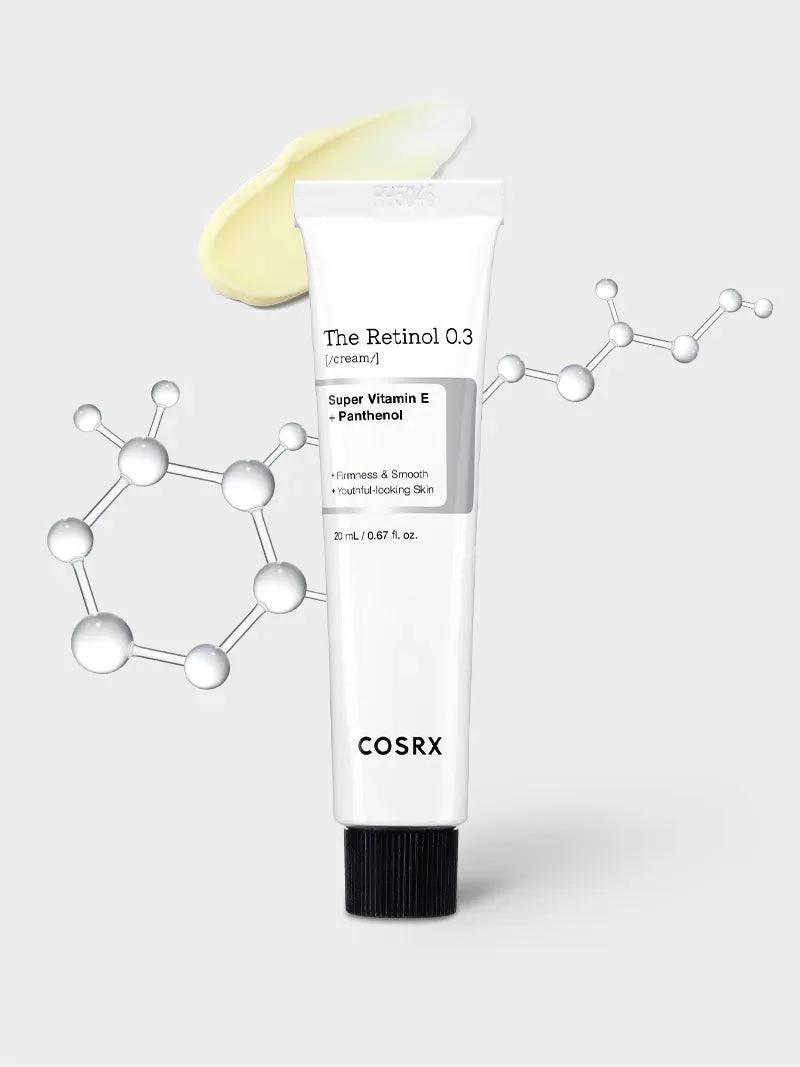
Nearly identical formulation to the beloved 0.1% version but with triple the retinol concentration. The same seven-antioxidant stabilization system and five-HA hydration complex make this one of the best-buffered 0.3% retinol products on the market. The graduated system design — step up from 0.1% when ready — is more systematic than most retinol brands offer.
The logical next step for anyone who mastered the 0.1% — same excellent seven-antioxidant and five-HA support system, three times the retinol potency. Delivers more visible anti-aging results with a manageable adjustment period for adapted skin. The tiny tube and refrigeration requirement remain pain points, but the formulation quality is hard to fault.
Released in December 2023, the 0.3% cream has about 500 to 800 reviews in just over two years, and crucially it mirrors the heavily-reviewed 0.1% version with only a concentration bump. That lineage lets the scoring borrow confidence from the established lower-strength formula while still leaning on antioxidant-and-hydration ingredient analysis where this potency's own user data stays modest.
Verdicts
How well it fits each concern
Verdict by concern tap a concern for the case
Good choicefor AgingIn your profileYou chose · Retinol is a trial-supported active for aging; this cream carries it at 0.3%.Moderate evidenceGentleNo reviews collected yet
The case for it
Retinol has trial-supported standing for this concern.
It is present at an effective concentration, declared or high in the ingredient list.
The formula carries none of the triggers this concern is sensitive to.
Same rule for everyone. “Good choice” is the verdict on 9,564 of 45,024 concern verdicts across the catalog; rule R5 decided 9,072 of them.
Unchanged since September 5, 2026, engine 5.1.1.
Promisingfor DullnessIn your profileYou chose · Hyaluronic Acid has trial-level evidence for dullness but no guideline or regulatory standing yet — promising, short of a recommendation; the other actives here are not yet assessed for it.Moderate evidenceGentleNo reviews collected yet
The case for it
Five Types of Hyaluronic Acid has trial-level evidence for this concern but no guideline or regulatory standing yet.
It is plausibly present at a working level, though the concentration is not declared.
The formula carries none of the triggers this concern is sensitive to.
What would change this: A declared concentration would move this to a firmer reading of the dose.
Same rule for everyone. “Promising” is the verdict on 7,858 of 45,024 concern verdicts across the catalog; rule R9p decided 7,858 of them.
Unchanged since September 5, 2026, engine 5.1.1.
R9p — 0.5.0: 'Unproven' beside three filled dots read as one question answered twice with opposite words (7,018 rows). The chip measures standing, the dots measure trial volume; where the row carries at least one RCT or a tier-2 source (moderate dots) and the active is present at a working level, the honest word is Promising. Unproven is reserved for plausible-standing rows with limited or weak evidence, or an under-dosed form. Same rank as Unproven — a bet either way; the dots order them. · the full register
Carrying active
Five Types of Hyaluronic Acid
Standing
plausible — trials support it
Form
plausible
Tolerability
gentle
Row checked
against its sources on July 17, 2026 (evidence table ev-2026.09-r228)
Unprovenfor Dark SpotsIn your profileYou chose · Retinol has early or mechanistic evidence for dark spots — a reasonable bet, not a recommendation; the other actives here are not yet assessed for it.Limited evidenceGentleNo reviews collected yet
The case for it
Retinol has early or mechanistic evidence for this concern, not trial-backed standing.
It is present at an effective concentration, declared or high in the ingredient list.
The formula carries none of the triggers this concern is sensitive to.
What would change this: Trial evidence for the active on this concern would move this from a bet to a recommendation.
Same rule for everyone. “Unproven” is the verdict on 1,111 of 45,024 concern verdicts across the catalog; rule R9 decided 1,111 of them.
Unchanged since September 5, 2026, engine 5.1.1.
R9 — Plausible-tier actives alone do not earn a recommendation, and 'not for this' would overstate the case against them. 'Unproven' with the evidence dots lets the reader judge the bet (added 0.2.0 after the first shadow run put a 10% niacinamide serum at 'not for this' for hyperpigmentation). 0.5.0: the closing clause reads the other heroes — "nothing else here addresses it" only when every other active has a researched 'none' row; "not yet assessed" when that is the truth. Rows whose dots read moderate or better now reach R9p first. · the full register
Carrying active
Retinol
Standing
plausible — trials support it
Form
adequate (declared 0.3%) — studied range 0.1–0.5%, from the OTC monograph or label; needs leave-on contact; judge it after ~12 weeks
Tolerability
gentle
Row checked
against its sources on July 17, 2026 (evidence table ev-2026.09-r228)
Promisingfor Large PoresIn your profileYou chose · Retinol has trial-level evidence for large pores but no guideline or regulatory standing yet — promising, short of a recommendation; the other actives here are not yet assessed for it.Moderate evidenceGentleNo reviews collected yet
The case for it
Retinol has trial-level evidence for this concern but no guideline or regulatory standing yet.
It is present at an effective concentration, declared or high in the ingredient list.
The formula carries none of the triggers this concern is sensitive to.
What would change this: Guideline or regulatory standing for the active on this concern would move this from a promising bet to a recommendation.
Same rule for everyone. “Promising” is the verdict on 7,858 of 45,024 concern verdicts across the catalog; rule R9p decided 7,858 of them.
Unchanged since September 5, 2026, engine 5.1.1.
R9p — 0.5.0: 'Unproven' beside three filled dots read as one question answered twice with opposite words (7,018 rows). The chip measures standing, the dots measure trial volume; where the row carries at least one RCT or a tier-2 source (moderate dots) and the active is present at a working level, the honest word is Promising. Unproven is reserved for plausible-standing rows with limited or weak evidence, or an under-dosed form. Same rank as Unproven — a bet either way; the dots order them. · the full register
Carrying active
Retinol
Standing
plausible — trials support it
Form
adequate (declared 0.3%) — studied range 0.1–1%, from the OTC monograph or label; needs leave-on contact; judge it after ~12 weeks
Tolerability
gentle
Row checked
against its sources on July 17, 2026 (evidence table ev-2026.09-r228)
Also listed for Rough Texture — the actives here (Panthenol (Vitamin B5) are in our research queue for that concern; there is no verdict until their evidence rows are written. That is a gap in our table, not a mark against the product.
Where our review and the verdict differ. The review below was written on the formulation and the published trials; the verdicts above apply the stricter standing test in our methodology — an active earns a recommendation only with guideline or regulatory standing for the concern. Where the two disagree, the verdict is DermApproved’s position.
A verdict is DermApproved’s assessment of how well a product’s ingredients fit a concern — never a claim about what the product treats. Evidence dots and collected reviews sit beside it and are never blended in.
Rules 0.5.1 · evidence table ev-2026.09-r228 · how we decide
Assessment
Pros & Cons
Pros
✓ Triple the retinol concentration with the same comprehensive seven-antioxidant stabilization system
✓ Five hyaluronic acids maintain the hydration buffer critical at higher retinol concentrations
✓ Smooth transition for 0.1% users — same texture, same feel, noticeably stronger results
✓ Visible texture improvement and brightening within 1-2 weeks for adapted skin
✓ Fragrance-free, cruelty-free, and vegan with well-studied supporting ingredients
✓ Lightweight cream texture absorbs quickly with a breathable satin finish
✓ Part of a systematic graduated approach (0.1% → 0.3% → 0.5%)
Cons
✗ 20 mL tube at $29 offers limited product for the price — same issue as the 0.1%
✗ Aluminum tube prone to cracking and paint flaking with extended use
✗ Requires refrigerated storage which limits portability and travel convenience
✗ Not suitable for retinol beginners — irritation risk is real without prior adaptation
✗ Not pregnancy-safe — standard for all retinol products
Review
Full Review
Most retinol brands treat concentration tiers like different products. The beginner version gets the soothing ingredients, the hydrating extras, the gentle marketing. The stronger version strips all that away and says 'good luck' — as if adapted skin no longer needs support. COSRX took a different approach with The Retinol 0.3 Cream. They kept everything.
Launched in December 2023, exactly fifteen months after the 0.1% starter, this cream shares an almost identical ingredient list with its gentler sibling. The seven-antioxidant stabilization system — tocotrienols, tocopherol, tocopheryl acetate, ascorbic acid, 3-O-ethyl ascorbic acid, glutathione, and beta-carotene — is unchanged. The five hyaluronic acid types providing multi-depth hydration are unchanged. The panthenol, shea butter, and allantoin soothing infrastructure is unchanged. COSRX simply tripled the retinol concentration and kept the protective ecosystem intact.
This matters more than it might sound. At 0.3%, retinol becomes meaningfully more active. Cell turnover accelerates. Collagen stimulation intensifies. But so does the potential for irritation, dryness, and the flaking that makes people self-conscious about their skin while supposedly improving it. The conventional industry approach to this trade-off is to accept more side effects as the cost of stronger results. COSRX's approach is to maintain the same buffering investment at the higher concentration, so the experience of stepping up feels like turning a dial rather than flipping a switch.
The assumption that tripling the percentage triples the misery is, happily, wrong. Irritation doesn't scale linearly with concentration, and skin that has spent three months getting comfortable at 0.1% arrives at 0.3% with a barrier already adapted to the work. In practice, most retinol-adapted users see mild extra peeling for one to two weeks, possibly some additional dryness around the nose and mouth, and then a return to comfortable nightly use. The five-HA complex does its job — surface-level moisture retention, deeper hydration, and sustained-release moisture that specifically counteracts retinol-induced barrier disruption — while hydrogenated lecithin further down the list suggests the retinol itself is liposomally carried rather than simply dispersed.
Results become more visible, more quickly, compared to the 0.1%. Most users report noticeable texture improvement and brightening within one to two weeks. By the four to six week mark, fine lines show meaningful softening. By eight to twelve weeks, skin elasticity and pore appearance improvements become clear to others, not just to you scrutinizing your face in bathroom lighting. The combination of retinol's cell turnover effects with the glutathione and dual vitamin C's brightening effects creates a comprehensive anti-aging treatment in a single step.
The texture is identical to the 0.1% — lightweight cream that absorbs quickly, leaves a breathable satin finish from the polysilicone-11, and doesn't interfere with sleep or pillow contact. No fragrance, no detectable scent beyond a faint vitamin note. If you liked how the 0.1% felt on your skin, the 0.3% feels exactly the same. The difference is entirely in what happens under the surface. The one thing to note in the fine print: soybean, sunflower, palm, and meadowfoam oils in the base mean this is not a fungal-acne-safe formula.
The packaging complaints from the 0.1% carry over unchanged. The aluminum tube protects against light — essential for retinol stability — but can crack, ooze, and flake paint with repeated squeezing. The 20 mL size means you're managing a small tube carefully to avoid waste. COSRX recommends refrigerated storage at 3-10°C, and this is one of the rare cases where the advice is worth following rather than dismissing as brand theater: at 0.3% there are simply more retinol molecules to protect from oxidation, and the six-month shelf life after opening is a real constraint. Not every retinol needs a fridge. This one benefits from it.
Using it well means starting slowly — two or three nights a week, building to every other night across six to eight weeks — on clean, dry skin, followed by a ceramide moisturizer. Nothing else exfoliating on the same night, no benzoyl peroxide in the same step, and sunscreen without fail the next morning. Retinol is off the table entirely during pregnancy.
At twenty-nine dollars for twenty milliliters — two dollars more than the 0.1% — the value calculation has the same tension. You're paying for the full support system, not just the retinol. A pea-sized amount per night means the tube lasts six to twelve weeks depending on frequency and coverage. It is a moderate monthly cost for a retinol treatment and a high one for twenty millilitres of anything, and the small tube is the single most common complaint among the several hundred reviews the cream has gathered.
The honest limitation of this product is one of positioning rather than formulation. At 0.3%, this sits in the middle of COSRX's graduated system — stronger than the 0.1% starter but less potent than the 0.5% advanced option, which switches to an oil base and will feel like a different product entirely. And users who are doing well on 0.1% may reasonably question whether stepping up is necessary, especially if their primary concern is texture and brightness rather than significant wrinkles.
But for the specific audience this targets — retinol-experienced users ready for more visible anti-aging results without abandoning the comfort of a well-buffered cream — this is one of the best-formulated intermediate retinol products available. COSRX understood that stepping up concentration doesn't mean stripping down support, and the result is a mid-strength retinol that treats the graduation like an achievement to be supported, not a hazing to be survived.
Formula
Key Ingredients
The hero actives that drive this product's performance.
Three times the concentration of the 0.1% starter, this mid-strength pure retinol accelerates cell turnover, stimulates collagen synthesis, and targets established fine lines and texture with more urgency. The same multi-antioxidant stabilization system (seven antioxidants) protects this higher concentration from degradation, maintaining potency in the tube and on the skin.
Provides 40-60 times the antioxidant potency of standard tocopherol, stabilizing the 0.3% retinol against oxidation while delivering independent anti-aging and photoprotective benefits. At this higher retinol concentration, the tocotrienol's stabilizing role becomes even more critical — more retinol means more molecules to protect from degradation.
The same multi-depth hydration system as the 0.1% version, providing sustained moisture at five layers of the epidermis. At 0.3% retinol, the drying and barrier-disrupting effects are more pronounced, making this five-HA safety net more functionally important — it's the primary defense against the flaking and tightness that mid-strength retinol can cause.
The soothing duo positioned high on the INCI list provides anti-inflammatory support and occlusive barrier protection. Panthenol penetrates and calms from within while shea butter creates a protective lipid layer on the surface — together preventing the irritation and moisture loss that 0.3% retinol can trigger during the adjustment period.
The same triple-antioxidant system as the 0.1% version — glutathione, ascorbic acid, and 3-O-ethyl ascorbic acid — provides retinol stabilization and independent brightening. At 0.3%, the additional brightening support from these antioxidants becomes more meaningful, helping to address the hyperpigmentation and dullness that retinol targets alongside its anti-wrinkle effects.
Not yet assessed
Ingredient standings describe the active at treatment-level doses and
vehicles; this product's own condition grades weigh its actual formula.
Apply a pea-sized amount to clean, dry skin in the evening after serums. Start with 2-3 nights per week and build to every other night over 6-8 weeks. Follow with a ceramide or barrier-repair moisturizer. Always use sunscreen the following morning.
Results Timeline
Visible texture refinement and brightness within 1-2 weeks. Noticeable softening of fine lines at 4-6 weeks. Significant improvement in elasticity, pore appearance, and wrinkle depth at 8-12 weeks of consistent use. Adjustment period (mild peeling, redness) may last 2-4 weeks.
At 0.3%, this cream enters the concentration range where clinical studies have demonstrated significant anti-aging effects with pure retinol.
The most-cited clinical study for OTC retinol is Kafi et al., published in the Archives of Dermatology (2007), which used 0.4% retinol and demonstrated significant increases in glycosaminoglycan and procollagen I expression in sun-damaged skin after 24 weeks. At 0.3%, the concentration is approaching this clinically validated range, and the conversion pathway — retinol to retinaldehyde to retinoic acid via endogenous skin enzymes — is well-established to produce measurable collagen synthesis and cell turnover acceleration.
The dose-response relationship for retinol is not perfectly linear. A study in the Journal of Investigative Dermatology (2006) by Varani et al. demonstrated that even low-dose retinol (0.1%) stimulated fibroblast growth and collagen production in aged human skin, while higher concentrations produced proportionally greater effects alongside proportionally greater irritation. This supports the graduated approach — each step up in concentration delivers incrementally more collagen stimulation.
The seven-antioxidant stabilization system becomes more critical at 0.3%. Retinol degradation follows first-order kinetics — the rate of degradation is proportional to concentration. More retinol molecules means more potential oxidation products (primarily retinaldehyde and then retinoic acid, but also inactive degradation products). The tocotrienol-tocopherol system provides primary radical scavenging, the ascorbic acid and 3-O-ethyl ascorbic acid regenerate oxidized tocopherols, and glutathione serves as the master redox buffer that regenerates the entire chain. This cascading antioxidant recycling is more relevant at higher retinol concentrations.
The five-HA complex addresses the well-documented barrier disruption caused by retinoids. Retinol increases transepidermal water loss (TEWL) during the adaptation period through accelerated desquamation — the shedding of corneocytes outpaces the formation of new lamellar lipid structures. Sodium hyaluronate crosspolymer's sustained moisture release and sodium acetylated hyaluronate's enhanced skin adhesion specifically target this temporary barrier vulnerability, maintaining hydration during the weeks when the skin is most susceptible to dryness.
Vitamin A antagonizes decreased cell growth and elevated collagen-degrading matrix metalloproteinases in human skin in vivo — Journal of Investigative Dermatology (2006)
Dermatologist Perspective
Dermatology professionals recognize 0.3% retinol as an intermediate concentration that delivers more visible results than starter doses while remaining within the OTC range. Dermatologists emphasize that this concentration is appropriate only for patients who have successfully adapted to lower concentrations for at least 2-3 months — introducing 0.3% to retinol-naive skin risks a level of irritation that can damage the barrier and set back the patient's skin health. The multi-antioxidant stabilization in this formula is noted favorably by dermatologists, who point out that retinol degradation in unstable products can reduce effective delivered concentration by 50% or more. Dermatologists commonly recommend the 'sandwich method' at this concentration — applying moisturizer before and after the retinol — for patients experiencing dryness, though this formula's built-in hydration system may reduce that need.
Guidance
Usage & Recommendations
How to Use
Apply a pea-sized amount to clean, dry skin in the evening after serums and before moisturizer. Start with 2-3 nights per week for the first 4 weeks. Increase to every other night for weeks 5-8 if tolerated. Build to nightly use by week 8-12 if no persistent irritation. Avoid the immediate eye area initially. Follow with a ceramide moisturizer. Use SPF 30+ sunscreen every morning without exception. Store refrigerated at 3-10°C and in an upright position.
Value Assessment
At $29 for 20 mL, this cream is priced identically per-mL to the 0.1% version with a $2 premium. The 2-pack at $49.30 offers modest savings. Given that the formulation base is nearly identical — same antioxidants, same HAs, same soothing agents — the price difference reflects primarily the higher retinol concentration. Monthly cost runs approximately $15-20 depending on frequency. For an intermediate retinol with this level of supporting ingredient sophistication, the formulation justifies the premium, though the tiny tube remains frustrating for a product you'll want to use consistently for months.
Who Should Buy
Retinol-experienced users who have adapted to 0.1% retinol (or equivalent) for at least 2-3 months and want more visible anti-aging results. Ideal for those targeting established fine lines, pore texture, and hyperpigmentation who appreciate the security of a well-buffered formula during the step-up process.
Who Should Skip
Retinol beginners — start with the 0.1% first. It's also not for you if you have sensitive, rosacea-prone, or eczema-affected skin that hasn't demonstrated tolerance to lower retinol concentrations. Pregnant or breastfeeding individuals should avoid all retinol products. Users who find the 20 mL format and refrigeration requirement impractical should consider alternatives with larger tubes or more stable retinol derivatives.
Rich but well-absorbing cream, slightly thicker than a gel-cream. Spreads smoothly and sinks in without leaving a heavy or oily residue. The polysilicone-11 creates a breathable, non-tacky finish.
Scent
Fragrance-free with only a faint characteristic vitamin scent that dissipates immediately on application.
Packaging
20 mL opaque aluminum squeeze tube designed to protect retinol from light. COSRX recommends refrigerated storage (3-10°C). Some users report tube cracking and paint flaking with extended use — the same issue as the 0.1% version.
Finish
satinnon-greasylightweight
What to Expect on First Use
First application may produce mild warmth or tingling — a sign the higher concentration is active. Users who've adapted to 0.1% retinol typically tolerate this well. Those jumping straight to 0.3% without prior retinol experience may experience redness and peeling within the first week. The cream itself feels identical to the 0.1% — lightweight, smooth, quick-absorbing.
Launched in December 2023, exactly fifteen months after the 0.1% starter, this cream was the natural next step in COSRX's graduated retinol system. The timing was intentional — long enough for 0.1% users to build tolerance and be ready for more potency. The formulation barely changed; COSRX simply tripled the retinol while keeping the protective ecosystem intact.
About COSRX Established Brand (5–20 years)
COSRX was founded in South Korea in 2013, combining 'Cosmetics' with 'Rx' to signal a clinical approach to K-beauty. The brand has earned 135+ global beauty awards and is sold in 146+ countries, with a reputation for effective, no-frills formulations built around well-researched actives.
Brand founded: 2013 · Product launched: 2023
Myth vs. Reality
Common Myths
Myth
Going from 0.1% to 0.3% retinol means you'll get three times the irritation
Reality
Irritation doesn't scale linearly with concentration. If your skin has adapted to 0.1%, the transition to 0.3% is typically manageable — mild peeling for 1-2 weeks, possibly some extra dryness. The comprehensive buffering system in this formula (five HAs, panthenol, shea butter, allantoin) specifically mitigates the jump. Start at 2-3 nights per week and build up.
Myth
You need to refrigerate all retinol products
Reality
COSRX specifically recommends refrigeration for their retinol creams (3-10°C), and at 0.3%, retinol stability is a real concern — higher concentration means more molecules susceptible to oxidation. While not all retinol products require refrigeration (some have more robust stabilization systems), storing this particular product in the fridge is worthwhile given its relatively minimal preservative system.
FAQ
Frequently Asked Questions
Should I start with 0.1% or go straight to 0.3% retinol?
If you've never used retinol before, start with the 0.1%. The 0.3% is designed as a step-up for skin that has already adapted to lower concentrations over at least 2-3 months. Jumping straight to 0.3% without retinol experience significantly increases your risk of irritation, redness, and peeling that may make you want to quit entirely.
How does COSRX Retinol 0.3 compare to the 0.1 version?
The formulation base is nearly identical — same seven antioxidants, same five hyaluronic acids, same soothing agents. The only meaningful difference is triple the retinol concentration (0.3% vs 0.1%). This means more visible anti-aging results but also higher irritation risk. The 0.3% costs $2 more ($29 vs $27) for the same 20 mL tube size.
Do I need to refrigerate COSRX Retinol 0.3 Cream?
COSRX recommends storing this product at 3-10°C (refrigerated) and in an upright position. At 0.3%, there's more retinol to degrade, making proper storage more important. Refrigeration slows oxidation and extends the active retinol's potency. If refrigeration isn't possible, store in the coolest, darkest place available.
How often should I use COSRX Retinol 0.3?
Start with 2-3 nights per week for the first 4 weeks. If tolerated without persistent redness or peeling, increase to every other night for weeks 5-8. Most users can build to nightly use (or near-nightly) by week 8-12. Always listen to your skin — if irritation increases, reduce frequency rather than pushing through.
Can I use COSRX Retinol 0.3 around my eyes?
Proceed with caution. The eye area has thinner, more delicate skin that's more susceptible to retinol irritation. If you tolerated the 0.1% around your eyes, the 0.3% may be fine with careful, sparing application. If you experience stinging, redness, or peeling around the eyes, restrict application to the broader face and use the 0.1% for the eye area.
Reviews
What Reviewers Tend to Say
Recurring themes our editors read across retailer reviews of this product — summaries in our words, not quotations, and not a substitute for your own patch test.
Common Praise
Noticeable improvement in skin texture and smoothness within 1-2 weeks
Lightweight cream texture absorbs well without greasiness
Effective step-up from the 0.1% with more visible anti-aging results
No irritation for users who had adapted to 0.1% retinol first
Improved skin brightness and elasticity with consistent use
Common Complaints
Very small 20 mL tube runs out quickly at the $29 price point
Can cause retinol burn and peeling if introduced too aggressively
Aluminum tube packaging prone to cracking with repeated use
Requires refrigerated storage which limits travel convenience
Not clearly labeled as non-beginner product on some retail sites
Notable Endorsements
Featured in beauty media at launch as a K-beauty retinol step-up
The standard product post opens with a percentage rather than a lifestyle photo, and the regulator makes brands publish their evidence. Both of those are ahead of the West. The metric they created is the problem.
It's a legitimately useful antioxidant with real anti-aging data — but 'nature's retinol' oversells a thin evidence base, and it isn't a retinoid at all.
Glow isn't a vibe or a filter. It's light bouncing off smooth, hydrated, evenly-toned skin, which means you can reverse-engineer it into a checklist instead of chasing it with a highlighter.
Mar 18, 2026· 6 min
Questions people ask about Hyperpigmentation
Verified answers from our questions library — the nuance a product page cannot carry.
Products, answers, therapy guides, tools and articles in one search. Brand names,
slang and abbreviations all work — accutane finds isotretinoin, bacne finds truncal acne.