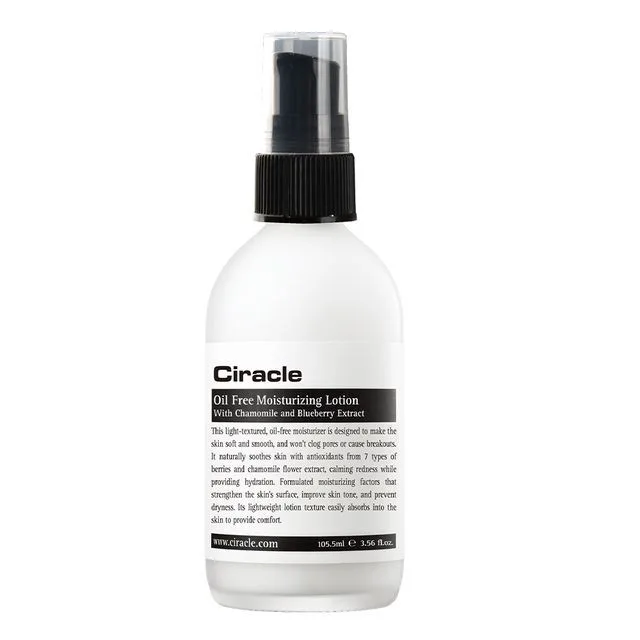
It is a deliberately simple Korean 'base lotion' built on glycerin and silicones, with jojoba wax ester supplying the only real emollience, which is how it earns its oil-free label while still feeling cushioned. The berry blend and green tea water are garnish; the product's actual identity is an easy, fast-absorbing hydrator in a generous bottle.
A pleasant, fast-absorbing base lotion that does the humble job of keeping normal and combination skin comfortable, in a generous bottle at a fair price. The 'oil-free' label is more about feel than chemistry, fragrance and methylparaben will rule it out for some, and there is nothing here that treats anything beyond everyday dehydration.
Our assessment of this lotion leans on its published ingredient list and scattered retailer feedback, since no sizable product-specific review count could be confirmed despite a market history going back to at least 2011. Ciracle has not released clinical testing for this specific formula, so claims about soothing or brightening effects remain unverified beyond what the ingredients themselves suggest.
Verdicts
How well it fits each concern
Verdict by concern tap a concern for the case
Good choicefor DehydrationIn your profileYou chose · Glycerin is a reference standard by mechanism for dehydration; this lotion carries it.Moderate evidenceStandard tolerabilityNo reviews collected yet
The case for it
Glycerin has trial-supported standing for this concern.
It is plausibly present at a working level, though the concentration is not declared.
The formula carries no trigger this concern is sensitive to, with the cautions noted.
What would change this: A declared concentration would move this to a firmer reading of the dose.
Same rule for everyone. “Good choice” is the verdict on 9,564 of 45,024 concern verdicts across the catalog; rule R5 decided 9,072 of them.
As of September 25, 2026, engine 5.1.1.
R5 — Trial-supported or guideline-supported active, adequately or plausibly dosed. · the full register
Carrying active
Glycerin
Standing
supported — its mechanism is established
Form
plausible — studied range 20%, from the trials on the row; needs leave-on contact; judge it after ~1 weeks
Tolerability
standard
Row checked
against its sources on July 17, 2026 (evidence table ev-2026.09-r228)
The studies behind the evidence row
USP glycerin monograph / Fluhr et al., glycerol and the skin (review) — glycerin is the reference humectant, drawing and holding water in the stratum corneum — reference work
Strong choicefor DrynessIn your profileYou chose · Dimethicone is an approved or monograph active for dryness; this lotion carries it high in the ingredient list.Moderate evidenceStandard tolerabilityNo reviews collected yet
The case for it
Dimethicone is a first-line active — approved, monograph-listed or named in current guidelines — for this concern.
It is present at an effective concentration, declared or high in the ingredient list.
The formula carries no trigger this concern is sensitive to, with the cautions noted.
Cautions: fragrance.
Same rule for everyone. “Strong choice” is the verdict on 1,459 of 45,024 concern verdicts across the catalog; rule R2 decided 892 of them.
As of September 25, 2026, engine 5.1.1.
Does the jobDoes what a moisturizer is for: draws in water, softens and smooths.
A verdict is DermApproved’s assessment of how well a product’s ingredients fit a concern — never a claim about what the product treats. Evidence dots and collected reviews sit beside it and are never blended in.
Rules 0.5.1 · evidence table ev-2026.09-r228 · how we decide
Assessment
Pros & Cons
Pros
✓ Glycerin placed second gives reliable, genuine everyday hydration
✓ Fluid milky texture absorbs within a minute without stickiness
✓ Sits smoothly under sunscreen and makeup without pilling
✓ Light enough for oily and combination skin in warm weather
✓ Allantoin and licorice derivative add a gentle soothing touch
✓ Large 105.5ml bottle lasts three months or longer
✓ No classic heavy pore-cloggers in the formula
Cons
✗ Contains added fragrance, a drawback for reactive skin
✗ Jojoba oil sixth makes the 'oil-free' name imprecise
✗ Too light to support very dry or damaged barriers
✗ Berry and vitamin C extracts sit at trace levels
✗ Methylparaben preservative rules it out for paraben-avoiders
✗ Polysorbate and fatty esters make it unsuitable for fungal acne
Review
Full Review
Turn the bottle around and the sixth ingredient is Simmondsia Chinensis (Jojoba) Seed Oil. On a product whose entire name is a promise about the absence of oil, that is the kind of detail that makes a careful shopper put the bottle back. It is worth pausing on, though, because the contradiction is less damning than it looks, and understanding it tells you almost everything about how this lotion is built and who it is actually for.
Jojoba is not a triglyceride like olive, sunflower or coconut oil. It is a liquid wax ester, structurally closer to the esters in human sebum than to the fats in a kitchen bottle. It spreads thin, it does not oxidize easily, and it rarely leaves the slick, lingering film people associate with facial oils. There is also no regulated definition of oil-free in cosmetics, so the phrase tends to describe a sensation rather than an ingredient list. By that measure, Ciracle is not really cheating: this lotion feels oil-free because the heavy lifting is done by glycerin, a light ester called cetyl ethylhexanoate, and two silicones, dimethicone and cyclopentasiloxane. The jojoba is supporting cast. Still, anyone avoiding every plant oil for a specific reason should know it is there, and it would be nice if the label were more precise.
With that settled, the formula reads as exactly what Korean shoppers mean by a base lotion: a simple, milky hydrator meant to follow toner and finish the routine without fuss. Glycerin sits second on the list, which is where you want the primary humectant in a product like this, and it does the real moisturizing work by drawing water into the outer layers of skin. The dimethicone then lays down a thin, breathable film that slows that water from evaporating and gives the lotion its smooth slip. Cetearyl alcohol and glyceryl stearate thicken the emulsion slightly so it does not run off your fingers, and the olive-derived emulsifiers keep everything stable. None of this is exciting, but all of it is sensible, and it is a formula that has been quietly doing the same job since at least 2011.
The supporting ingredients are where expectations need managing. Chamomile extract sits tenth, respectably high for a botanical, and allantoin and dipotassium glycyrrhizate, the calming licorice derivative, add a gentle soothing touch. Beyond that, the marketing leans hard on a berry blend: cranberry, blueberry, raspberry, blackberry, black currant, strawberry and açaí, plus green tea water and a whisper of ascorbic acid. Every one of those sits after the fragrance and after the methylparaben, which puts them in the final fraction of a percent of the formula. They are there so the box can mention vitamin C-rich berries; they are not there to brighten, and you should not buy this expecting antioxidant protection. Think of them as a pleasant garnish on a plain plate.
The texture is the lotion's best argument. It pours out fluid and milky, spreads across the face in two or three strokes, and disappears within a minute into a soft, faintly velvety finish. There is no stickiness and no greasy sheen, which is precisely what oily and combination skin types want from a daytime moisturizer. It layers well under sunscreen and makeup, rarely pills, and does not change the way a matte foundation sits. On normal skin in spring and summer it can be the only moisturizer you need. On dry skin in a heated winter room, it will feel pleasant for an hour and then leave you wanting more; there are no ceramides, no butters, no petrolatum and nothing that meaningfully rebuilds a compromised barrier.
Fragrance is the most important limitation. It is listed right in the middle of the formula, and while the scent is soft and clean and fades quickly, a moisturizer marketed partly on minimal irritation would be better without it. Witch hazel extract also appears, low in the list, which some very reactive skin types dislike. Methylparaben rounds out the preservative system; it has a long and reassuring safety record at cosmetic levels, but it will be a dealbreaker for shoppers who avoid parabens as a rule, and it is fair for them to know before buying. Polysorbate 20 and the fatty esters mean the lotion is not a match for fungal acne, either.
For acne-prone skin more broadly, the picture is decent. Nothing here is a classic heavy pore-clogger, the silicones are lightweight, and the whole thing was designed to sit beside Ciracle's blemish treatments without adding load. If you are using a drying active such as benzoyl peroxide or a retinoid, a light lotion like this can be a comfortable buffer in the evening, though very irritated skin would be better served by something fragrance-free and more barrier-focused.
The user feedback that can be found fits that description, though it is scattered rather than plentiful. Early and long-time buyers mostly praise the same things: fast absorption, no stickiness, comfortable wear under makeup, and a bottle that lasts. The complaints are equally predictable, mostly about the scent and about the lotion running thin for truly dry skin. There is no large, product-specific review pool to lean on, which is a reminder that this has always been a quiet staple rather than a cult item.
Value is fair rather than remarkable. At roughly twenty dollars for 105.5ml, you are paying for a large volume of a basic, well-textured moisturizer, and the bottle will last three months or more. You are not paying for any standout active ingredient, because there isn't one. For shoppers who already get their treatment from serums and simply want a comfortable, invisible final layer, that is a reasonable trade.
So who should reach for it? Normal and combination skin types who want a light, no-thinking moisturizer that disappears under sunscreen will be happy, as will oily skin that still wants a little hydration without shine. Sensitive, fragrance-reactive or genuinely dry skin should look elsewhere, and anyone drawn in by the berries should adjust their expectations downward. Judged as what it actually is, a modest, well-made base lotion with an imprecise name, it does its job reliably and has for a long time.
Formula
Key Ingredients
The hero actives that drive this product's performance.
Listed second, glycerin does most of the actual moisturizing here, pulling water into the upper skin layers while the dimethicone above it slows that water from leaving again.
Established mechanismfor Dehydration · established mechanism
The silicone that gives this 'oil-free' lotion its slip and its light occlusive film, standing in for the heavier plant oils a richer lotion would use to hold hydration in.
Regulator-approvedfor Dryness · established mechanism
Sixth on the list despite the product name: jojoba is technically a liquid wax ester rather than a triglyceride oil, which is how a lotion carrying it can still be marketed as oil-free while adding a soft, sebum-like emollience.
Established mechanismfor Dryness · established mechanism
A small soothing pair sitting behind the fragrance: allantoin softens and calms, while the licorice-derived glycyrrhizate adds mild anti-redness support to what is otherwise a plain hydrating base.
Chamomile is the highest-placed botanical in the formula, offering a gentle calming note that suits the lotion's pitch as a low-fuss base moisturizer for easily unsettled skin.
Not yet assessed
Ingredient standings describe the active at treatment-level doses and
vehicles; this product's own condition grades weigh its actual formula.
Works as the last hydrating layer after toner and any thin serum; in the morning a pea or two is enough to sit smoothly under sunscreen without pilling, and at night richer skin types can stop here while drier ones add a cream on top.
Results Timeline
Skin feels softer and less tight immediately after application. Over one to two weeks, flaky patches and end-of-day tightness ease for normal and combination skin; this is maintenance hydration rather than a corrective treatment, so there is no longer-term transformation to wait for.
The working chemistry of this lotion rests on a pairing that dermatology has understood for decades: a humectant to attract water and a light occlusive to keep it. Glycerin is among the most thoroughly studied moisturizing ingredients in skin care; beyond simply binding water, it supports the normal shedding of surface cells and helps maintain stratum corneum hydration, which is why it appears near the top of most well-designed moisturizers. Here it sits second on the INCI, meaning it is present at a meaningful level rather than as a label claim.
Dimethicone does the complementary job. Silicones form a thin, permeable film that reduces transepidermal water loss without the heavy feel of petrolatum, and they are generally regarded as low in irritation and non-comedogenic in typical use. That combination explains the lotion's character: good hydration with very little weight, and correspondingly limited power to repair a genuinely damaged barrier, since there are no physiological lipids such as ceramides or cholesterol to replace what is missing.
Jojoba's inclusion is chemically interesting. Unlike most plant oils, it consists mainly of long-chain wax esters, the same class of lipid that makes up roughly a quarter of human sebum. That structural similarity is often cited as a reason jojoba feels light and tends to be well tolerated on oily skin, though controlled data on its comedogenicity are sparse.
The soothing agents have modest support. Allantoin is an established skin protectant ingredient with a long safety record, and glycyrrhizate derivatives from licorice have shown anti-inflammatory activity in laboratory and small clinical settings. The berry extracts and ascorbic acid, however, sit below the fragrance and preservatives, well under the concentrations used in any study showing antioxidant or brightening benefits, so the evidence for them does not transfer to this formula.
Dermatologist Perspective
From a clinical standpoint, this is a textbook light moisturizer: humectant plus silicone, with little that would provoke problems in most skin. Dermatologists routinely suggest this style of lotion for oily or combination patients who complain that creams feel heavy, and for people using drying acne treatments who need hydration without adding occlusion. The added fragrance is the main point a clinician would flag, since fragrance mixes remain one of the most common causes of cosmetic contact dermatitis; patients with eczema, rosacea or a history of reactions are usually steered toward fragrance-free alternatives. The absence of ceramides or other barrier lipids also means it is not the product a derm would choose for visibly dry, cracked or eczema-prone skin. For intact, easy-going skin, it is a perfectly reasonable daily base.
Guidance
Usage & Recommendations
How to Use
After cleansing and toning, dispense a small amount, roughly the size of a large pea, into the palm and press it over the face and neck rather than rubbing hard. Its thin texture spreads far, so start small and add more only to dry areas such as the cheeks. In the morning, give it a minute to settle before sunscreen; it sits well under most formulas. At night it can follow any treatment serum as the final step, or act as a buffer beneath a richer cream for drier skin. Patch test on the jaw for a few days if fragrance has caused problems before.
Value Assessment
At about twenty dollars for 105.5ml, the per-milliliter cost is low for an imported K-beauty moisturizer, and at twice-daily facial use a bottle stretches past three months. The money buys texture and volume rather than actives: the formula is a sound glycerin-silicone base with trace botanicals, nothing that would justify a premium. Ciracle's long track record means you are not gambling on an untested newcomer, but you are also not paying for any clinically studied hero. For shoppers who want a large, reliable, invisible final layer, it is fair value. Those hoping the berry blend delivers brightening would be paying for a promise the ingredient list cannot keep. It comes in one size only.
Who Should Buy
Normal, combination and oily skin types looking for a light, fast-absorbing daily moisturizer that disappears under sunscreen and makeup. It also suits people using drying acne actives who want a simple hydration layer, and anyone who values a large bottle at a modest price.
Who Should Skip
Fragrance-sensitive, rosacea-prone or eczema-prone skin is better served by an unscented, barrier-focused formula. Genuinely dry or flaking skin will find it too light on its own, fungal-acne sufferers should avoid the polysorbate and esters, and strict paraben-avoiders will balk at the methylparaben.
Ready to try Ciracle Oil Free Moisturizing Lotion?
A milky, fluid lotion, thinner than a cream, that spreads in a couple of strokes and leaves a faint silicone slip rather than grease.
Scent
Lightly perfumed with a clean, soft fragrance that fades within a few minutes of application.
Packaging
Frosted white 105.5ml bottle with a pump dispenser and clear cap, which keeps the thin lotion hygienic and easy to meter out.
Finish
lightweightfast-absorbingsatin
What to Expect on First Use
The first application tends to feel almost weightless: skin drinks it in and is left smooth and soft to the touch. There is no tingle or adjustment period. Anyone reactive to fragrance should watch the jawline and cheeks over the first few days.
How Long It Lasts
Roughly three to four months at two small pumps' worth, twice a day, on the face alone.
Ciracle built its reputation on blemish and redness treatments, and this lotion was designed as the undemanding moisturizer to sit alongside them — something acne-prone users could apply without adding heaviness. It has stayed in the lineup largely unchanged for more than a decade.
About Ciracle Established Brand (5–20 years)
Ciracle is a South Korean cosmeceutical brand known mainly for its acne, blemish and redness lines, including the Red Spot spot treatments. This basic lotion is one of its older staples, sold through K-beauty retailers for well over a decade, though no product-specific clinical data is published.
Brand founded: 2008
Myth vs. Reality
Common Myths
Myth
An 'oil-free' lotion contains no oils of any kind.
Reality
This one lists jojoba seed oil sixth. Jojoba is chemically a wax ester rather than a triglyceride, and 'oil-free' in cosmetic marketing has no regulated definition, so the label describes the lotion's feel more than its ingredient list.
Myth
Berry extracts make this a vitamin C moisturizer.
Reality
The six fruit extracts and the trace of ascorbic acid all sit near the end of the INCI, after the fragrance. At those levels they add marketing color, not measurable antioxidant or brightening effect.
FAQ
Frequently Asked Questions
Is the Ciracle Oil Free Moisturizing Lotion actually oil-free?
Not strictly. Jojoba seed oil is the sixth ingredient, though jojoba is a wax ester that behaves more like skin's own sebum than a heavy plant oil. The lotion feels oil-free because glycerin and silicones carry the texture.
Will this Ciracle lotion be enough moisture for dry skin?
For mildly dry skin in warm months, often yes. It has no butters, ceramides or heavier occlusives, so genuinely dry or flaking skin will usually want a cream layered over it at night.
Can acne-prone skin use the Oil Free Moisturizing Lotion?
Its light glycerin-and-dimethicone base is a reasonable fit for oily, breakout-prone skin, and nothing in it is a classic pore-clogger. It does contain polysorbate 20 and fatty esters, so it is not a fit for fungal acne.
Does the Ciracle Oil Free Moisturizing Lotion have fragrance?
Yes, fragrance is listed mid-formula, ahead of the allantoin and licorice derivative. The scent is soft and fades quickly, but fragrance-sensitive skin should patch test on the jaw first.
Is this lotion safe during pregnancy?
Nothing in the formula is a retinoid, high-dose salicylic acid or hydroquinone; it is a plain humectant and silicone moisturizer. As with any product in pregnancy, clearing it with the treating clinician is sensible.
Does it contain parabens?
Yes, methylparaben is part of the preservative system alongside phenoxyethanol. Methylparaben has a long safety record at cosmetic levels, but shoppers who avoid parabens on principle will want to skip it.
Reviews
What Reviewers Tend to Say
Recurring themes our editors read across retailer reviews of this product — summaries in our words, not quotations, and not a substitute for your own patch test.
Chamomile's active fraction inhibits the same inflammatory pathways a steroid does, at a fraction of the strength — and the version that works best is grubbed out of Brazilian cerrado, while the synthetic substitute is half inactive by construction.
The burn trials are real and the skeptics who dismiss aloe as folklore are wrong — but the same substance has delayed healing in other wounds, and none of it says anything about what a soothing gel does to intact skin.
Clean-beauty marketing cast silicones as pore-clogging plastic wrap for your face. The chemistry — and the scar clinic — say almost the exact opposite.
The cheapest humectant on the ingredient list is also the best-studied, the most reliable in dry air, and the one your favorite moisturizer is quietly built around.
Products, answers, therapy guides, tools and articles in one search. Brand names,
slang and abbreviations all work — accutane finds isotretinoin, bacne finds truncal acne.