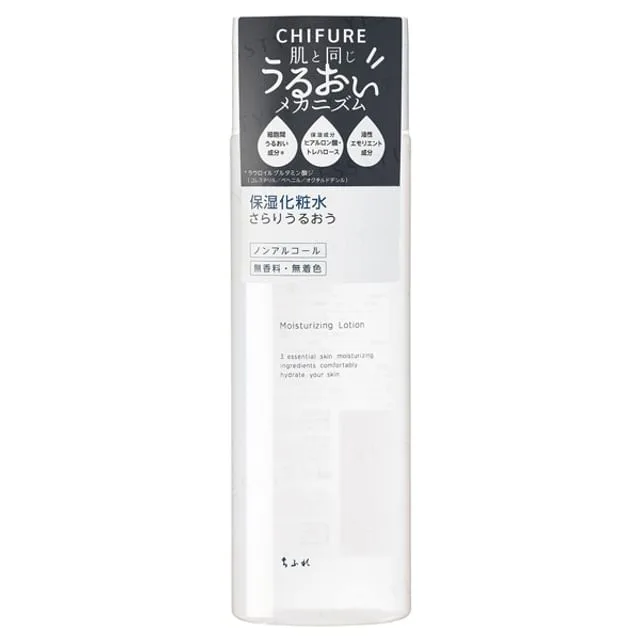
It strips a hydrating toner down to its essentials — hyaluronic acid, trehalose, and a soft emollient base — and sells it at near-cost with a fully published ingredient list. That combination of radical price-and-formula transparency and dependable, fragrance-free hydration is Chifure's signature, and it's rare to find at this price anywhere outside Japan.
A no-frills Japanese drugstore hydrating toner that does exactly one thing well — comfortable, fragrance-free hydration from hyaluronic acid and trehalose — at a near-cost price that shames most of the category. It won't thrill ingredient hunters and it uses parabens, but for gentle, reliable daily hydration and unmatched transparency, it's a quietly excellent basic.
As a long-standing Japanese drugstore product, this lotion has a deep domestic following and full ingredient transparency from the brand, but English-language review volume is thinner and grey-market import pricing varies by seller. The assessment leans on the well-understood science of its hydration ingredients and the brand's disclosed formula, so treat the value and quality reads as sound while allowing that international availability and price can fluctuate.
Verdicts
How well it fits each concern
Verdict by concern tap a concern for the case
Supporting rolefor DehydrationIn your profileYou chose · Hyaluronic Acid is a reference standard by mechanism for dehydration, but this liquid carries it below the studied range — a supporting role at best.Moderate evidenceGentleNo reviews collected yet
The case for it
Sodium Hyaluronate has trial-supported standing for this concern.
It is present below the studied range.
The formula carries none of the triggers this concern is sensitive to.
What would change this: A concentration inside the studied range would raise this a step.
Same rule for everyone. “Supporting role” is the verdict on 8,197 of 45,024 concern verdicts across the catalog; rule R7 decided 258 of them.
Unchanged since September 5, 2026, engine 5.1.1.
R7 — A supported active under-dosed cannot be recommended for the concern; if the category has a supportive job it may still help alongside treatment. · the full register
Carrying active
Sodium Hyaluronate
Standing
supported — its mechanism is established
Form
sub threshold (declared 0.01%) — studied range 0.1%, from the trials on the row; needs leave-on contact; judge it after ~1 weeks
Tolerability
gentle
Row checked
against its sources on July 17, 2026 (evidence table ev-2026.09-r228)
The studies behind the evidence row
Draelos ZD, Cosmetic Dermatology: Products and Procedures — hyaluronic acid classified as a humectant water-binding agent holding many times its weight in water — reference work
Good choicefor SensitivityIn your profileYou chose · No fragrance, drying alcohol, declarable allergens or sensitising preservatives in this liquid — the profile sensitive skin looks for.Not yet assessedGentleNo reviews collected yet
The case for it
Glutamate Lipid Emollients has no evidence row yet for this concern — it is in the research queue.
The formula carries none of the triggers this concern is sensitive to.
What would change this: A researched evidence row for the lead active would replace this with a verdict.
Same rule for everyone. “Good choice” is the verdict on 1,938 of 45,024 concern verdicts across the catalog; rule F2 decided 1,938 of them.
Unchanged since September 5, 2026, engine 5.1.1.
Also listed for Dryness — the actives here (glutamate lipids, Hyaluronic Acid, Trehalose, Vitamin E) are in our research queue for that concern; there is no verdict until their evidence rows are written. That is a gap in our table, not a mark against the product.
Does the jobDoes what a toner is for: not alcohol-driven, adds something real. Not measured from the label: restores skin pH, plays well with what follows.
A verdict is DermApproved’s assessment of how well a product’s ingredients fit a concern — never a claim about what the product treats. Evidence dots and collected reviews sit beside it and are never blended in.
Rules 0.5.1 · evidence table ev-2026.09-r228 · how we decide
Assessment
Pros & Cons
Pros
✓ Genuinely effective hydration from hyaluronic acid and trehalose
✓ Fragrance-free, alcohol-free, and colorant-free
✓ Gentle and low-risk for sensitive, reactive skin
✓ Short, fully transparent ingredient list with nothing superfluous
✓ Exceptional value, especially at Japanese domestic prices
✓ Layers beautifully in the Japanese lotion-and-emulsion routine
✓ Refill option reduces cost and packaging waste
Cons
✗ Contains methyl- and propylparaben, which some shoppers avoid
✗ No targeted actives — pure hydration only
✗ Pricier and harder to source outside Japan
✗ Plain packaging with no pump
✗ Basic emollient base may underwhelm very dry skin alone
Review
Full Review
Most skincare brands want you to believe their formula is special. Chifure does almost the opposite. The Japanese drugstore brand, founded in 1968, built its entire reputation on a kind of radical honesty that's still rare today: it publishes complete ingredient lists, explains its cost-to-price logic, and prices its products so close to cost that buying them feels less like a transaction and more like being let in on a secret. The Moisturizing Lotion is the purest expression of that philosophy — a basic hydrating toner that makes no grand claims, hides nothing, and costs about as much as a coffee. Reviewing it means judging it on its own modest terms, and on those terms it's genuinely good.
In Japanese skincare, 'lotion' doesn't mean a thick cream; it means a watery toner that serves as the first hydration step after cleansing. This one keeps its ingredient list short and legible. The hydration comes from a pairing Chifure markets as 'intercellular moisturizing ingredients': sodium hyaluronate, the well-known humectant that draws water into the skin, and trehalose, a sugar-derived humectant that holds moisture and helps protect skin cells against dehydration stress. Around them sits a soft emollient base — a cholesteryl-and-behenyl glutamate complex with triethylhexanoin — that gives the watery formula a faint silky slip so it doesn't feel completely bare on the skin, plus a touch of tocopherol for antioxidant protection. That's essentially the whole formula, and that's the point: there's nothing here that isn't doing a clear job.
The experience matches the ingredient list. It's a thin, water-light lotion that sinks in within seconds, leaving skin soft and comfortably hydrated with no stickiness and no scent. It's fragrance-free, alcohol-free, and colorant-free, which combined with the short ingredient list makes it a sensible, low-risk choice for sensitive and reactive skin. There's nothing dramatic to report — no tingle, no glow-up, no purge — because it isn't trying to treat anything. It's a hydration step, and it hydrates dependably. Layered in the classic Japanese way, with two or three thin passes and then sealed under an emulsion, it builds a comfortable, well-moisturized base that the rest of your routine can sit on. Pairing it with Chifure's matching Moisturizing Emulsion is the intended one-two, and it's a lovely, frictionless routine.
The drawbacks are exactly what you'd expect from a deliberately minimalist budget product, and none of them are surprises. There are no targeted actives — no niacinamide, no vitamin C, no peptides — so if you want a toner that brightens or fights aging, this isn't it, and it doesn't pretend to be. It uses methyl- and propylparaben as preservatives, which are well-studied, well-tolerated, and used at tiny regulated levels; they're a perfectly reasonable choice scientifically, but they're a dealbreaker for the segment of shoppers who avoid parabens on principle, so it's worth flagging plainly. The packaging is basic, with no pump, in keeping with the near-cost pricing. And there's the import question: in Japan this costs around ¥770, an almost absurd value, but outside Japan you're buying through exporters and the price climbs to the low-to-mid teens, which dulls — though doesn't erase — the value story.
That value is still the headline, even with import markup factored in. Domestically, this is one of the best hydration-per-yen deals in existence; internationally, even at ten to fifteen dollars for 180 ml of a clean, fragrance-free, hyaluronic-acid toner, it holds up well against pricier rivals that often charge you for scent, packaging, and branding rather than better core hydration. The refill option, where you can find it, pushes the value further and cuts waste. What you're really buying is honesty: a brand that tells you exactly what's in the bottle and charges you something close to what it costs to make. If you have normal, dry, combination, or sensitive skin and want a dependable, gentle, fragrance-free hydrating toner without paying for marketing, this is a quietly excellent pick. The only people who should look elsewhere are those who want active treatment from their toner, or who strictly avoid parabens — and for everyone else, it's a refreshing reminder that good skincare doesn't have to be complicated or expensive. There's a real pleasure in a product this unpretentious doing its job without asking for applause. It's worth knowing this lotion comes in three tunings — this standard version plus Light and Moist variants — so you can match the texture to your skin rather than forcing a one-size-fits-all formula, a small flexibility that's rare at this price. In a skincare culture increasingly drawn to long, expensive routines, there's also something quietly radical about a product that asks so little of you: no ritual, no mythology, no upsell, just a clean hydrating step that works and gets out of the way. For anyone trying to build a sensible routine without being talked into a dozen serums, a transparent, fragrance-free, near-cost hydrating lotion is exactly the kind of unglamorous foundation worth starting from — and trading up from only if your skin actually asks for more.
Formula
Key Ingredients
The hero actives that drive this product's performance.
The headline humectant, drawing water into the skin to deliver the dewy, plumped finish this lotion is built around. In such a stripped-back formula it does its job without competing with a crowd of other actives, working alongside trehalose so the simple ingredient list still hydrates effectively.
Established mechanismfor Dehydration · established mechanism
A sugar-derived humectant Chifure pairs with hyaluronic acid as an 'intercellular moisturizing ingredient.' It holds water and helps protect skin cells against dehydration stress, reinforcing the hyaluronic acid so the lotion's hydration feels more resilient than its short ingredient list would suggest.
Not yet assessed
Glutamate Lipid Emollients
A cholesteryl-and-behenyl lauroyl glutamate complex with triethexanoin that supplies a soft, silky slip and a light emollient layer. It gives this watery toner a smoother, less bare feel on the skin, helping the hydration sit comfortably rather than evaporating instantly off the surface.
A small antioxidant addition that helps protect the formula and offers mild skin-conditioning benefit. In a minimalist toner like this, it's the one quiet extra that nudges the product slightly beyond pure hydration toward light skin protection.
Not yet assessed
Ingredient standings describe the active at treatment-level doses and
vehicles; this product's own condition grades weigh its actual formula.
Pat it onto cleansed skin before serums and emulsion to lay down a hydrated base. In the Japanese style it pairs naturally with Chifure's matching emulsion layered on top to seal the moisture. For extra hydration, press on two or three thin layers, letting each absorb before the next.
Results Timeline
Skin feels softer and more hydrated immediately. With daily use the main benefit is a consistently comfortable, well-hydrated base; there are no active-driven changes to wait weeks for — it's a reliable hydration step rather than a treatment.
Pairs Well With
Chifure's matching Moisturizing Emulsion to seal it inA treatment serum layered afterAny moisturizer or sunscreen as the next step
The science here is modest by design, so the fair thing is to assess whether the simple formula achieves what it sets out to. Hydration in a toner like this rests on humectants, and the two chosen are well-supported: hyaluronic acid (as sodium hyaluronate) is a gold-standard humectant capable of binding many times its weight in water, drawing moisture into the stratum corneum, while trehalose is a disaccharide with documented water-retention properties and a notable ability to stabilize and protect cells against desiccation stress — the pairing is a sensible, complementary humectant duo. The glutamate-based emollient complex (cholesteryl/behenyl/octyldodecyl lauroyl glutamate) functions as a skin-conditioning, slip-giving agent; its evidence base is more cosmetic than clinical, but it serves a real textural purpose in keeping a watery formula from feeling stripping. Tocopherol is a well-established lipophilic antioxidant that protects both the formula and, modestly, the skin. On preservation, methylparaben and propylparaben are among the most extensively studied cosmetic preservatives, effective at low concentrations and considered safe by major regulatory reviews at the levels used; the parabens debate is largely driven by consumer sentiment rather than by evidence of harm at cosmetic doses. The honest scientific summary: this is a correctly formulated, no-nonsense humectant toner with proven core ingredients and a reasonable preservative system, making no active-treatment claims it can't support — its strength is doing simple hydration properly rather than chasing novelty.
References
Hyaluronic acid: a key molecule in skin hydration — Dermato-Endocrinology (2012)
Trehalose: protective effects against dehydration and cellular stress — Journal of Cosmetic Science (2009)
Safety assessment of parabens as used in cosmetics — International Journal of Toxicology (2008)
Dermatologist Perspective
A simple humectant toner like this fits comfortably into the kind of pared-back, hydration-first routine clinicians often recommend, especially for sensitive or easily-irritated skin where fewer ingredients means fewer potential triggers. The fragrance-free, alcohol-free, dye-free profile aligns with standard guidance for reactive complexions, and hyaluronic acid plus trehalose are unobjectionable, well-tolerated hydrators. On the parabens that some patients ask about, the dermatological consensus is that they are safe and effective preservatives at the regulated levels used in products like this, and that the alternative — a poorly preserved water-based product — carries a more tangible risk of microbial contamination. Clinicians would note this is a hydration and prep step rather than a treatment, best followed by a moisturizer to seal in the water, and that its value lies in being a gentle, reliable base rather than in any corrective action. For anyone wanting effective basics without unnecessary additives, it's an easy product to endorse.
Guidance
Usage & Recommendations
How to Use
After cleansing, dispense a small amount into your palms or onto a cotton pad and press it gently over the face and neck as your first hydrating step. For deeper moisture, layer two or three thin applications, letting each absorb before the next. Follow with any treatment serum, then seal everything with an emulsion or moisturizer — pairing it with Chifure's matching Moisturizing Emulsion is the traditional approach. Use morning and night, finishing the morning routine with sunscreen.
Value Assessment
Value is this lotion's defining trait. In Japan it sells for around ¥770 for 180 ml — an almost unbeatable price for a clean, fragrance-free hyaluronic acid toner — and a refill version trims cost and waste further. Outside Japan, grey-market and exporter markups push it into roughly the ten-to-fifteen-dollar range, which softens the story but still compares favorably with Western hydrating toners that often cost more while delivering similar core hydration wrapped in scent and packaging. The brand's near-cost pricing philosophy means you're paying for ingredients, not branding, and the transparent ingredient and cost disclosures back that up. The honest caveat for international buyers is sourcing: confirm a reputable seller and factor in shipping, since the further the bottle travels from Japan, the more its standout value erodes — though even marked up, it remains a sensible, economical basic.
Who Should Buy
Buy this if you have normal, dry, combination, or sensitive skin and want a dependable, gentle, fragrance-free hydrating toner without paying for branding or scent. It's ideal for minimalists, for those building a simple Japanese-style layering routine, and for anyone who values full ingredient transparency.
Who Should Skip
Pass on it if you want a toner with active treatment benefits like brightening or anti-aging, since this is pure hydration. Those who strictly avoid parabens, or who can't reliably source it from a reputable importer at a fair price, should also consider another option.
A thin, water-light lotion with a faint silky slip that absorbs quickly into a soft, non-sticky finish.
Scent
Fragrance-free and essentially odorless.
Packaging
A simple, no-frills bottle in keeping with the brand's near-cost pricing; a refill version is sold to cut waste and cost, though there's no pump.
Finish
non-greasylightweight
What to Expect on First Use
On first use it sinks in fast and leaves skin feeling soft and comfortably hydrated, with no tackiness and no scent. There's nothing dramatic to notice — no tingle, no purge — which is exactly as intended for a gentle daily hydration step.
How Long It Lasts
Around three to four months of morning and night use from the 180 ml bottle, and the refill stretches the cost further.
Chifure built its reputation on honesty: founded in 1968, it became known for disclosing complete ingredient lists and even its cost-to-price breakdown long before transparency was a marketing trend. This lotion embodies that ethos — a basic, effective hydrator priced so low it's almost a public service, aimed at people who want reliable skincare without paying for branding.
About Chifure Legacy Brand (20+ years)
Chifure is a Japanese drugstore institution founded in 1968 and famous for radical transparency — it was a pioneer in publishing full ingredient lists and disclosing its pricing structure decades before that became fashionable. Its formulas are deliberately no-frills and sold at near-cost, building deep trust among Japanese consumers as honest, effective basics rather than marketing-driven skincare.
Brand founded: 1968 · Product launched: 2018
Myth vs. Reality
Common Myths
Myth
A cheap drugstore toner can't hydrate as well as an expensive one.
Reality
Hydration comes from humectants like hyaluronic acid and trehalose, which work the same regardless of price. This lotion delivers them in a clean, fragrance-free base — the higher cost of premium toners often buys packaging, scent, and marketing rather than better core hydration.
Myth
Parabens in a product like this make it unsafe.
Reality
The methyl- and propylparaben here are long-studied, well-tolerated preservatives used at tiny, regulated levels to keep a water-based formula safe from microbes. They're a reasonable, evidence-backed choice; avoiding them is a personal preference, not a safety necessity.
FAQ
Frequently Asked Questions
Is Chifure Moisturizing Lotion a toner or a moisturizer?
In the Japanese sense, 'lotion' means a watery hydrating toner, so this is applied after cleansing as your first hydration step, before serums and emulsion. It hydrates but isn't a rich moisturizer — Chifure sells a separate emulsion to seal it in.
What makes Chifure Moisturizing Lotion so inexpensive?
Chifure deliberately prices near cost and keeps formulas, packaging, and marketing minimal, even publishing its pricing logic. You're paying for effective core ingredients — hyaluronic acid and trehalose — rather than scent, fancy packaging, or brand premium, which is the whole philosophy of the company.
Is Chifure Moisturizing Lotion good for sensitive skin?
Generally yes — it's fragrance-free, alcohol-free, and colorant-free with a short, simple ingredient list, which suits reactive skin well. The only caveat is that it contains parabens; those are well-tolerated by most people but a consideration if you specifically avoid them.
How do I use Chifure Moisturizing Lotion in a routine?
After cleansing, pat it over the face as your first hydrating step, optionally in two or three thin layers for more moisture. Follow with any serum, then seal with an emulsion or moisturizer — pairing it with Chifure's matching Moisturizing Emulsion is the classic Japanese approach.
Does Chifure Moisturizing Lotion come in different versions?
Yes — alongside this standard lotion, Chifure offers Light and Moist variants tuned for different skin types and a refill option to reduce cost and packaging. The standard version is the balanced middle choice suitable for most skin.
Reviews
What Reviewers Tend to Say
Recurring themes our editors read across retailer reviews of this product — summaries in our words, not quotations, and not a substitute for your own patch test.
Common Praise
Genuinely hydrating despite a tiny price tag
Fragrance-free and gentle on sensitive skin
Simple, no-nonsense formula with nothing unnecessary
Layers well in the Japanese lotion-and-emulsion routine
Common Complaints
Contains parabens, which some shoppers avoid
Basic formula with no targeted actives
Harder to find and pricier outside Japan
Plain packaging with no pump
Notable Endorsements
A cult budget staple in Japanese drugstore skincarePraised for Chifure's full ingredient and price transparency
That headline is the story every brand tells about trehalose. It is also, as of a 2017 paper in Molecular Cell, not quite true — which turns out to be the most interesting thing about the ingredient.
The internet's favorite hydrator has a counterintuitive dark side — in dry air, a humectant with nothing to seal it can pull water out of your skin instead of into it.
The burn trials are real and the skeptics who dismiss aloe as folklore are wrong — but the same substance has delayed healing in other wounds, and none of it says anything about what a soothing gel does to intact skin.
Products, answers, therapy guides, tools and articles in one search. Brand names,
slang and abbreviations all work — accutane finds isotretinoin, bacne finds truncal acne.