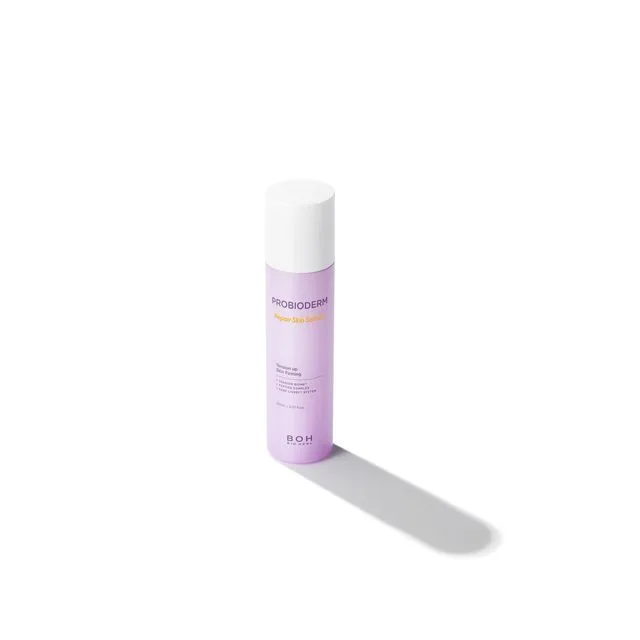
It pairs the brand's patented multi-strain Probioderm ferment complex with functional niacinamide, a deep peptide cascade and ceramide, aiming to rebalance the skin's oil-water levels and support firmness from the very first step rather than just prepping for what follows.
A loaded probiotic-and-peptide rebalancing softener that pairs the brand's patented multi-strain ferment complex with functional niacinamide, a deep peptide cascade and ceramide. It softens, balances and brightens from the first step, with a light, non-sticky finish oily skin loves. The ethanol and fragrance push irritation risk up for dry or sensitive skin, but for balanced-to-oily skin it's a substantive, vegan first step.
As a staple of Bioheal BOH's Probioderm line from an emerging brand, this softener's score draws on its dense formulation — a patented ferment complex with niacinamide, peptides and ceramide — and a solid base of domestic and international reviews rather than years of independent long-term data. Its broader performance across skin types continues to be established.
Verdicts
How well it fits each concern
Verdict by concern tap a concern for the case
Promisingfor AgingIn your profileYou chose · Niacinamide has trial-level evidence for aging but no guideline or regulatory standing yet — promising, short of a recommendation; the other actives here are not yet assessed for it.Moderate evidenceStandard tolerabilityNo reviews collected yet
The case for it
Niacinamide has trial-level evidence for this concern but no guideline or regulatory standing yet.
It is plausibly present at a working level, though the concentration is not declared.
The formula carries no trigger this concern is sensitive to, with the cautions noted.
What would change this: A declared concentration would move this to a firmer reading of the dose.
Same rule for everyone. “Promising” is the verdict on 7,858 of 45,024 concern verdicts across the catalog; rule R9p decided 7,858 of them.
Unchanged since September 5, 2026, engine 5.1.1.
R9p — 0.5.0: 'Unproven' beside three filled dots read as one question answered twice with opposite words (7,018 rows). The chip measures standing, the dots measure trial volume; where the row carries at least one RCT or a tier-2 source (moderate dots) and the active is present at a working level, the honest word is Promising. Unproven is reserved for plausible-standing rows with limited or weak evidence, or an under-dosed form. Same rank as Unproven — a bet either way; the dots order them. · the full register
Carrying active
Niacinamide
Standing
plausible — trials support it
Form
plausible — studied range 4–5%, from the trials on the row; needs leave-on contact; judge it after ~8 weeks
Tolerability
standard
Row checked
against its sources on July 17, 2026 (evidence table ev-2026.09-r228)
Avoidfor DehydrationIn your profileYou chose · This formula carries drying alcohol — a known trigger for dehydration — so it is not a fit however good its actives are.Not yet assessedCarries a triggerNo reviews collected yet
The case for it
Niacinamide has no evidence row yet for this concern — it is in the research queue.
The formula carries a known trigger for this concern, which decides the verdict before any efficacy question.
What would change this: Removing the trigger named above would let the actives be judged on their own.
Same rule for everyone. “Avoid” is the verdict on 1,909 of 45,024 concern verdicts across the catalog; rule R1 decided 1,304 of them.
Unchanged since September 5, 2026, engine 5.1.1.
R1 — Safety outranks praise (MASTER-PLAN §1.7). A condition-weighted trigger (multiplier ≥ 2 in condition-fit-matrix) decides the verdict before any efficacy question. · the full register
Promisingfor Excess OilinessIn your profileYou chose · Niacinamide has trial-level evidence for excess oiliness but no guideline or regulatory standing yet — promising, short of a recommendation; the other actives here are not yet assessed for it.Moderate evidenceStandard tolerabilityNo reviews collected yet
The case for it
Niacinamide has trial-level evidence for this concern but no guideline or regulatory standing yet.
It is plausibly present at a working level, though the concentration is not declared.
The formula carries no trigger this concern is sensitive to, with the cautions noted.
What would change this: A declared concentration would move this to a firmer reading of the dose.
Same rule for everyone. “Promising” is the verdict on 7,858 of 45,024 concern verdicts across the catalog; rule R9p decided 7,858 of them.
Unchanged since September 5, 2026, engine 5.1.1.
R9p — 0.5.0: 'Unproven' beside three filled dots read as one question answered twice with opposite words (7,018 rows). The chip measures standing, the dots measure trial volume; where the row carries at least one RCT or a tier-2 source (moderate dots) and the active is present at a working level, the honest word is Promising. Unproven is reserved for plausible-standing rows with limited or weak evidence, or an under-dosed form. Same rank as Unproven — a bet either way; the dots order them. · the full register
Carrying active
Niacinamide
Standing
plausible — trials support it
Form
plausible — studied range 2%, from the trials on the row; needs leave-on contact; judge it after ~8 weeks
Tolerability
standard
Row checked
against its sources on July 17, 2026 (evidence table ev-2026.09-r228)
Avoidfor Compromised Skin BarrierIn your profileYou chose · This formula carries fragrance, drying alcohol — a known trigger for compromised skin barrier — so it is not a fit however good its actives are.Moderate evidenceCarries a triggerNo reviews collected yet
The case for it
Niacinamide has trial-supported standing for this concern.
It is present at an effective concentration, declared or high in the ingredient list.
The formula carries a known trigger for this concern, which decides the verdict before any efficacy question.
What would change this: Removing the trigger named above would let the actives be judged on their own.
Same rule for everyone. “Avoid” is the verdict on 1,909 of 45,024 concern verdicts across the catalog; rule R1 decided 1,304 of them.
Unchanged since September 5, 2026, engine 5.1.1.
R1 — Safety outranks praise (MASTER-PLAN §1.7). A condition-weighted trigger (multiplier ≥ 2 in condition-fit-matrix) decides the verdict before any efficacy question. · the full register
Carrying active
Niacinamide
Standing
supported — its mechanism is established
Form
adequate — studied range 2%, from the trials on the row; needs leave-on contact; judge it after ~8 weeks
Tolerability
harsh — fragrance load, drying alcohol
Row checked
against its sources on July 17, 2026 (evidence table ev-2026.09-r228)
Also listed for Dullness — the actives here (Niacinamide, Ceramides, Peptides, Probiotics & Prebiotics) are in our research queue for that concern; there is no verdict until their evidence rows are written. That is a gap in our table, not a mark against the product.
Does the jobDoes what a toner is for: adds something real, not alcohol-driven. Not measured from the label: restores skin pH, plays well with what follows.
A verdict is DermApproved’s assessment of how well a product’s ingredients fit a concern — never a claim about what the product treats. Evidence dots and collected reviews sit beside it and are never blended in.
Rules 0.5.1 · evidence table ev-2026.09-r228 · how we decide
Assessment
Pros & Cons
Pros
✓ Patented multi-strain probiotic ferment complex for microbiome support
✓ Functional niacinamide brightens and rebalances oil-water levels
✓ Deep peptide cascade adds firming and elasticity support
✓ Ceramide NP and biotin reinforce the barrier
✓ Light, non-sticky finish ideal for oily and combination skin
✓ Vegan and cruelty-free formula
✓ Mid-range price for a loaded softener
Cons
✗ Ethanol sits fairly high, a caveat for dry skin
✗ Contains fragrance, unsuitable for sensitive skin
✗ Lifting and brightening benefits are gradual
✗ Contains silicones some users prefer to avoid
✗ Unlikely to suit malassezia-prone (fungal acne) skin
Review
Full Review
Korean skincare has a vocabulary problem in translation, and 'softener' is one of its more confusing words. A skin softener — sometimes labeled 'skin' or 'toner' depending on the brand — is the watery first step after cleansing, and to a Western shopper raised on the idea that toners are an optional relic, it can look like exactly the kind of step to skip. Bioheal BOH's Probioderm Repair Skin Softner is a useful corrective to that instinct, because while it occupies the humble softener slot, its ingredient list is doing considerably more than rebalancing pH and adding a splash of hydration. This is a treatment-grade first step wearing a modest name.
The foundation is the brand's signature, and its actual claim to distinctiveness: the patented Probioderm complex. Rather than a single ferment, this is a multi-strain blend — lactobacillus, bacillus and micrococcus ferments — joined by chlorella extract and prebiotics like fructooligosaccharides. The logic is microbiome support: a more balanced, resilient skin surface that's less prone to the low-grade inflammation that undermines barrier health and accelerates visible aging. It's the conceptual heart of the whole brand, and here it forms the conditioning base of the softener, the layer that 'repairs' and rebalances before the actives go to work.
Those actives are more substantial than a softener usually carries. Niacinamide sits seventh — high enough to be functional — bringing barrier support, oil-water rebalancing and gradual brightening, which is exactly the kind of evidence-backed workhorse that anchors a 'repair' claim. Beneath it runs a deep peptide cascade (copper tripeptide-1, palmitoyl pentapeptide-4, acetyl hexapeptide-8 and others) for a firming-and-elasticity dimension, plus ceramide NP and biotin for barrier reinforcement. So in one watery first step you get microbiome support, brightening, firming and barrier care — genuinely multifunctional, and a clear step above a basic prep toner.
In use, the character is light and fresh. This is a thin, watery softener that absorbs quickly to a non-sticky, faintly silky finish, which is part of why it suits oily and combination skin so well — it rebalances and refreshes without any heaviness. Pat it on after cleansing, layer your serums and moisturizer on top, and skin feels soft and balanced. For oilier skin types that find richer first essences cloying, this lightness is a real selling point, and the oil-water rebalancing focus is well matched to that audience.
The honest caveat is the formula's freshness comes partly from alcohol. Ethanol sits around sixth on the list — not trivial, but not dominant either. It contributes the light, quick-drying finish and aids absorption, and for balanced-to-oily skin it's generally a non-issue. But for dry, sensitive or alcohol-reactive skin, that placement is worth knowing, and following with a richer moisturizer is wise. There's also fragrance, mild but present, the usual reason for fragrance-sensitive skin to be cautious. Together, the alcohol and fragrance are what keep this from being a universal recommendation — it's a softener that leans toward resilient, oilier skin rather than delicate complexions.
On the plus side, and unlike several of the brand's collagen-containing products, this softener is vegan as well as cruelty-free, using fermented and plant-derived ingredients throughout. That broadens its appeal for shoppers who prioritize vegan formulations and have had to skip the brand's collagen items. Value is reasonable: at around twenty-four dollars for 150ml, it's mid-range for a K-beauty treatment softener, and the density of functional actives — patented ferments, niacinamide, peptides, ceramide — genuinely justifies the price over a basic toner.
It's interesting to compare this older 'Repair' softener with the brand's newer 3D Lifting Essential Toner, because the contrast reveals how Bioheal BOH's formulation philosophy has evolved. The Repair softener is lighter, more oil-control-oriented, and notably contains alcohol for that fresh, fast-drying finish — hallmarks of an earlier era of K-beauty toners aimed at balancing oilier skin. The newer lifting toner drops the alcohol, leans harder into a cushioned, peptide-rich feel, and reads as more universally hydrating. Neither is strictly better; they're tuned for different skins and different goals. If you run oily and like a brisk, rebalancing first step, the Repair softener's character may actually suit you better than the plusher newer toner, which is a useful reminder that 'newer' doesn't automatically mean 'right for you' when the formulas are aimed at different targets.
There's also a small lesson here about reading past a product's category name to its ingredient list. Had this launched in a Western market, it might well have been called an 'essence' or a 'treatment toner' and priced higher, because functionally that's closer to what it is — a watery step carrying real actives, not just a wipe of hydration. The 'softener' label undersells it to anyone unfamiliar with Korean conventions, which is precisely why it's worth doing what we've done here: ignoring the modest name and judging the product by what's actually in the bottle. On that basis it earns its place, with the alcohol-and-fragrance caveat being the only thing standing between it and a broader recommendation.
The verdict is warm, with a clear steer on fit. If you have normal, combination or oily skin, you want a light, non-sticky first step that actually rebalances, brightens and supports firmness rather than just prepping, and you appreciate a vegan formula, this is a smart, substantive softener and a strong entry to the Probioderm Repair routine. If your skin is dry, sensitive or reactive to alcohol and fragrance, the upper-list ethanol is your cue to choose a gentler, fragrance-free option instead. But for the resilient, oilier skin it's built for, it makes a convincing case that the softener step, done well, is anything but skippable.
Formula
Key Ingredients
The hero actives that drive this product's performance.
The brand's patented Probioderm blend — lactobacillus, bacillus and micrococcus ferments plus chlorella and prebiotics — is the softener's microbiome-supporting heart, conditioning and balancing the skin so it absorbs the repair actives that follow.
Sitting seventh, niacinamide adds barrier support, oil-water rebalancing and gradual brightening, anchoring the 'repair' claim with one of the most evidence-backed actives in the formula.
Established mechanismfor Compromised Skin Barrier · established mechanism
A cascade of signal and carrier peptides — copper tripeptide-1, palmitoyl pentapeptide-4, acetyl hexapeptide-8 and more — gives the softener a firming-and-elasticity dimension beyond simple hydration.
Ceramide NP plus biotin and panthenol reinforce the barrier and condition the skin, helping the watery softener leave skin supple and balanced rather than merely prepped.
Established mechanismfor Compromised Skin Barrier · established mechanism
Ingredient standings describe the active at treatment-level doses and
vehicles; this product's own condition grades weigh its actual formula.
Use it as the first step right after cleansing, patting it in to rebalance and hydrate; it layers cleanly under serums and moisturizer. For drier skin, follow with a richer cream to offset the light alcohol content.
Results Timeline
Skin feels softened and balanced immediately; brightening from the niacinamide and firming from the peptides build over four to eight weeks of consistent use.
The softener combines microbiome support, brightening and peptides in a light, alcohol-containing base. Its Probioderm complex — lactobacillus, bacillus and micrococcus ferments with chlorella and prebiotics — reflects emerging evidence that supporting the skin microbiome can aid barrier resilience and reduce reactivity, though cosmetic microbiome science is still maturing. Niacinamide, at a functional position, is among the best-evidenced actives for barrier improvement, sebum regulation and tone-evening, directly supporting the rebalancing-and-brightening claims. The peptide cascade carries promising but gradual evidence for the appearance of firmness, and ceramide NP is a physiological barrier lipid that reduces trans-epidermal water loss, with biotin and panthenol adding conditioning. The formulation trade-off is ethanol, positioned around sixth, which improves the light finish and penetration but raises drying and irritation potential for dry or compromised skin, and fragrance, an additional sensitization consideration. The honest scientific read is a genuinely multifunctional rebalancing softener whose brightening, barrier and microbiome benefits are well grounded, with its alcohol and fragrance content the main limits on tolerability.
Dermatologist Perspective
Lightweight rebalancing toners that pair microbiome-supporting ferments with niacinamide and peptides are generally viewed in clinical practice as useful, low-commitment first steps, particularly for oily and combination skin. The niacinamide content is well supported for barrier and tone benefits, and the ferment base aligns with emerging interest in microbiome support. Dermatology guidance would, however, flag the relatively high ethanol position and the added fragrance as reasons for caution in dry, sensitive or barrier-impaired skin, which are typically steered toward alcohol- and fragrance-free formulations. For resilient, oilier skin, the light, non-sticky finish is an advantage, and clinicians would view the softener as a reasonable hydrating-and-brightening step, while emphasizing that consistent sunscreen and, where appropriate, retinoids deliver more measurable anti-aging benefit, with a softener serving as a complementary layer rather than a primary treatment.
Guidance
Usage & Recommendations
How to Use
After cleansing, dispense the softener into your palms or onto a cotton pad and pat it gently over the face as your first step, letting it absorb. For oily and combination skin it rebalances and refreshes on its own; for drier skin, follow with a richer moisturizer to offset the light alcohol content. Layer your serums and moisturizer on top as usual. Use it morning and night, and in the morning always finish with sunscreen. If your skin is dry or reactive, patch test first because of the ethanol and fragrance, and reduce frequency if you notice any tightness.
Value Assessment
At around twenty-four dollars for 150ml, the softener is mid-range for a K-beauty treatment toner, and the density of functional actives — a patented multi-strain ferment complex, niacinamide, a deep peptide cascade and ceramide — genuinely justifies the cost over a basic prep toner. Being vegan and cruelty-free broadens its appeal relative to the brand's collagen products. There's no larger size to weigh for savings, and the value is best realized by balanced-to-oily skin that suits the light, alcohol-containing formula. The main limit on value is fit: dry or sensitive skin that reacts to the ethanol and fragrance would need a gentler softener, where this one's actives advantage is lost, but for its target skin types the actives-per-dollar is solid.
Who Should Buy
Choose it if you have normal, combination or oily skin and want a light, non-sticky first step that genuinely rebalances oil and water, brightens and supports firmness rather than just prepping, and you appreciate a vegan formula. It's a strong entry to the Probioderm Repair routine for resilient skin.
Who Should Skip
It's less suited to dry, sensitive or alcohol-reactive skin, since the fairly high ethanol and added fragrance can dry and irritate. Those who avoid silicones, or who want a gentle, fragrance-free softener, should choose a milder formula instead.
Ready to try Bioheal BOH Probioderm Repair Skin Softner?
A lightweight, watery softener with a quick, non-sticky absorption and a faintly silky finish.
Scent
A soft, clean fragrance noticeable on application that fades quickly.
Packaging
A 150ml bottle, simple and functional, designed as the first step of the Probioderm Repair routine.
Finish
lightweightfast-absorbingnon-greasy
What to Expect on First Use
The first use feels light and quickly absorbed, leaving skin soft and balanced; there's a faint fresh feel from the alcohol and a light fragrance that fades, with no sting for most users.
How Long It Lasts
Around 2-3 months of morning and evening use from the 150ml bottle.
It's a longer-running staple of Bioheal BOH (formerly Botanic Heal boH), built around the brand's signature Probioderm probiotic complex of lactobacillus, bacillus and micrococcus ferments for microbiome-led repair and rebalancing.
About Bioheal BOH Emerging Brand (2–5 years)
Bioheal BOH (formerly Botanic Heal boH) is a Korean Olive Young skincare brand built on its patented Probioderm probiotic complex. This repair softener is one of its longer-running staples; as an emerging brand its formulas are actives-dense and popular domestically but light on independent long-term validation.
Brand founded: 2021 · Product launched: 2021
Myth vs. Reality
Common Myths
Myth
A softener is just a Korean word for toner with no real benefit.
Reality
This softener carries a patented ferment complex, niacinamide, peptides and ceramide, so it rebalances, brightens and supports firmness as it hydrates, doing more than a basic prep toner.
FAQ
Frequently Asked Questions
What is a 'skin softner' and how is it different from a toner?
In Korean skincare a softener is essentially a hydrating, rebalancing first-step toner. This one goes further than basic prep, carrying a patented probiotic ferment complex, niacinamide, peptides and ceramide to rebalance and condition the skin.
Does the Probioderm Repair Softner contain alcohol?
Yes, ethanol sits around sixth on the list. It gives a light, fresh finish and aids absorption, but dry or alcohol-sensitive skin should be aware of it and follow with a richer moisturizer.
Is this softener good for oily skin?
Yes. The light, non-sticky texture, niacinamide and oil-water rebalancing focus suit oily and combination skin especially well, leaving a fresh, balanced finish rather than a heavy one.
Is the Probioderm Repair Softner vegan?
Yes, this softener is vegan and cruelty-free, using fermented and plant-derived ingredients rather than animal-derived ones, unlike some of the brand's collagen-containing products.
What does the Probioderm complex do?
It's the brand's patented blend of lactobacillus, bacillus and micrococcus ferments plus prebiotics, which support the skin microbiome to help keep skin calm, balanced and resilient as the repair actives work.
Reviews
What Reviewers Tend to Say
Recurring themes our editors read across retailer reviews of this product — summaries in our words, not quotations, and not a substitute for your own patch test.
Serums, masks, and peptide 'treatments' replaced the waxy balm this year. Some of it is real barrier science; some is a controlled irritant that stings your lips into looking fuller for an hour.
Western sensitive skincare works by subtraction — remove the fragrance, remove the alcohol, shorten the list. Japan's answer adds a designed molecule back in, and one of the two bets has a trial literature.
The trials are real, they are positive, and the pooled effect sizes are moderate. They also average fewer than forty people each, and what they measure is an instrument reading rather than something anyone notices in a mirror.
A wrecked barrier is the most common self-inflicted skin condition and the one with the clearest fix — the difficulty is that the routine which caused it feels productive and the one that repairs it feels like giving up.
Products, answers, therapy guides, tools and articles in one search. Brand names,
slang and abbreviations all work — accutane finds isotretinoin, bacne finds truncal acne.