You Don't Look Tired. You Have Three Separate Things Happening Under Your Eyes.
Blood, pigment and shadow produce almost identical darkness in a bathroom mirror — and only one of them is a skincare problem.
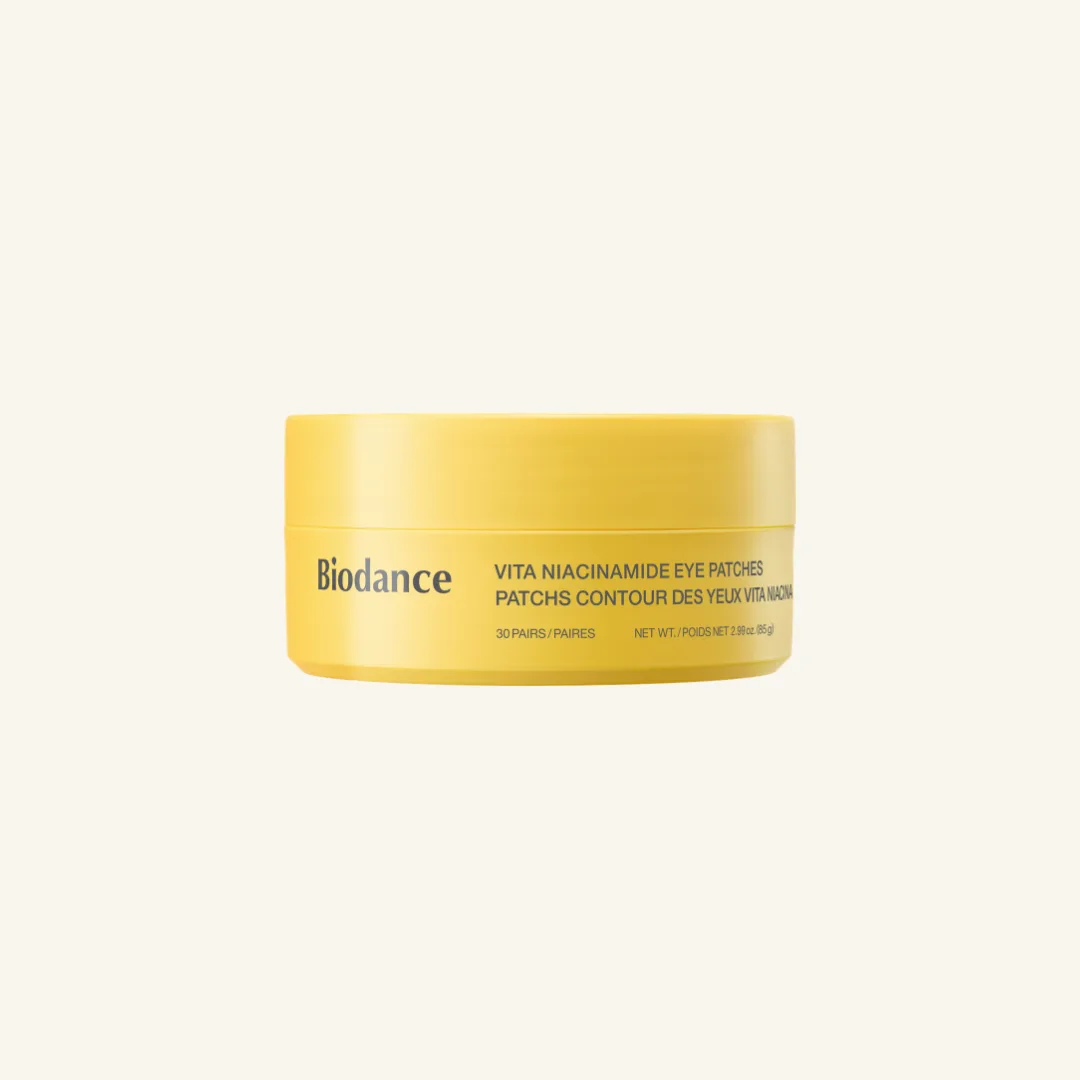
Among the three Biodance eye patches this is the only one that discloses its active percentage — 2 percent niacinamide — and the only one aimed at pigment rather than firmness, pairing that dose with caffeine for the vascular side of dark circles and a Coptis root extract for calm. It also has the shortest list of the trio, thirty-one ingredients, which makes it the simplest to read and the easiest to recommend to reactive under-eyes.
The simplest and most straightforwardly dosed of Biodance's eye patches: a cold hydrogel with a disclosed 2 percent niacinamide, caffeine for puffiness and a soothing Coptis extract, sold for under 40 cents a pair. It brightens for a morning and may nudge pigment-type dark circles over months; the pineapple, the glutathione and the brand's 101 percent are decoration.
Published on the brand's site on 10 July 2026 and barely two months old at the time of writing, these patches have almost no independent review history, so this assessment is built from the disclosed 2 percent niacinamide figure, the complete published ingredient list, Biodance's long track record with the same hydrogel, and independent research on niacinamide and caffeine. The eight-week efficacy percentages are the brand's own and one of them is arithmetically impossible; the score will be revisited once real-world feedback exists.
The case for it
What would change this: A concentration inside the studied range would raise this a step.
Same rule for everyone. “Supporting role” is the verdict on 8,197 of 45,024 concern verdicts across the catalog; rule R8 decided 4,250 of them. As of September 25, 2026, engine 5.1.1.
Brand or formulator? Disclose a concentration or correct a fact →
The studies behind the evidence row
The case for it
Same rule for everyone. “Good choice” is the verdict on 9,564 of 45,024 concern verdicts across the catalog; rule R5 decided 9,072 of them. As of September 25, 2026, engine 5.1.1.
Brand or formulator? Disclose a concentration or correct a fact →
The studies behind the evidence row
Also listed for Dullness and Dehydration — the actives here (Botanical Extracts, Niacinamide, Caffeine, Glutathione) are in our research queue for those concerns; there is no verdict until their evidence rows are written. That is a gap in our table, not a mark against the product.
Does the jobDoes what a eye cream is for: safe for eye skin, targets a real eye concern. Not measured from the label: hydrates without heaviness, stays where it's put.
A verdict is DermApproved’s assessment of how well a product’s ingredients fit a concern — never a claim about what the product treats. Evidence dots and collected reviews sit beside it and are never blended in. Rules 0.5.1 · evidence table ev-2026.09-r228 · how we decide
Biodance's page for these patches says they reduced dark circles by 101.2 percent in eight weeks, and I want to begin there, because a reduction of more than one hundred percent means the under-eye became brighter than the skin around it, and nobody has ever wanted that. It is the kind of number that comes out of an instrument reading pasted onto a marketing slide without anyone checking whether it means anything, and it tells you something useful about how to read the rest of the lid. The Vita Niacinamide Eye Patches are a good product with one sensible active at a sensible dose, wrapped in claims that treat arithmetic as a suggestion. Strip the claims and what is left is worth buying.
The active is niacinamide at 2 percent, and Biodance deserves credit for saying so — of its three eye-patch variants this is the only one that discloses a concentration. Two percent is the floor of the range with human data for slowing the transfer of pigment into the surface skin, which is the mechanism behind niacinamide's effect on brown, pigment-type dark circles, and it is also a dose that nobody's under-eyes react to. It sits fourth on a list of thirty-one, which for a hydrogel is a real position rather than a nominal one. Around it are caffeine, mid-list, which constricts the small vessels responsible for bluish, vascular darkness and, with the cold of the gel, eases morning puffiness for an hour or two; a Coptis japonica root extract, berberine-rich and calming; dipotassium glycyrrhizate for the same reason; and at the very end a token ceramide NP folded into hydrogenated lecithin, which with a little shea butter gives the patch a faintly conditioning finish. No fragrance, no alcohol, the gentle 1,2-hexanediol and hydroxyacetophenone preservative pair. It is the shortest and calmest formula of the trio and the one I would hand to someone whose eyelids react to everything.
The hydrogel itself is the reason any of this works for twenty minutes. Biodance's diamond-faceted gel is firm, cold and clingy in the good sense; the crescents settle into the orbital contour, stay put through a shower, and come off cleanly leaving a thin essence. Under that seal the skin's surface fills with water, fine dehydration lines flatten, and the under-eye looks smoother and brighter — helped by the pale pearl of titanium dioxide and tin oxide on alumina, which reflects light for a few hours. This is the same mechanism as every hydrogel patch on the market, it is temporary, and it is pleasant enough to justify the ritual on its own.
Then there is the vitamin complex on the lid. Pineapple fruit water is ten percent of the gel and, according to the brand, brings bromelain and natural vitamin C. It brings neither in any active sense: a protease enzyme and ascorbic acid do not survive in a preserved, gelled, room-temperature cosmetic at a level that does anything to skin, and what the pineapple water actually contributes is fruit-sugar humectancy, a pale yellow tint and a faint sweet smell from the tub. Glutathione appears third from last, liposomal by virtue of the lecithin beside it; topical glutathione's evidence for lightening is thin even at proper doses, and this is not a proper dose. Biodance's own comparison — that its 'multi-vita mix' has 2.42 times the antioxidant power of pineapple water alone — is a lab-bench figure about the mix in a tube, not about your skin. The honest description of the brightening here is: niacinamide, hydration, caffeine, pearl. In that order.
Used with that understanding, the patches perform well. Morning puffiness eases visibly within the session. The under-eye looks fresher for the working day. Over a month of near-daily use I would expect — and early users report — a slight evening of tone that is consistent with a low-dose niacinamide doing its slow work, and I would not expect more than that. The brand's eight-week dark-circle figure aside, the credible timeline for pigment change at 2 percent is two to three months of consistent use, and the patches cannot touch the shadow of a hollow tear trough or the show-through of thin skin except for the hour that caffeine buys.
The limitations are the format's. The result is a morning's worth. The tub-and-spatula packaging takes a little patience with the top pairs. The shea butter and lecithin mean these are not strictly fungal-acne-clean, which is irrelevant under the eye and relevant if you take up the brand's suggestion to use them on cheeks and smile lines. And the product is brand new — published on the Biodance site on 10 July 2026 and on Amazon soon after — so the review base at the time of writing is a handful of people and the eight-week claims have not yet been lived through by anyone outside the company.
Biodance, for context, is a young Korean brand that became famous almost overnight in 2023 for a hydrogel collagen mask, and it is a company that does gel superbly and numbers loosely. Both are on display here. What makes this particular tub the easiest of the three to recommend is that its one real active is disclosed, modest and appropriate, and its formula is short enough that the marketing has fewer places to hide.
So: at $23 for thirty pairs, these are a gentle, cooling, genuinely brightening-for-a-morning eye patch with a low but honest niacinamide dose that may help pigment-type dark circles over months of daily use. Buy them for that — for dull, tired, slightly shadowed under-eyes that want a daily ritual and cannot tolerate much. Do not buy them expecting a hundred and one percent of anything.
The hero actives that drive this product's performance.
| Ingredient | Function | Evidence |
|---|---|---|
| Niacinamide (2%) | Declared at 2 percent — 20,000 ppm on the Korean label — and fourth on the list, which makes this the most honestly dosed of Biodance's three eye patches. Two percent is the low end of the range with clinical data for slowing pigment transfer and supporting the barrier, and it is the only ingredient here that can plausibly shift pigment-type dark circles with repeated sessions. | Emerging for Hyperpigmentation |
| Ananas Sativus (Pineapple) Fruit Water (10%) | A tenth of the gel, standing in for part of the water and lending a faint sweet smell. Biodance credits it with bromelain and natural vitamin C; in a preserved hydrogel neither survives at an active level, so its real contribution is fruit-sugar humectancy and the pale yellow tint. | Not yet assessed |
| Glutathione (liposomal) | Listed third from the end alongside the hydrogenated lecithin that makes it 'liposomal'. Topical glutathione's lightening evidence is thin even at high doses; here it is the vitamin-complex flourish on the lid rather than a working brightener. | Not yet assessed |
| Caffeine | The de-puffing agent, mid-list beneath the pigments: it constricts small under-eye vessels and the cold gel compounds the effect for an hour or two after use. Vascular dark circles — the bluish kind — look briefly lighter for this reason. | Limited for Dark Circles |
| Ceramide NP | The last ingredient, packaged with lecithin into a small lipid delivery. Ceramide NP is a barrier lipid the thin under-eye skin lacks; the dose is token, but with the shea butter it gives this oil-free-looking patch a slightly more conditioning finish than the collagen version. | Not yet assessed |
Ingredient standings describe the active at treatment-level doses and vehicles; this product's own condition grades weigh its actual formula.
Water, Glycerin, Ananas Sativus (Pineapple) Fruit Water, Niacinamide, 1,2-Hexanediol, Ceratonia Siliqua (Carob) Gum, Chondrus Crispus Powder, Hydroxyacetophenone, Cyamopsis Tetragonoloba (Guar) Gum, Chondrus Crispus Extract, Butyrospermum Parkii (Shea) Butter, Glucomannan, Calcium Chloride, Potassium Chloride, Coptis Japonica Root Extract, Butylene Glycol, Sucrose, Ethylhexylglycerin, Dipotassium Glycyrrhizate, Adenosine, Disodium EDTA, Alumina, Arginine, Silica, Titanium Dioxide, Caffeine, Lactobacillus Ferment Lysate, Tin Oxide, Glutathione, Hydrogenated Lecithin, Ceramide NP
treatment
AM & PM
Apply on clean, dry, bare skin before serums so the gel seals; pat the essence in afterwards and follow with eye cream. On days when you also use a vitamin C serum, there is no conflict — the niacinamide here is 2 percent and the old incompatibility story is a myth — but apply the patch first.
The under-eye looks brighter and smoother straight after removal and stays that way for a few hours, with vascular puffiness eased by the caffeine and cold. Biodance reports dark-circle change at eight weeks; independent data on 2 percent niacinamide point to gradual pigment improvement over eight to twelve weeks of near-daily use, and no faster.
The mechanism worth trusting here is niacinamide's, and the dose is at the low edge of where it has been shown to work. Hakozaki and colleagues, in the British Journal of Dermatology in 2002, demonstrated in cell co-culture that niacinamide reduces the transfer of melanosomes from melanocytes to keratinocytes by roughly 35 to 68 percent, and then showed in clinical trials that a 5 percent niacinamide moisturizer applied over eight weeks significantly reduced facial hyperpigmentation versus vehicle. Two percent in a patch worn for twenty minutes delivers a smaller dose per session than 5 percent in a leave-on used twice daily, so the credible expectation is a gentler, slower version of that effect on pigment-type periorbital darkness — measurable over two to three months of near-daily use, not eight weeks of occasional ones. Niacinamide's barrier benefit, via increased ceramide synthesis, is a useful bonus for skin as thin as the under-eye's.
Caffeine addresses a different cause. Herman and Herman's 2013 review in Skin Pharmacology and Physiology describes its ready penetration of skin, its vasoconstrictive activity and its cosmetic use against puffiness and periorbital dark circles of vascular origin, with the caveat that the effects are short-lived — consistent with the couple of hours users see. The hydrogel's occlusion accounts for the immediate smoothing: stratum corneum hydration rises under a sealed gel and fine lines flatten until the water leaves. Beyond these, the evidence thins out. Pineapple fruit water's bromelain and ascorbic acid are not stable or active in a preserved, gelled cosmetic; glutathione has weak and inconsistent data for topical lightening and is present here in a trace; the Lactobacillus ferment lysate has in-vitro soothing data; and the brand's eight-week figures — 101.2 percent dark-circle reduction, 113.6 percent discoloration improvement — are internal instrument readings whose arithmetic exceeds what is physically possible and which should not be read as evidence of anything beyond the fact that a measurement was taken.
Periorbital darkness is a diagnosis before it is a product choice, and clinicians usually sort it into three causes: pigment, which topical niacinamide, azelaic acid, retinoids and sun protection can improve; vascular show-through, which caffeine lightens briefly and which lasers or fillers address durably; and structural shadow from tear-trough hollowing, which no topical changes. A 2 percent niacinamide hydrogel patch is a reasonable, low-risk adjunct for the first group and a pleasant temporary measure for the second. Its formulation — fragrance-free, alcohol-free, with anti-inflammatory botanicals and a short list — is appropriate for the thin, reactive skin of the eyelid, and the dose is low enough that irritation is unlikely even in patients who have flushed with higher-strength niacinamide products. Practitioners would set expectations at months rather than weeks, would treat the brand's efficacy percentages as promotional rather than clinical, and would remind patients that daily broad-spectrum sunscreen does more for pigment-type dark circles than any patch. Contact allergy to the components is uncommon; the shea butter and lecithin are the only ingredients that occasionally trouble acne-prone skin if the patches are used on the cheeks.
Cleanse, then dry the under-eye fully so the gel can grip. Use the spatula to lift a patch from the stack, hold it by the rim and lay it gel-side down with the wide end toward the temple, pressing gently along the orbital bone; repeat on the other side. Leave for twenty to thirty minutes — not overnight — then peel from the outer corner and pat the leftover essence in before eye cream and the rest of the routine. Use in the morning for puffiness and vascular shadow, or at night before a retinol applied outside the patch zone. For pigment-type dark circles, consistency matters more than duration: daily or near-daily for at least two months, with sunscreen every morning. Keep the lid tight and the tub cool; a spell in the fridge makes the caffeine effect more noticeable.
At $23 for thirty pairs — under 40 cents a session — these are priced identically to Biodance's other two eye patches and cheaply against the wider market of niacinamide eye products, most of which charge more for a leave-on with a similar dose. What the money buys is a well-made hydrogel with one honest active and good tolerability, plus caffeine; what it does not buy is the vitamin-complex story, since the pineapple and glutathione contribute little. For someone who will use them daily as a slow, gentle treatment for pigment-type dark circles, the value is fair. For someone who wants faster pigment change, a leave-on 4 to 5 percent niacinamide or azelaic acid product used twice daily is a better use of the same money, and the patches become a pleasant extra rather than the treatment. There is one size; the brand is new and its claims are its own, which the low price honestly reflects.
Anyone with dull, tired or lightly shadowed under-eyes who wants a gentle daily patch that brightens for the morning and, used consistently for months, may soften pigment-type dark circles — especially readers with reactive skin who found stronger niacinamide products sting. It is the right pick of the three Biodance patches when tone rather than lines is the concern.
People whose dark circles come from hollowing or thin skin, which need fillers or procedures, not patches, and anyone expecting change in weeks rather than months. Skip them too if you want a working dose of vitamin C or glutathione — neither is meaningfully present — or if you plan to use them on acne-prone cheeks.
Ready to try Biodance Vita Niacinamide Eye Patches?
Buy at Amazon ♥Cool, firm diamond-cut hydrogel crescents tinted a pale primrose yellow, with a slick gel underside and a barely-there conditioning film left behind from the shea and lecithin.
No fragrance added; the pineapple water leaves a faint sweet-fruit note in the tub that is gone once the patches are on.
The same squat screw-lid tub as the rest of Biodance's eye-patch trio, here in the pale yellow of the Vita line, holding thirty pairs in gel with a small spatula. Compact and travel-proof; separating the top pairs takes a little care.
Nothing to acclimatise to: the gel is cold and pleasant, grips instantly, and comes off after twenty minutes leaving the under-eye smoother and visibly brighter — the pale pearl pigments do some of that work. Sensitive-skin users report no tingle at the 2 percent niacinamide dose. What you see on day one is the hydration effect; the pigment-related change the brand promises, if it comes, is a matter of months.
One month of daily sessions, or around two months used three to four times a week.
All Year
The Vita line began as Biodance's yellow brightening mask and grew into a serum and cream in 2025. The eye patches arrived on 10 July 2026 as the last of the brand's three-variant eye-patch launch, positioned for dark circles specifically — a concern the collagen and caviar versions only gesture at.
Biodance is a Korean hydrogel specialist that went from small mask maker to Amazon chart-topper after a 2023 TikTok surge; the Vita line is its brightening tier. Its efficacy claims come from in-house instrument tests with occasionally implausible arithmetic, and no independent clinical data on its products exist.
The patches reduce dark circles by 101 percent in eight weeks, as the brand's page states.
A reduction greater than 100 percent is arithmetically impossible — it would mean the under-eye became lighter than the surrounding skin. The figure is an in-house instrument reading reported without method. What 2 percent niacinamide can credibly do is gradually reduce pigment-type darkness over two to three months of consistent use; it cannot touch shadow from hollowing or thin-skin vascular show-through beyond the temporary caffeine effect.
The pineapple water supplies vitamin C and bromelain that brighten the eye area.
Fresh pineapple contains both, but neither ascorbic acid nor a protease enzyme survives in a preserved, gelled hydrogel at an active level. The fruit water here is a humectant and a tint; the brightening comes from the niacinamide and from surface hydration.
Two percent, or 20,000 ppm on the Korean label — Biodance discloses this figure, unlike the collagen and caviar patches. It is the low end of the clinically studied range for pigment and barrier benefit, and low enough that even reactive under-eyes tolerate it.
If the darkness is pigment, gradually — 2 percent niacinamide slows pigment transfer and can lighten it over two to three months of near-daily use. If it is bluish and vascular, the caffeine and cold gel lighten it for a couple of hours. If it is a shadow from hollowing, nothing in a patch will change it.
Same hydrogel, same tub, same twenty minutes. The Vita version is built around a disclosed 2 percent niacinamide for dark circles and has the shorter, simpler list; the Collagen Peptide version is oil-free, targets fine lines, and carries a long peptide roster. Choose by whether tone or lines is the priority.
Yes. The idea that niacinamide and vitamin C cancel each other out is a long-debunked myth, and at 2 percent in a rinse-nothing patch there is no interaction to manage. Apply the patches first on bare skin, then the serum afterwards.
They are the gentlest of the three Biodance patches: fragrance-free, alcohol-free, a modest niacinamide dose, and a Coptis root extract plus dipotassium glycyrrhizate for calm. Eczema-prone eyelids should still patch-test because of the shea and lecithin.
Biodance suggests placing them over cheeks, smile lines or the neck. They will hydrate any clean skin; for a stubborn dark spot the 2 percent niacinamide in twenty-minute sessions is a slow tool, and a leave-on niacinamide or azelaic acid product is more efficient.
Recurring themes our editors read across retailer reviews of this product — summaries in our words, not quotations, and not a substitute for your own patch test.
Under-eye looks brighter immediately after use
Gentle — no sting on sensitive skin
Cooling and comfortable, stays in place
Sixty patches for the price
Results are short-lived
Too new for anyone to report on dark-circle change
Fiddly tub and spatula