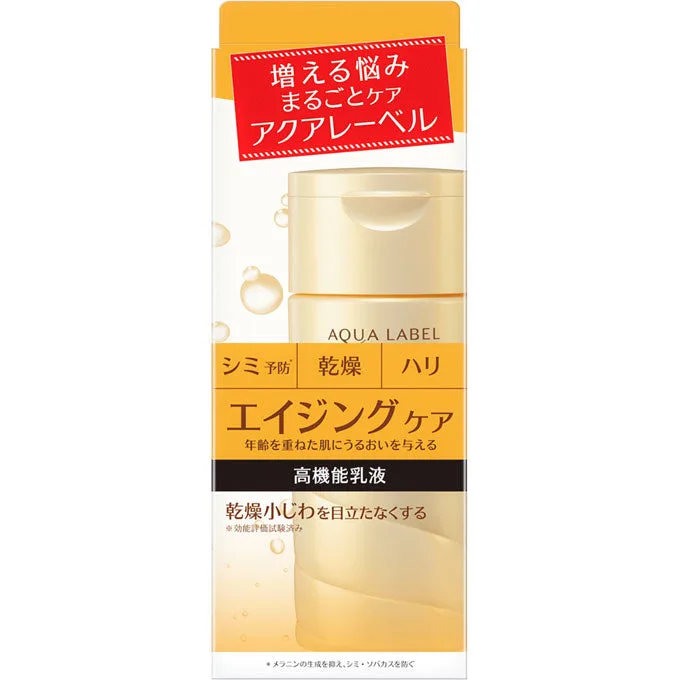
Most affordable emulsions leave the brightening to a separate serum, but this one is built around tranexamic acid as a ministry-approved quasi-drug active, so the moisturizing step itself is doing pigment work. The double hyaluronic acid and amino-acid complex give it a distinctive 'bouncy' rebound feel that Aqualabel built the whole line's identity around.
A quietly clever drugstore emulsion that puts a ministry-approved brightening active into the moisturizing step itself. The double hyaluronic acid earns the 'bouncy' name with real cushioned plumpness, and the tranexamic acid does steady work on uneven tone. Fragrance and parabens keep it from being a universal pick, but for dry, spot-prone skin it's a steal.
Because Aqualabel is a Japanese domestic line, the English-language review pool for this specific emulsion is moderate rather than deep, and import pricing varies enough that value can shift with where you buy it. This assessment draws on the registered quasi-drug active, Shiseido's formulation record, and aggregated importer feedback; long-term independent testing under Western conditions is still limited.
Verdicts
How well it fits each concern
Verdict by concern tap a concern for the case
Promisingfor HyperpigmentationIn your profileYou chose · Tranexamic Acid has trial-level evidence for hyperpigmentation but no guideline or regulatory standing yet — promising, short of a recommendation; the other actives here are not yet assessed for it.Moderate evidenceStandard tolerabilityNo reviews collected yet
The case for it
Tranexamic Acid has trial-level evidence for this concern but no guideline or regulatory standing yet.
It is plausibly present at a working level, though the concentration is not declared.
The formula carries no trigger this concern is sensitive to, with the cautions noted.
What would change this: A declared concentration would move this to a firmer reading of the dose.
Same rule for everyone. “Promising” is the verdict on 7,858 of 45,024 concern verdicts across the catalog; rule R9p decided 7,858 of them.
Unchanged since September 5, 2026, engine 5.1.1.
R9p — 0.5.0: 'Unproven' beside three filled dots read as one question answered twice with opposite words (7,018 rows). The chip measures standing, the dots measure trial volume; where the row carries at least one RCT or a tier-2 source (moderate dots) and the active is present at a working level, the honest word is Promising. Unproven is reserved for plausible-standing rows with limited or weak evidence, or an under-dosed form. Same rank as Unproven — a bet either way; the dots order them. · the full register
Carrying active
Tranexamic Acid
Standing
plausible — trials support it
Form
plausible — studied range 2–5%, from the OTC monograph or label; needs leave-on contact; judge it after ~12 weeks
Tolerability
standard
Row checked
against its sources on July 17, 2026 (evidence table ev-2026.09-r228)
Supporting rolefor DrynessIn your profileYou chose · Nothing here targets dryness directly; humectant and occlusive hydration is the recognised companion to treating it, and this emulsion does that without known triggers.Not yet assessedStandard tolerabilityNo reviews collected yet
The case for it
Tranexamic Acid has no evidence row yet for this concern — it is in the research queue.
The formula carries no trigger this concern is sensitive to, with the cautions noted.
Cautions: fragrance.
What would change this: A researched evidence row for the lead active would replace this with a verdict.
Same rule for everyone. “Supporting role” is the verdict on 8,197 of 45,024 concern verdicts across the catalog; rule R8 decided 4,250 of them.
Unchanged since September 5, 2026, engine 5.1.1.
R8 — The category's job (barrier care, humectant hydration, gentle cleansing, photoprotection) is the documented supportive role for this concern. This is the honest verdict for a moisturizer on an acne page. · the full register
Supporting rolefor AgingIn your profileYou chose · Nothing here targets aging directly; hydration and barrier support is the recognised companion to treating it, and this emulsion does that without known triggers.Not yet assessedStandard tolerabilityNo reviews collected yet
The case for it
Tranexamic Acid has no evidence row yet for this concern — it is in the research queue.
The formula carries no trigger this concern is sensitive to, with the cautions noted.
What would change this: A researched evidence row for the lead active would replace this with a verdict.
Same rule for everyone. “Supporting role” is the verdict on 8,197 of 45,024 concern verdicts across the catalog; rule R8 decided 4,250 of them.
Unchanged since September 5, 2026, engine 5.1.1.
R8 — The category's job (barrier care, humectant hydration, gentle cleansing, photoprotection) is the documented supportive role for this concern. This is the honest verdict for a moisturizer on an acne page. · the full register
Also listed for Dark Spots — the actives here (Tranexamic Acid, Retinyl Palmitate, Amino Acids, Hyaluronic Acid) are in our research queue for that concern; there is no verdict until their evidence rows are written. That is a gap in our table, not a mark against the product.
Does the jobDoes what a moisturizer is for: seals moisture in, draws in water.
A verdict is DermApproved’s assessment of how well a product’s ingredients fit a concern — never a claim about what the product treats. Evidence dots and collected reviews sit beside it and are never blended in.
Rules 0.5.1 · evidence table ev-2026.09-r228 · how we decide
Assessment
Pros & Cons
Pros
✓ Tranexamic acid leads as a ministry-approved brightening active
✓ Treats tone and moisture in a single emulsion step
✓ Rich, cushioned finish ideal for dry winter skin
✓ Shiseido formulation pedigree at a drugstore price
✓ Amino-acid and royal jelly base keeps the barrier calm
✓ Light, fast-fading rose scent rather than a heavy perfume
Cons
✗ Added rose fragrance rules it out for reactive skin
✗ Petrolatum and corn oil make it too rich for oily skin
✗ Contains methylparaben, a dealbreaker for some shoppers
✗ Retinyl palmitate means pregnancy caution applies
✗ Sold mainly through importers, so pricing and stock vary widely
Review
Full Review
There's a particular trick Japanese drugstore skincare pulls that the Western market still hasn't quite copied: it folds a regulated, ministry-approved active into a product you'd otherwise dismiss as a basic moisturizer. Aqualabel Bouncing Care Milk is a textbook example. On the shelf it looks like a humble pale-blue tube of face lotion, the kind of thing you'd grab on autopilot. Read the ingredient list, though, and tranexamic acid sits right at the top — not buried as a marketing sprinkle, but listed first as the registered quasi-drug active. That single detail reframes the whole product. This isn't a moisturizer that happens to mention brightening on the box; it's a brightening treatment that happens to moisturize, and it costs roughly what a sandwich costs in Tokyo.
Tranexamic acid is the reason to pay attention. It's one of the best-studied tone-evening actives going, with a strong record for melasma and the stubborn post-acne and sun marks that drive so much of Japanese skincare. What makes it appealing in a daily emulsion like this is how undramatic it is — it gently regulates the melanin pathway rather than stripping or bleaching, so it can sit in something you smooth on twice a day without the irritation and fuss a stronger pigment treatment demands. You're not babysitting this product. You apply it, you wear sunscreen, and over a couple of months your tone quietly settles.
The 'Bouncing Care' name isn't just branding fluff, either, and that surprised me. The formula pairs ordinary sodium hyaluronate with an acetylated 'super' hyaluronic acid that grips the skin surface longer, and the immediate after-feel genuinely is springy — press a finger into your cheek after application and there's a cushioned rebound that the line built its identity around. Underneath that, Shiseido layers in its trio of free amino acids, fermented royal jelly, and water-soluble collagen, which together give the milk a conditioned, supple slip. None of those are miracle workers on their own, but they're the kind of barrier-friendly humectants and emollients that keep skin calm enough to tolerate daily brightening, which is the point.
There's also a whisper of retinyl palmitate low in the formula. Let's be honest about what that is: the mildest vitamin A ester on the market, included to nudge texture and fine lines rather than to act like a real retinol treatment. If you came here expecting resurfacing power, recalibrate — this is a gentle, approachable formula by design, and the retinyl palmitate is there for slow, low-stakes smoothing, not transformation. That restraint is consistent with the whole product's personality: it wants to be the easy, every-night step you never think twice about.
The texture follows suit. It's a medium-weight white emulsion that breaks into a slippery lotion as you press it in and settles to a satiny, non-greasy finish. On dry and normal skin through autumn and winter, it's lovely — rich enough to feel like a proper seal without the tackiness of a heavy cream. That richness is also its main limitation. There's petrolatum and a touch of corn oil in the base, and oily or breakout-prone skin, especially in a humid summer, will likely find it more than they need. This is a cool-weather, drier-skin product at heart, and trying to force it onto oily skin in July is asking for disappointment.
The other honest caveats are the unglamorous ones. There's a rose fragrance — pleasant, soft, and gone within a minute or two, but present, and anyone with reactive skin or a fragrance-free rule should walk on. There's methylparaben, which is a perfectly safe preservative by the evidence but a dealbreaker for shoppers who avoid them. And the retinyl palmitate, mild as it is, is still a vitamin A derivative many people skip during pregnancy out of caution. None of these are formulation crimes; they're just the trade-offs of a mass-market drugstore product designed for the broadest possible Japanese audience rather than the sensitive-skin niche.
Value is where it gets genuinely interesting, and where the skepticism dissolves. In Japan this is a few-dollar drugstore staple. By the time it reaches Western buyers through importers, the price climbs to the low-to-mid twenties for the 130ml tube — still a remarkable amount of functional skincare for the money, given you're getting a quasi-drug brightening active, a double-HA hydration system, and Shiseido's formulation know-how in one step. The catch is availability: because it's a Japanese domestic line, you're buying from grey-market sellers, prices swing wildly from listing to listing, and you'll occasionally hit an out-of-stock or a suspiciously expensive single unit. That hunt is the real cost here, not the formula.
So who is this for? Dry, normal, or maturing skin dealing with dullness and uneven tone, who wants their moisturizer to multitask and doesn't mind a light rose scent. If that's you, this is one of the better-value brightening emulsions you can buy, and the bouncy finish is a small daily pleasure. If you're oily, fragrance-sensitive, pregnant, or you want serious retinoid resurfacing, this isn't your product — and that's fine. Not everything needs to be for everyone. What this milk does, it does with a quiet competence that punches well above its drugstore price.
Formula
Key Ingredients
The hero actives that drive this product's performance.
Listed first as the registered quasi-drug active, it interrupts the melanin signalling cascade that drives Japanese-skin concerns like sun spots and post-acne marks. Here it does the brightening heavy-lifting while the emollients and double hyaluronic acid below it handle the moisture side, so the milk treats pigmentation and dryness in one emulsion step.
Shiseido's trio of free amino acids sits in the water phase to top up the skin's natural moisturising factor, working alongside the tranexamic acid to keep the barrier calm enough to tolerate daily brightening without flaking.
Pairs standard sodium hyaluronate with its acetylated 'super' form, which clings to the skin surface longer for a film of lasting hydration that gives the emulsion its signature plumped, bouncy after-feel rather than a quick drink that evaporates.
A gentle, ester-form vitamin A tucked low in the formula to nudge texture and fine lines over time. It is the mildest retinoid available, chosen deliberately here so the milk stays approachable for daily morning-and-night use rather than acting like a true treatment retinol.
The fermented royal jelly extract and water-soluble collagen are the line's 'resilience' story, sitting in the emollient base to add a conditioning, supple slip that makes mature or dehydrated skin feel cushioned immediately on application.
Not yet assessed
Ingredient standings describe the active at treatment-level doses and
vehicles; this product's own condition grades weigh its actual formula.
Smooth on after the matching Aqualabel lotion (toner) and any serum, while skin is still slightly damp. In the morning, always follow with sunscreen — tranexamic acid brightening only holds if you block fresh UV.
Results Timeline
Immediate plumped, cushioned softness from the hyaluronic acid and emollients. Brightening from tranexamic acid is gradual — expect a more even tone over 6-8 weeks of consistent twice-daily use, with the retinyl palmitate's texture benefits taking a similar window.
The standout active here is tranexamic acid, a synthetic lysine derivative originally used as an antifibrinolytic that found a second life in dermatology for pigmentation. Its topical mechanism is distinct from tyrosinase inhibitors: it interferes with the plasmin pathway in keratinocytes, dampening the prostaglandin and arachidonic-acid signalling that prompts melanocytes to overproduce pigment after UV exposure and inflammation. That makes it especially relevant for the sun-spot and post-inflammatory discoloration this emulsion targets. In this formulation it isn't acting alone — the value comes from pairing a melanin-regulating active with a barrier-supportive base, because tone correction only sticks when the skin isn't simultaneously inflamed or dehydrated. The double hyaluronic acid system matters here for a practical reason: standard sodium hyaluronate hydrates the upper layers, while the acetylated form is more substantive and surface-retentive, extending the hydration film so the skin stays in the calm, well-moisturized state that lets the tranexamic acid do its slow work. The free amino acids (glutamic acid, alanine, methionine) replenish components of the skin's natural moisturizing factor, reinforcing that same barrier-first logic. The retinyl palmitate is the weakest evidence link in the formula; as an ester it must convert through several steps to active retinoic acid, so its resurfacing contribution is modest and best thought of as a gentle long-term texture nudge rather than a clinical retinoid effect. The honest read is that this is a well-constructed delivery of one strong, well-evidenced active inside a thoughtfully supportive moisturizing matrix.
References
Tranexamic acid in the treatment of melasma: A review of the literature — American Journal of Clinical Dermatology (2019)
Topical tranexamic acid as a promising treatment for melasma — Journal of Cosmetic Dermatology (2017)
Dermatologist Perspective
Tranexamic acid has become a clinical favorite for melasma and post-inflammatory hyperpigmentation precisely because it works on the inflammatory melanin pathway rather than bleaching, making it gentle enough for daily use. In practice, delivering it through a moisturizing emulsion is a sensible way to encourage the consistency these conditions demand, since pigment correction rewards months of uninterrupted application over short bursts of a stronger product. Clinicians routinely stress that any brightening regimen is only as good as the sunscreen alongside it; fresh UV exposure undoes tranexamic acid's gains quickly. The fragrance and retinyl palmitate here would prompt a caution for reactive skin and for anyone pregnant, where a fragrance-free, retinoid-free alternative is the conservative call. For dry, sun-marked skin without those sensitivities, an emulsion that combines a proven tone-evening active with humectants and emollients fits comfortably within standard guidance.
Guidance
Usage & Recommendations
How to Use
Smooth a coin-sized amount over cleansed skin as your emulsion step, after your hydrating lotion or toner and any treatment serum, while skin is still slightly damp to lock in moisture. Press it in with the palms rather than rubbing. Use it morning and night; on dry days you can layer it a touch more generously over the cheeks and around the eyes. The one non-negotiable is daytime sunscreen — the tranexamic acid's tone-evening work depends on blocking the UV that triggers pigment in the first place, so skipping SPF undermines the whole point.
Value Assessment
At a Japanese drugstore this is a genuine bargain, and even at the low-to-mid-twenties import price for 130ml it represents strong value: you're getting a quasi-drug brightening active, a double-hyaluronic-acid hydration system, and Shiseido's formulation know-how in a single step that would cost considerably more split across a Western serum-plus-moisturizer routine. The brand heritage works in its favor here — this is an established line from a legacy house with real formulation depth, not an untested newcomer charging on hype. The only true cost is logistical: because it's a Japanese domestic product, you'll buy through importers where prices swing and stock is inconsistent, so it pays to compare listings rather than grab the first one.
Who Should Buy
Dry, normal, or maturing skin contending with dullness, sun spots, and uneven tone, who wants a moisturizer that also treats pigment and doesn't mind a soft, fleeting rose scent. It's a particularly smart pick for anyone who likes the Japanese lotion-then-milk routine and wants quasi-drug brightening without paying serum prices.
Who Should Skip
Oily and breakout-prone skin will likely find the petrolatum-and-oil base too rich, especially in summer. Give it a pass if you're fragrance-sensitive, avoid parabens on principle, or are pregnant and would rather steer clear of vitamin A esters — a fragrance-free, retinoid-free emulsion is the safer match.
A medium-weight white emulsion that breaks into a slippery lotion as you press it in, settling to a cushioned, slightly satiny finish.
Scent
A soft rose floral that lingers briefly after application before fading.
Packaging
A simple squeeze tube in Aqualabel's signature pale-blue livery, functional but without a pump.
Finish
satinnon-greasy
What to Expect on First Use
Skin feels instantly bouncier and more cushioned on first use thanks to the double hyaluronic acid. There is no tingle or purge; the rose scent is the most noticeable thing early on, and it dissipates within a minute or two.
How Long It Lasts
Around 2.5 to 3 months of twice a day use face application from the 130ml tube.
Aqualabel relaunched its core range as the 'Bouncing Care' line in 2021, leaning into the springy, resilient skin-feel that Japanese consumers prize. The milk is the emulsion tier of a lotion-plus-milk routine that mirrors how skincare is traditionally layered in Japan.
About Aqualabel Established Brand (5–20 years)
Aqualabel is Shiseido's mass-market drugstore line, launched in 2007 and sold in Japanese pharmacies nationwide. It carries Shiseido's formulation pedigree at a budget price, and several of its products are registered quasi-drugs (medicated cosmetics) approved by Japan's health ministry.
Brand founded: 2006 · Product launched: 2021
Myth vs. Reality
Common Myths
Myth
Tranexamic acid will bleach my skin like hydroquinone.
Reality
It doesn't bleach. In this formula it gently regulates the melanin pathway to fade discoloration and even tone, which is why it can sit in a daily emulsion without the irritation risk hydroquinone carries.
Myth
A milk emulsion can't really brighten — you need a dedicated serum.
Reality
Because tranexamic acid is the lead quasi-drug active here, this emulsion delivers the brightening function directly; the milk format simply pairs it with the moisture this skin type also needs.
FAQ
Frequently Asked Questions
What does the Bouncing Care Milk actually do?
It's a moisturizing emulsion with tranexamic acid as a quasi-drug active, so it hydrates while gradually fading sun spots and uneven tone. The double hyaluronic acid gives the plump, bouncy after-feel the line is named for.
Is Aqualabel Bouncing Care Milk a toner or a moisturizer?
It's the emulsion (milk) step, used after the Aqualabel lotion which is the toner. In a Japanese routine the lotion hydrates first and this milk seals and treats, making it the moisturizer in a Western routine.
Can oily skin use this emulsion?
It leans rich, with petrolatum and corn oil in the base, so oily or breakout-prone skin may find it heavy — especially in summer. Drier and normal skin gets the most from its cushioned finish.
Does the tranexamic acid in this milk fade dark spots?
Tranexamic acid is well-studied for melasma and post-inflammatory pigmentation, and as the lead active here it works on uneven tone with daily use over six to eight weeks. Daily sunscreen is essential for the results to hold.
Is Aqualabel Bouncing Care Milk safe during pregnancy?
It contains retinyl palmitate, a vitamin A ester many people prefer to avoid during pregnancy out of caution. Check with your doctor, or choose a retinoid-free emulsion if you'd rather not.
Why is it hard to find outside Japan?
Aqualabel is a Japanese domestic drugstore line, so most Western buyers get it through importers and grey-market sellers. That's also why pricing varies widely from listing to listing.
Reviews
What Reviewers Tend to Say
Recurring themes our editors read across retailer reviews of this product — summaries in our words, not quotations, and not a substitute for your own patch test.
Japan runs a third regulatory tier between cosmetic and pharmaceutical, and once you can see it, the entire J-beauty aisle stops looking modest and starts looking legally precise.
Most heritage claims are unfalsifiable. This one sits on a public regulatory register — which makes it the rare case where you can check what 150 years of institutional research actually bought.
It was invented to stop bleeding during surgery. In 2026 it's in dozens of brightening serums — and the evidence is better than most trend ingredients can claim.
Body grooming produces the same four complications in the same order, in a predictable population — and almost every fix is upstream of the razor rather than downstream of it.
Aug 28, 2026· 11 min
Questions people ask about Hyperpigmentation
Verified answers from our questions library — the nuance a product page cannot carry.
Products, answers, therapy guides, tools and articles in one search. Brand names,
slang and abbreviations all work — accutane finds isotretinoin, bacne finds truncal acne.