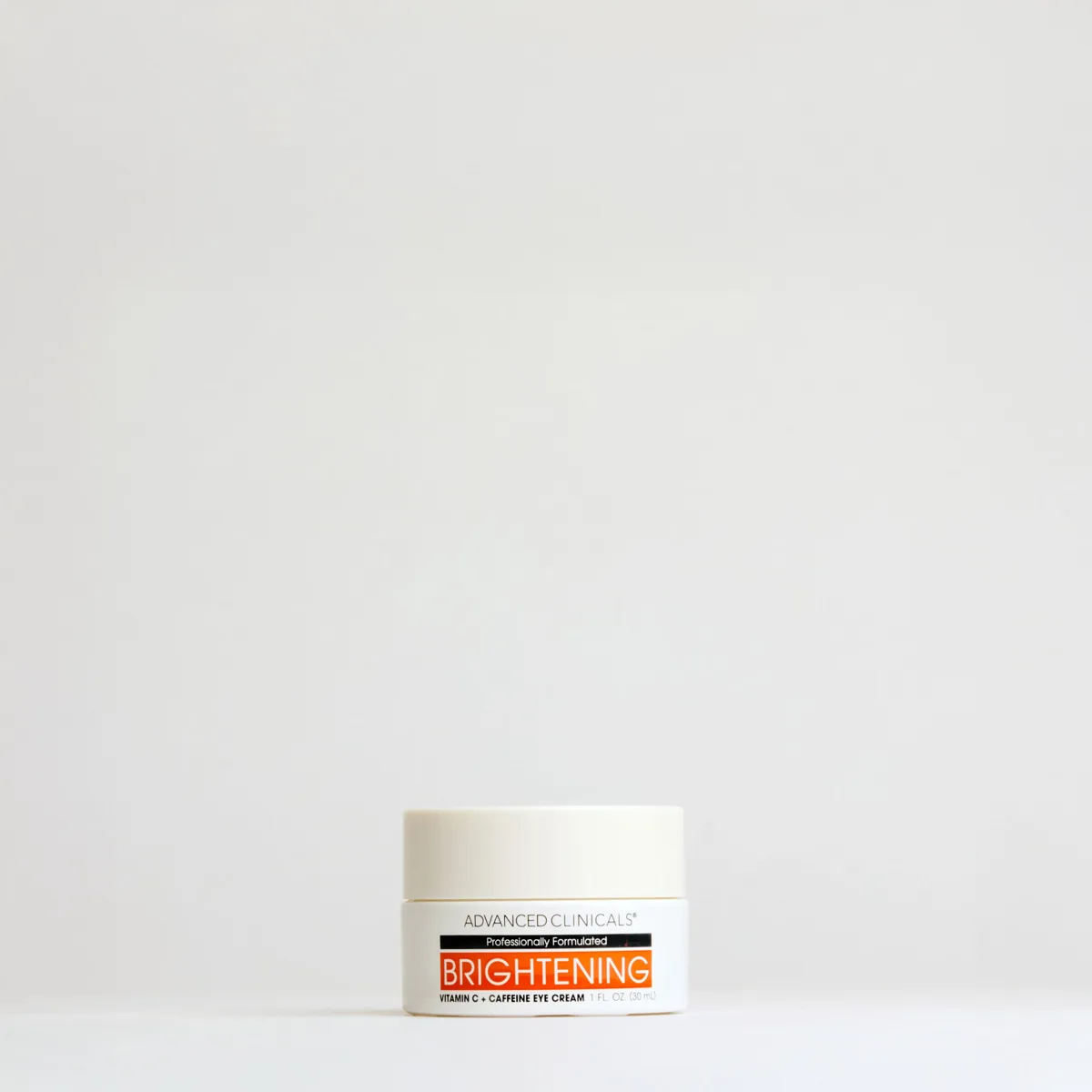
The brand's earlier eye products lean on a fruit extract for their vitamin C story; this cream lists tetrahexyldecyl ascorbate and ascorbic acid ninth and tenth, ahead of the caffeine, in a shea-and-coconut base built to carry the oil-soluble ester. It is a proper morning vitamin C eye cream, fragrance-free, at fifteen dollars, with a plant-expressed peptide and astaxanthin as a modern supporting cast.
The most purposeful eye product Advanced Clinicals makes: two forms of vitamin C and caffeine placed high in a rich, fragrance-free shea-and-coconut cream, with a plant-expressed peptide and astaxanthin behind them, for fifteen dollars. It is too rich for oily or milia-prone eyes, the peptide is unproven, and its 2025 track record is short, but as a budget morning eye cream it is a real step up from the brand's serums.
As a spring-2025 launch with roughly a hundred Amazon ratings, this cream's user record is too short to establish reliable patterns, and Advanced Clinicals publishes no product testing. The assessment therefore weighs the published ingredient list and the independent literature on tetrahexyldecyl ascorbate, ascorbic acid and caffeine, and will firm up as the review base grows.
Verdicts
How well it fits each concern
Verdict by concern tap a concern for the case
Supporting rolefor Dark CirclesIn your profileYou chose · Vitamin C has early evidence for dark circles, and hydration of the periorbital area is the recognised companion to treating it — a reasonable supporting choice, short of a recommendation.Moderate evidenceGentleNo reviews collected yet
The case for it
Tetrahexyldecyl Ascorbate & Ascorbic Acid has early or mechanistic evidence for this concern, not trial-backed standing.
It is plausibly present at a working level, though the concentration is not declared.
The formula carries none of the triggers this concern is sensitive to.
What would change this: A declared concentration would move this to a firmer reading of the dose.
Same rule for everyone. “Supporting role” is the verdict on 8,197 of 45,024 concern verdicts across the catalog; rule R8a decided 1,489 of them.
As of September 25, 2026, engine 5.1.1.
R8a — A plausible-tier active in a category with a supportive job: the sentence names the active instead of saying nothing targets the concern (the AmLactin / CeraVe SA case for keratosis pilaris, where no guideline and single trials leave the keratolytics at early evidence). · the full register
Carrying active
Tetrahexyldecyl Ascorbate & Ascorbic Acid
Standing
plausible — trials support it
Form
plausible — studied range 10%, from the OTC monograph or label; needs leave-on contact; judge it after ~12 weeks
Tolerability
gentle
Row checked
against its sources on July 17, 2026 (evidence table ev-2026.09-r228)
Good choicefor DrynessIn your profileYou chose · Shea Butter is a reference standard by mechanism for dryness; this cream carries it high in the ingredient list.Moderate evidenceGentleNo reviews collected yet
The case for it
Butyrospermum Parkii has trial-supported standing for this concern.
It is present at an effective concentration, declared or high in the ingredient list.
The formula carries none of the triggers this concern is sensitive to.
Same rule for everyone. “Good choice” is the verdict on 9,564 of 45,024 concern verdicts across the catalog; rule R5 decided 9,072 of them.
As of September 25, 2026, engine 5.1.1.
Promisingfor AgingIn your profileYou chose · Vitamin C has trial-level evidence for aging but no guideline or regulatory standing yet — promising, short of a recommendation; the other actives here are not yet assessed for it.Moderate evidenceGentleNo reviews collected yet
The case for it
Tetrahexyldecyl Ascorbate & Ascorbic Acid has trial-level evidence for this concern but no guideline or regulatory standing yet.
It is plausibly present at a working level, though the concentration is not declared.
The formula carries none of the triggers this concern is sensitive to.
What would change this: A declared concentration would move this to a firmer reading of the dose.
Same rule for everyone. “Promising” is the verdict on 7,858 of 45,024 concern verdicts across the catalog; rule R9p decided 7,858 of them.
As of September 25, 2026, engine 5.1.1.
R9p — 0.5.0: 'Unproven' beside three filled dots read as one question answered twice with opposite words (7,018 rows). The chip measures standing, the dots measure trial volume; where the row carries at least one RCT or a tier-2 source (moderate dots) and the active is present at a working level, the honest word is Promising. Unproven is reserved for plausible-standing rows with limited or weak evidence, or an under-dosed form. Same rank as Unproven — a bet either way; the dots order them. · the full register
Carrying active
Tetrahexyldecyl Ascorbate & Ascorbic Acid
Standing
plausible — trials support it
Form
plausible — studied range 5%, from the trials on the row; needs leave-on contact; judge it after ~12 weeks
Tolerability
gentle
Row checked
against its sources on July 17, 2026 (evidence table ev-2026.09-r228)
Promisingfor HyperpigmentationIn your profileYou chose · Vitamin C has trial-level evidence for hyperpigmentation but no guideline or regulatory standing yet — promising, short of a recommendation; the other actives here are not yet assessed for it.Moderate evidenceGentleNo reviews collected yet
The case for it
Tetrahexyldecyl Ascorbate & Ascorbic Acid has trial-level evidence for this concern but no guideline or regulatory standing yet.
It is plausibly present at a working level, though the concentration is not declared.
The formula carries none of the triggers this concern is sensitive to.
What would change this: A declared concentration would move this to a firmer reading of the dose.
Same rule for everyone. “Promising” is the verdict on 7,858 of 45,024 concern verdicts across the catalog; rule R9p decided 7,858 of them.
As of September 25, 2026, engine 5.1.1.
R9p — 0.5.0: 'Unproven' beside three filled dots read as one question answered twice with opposite words (7,018 rows). The chip measures standing, the dots measure trial volume; where the row carries at least one RCT or a tier-2 source (moderate dots) and the active is present at a working level, the honest word is Promising. Unproven is reserved for plausible-standing rows with limited or weak evidence, or an under-dosed form. Same rank as Unproven — a bet either way; the dots order them. · the full register
Carrying active
Tetrahexyldecyl Ascorbate & Ascorbic Acid
Standing
plausible — trials support it
Form
plausible — studied range 5–6%, from the trials on the row; needs leave-on contact; judge it after ~12 weeks
Tolerability
gentle
Row checked
against its sources on July 17, 2026 (evidence table ev-2026.09-r228)
Also listed for Dullness — the actives here (Shea Butter, Vitamin C, Caffeine, Growth Factors (EGF) are in our research queue for that concern; there is no verdict until their evidence rows are written. That is a gap in our table, not a mark against the product.
Does the jobDoes what a eye cream is for: safe for eye skin, targets a real eye concern. Not measured from the label: hydrates without heaviness, stays where it's put.
A verdict is DermApproved’s assessment of how well a product’s ingredients fit a concern — never a claim about what the product treats. Evidence dots and collected reviews sit beside it and are never blended in.
Rules 0.5.1 · evidence table ev-2026.09-r228 · how we decide
Assessment
Pros & Cons
Pros
✓ Tetrahexyldecyl ascorbate and ascorbic acid placed ninth and tenth, ahead of the caffeine
✓ Oil-soluble vitamin C ester is stable in the shea-and-coconut base
✓ Caffeine gives a same-morning de-puffing effect
✓ Fragrance-free, unlike the brand's rose-scented eye serums
✓ Rich emollient base smooths crepey, dehydrated under-eye skin quickly
✓ Astaxanthin and green tea add antioxidant support under sunscreen
✓ Fifteen dollars for a purposeful vitamin C eye cream
Cons
✗ Coconut oil fifth on the list makes it too rich for oily or milia-prone eyes
✗ Plant-expressed peptide has supplier data only, no independent trials
✗ Brightening is slow and subtle even at best
✗ Can pill under heavy concealer if over-applied
✗ Only around a hundred user ratings since the 2025 launch
Review
Full Review
For years the vitamin C in an Advanced Clinicals eye product meant a kakadu plum extract listed somewhere in the twenties, a botanical footnote doing marketing work. This cream, launched in April 2025, does something the brand had not done around the eyes before: it lists tetrahexyldecyl ascorbate ninth and ascorbic acid tenth, straight after the emollient base and ahead of the caffeine. That is the placement of a formula that intends its vitamin C to matter, and it is the reason to take a fifteen-dollar eye cream from a value brand more seriously than its price and packaging suggest.
Advanced Clinicals is a Midwest-based brand founded in 2004 whose reputation was built on sixteen-ounce jars of retinol and collagen cream at off-price stores and on Amazon. It does not disclose concentrations or publish testing, and its products have historically been generous in size and generic in construction. The 2025 eye creams, this brightening one for the morning and a retinol one for the night, are a change of approach: one-ounce tubes, no fragrance, and ingredient lists that read like someone thought about order. The pair was clearly designed together, with the label on each advising against layering with the other.
The formula is a conventional rich cream done sensibly. Water and glycerin, then cetyl alcohol, a caprylic triglyceride, coconut oil, glyceryl stearate, shea butter and stearic acid, which together make a dense, buttery emulsion. Then the actives in a run: the oil-soluble vitamin C ester, the pure acid, kakadu plum, caffeine, sodium hyaluronate, a plant-expressed growth-factor-mimicking peptide, astaxanthin-rich algae extract, green tea, tocopherol, rice bran, rosemary and sunflower. A dimethicone and a copolymer for slip and stability, and a mild preservative system close it out. The choice of tetrahexyldecyl ascorbate is the intelligent part: pure ascorbic acid oxidises quickly in water, but the ester is stable in a lipid base, penetrates lipid-rich skin well, and converts to active vitamin C in the skin, and small open-label studies of serums built on it have shown improvement in pigmentation and photoaging over weeks. A 2026 systematic review of vitamin C in dermatology confirms the broader case for topical vitamin C in pigmentation and photodamage while noting that formulation and stability determine whether any given product delivers.
On skin it is rich. The cream is dense and pale, softens on contact and needs a few taps to work in, then settles to a satin, cushioned finish with no greasiness on dry or normal skin. Under sunscreen it behaves well; under heavy concealer it can pill if too much is used, and a pea-sized amount for both eyes is genuinely enough. The caffeine gives a same-morning reduction in puffiness that reviewers reliably notice, and the emollients make crepey, dehydrated under-eye skin look smoother within days. Some people feel a brief tingle from the ascorbic acid in the first week, which settles. The one-ounce tube is a welcome change from the brand's pump bottles, too: the narrow nozzle doses a pea-sized amount cleanly, keeps air away from the vitamin C, and fits in a wash bag, none of which the 52ml serums manage. It also means the cream lasts two to three months rather than five, which at this price is no hardship.
It is worth being clear about what the two vitamin C forms are each doing. The ester is the workhorse, stable in the fat-rich base and able to move through the lipid-heavy periorbital skin; the small amount of pure ascorbic acid adds immediate antioxidant activity and is the source of the tingle. Neither is disclosed by percentage, so the honest claim is placement rather than potency, but the placement is well ahead of anything the brand's serums manage and comparable to mid-market vitamin C eye creams.
The honest limits are texture and time. Coconut oil is the fifth ingredient, which is a lot of coconut for the eye area, and oily skin or anyone who forms milia under the eyes should be careful; this is a dry-and-normal-skin cream. The plant-expressed peptide, sh-polypeptide-47 from Nicotiana benthamiana, is a newer biotech ingredient with supplier data and no independent trials, so its firming claim is plausible marketing rather than evidence. Astaxanthin has some clinical support as an antioxidant but is a supporting player here. And brightening from vitamin C is slow everywhere; eight to twelve weeks of daily use with sunscreen is the fair trial, the result is usually subtle, and only pigmented circles respond, since hollowing casts a shadow no cream lightens.
As a 2025 launch it has around a hundred Amazon ratings, which is enough to see that early users like the texture and the de-puffing and are split on how much brightening they see, and not enough to call anything settled. The brand's own history is long, but this specific formula's is short.
The recommendation is warm and specific. For dry, normal or combination skin wanting a fragrance-free morning eye cream with real vitamin C at a drugstore price, this is one of the better options at fifteen dollars, and a clear improvement on the brand's gel serums. Pair it with sunscreen, give it three months, keep the amount small, and skip it if your eye area is oily or milia-prone. It will not transform dark circles, but for once the vitamin C is high enough on the list to try.
Formula
Key Ingredients
The hero actives that drive this product's performance.
Two forms of vitamin C sitting ninth and tenth, directly after the emollient base: an oil-soluble ester that survives in a shea-and-coconut cream and penetrates lipid-rich skin, and a small amount of the pure acid. That double placement is far more serious than the kakadu plum garnish in the brand's eye serums and is the reason this cream can honestly call itself brightening.
Twelfth on the list, immediately after the vitamin C and kakadu plum, giving the cream a de-puffing, vessel-constricting component alongside the pigment work. In a rich morning cream the caffeine makes the eye area look less swollen while the vitamin C is left to do its slower job.
A plant-expressed growth-factor-mimicking peptide, the brand's proprietary peptide claim, placed fourteenth. It is a newer biotech ingredient with supplier data rather than independent trials, so its firming contribution is plausible but unproven; it does signal a more current formula than the brand's older serums.
The emollient base that makes this a cream rather than a gel: shea and coconut oil with a triglyceride and fatty alcohols, which cushion dry, crepey under-eye skin and give the vitamin C ester a lipid vehicle. Coconut oil so high in an eye cream is also the reason milia-prone users should be cautious.
Established mechanismfor Dryness · established mechanism
The astaxanthin-rich algae extract that the brand's eye serums promise but only this cream actually lists, placed fifteenth as a supporting antioxidant to the vitamin C. It adds a second free-radical scavenger to a morning product that will sit under sunscreen.
Not yet assessed
Ingredient standings describe the active at treatment-level doses and
vehicles; this product's own condition grades weigh its actual formula.
The brand positions this as the morning half of a pair, with its retinol eye cream at night, and that split makes sense: apply a pea-sized amount under the eyes after cleansing, let it settle, then sunscreen. It is rich enough to replace an eye moisturizer. Skip layering it with the retinol cream in the same application, as the label advises, not because they clash chemically but because stacking two rich creams around the eye invites milia.
Results Timeline
The caffeine and the emollient base produce a less puffy, smoother-looking eye area from the first morning. Any genuine brightening from the two vitamin C forms is a slow effect: allow eight to twelve weeks of daily use plus sunscreen before judging pigmented circles, and expect modest rather than dramatic change. Structural shadow from hollowing will not respond.
Pairs Well With
Broad-spectrum sunscreenRetinol eye cream at nightLightweight hydrating serumsNiacinamide serums
Advanced Clinicals Brightening Vitamin C + Caffeine Eye Cream
Moisturizer
Sunscreen SPF 30+
Sample PM Routine
Gentle cleanser
Serum
Retinol eye cream
Moisturizer
Evidence
Science & Expert Perspective
The Science
Topical vitamin C has one of the more substantial evidence bases in cosmetic dermatology, and a 2026 systematic review in the Journal of Clinical and Aesthetic Dermatology summarised its clinical applications: reduction of hyperpigmentation through tyrosinase inhibition, antioxidant protection against UV-generated free radicals, and support for collagen synthesis, with the recurring caveat that formulation stability and skin penetration determine whether a product delivers. This cream addresses the stability problem by pairing pure ascorbic acid with tetrahexyldecyl ascorbate, a lipophilic ester that is stable in emollient bases, penetrates well and is converted to ascorbic acid in the skin. A 2024 open-label study in the Journal of Cosmetic Dermatology of a tetrahexyldecyl ascorbate serum reported improvement in the appearance of photoaging and uneven pigmentation over the study period, supporting the ester's use for tone; the study product differed from this cream and was not an eye product, and neither form's concentration here is disclosed, though ninth and tenth placement after the emollient base is consistent with functional cosmetic levels.
Caffeine's de-puffing role rests on the pharmacology summarised in a 2013 Skin Pharmacology and Physiology review: it penetrates readily, constricts superficial vessels and reduces fluid accumulation, producing a temporary reduction in periorbital puffiness. The peptide, sh-polypeptide-47 expressed in Nicotiana benthamiana, is a plant-derived growth-factor mimetic with supplier-generated data on firmness and no independent published trials; it should be read as a plausible but unverified addition. Haematococcus pluvialis extract supplies astaxanthin, a carotenoid antioxidant with some clinical evidence in oral and topical use for photoaging, here at a supporting level. The base itself has a bearing on outcome: shea butter and coconut oil are effective emollients for the thin, dry periorbital skin, and the smoothing of crepey texture users report is largely their doing, while the high coconut placement is the reason the cream is unsuited to milia-prone or oily eye areas.
Vitamin C is one of the few over-the-counter ingredients that clinicians will name for periorbital pigmentation, usually alongside sunscreen and, at night, a retinoid, and the advice tends to favour stable derivatives in emollient bases for the eye area because pure ascorbic acid at high concentration stings thin skin. A cream pairing a lipophilic ester with a small amount of the acid, with caffeine for the vascular component, fits that guidance well for a drugstore product. The practical cautions raised in clinic would be the rich coconut-and-shea base, which is a known contributor to periorbital milia in susceptible people, and expectation-setting: pigmented circles lighten slowly and partially, vascular circles respond modestly, and structural shadow from tear-trough hollowing responds to none of this. For patients with active eyelid dermatitis the fragrance-free list is a point in its favour.
Guidance
Usage & Recommendations
How to Use
In the morning, after cleansing and any serum, squeeze out a pea-sized amount for both eyes, warm it briefly between the ring fingers and tap it along the orbital bone from the inner corner outward, keeping it below the lash line and away from the lid. Give it a minute to settle before moisturizer and sunscreen, which is essential since vitamin C works best under daily UV protection. Use less than feels natural; the cream is rich and over-application is what causes pilling under concealer. The brand designed it to alternate with its retinol eye cream at night rather than to layer with it, which also avoids stacking two rich creams around the eye. If a tingle from the ascorbic acid persists beyond the first week, cut back to alternate days.
Value Assessment
Fifteen dollars for a one-ounce vitamin C eye cream is drugstore pricing for a formula that reads closer to mid-market: a stable ester plus the acid, caffeine, a modern peptide, astaxanthin and no fragrance. Comparable vitamin C eye creams from dermatology brands run three to five times the price, and while those often disclose concentrations and carry some product-level testing, which this does not, the ingredient logic here is sound. Advanced Clinicals is an established two-decade brand, not a newcomer, though it has no clinical program, so the price reflects a formula rather than a claim. The tube lasts two to three months at the right pea-sized dose. Good value for dry and normal skin; the wrong purchase for oily eye areas regardless of price.
Who Should Buy
People with dry, normal or combination skin who want a fragrance-free morning eye cream with genuinely placed vitamin C and caffeine at a drugstore price. Anyone building an AM vitamin C, PM retinol eye routine on a budget, particularly alongside the brand's matching retinol cream.
Who Should Skip
Anyone with an oily eye area or a history of milia, given coconut oil fifth on the list. People expecting fast or dramatic dark-circle correction, or whose circles are structural. Those who want disclosed concentrations and product-level testing, which this brand does not provide.
Ready to try Advanced Clinicals Brightening Vitamin C + Caffeine Eye Cream?
A dense, pale cream with a buttery slip from shea and coconut that softens on contact and works in with a few taps, leaving a satin, slightly cushioned finish rather than a dry one.
Scent
Nothing added, and only a faint, waxy note from the shea and coconut base that fades as it absorbs.
Packaging
A 1 fl oz white squeeze tube with a narrow nozzle, a sensible format for an eye cream and a departure from the brand's oversized pump bottles.
Finish
satinvelvetynatural
What to Expect on First Use
The first mornings deliver what the caffeine and the emollients can: a smoother, less puffy, more comfortable eye area that stays hydrated through the day. Some people feel a brief tingle from the ascorbic acid on the first applications, which settles within a week. Brightening, if it comes, is a matter of months, and the early weeks are about texture and comfort rather than tone.
How Long It Lasts
About two to three months at a pea-sized amount under both eyes each morning.
Advanced Clinicals launched a matched pair of eye creams in April 2025, a brightening vitamin C cream for the morning and a firming retinol cream for the night, marking the brand's move from oversized gel serums toward smaller, more conventionally formulated eye products. This is the morning half, and its ingredient list is noticeably more purposeful than the 2021 serums it sits beside.
About Advanced Clinicals Established Brand (5–20 years)
Advanced Clinicals has sold value skincare since 2004 from an in-house formulation team in the US Midwest, reaching shoppers through Amazon, Walmart and off-price stores. Its authority is longevity and price rather than research: concentrations go undisclosed and the brand publishes no clinical testing, so each product stands on its ingredient list.
Brand founded: 2004 · Product launched: 2025
Myth vs. Reality
Common Myths
Myth
Vitamin C cannot work in a cream because it oxidises too quickly.
Reality
Pure ascorbic acid is unstable in water, which is why this cream also uses tetrahexyldecyl ascorbate, an oil-soluble ester that remains stable in a lipid base and converts to active vitamin C in the skin. The pairing is a deliberate answer to the stability problem, not an oversight.
Myth
An eye cream with caffeine and vitamin C will fix dark circles of any kind.
Reality
Caffeine helps the vascular, puffy component and vitamin C can slowly soften pigmented circles with months of use and sunscreen. Neither touches the shadow cast by hollowing under the eye, which is structural and unaffected by anything in a tube.
FAQ
Frequently Asked Questions
What kind of vitamin C is in the Advanced Clinicals Brightening Eye Cream?
Two kinds: tetrahexyldecyl ascorbate, an oil-soluble ester listed ninth that stays stable in the cream's shea and coconut base, and ascorbic acid, the pure form, listed tenth. Kakadu plum extract follows as a botanical source. Concentrations are not disclosed, but the placement is well ahead of the caffeine and the peptides.
Should the Advanced Clinicals Brightening Eye Cream be used morning or night?
Morning. The brand pairs it with its Firming Retinol + Peptides Eye Cream for night, and the split is sensible: vitamin C and caffeine suit the morning under sunscreen, and the label advises against layering it with retinol in the same application.
Is the Advanced Clinicals vitamin C eye cream too heavy for oily skin?
It can be. Coconut oil is the fifth ingredient and shea butter the seventh, which makes it a rich cream that oily skin and anyone prone to milia around the eyes may find too much. Dry and normal skin will find it comfortable and non-greasy once it settles.
Does the Advanced Clinicals Brightening Eye Cream have fragrance?
No. Unlike the brand's eye serums, which include a rose flower extract, this cream lists no parfum and no scented botanical, only a faint natural note from its shea and coconut base.
How long before the Advanced Clinicals vitamin C eye cream brightens dark circles?
De-puffing from the caffeine is same-day. Brightening from the vitamin C is slow, and eight to twelve weeks of daily use with sunscreen is a fair trial period; the change is usually subtle, and only pigmented circles respond, not shadows from hollowing.
Can I use the Advanced Clinicals Brightening Eye Cream if I am pregnant?
Its actives are vitamin C, caffeine, a peptide and antioxidants, none of which raise pregnancy concerns, and it contains no retinoid. The brand's companion retinol eye cream is the one to avoid in pregnancy; this morning cream is the safer of the pair.
Reviews
What Reviewers Tend to Say
Recurring themes our editors read across retailer reviews of this product — summaries in our words, not quotations, and not a substitute for your own patch test.
The standard product post opens with a percentage rather than a lifestyle photo, and the regulator makes brands publish their evidence. Both of those are ahead of the West. The metric they created is the problem.
The one home formulation with a genuinely coherent case, taken apart on its own terms: the pH window, the oxidation clock, and what a browning serum has actually become.
Pure vitamin C is the most-studied form and the hardest to keep alive in a bottle. The alphabet soup of derivatives isn't a downgrade — it's a series of trades, and some of them are the smarter buy.
Jun 1, 2026· 6 min
Questions people ask about Hyperpigmentation
Verified answers from our questions library — the nuance a product page cannot carry.
Products, answers, therapy guides, tools and articles in one search. Brand names,
slang and abbreviations all work — accutane finds isotretinoin, bacne finds truncal acne.