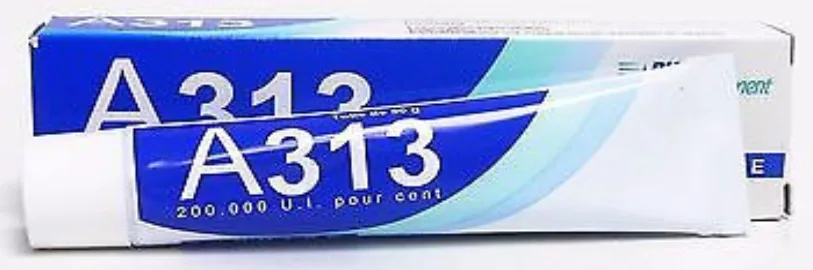
It delivers a meaningful dose of vitamin A as retinyl palmitate in a stabilizing, penetration-boosting macrogol occlusive base, sold cheaply over the counter in France. The minimalist, fragrance-free formula and gentle ester make it a famous gateway retinoid that punches above its category.
The famous French pharmacy retinoid earns its cult status: a meaningful dose of vitamin A as retinyl palmitate in a clever occlusive base that stabilizes it and boosts penetration, all for the price of a drugstore moisturizer. It is a genuinely good gateway retinoid — gentler than retinol, fragrance-free, effective on texture and tone over time. Two real caveats stand out: it contains peanut oil, and it is not as strong as tretinoin, despite the internet sometimes implying otherwise.
Unprovenfor AgingIn your profileYou chose · Vitamin E has early or mechanistic evidence for aging — a reasonable bet, not a recommendation; the other actives here are not yet assessed for it.Limited evidenceGentleNo reviews collected yet
The case for it
Vitamin E has early or mechanistic evidence for this concern, not trial-backed standing.
It is plausibly present at a working level, though the concentration is not declared.
The formula carries none of the triggers this concern is sensitive to.
What would change this: A declared concentration would move this to a firmer reading of the dose.
Same rule for everyone. “Unproven” is the verdict on 1,111 of 45,024 concern verdicts across the catalog; rule R9 decided 1,111 of them.
Unchanged since September 5, 2026, engine 5.1.1.
R9 — Plausible-tier actives alone do not earn a recommendation, and 'not for this' would overstate the case against them. 'Unproven' with the evidence dots lets the reader judge the bet (added 0.2.0 after the first shadow run put a 10% niacinamide serum at 'not for this' for hyperpigmentation). 0.5.0: the closing clause reads the other heroes — "nothing else here addresses it" only when every other active has a researched 'none' row; "not yet assessed" when that is the truth. Rows whose dots read moderate or better now reach R9p first. · the full register
Carrying active
Vitamin E
Standing
plausible — trials support it
Form
plausible — studied range 1%, from the OTC monograph or label; needs leave-on contact
Tolerability
gentle
Row checked
against its sources on July 17, 2026 (evidence table ev-2026.09-r228)
Also listed for Rough Texture, Hyperpigmentation, Dullness and Large Pores — the actives here (Retinyl Palmitate, Emulsifiers, Vitamin E) are in our research queue for those concerns; there is no verdict until their evidence rows are written. That is a gap in our table, not a mark against the product.
Where our review and the verdict differ. The review below was written on the formulation and the published trials; the verdicts above apply the stricter standing test in our methodology — an active earns a recommendation only with guideline or regulatory standing for the concern. Where the two disagree, the verdict is DermApproved’s position.
A verdict is DermApproved’s assessment of how well a product’s ingredients fit a concern — never a claim about what the product treats. Evidence dots and collected reviews sit beside it and are never blended in.
Rules 0.5.1 · evidence table ev-2026.09-r228 · how we decide
Assessment
Pros & Cons
Pros
✓ Effective entry-level vitamin A at a remarkable price
✓ Gentler retinoid ester suited to beginners
✓ Occlusive macrogol base stabilizes and boosts penetration
✓ Fragrance-free, minimalist formula
✓ Smooths texture and refines tone over time
✓ A thin layer goes far, so a tube lasts months
Cons
✗ Contains peanut oil — unsafe for peanut allergy
✗ Weaker and slower than retinol or tretinoin
✗ Thick, greasy ointment texture divides users
✗ Can still cause dryness and purging if rushed
✗ Not pregnancy-safe and not fungal-acne-safe
Review
Full Review
Few skincare products carry a backstory as romantic as this one. For years, A313 was the thing you begged a friend to smuggle home from a Paris pharmacy — a cheap aluminum tube of vitamin A pommade with a near-mythical reputation, the modern heir to Avibon, a French medicine-cabinet staple for decades before its original formula was discontinued and relaunched as a cosmetic in 2013. That mystique is genuinely half the appeal. The other, more useful half is that the product under the legend actually holds up to scrutiny — though not always in the way the internet implies.
What you're buying is a vitamin A treatment built on retinyl palmitate, labeled at 200,000 IU, roughly 0.12% retinoid activity. Retinyl palmitate sits at the gentle end of the retinoid family: it's an ester the skin has to hydrolyze to retinol, then oxidize to retinaldehyde and finally to retinoic acid, the form that actually binds nuclear receptors to drive cell turnover, collagen support, and pigment regulation. Every conversion step bleeds potency, which is exactly why it's milder and slower than retinol and far gentler than prescription tretinoin — and why beginners tolerate it. On its own, that mildness could read as a weakness, but A313's formula is cleverer than its three-line ingredient list lets on. The vitamin A is suspended in a macrogol base of PEG-8, PEG-75, and polysorbate 80 that does two jobs at once: it stabilizes the famously fragile vitamin A in the tube, and it forms an occlusive film on the skin that drives penetration. A small dose of tocopherol guards against oxidation through use. The net effect is a weak ester delivered in a way that lets it punch above its category — not magic, just smart pharmacy.
The occlusive base is worth dwelling on, because it's the part most people overlook and the part that explains why A313 works better than its humble ester suggests it should. Retinyl palmitate is among the most oxidation-prone ingredients in skincare; expose it to air and light and it degrades, which is part of why ester-based products with poor packaging often underdeliver. The macrogol matrix here both shields it from that degradation and, once on the skin, forms a film that increases occlusion and pushes the active deeper into the stratum corneum. Occlusion is a genuine penetration-enhancing strategy, not a gimmick — it's the same principle behind slugging — and pairing it with a stabilized vitamin A is how A313 squeezes real performance out of a molecule that, in a flimsier formula, might do very little. The minimalist ingredient list isn't laziness; it's a clean delivery system with nothing extraneous to destabilize the active.
In practice it behaves like a well-judged gateway retinoid. It's a thick, slightly tacky, pale-yellow ointment that sits richly before absorbing — the occlusive texture is part of the mechanism, not a flaw, and a thin layer is genuinely all you need. Used at night, starting a couple of times a week and building up, most people walk the classic retinoid arc: some dryness, tightness, or light flaking in the first week or two as skin acclimates, then smoother texture by around four to six weeks and gradual improvement in tone and fine lines over about three months. For someone easing into vitamin A for the first time, it's a forgiving on-ramp, and the cult following — a 4.5-ish average across thousands of reviews — clusters around exactly that combination of effectiveness and gentleness.
Now the caveats, because they genuinely matter and one of them is non-negotiable. The biggest has nothing to do with efficacy: A313 contains arachis hypogaea, peanut oil. For anyone with a peanut allergy, that's a hard stop, full stop, and it's worth shouting precisely because no one expects a major allergen lurking in a French retinoid. Beyond that, the honest framing of its strength: the internet sometimes treats A313 as a sneaky tretinoin dupe, and it simply isn't one. It's a gentle ester — effective for a beginner, but not equivalent to a prescription retinoid — so anyone experienced, with serious resurfacing goals, will outgrow it. It can still trigger retinoid dryness and purging if you rush the ramp-up, it isn't fungal-acne safe, the greasy ointment texture and tube format divide users (the tube is less hygienic and travels poorly), and like all retinoids it's best avoided in pregnancy and breastfeeding and demands diligent daily sunscreen.
Where it's genuinely outstanding is value, and that's no small thing. At roughly the price of a basic moisturizer — and cheaper still in France — it delivers an effective, stabilized, fragrance-free vitamin A treatment that a single tube stretches across months, since a thin layer goes so far. Set against the prestige retinol market, where similar or even weaker actives arrive dressed in luxury packaging at several times the cost, A313 is almost comically good value, and that, far more than the smuggled-from-Paris glamour, is the real reason it deserves its following.
So it lands as a near-ideal starter retinoid for the right person: normal, combination, or oily skin, with no peanut allergy, looking to begin vitamin A gently and cheaply. The people who should pass are clear too — anyone with a peanut allergy, anyone pregnant or breastfeeding, very sensitive or reactive skin that struggles with occlusive textures, and seasoned retinoid users who need real tretinoin-level strength rather than a gentle gateway. Buy it for what it is, an excellent first vitamin A, and it overdelivers; mistake it for something stronger, and you'll feel the gap.
Formula
Key Ingredients
The hero actives that drive this product's performance.
The whole point of the pommade: a gentle vitamin A ester that the skin converts in steps toward active retinoic acid, supporting cell turnover, smoothing and tone — milder than retinol or tretinoin, which is why beginners tolerate it.
Not filler — this water-soluble PEG/macrogol matrix both stabilizes the notoriously fragile vitamin A and forms an occlusive film that drives penetration, which is how a weak ester punches above its class in this formula.
An antioxidant that guards the oxidation-prone retinyl palmitate in the tube and on the skin, helping preserve the vitamin A's activity through use — a small but essential inclusion in a minimalist formula.
Use at night only, on clean dry skin, starting a couple of times a week and building up as tolerated. Follow with moisturizer to buffer dryness, and commit to daily SPF the next morning. Avoid layering with other acids or retinoids on the same night.
Results Timeline
Possible mild dryness or flaking in the first 1-2 weeks; smoother texture by 4-6 weeks and tone and fine-line improvements over 12 weeks of consistent use.
A313's effectiveness hinges on a clever delivery solution to a well-known weakness. Retinyl palmitate is the gentlest commonly used retinoid: topically, the skin must hydrolyze it to retinol, then oxidize that to retinaldehyde and finally to retinoic acid, the form that binds nuclear receptors to drive cell turnover, collagen support and pigment regulation. Each conversion step loses potency, which is why retinyl palmitate is markedly weaker than retinol or prescription tretinoin and why some research questions ester efficacy at low levels. A313 compensates in two ways supported by formulation science: it uses a comparatively high labeled vitamin A load (200,000 IU), and it suspends it in a macrogol/PEG occlusive base that both protects the oxidation-prone retinoid and increases occlusion, which enhances penetration of actives into the stratum corneum. Tocopherol adds antioxidant stabilization. The broader retinoid evidence base — for texture, fine lines and tone with consistent use — is robust, but applies most strongly to retinol and retinoic acid; for retinyl palmitate, real-world results are real but gentler and slower. In short, the science explains both why A313 works as a beginner retinoid and why it should not be mistaken for a prescription-strength one.
Dermatologist Perspective
Dermatologists generally regard retinyl palmitate as a mild, beginner-friendly retinoid, useful for those who cannot tolerate stronger forms, while noting it is less potent than retinol or prescription tretinoin and slower to show results. A313 is often acknowledged as a reasonable, affordable introduction to vitamin A, with the standard retinoid guidance: start low and slow, buffer with moisturizer, use only at night, and pair with daily broad-spectrum sunscreen since retinoids increase photosensitivity. Clinicians would flag two specific cautions here — the peanut oil, which makes it unsuitable for peanut-allergic patients, and the general advice to avoid topical vitamin A derivatives during pregnancy and breastfeeding. For tolerant, non-allergic skin beginning a retinoid, it is viewed as a sensible, low-cost option.
Guidance
Usage & Recommendations
How to Use
At night, after cleansing, apply a thin layer to clean, dry skin, avoiding the eye area and corners of the nose and mouth. Start with two nights a week and increase gradually as tolerated, following with a moisturizer to buffer dryness. Always wear broad-spectrum sunscreen the next morning, since vitamin A increases sun sensitivity. Avoid combining it with exfoliating acids or other retinoids on the same night, do not use it during pregnancy or breastfeeding, and skip it entirely if you have a peanut allergy.
Value Assessment
Value is A313's standout quality. At roughly the price of a basic drugstore moisturizer in the US — and €10 to €18 in French pharmacies — it delivers an effective, stabilized, fragrance-free vitamin A treatment, and because a thin layer suffices a 50g tube lasts months, pushing cost-per-use very low. Compared with the prestige retinol market, where comparable or weaker actives are sold in elaborate packaging for many times the price, A313 is almost unmatched on price-to-performance for a beginner retinoid. The main asterisk is that it is an entry-level ester, so experienced users seeking stronger results may need to graduate to retinol or prescription options; for its intended role, the value is exceptional.
Who Should Buy
It earns a spot if you have normal, combination or oily skin with no peanut allergy and want an affordable, gentle introduction to vitamin A for texture, tone and early anti-aging. It is ideal for beginners who found retinol too harsh and want an effective, no-frills retinoid that lasts.
Who Should Skip
Skip it if you have a peanut allergy, are pregnant or breastfeeding, or have very sensitive, rosacea-prone or compromised skin that reacts to retinoids. Experienced retinoid users seeking true tretinoin-level strength, and anyone wanting a lightweight, fungal-acne-safe texture, should also look elsewhere.
Thick, slightly tacky pale-yellow ointment that sits richly before absorbing
Scent
Faint neutral, slightly waxy note with no added fragrance
Packaging
Aluminum squeeze tube, pharmaceutical in style
Finish
occlusiverich
What to Expect on First Use
Goes on as a thick, occlusive ointment that feels rich and slightly greasy before settling. Early on, expect some dryness, tightness or light flaking as skin adjusts to the vitamin A — a normal retinization period that eases within a couple of weeks if frequency is built up slowly. Skin looks smoother and more refined once acclimated.
How Long It Lasts
Around 4-6 months at a few nights per week on the 50g tube, since a thin layer is plenty
A313 is the modern reincarnation of Avibon, a vitamin A pommade that sat in French medicine cabinets for decades before its original formula was discontinued and relaunched as a cosmetic. That heritage, plus its over-the-counter availability and low price in French pharmacies, turned it into an internationally smuggled-home cult object well before it was easy to buy abroad.
About A313 Established Brand (5–20 years)
A313 is a French pharmacy vitamin A pommade and the modern successor to Avibon, a decades-old French chemist staple. Sold over the counter in France, it has a long real-world track record and cult following, though as a cosmetic it lacks the formal clinical trials of prescription retinoids.
Brand founded: 2013 · Product launched: 2013
Myth vs. Reality
Common Myths
Myth
Retinyl palmitate in A313 is as strong as prescription tretinoin.
Reality
Retinyl palmitate is a gentle ester that the skin must convert through several steps to reach active retinoic acid, so it is milder and slower than retinol or prescription tretinoin — effective for a beginner, but not an equivalent to a prescription retinoid.
FAQ
Frequently Asked Questions
How strong is A313 compared to retinol or tretinoin?
A313 uses retinyl palmitate, a gentle vitamin A ester that converts to active retinoic acid through several steps, making it milder and slower than retinol and far gentler than prescription tretinoin — a good entry point rather than an equivalent.
Is A313 safe for people with a peanut allergy?
No — A313 contains arachis hypogaea (peanut) oil, so anyone with a peanut allergy should avoid it entirely and choose a different vitamin A product.
Can I use A313 while pregnant or breastfeeding?
It is best avoided during pregnancy and breastfeeding; topical vitamin A derivatives are generally advised against in pregnancy, so consult your doctor and opt for a pregnancy-safe alternative.
How often should I use A313?
Start with a thin layer a couple of nights a week and build up gradually as your skin tolerates it; nightly use is possible for acclimated skin, but ramping too fast causes dryness, flaking and irritation.
Why does A313 feel so thick and greasy?
It is an occlusive macrogol (PEG) ointment, a base chosen to stabilize the fragile vitamin A and boost its penetration; the rich texture is part of how it works, and a thin layer is all you need.
Reviews
What Reviewers Tend to Say
Recurring themes our editors read across retailer reviews of this product — summaries in our words, not quotations, and not a substitute for your own patch test.
Common Praise
Smooths texture and refines skin
Gentler introduction to retinoids
Remarkable value for an effective vitamin A
Occlusive base feels nourishing
Common Complaints
Contains peanut oil — unsafe for peanut allergy
Thick, greasy ointment texture
Can still cause retinoid dryness and purging
Tube format is less hygienic and travels poorly
Notable Endorsements
Cult French pharmacy retinoidWidely covered beginner retinoid pick
The fourth most frequent positive patch test in North America is an oxidation product of a molecule that occurs naturally in lavender. Nobody synthesised it into your face cream.
Western sensitive skincare works by subtraction — remove the fragrance, remove the alcohol, shorten the list. Japan's answer adds a designed molecule back in, and one of the two bets has a trial literature.
Antiperspirants and deodorants solve unrelated problems, a large share of people buying either are genetically incapable of producing the smell, and the aluminium question has a real answer that nobody bothers to give.
The smallest AHA gets deepest and shows results soonest — which is precisely why routines built around it overshoot, and why the people who do best with it use it least.
Jul 30, 2026· 7 min
Questions people ask about Hyperpigmentation
Verified answers from our questions library — the nuance a product page cannot carry.
Products, answers, therapy guides, tools and articles in one search. Brand names,
slang and abbreviations all work — accutane finds isotretinoin, bacne finds truncal acne.