Blue Tansy (Tanacetum annuum)
Products with Blue Tansy (Tanacetum annuum)
 Aromatic Comfort Oil
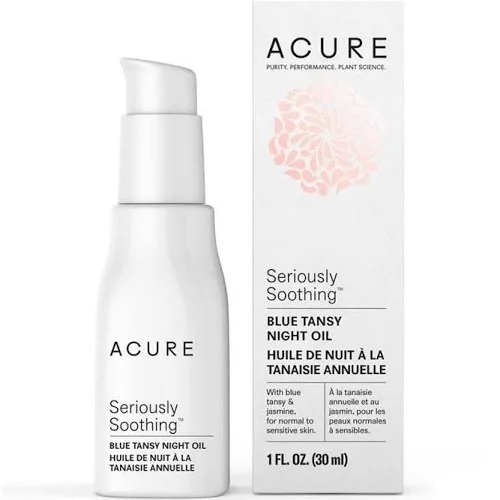
 Seriously Soothing Blue Tansy Night Oil
A budget-friendly blue tansy face oil that delivers the aromatic ritual and visible blue color of the prestige category at a fraction of the price. The essential oil load means the soothing marketing doesn't quite hold up for very sensitive skin — but for normal-to-dry skin that loves a botanical face oil, it's a fair pick.
 Two-in-One Mineral SPF
 Seriously Soothing SPF Day Cream
A genuinely gentle two-in-one mineral SPF 30 day cream that pairs a high zinc oxide level with barrier-calming niacinamide and panthenol, aimed squarely at sensitive, dry skin. It moisturizes and protects in one step and skips synthetic fragrance, with the trade-offs being a slight white cast, only SPF 30, and a blue tansy essential oil that not everyone can wear.
 Drenched Compress Pad
 It Began Tansy Watery Pads
A generously soaked, oil-free hydrating pad that works nicely as a quick cooling compress, with a pleasingly simple humectant base and a label that honestly discloses its blue tansy at about 0.01%. Its sensitive-skin pitch is undercut by fragrance and a long list of herbal extracts, and at nearly thirty dollars for fifty pads it is a hydration step, not a treatment.
 Gentle Acne Fighter
 Clarifying Serum
A smartly formulated clarifying serum that breaks the cycle of harsh acne treatments followed by barrier damage followed by more acne. PHA, zinc, and blue tansy manage breakouts gently while the tri-ceramide complex builds the barrier resilience that aggressive treatments strip away — all for sixteen dollars.
 Cult Blue Tansy Face Oil
 Lapis Blue Tansy Face Oil
A genuinely well-conceived face oil that proves oily skin can use oils — squalane and jojoba mimic sebum, blue tansy calms breakouts. But six declared fragrance allergens in a product aimed at reactive, acne-prone skin is a real formulation contradiction, and $72 for 1.7 ounces is steep for what's mostly squalane. Beloved for good reasons; flawed for honest ones.
 Adult-Acne Night Oil
 Retinoid Acne Clearing Oil
An original answer to adult acne: the full 2 percent salicylic acid dose carried in a cushioning oil so it clears without stripping, with a serious brightener for the marks and a retinyl ester gentle enough to sit beside the acid nightly. It works, and hundreds of reviews say so. The retinoid is the weakest form on the market, though, and eighty-nine dollars an ounce is a lot to pay for salicylic acid in nicer clothes.
 Gentle Retinoid Pick
 Youth Boosting Blue-ty Sleep Night Oil
A genuinely gentle, fragrance-free way into retinoids: 1% granactive retinoid cushioned in nourishing plant oils with soothing chamomile and licorice botanicals. It trades speed for comfort, so results are gradual, and it's too rich for oily skin and off-limits in pregnancy. But for dry or nervous first-time retinoid users, it's a thoughtful, affordable soft landing at eighteen dollars.
 Cult Sephora Blue Tansy Mask
 Blue Tansy Resurfacing Clarity Face Mask
Herbivore's Blue Tansy Mask is a long-running Sephora cult product that pairs dual enzymes (papain and bromelain) with willow bark BHA and chamazulene-rich blue tansy oil for a genuinely effective weekly exfoliating mask. The striking blue color is real, the results are visible after one use, and the only real drawback is the $58 price tag and the essential oil content that rules it out for truly sensitive skin.
 Pregnancy-Safe Bakuchiol Serum
 We Come in Peace Probiotic Serum
A credible bakuchiol-plus-postbiotic anti-aging serum with multi-mechanism approach — bakuchiol for retinol-alternative anti-aging, lactococcus ferment for microbiome support, plant oils for antioxidant and emollient activity. Pregnancy-safe and tolerated by sensitive skin. The $24 price for 35 mL is reasonable for K-beauty bakuchiol serum tier. One of the more thoughtful non-retinoid anti-aging options in the broader market.
 Clean Beauty Mask Standout
 Blue Tansy BHA + Enzyme Pore Refining Mask
A genuinely thoughtful multi-active exfoliating mask that earns its cult following on more than just its photogenic cobalt color. Willow bark BHA, fruit enzymes, and anti-inflammatory blue tansy do real work on texture and congestion without the harsh sting of dedicated acid treatments. The $48 price is steep for 2 ounces, and it's gentler than its reputation suggests, but for clean-beauty fans it delivers.
 Sephora Blue Tansy Cult Cleanser
 Aquarius BHA + Blue Tansy Clarity Facial Cleanser
Herbivore's Aquarius cleanser is a gentle, sulfate-free gel built around willow bark BHA, blue tansy, and zinc PCA — a thoughtful oily-skin formula wrapped in the brand's signature deep-blue visual identity. It's genuinely pleasant to use, non-stripping, and worth considering if you value clean beauty positioning, but a drugstore salicylic acid cleanser will do equivalent oil control for a fraction of the price.
 Plant-Based Retinol Alternative
 Fullmoon Serum
A fully plant-based, vegan serum that swaps synthetic retinol for moth bean extract as a botanical 'bio-retinol.' It's lightweight, hydrating, and appealing if you want anti-aging without retinoids. But two honest truths temper it: the plant-retinol claim has thin evidence and won't match real retinol, and the 'gentle natural' serum is loaded with essential oils that make it riskier for sensitive skin than its clean image suggests.
 Luxury Splurge
 The Blue Cocoon
The Blue Cocoon is a gorgeously made, deeply sensory balm whose vivid blue comes from genuinely anti-inflammatory blue tansy. As an experience and as a softening treatment for dry skin, it delivers. But it is built on a heavy load of fragrant essential oils, an awkward fit for an anti-inflammatory product, and at its price you are paying largely for ritual and reputation. Lovely if your skin tolerates it and the splurge appeals; risky and overpriced if not.
 Bumpy-Skin Smoother
 Smoothing Body Serum
A lightweight leave-on body serum that tackles bumpy, breakout-prone skin with a smart succinic-acid, zinc, and willow-bark blend, balanced by barrier lipids and calming blue tansy so it smooths without the usual dryness. The fragrance load and exfoliating actives keep it off the sensitive list, and succinic acid is newer science, but for under fourteen dollars it is a genuinely useful body treatment.
 Retinoid Gateway Oil
 Luna Sleeping Night Oil
Luna is a beautifully formulated introduction to retinoids for anyone who's been burned — literally or figuratively — by traditional retinol. The HPR-in-oil delivery is genuinely clever, the botanical support system works, and the sensory experience is luxurious. But the undisclosed retinoid concentration and steep price-per-ounce make it a better gateway product than a long-term workhorse.
 Clean-Beauty BHA Cleanser
 Aquarius BHA + Blue Tansy Clarity Cleanser
That vivid blue color is not dye — it is chamazulene from blue tansy oil, a genuine anti-inflammatory compound, and it tells you this is a thoughtfully built cleanser for oily skin. Willow bark BHA, niacinamide, and zinc PCA give it real multi-action credentials. But the BHA is mild, the essential oils flag for sensitive skin, and the price runs premium. A good clean-beauty pick with honest limits.
 Botanical Ritual Cleanser
 Blue Moon Tranquility Cleansing Balm
A genuinely sensorial cleansing balm that turns makeup removal into an aromatherapeutic ritual — the natural blue color from chamazulene is stunning and the dual-chamomile soothing complex is thoughtful. But seven essential oils, cocoa butter comedogenicity, and a $50 cleanser price tag mean this is a product for the ritual-minded, not the practical-minded.
The full blue tansy (tanacetum annuum) guide
That vivid indigo color making blue tansy products so instantly recognizable isn't dye — it's chamazulene, a sesquiterpene that forms during steam distillation of the Moroccan wildflower Tanacetum annuum and brings real anti-inflammatory chemistry with it.
In lab settings chamazulene blocks leukotriene B4 formation and quenches lipid peroxidation, two mechanisms that plausibly translate to calmer, less reactive skin. The catch: human clinical data on topically applied blue tansy is thin, and the oil also carries a notable camphor fraction. It reads less like a proven hero active and more like a botanically-sourced soothing agent worth using thoughtfully — patch-tested, in a well-built formula, and not while pregnant.
How it's regulated in the US
FDA does not classify ingredients — it classifies products, by what they are sold to do. The same molecule can be a drug active in one product and a cosmetic ingredient in the next, and only the claim on the label decides which. What follows is a statement about that legal standing, not about whether it works — the evidence question is answered separately above.
Cosmetic Blue Tansy (Tanacetum annuum) is a cosmetic ingredient in the US: no OTC monograph covers it and it is not an active in any FDA-approved drug, so a product built around it is a cosmetic rather than a drug.
The case for blue tansy rests almost entirely on its standout constituent, chamazulene, rather than studies of the whole oil. A 1994 Planta Medica paper found chamazulene inhibits leukotriene B4 formation in neutrophilic granulocytes in a concentration-dependent way (IC50 around 15 µM in intact cells), describing it as an antioxidant-type inhibitor. A 1996 paper reported dose-dependent suppression of lipid peroxidation (IC50 around 18 µM). A 2025 Antioxidants study showed topical chamazulene reduced UVB-induced photoaging in mouse skin by activating PPARα/γ pathways and downregulating p38 MAPK/COX-2 signaling — encouraging, but confined to an animal model. Whole blue tansy essential oil has not been tested in large human skin trials. So the evidence sits between traditional use and genuinely promising: the mechanisms are well characterized, but stretching isolated chamazulene findings to a diluted oil on human skin requires several inferential leaps. The camphor fraction (roughly 4–18% of the oil) adds its own counterirritant, stimulating profile that muddies any clean read of the oil's net effect.
How it works
Blue tansy's blue-black oil is a product of chemistry, not added pigment. The Tanacetum annuum flower contains matricin, a colorless sesquiterpene lactone. Steam distillation heats that precursor and converts it into chamazulene — and chamazulene's deep blue color suffuses the whole oil while its biological activity comes online. Once on skin, chamazulene is thought to interfere with the production of leukotriene B4, a pro-inflammatory messenger that normally amplifies redness, swelling, and immune activation in irritated tissue; the foundational lab work frames this as an antioxidant-type effect rather than a clean enzyme block. By damping that signal, it may quiet one of the skin's primary inflammatory alarms. Chamazulene also behaves as a lipid-phase antioxidant, intercepting free radicals before they trigger the membrane lipid peroxidation chain reaction that drives oxidative damage. The 2025 PPARα/γ animal research suggests a further angle: in UV-stressed skin, chamazulene appears to nudge cells toward fatty acid synthesis and away from inflammatory output. Blue tansy oil isn't only chamazulene, though — it contributes sabinene (mild antimicrobial activity) and camphor (commonly 4–18%), a counterirritant that can itself irritate at higher levels. In a thoughtfully built product the felt result is quick soothing and visible redness reduction, but how much owes to chamazulene's pharmacology versus camphor's sensory cooling is genuinely hard to separate from user reports alone.
Key benefits
- Helps visibly reduce redness and reactivity in sensitized, easily-flushed skin
- Carries chamazulene, which shows antioxidant-type leukotriene B4 inhibition in lab studies
- Quenches lipid peroxidation, adding antioxidant support within the skin's lipid layer
- May ease the inflammatory side of acne papules and post-breakout flushing
- Deep blue-green color is a useful purity and chamazulene-richness signal for the raw oil
- Shows early, animal-model promise against UV-induced photoaging
Concentration & usage
In finished skincare, blue tansy shows up as a diluted essential oil, typically around 0.1–1% of the formula. Common safety guidance caps whole-oil dermal use near 0.5–1% in leave-on products to limit sensitization from camphor and other volatiles. On an INCI list it appears as Tanacetum Annuum (Blue Tansy) Flower Oil or Tanacetum Annuum Flower Oil, usually toward the bottom — low percentages that can still be active. A visibly blue or blue-green product almost certainly carries enough chamazulene to matter; a clear or white product listing blue tansy near the very end is likely leaning on it for fragrance and color more than function. No validated effective topical concentration has been established for the whole oil in human trials, so treat any potency claim with healthy skepticism.
Who it's for & who should be cautious
Who it's for
Oily, combination, and resilient-but-occasionally-sensitive skin tends to see the clearest payoff — especially anyone dealing with post-breakout redness, mild inflammatory acne, or flushing after sun and weather exposure. It suits oil and serum formats for people who want a natural-origin calming active that doesn't feel clinical or medicinal. If essential-oil-based products have historically agreed with your skin and a patch test goes smoothly, blue tansy can be a satisfying PM-routine addition aimed at barrier recovery and toning down redness.
Who should be cautious
Anyone allergic to plants in the Asteraceae/Compositae family — chamomile, ragweed, chrysanthemum, echinacea — should be cautious, since cross-reactivity is plausible. Highly reactive or barrier-compromised skin warrants the same care: the camphor content (up to roughly 18% of the oil) can irritate when the barrier is already breached, and every essential oil carries sensitization risk, more so once the product has oxidized. Pregnancy is a firm no — camphor is absorbed transdermally and is contraindicated at meaningful doses during pregnancy and nursing. And people with rosacea who react to fragrant botanicals may find blue tansy aggravates flares rather than calming them, regardless of the soothing marketing narrative.
Pairs with & conflicts
Pairs well with: Squalane, Rosehip Oil, Jojoba Oil, Centella Asiatica (Cica), Chamomile Extract, Bisabolol (Alpha-Bisabolol), Hemp Seed Oil, Evening Primrose Oil
Use with care alongside: Salicylic Acid (BHA), Glycolic Acid (AHA), Retinol, Benzoyl Peroxide, Vitamin C (L-Ascorbic Acid)
Myths & facts
Myth: Blue tansy and German chamomile are the same thing and interchangeable in skincare.
Reality: Both generate chamazulene during steam distillation and both turn blue, but they come from entirely different plants — German chamomile is Matricaria chamomilla, blue tansy is Tanacetum annuum. Their broader chemistry diverges: blue tansy carries considerably more camphor, which shifts its safety profile and irritation potential at comparable doses.
Myth: The bluer the product, the stronger its anti-inflammatory effect.
Reality: Color tracks chamazulene concentration in the raw oil, but once that oil is diluted into a finished formula at well under 1%, the link between visible blue tint and delivered dose largely breaks down. A more saturated product may just use a touch more high-chamazulene oil, while the difference in active actually reaching skin cells is small. Color is a decent quality cue for the raw oil — not a potency gauge for the bottle on your shelf.
Myth: Blue tansy is universally calming and safe for every sensitive skin type.
Reality: The anti-inflammatory framing is legitimate, yet this is still an essential oil with a camphor fraction, fragrance components, and real sensitization potential. Some reactive-skinned people find it stings rather than soothes — particularly on a damaged barrier or with an oxidized product. 'Calming' and 'tolerated by everyone' are not the same claim.
Frequently asked questions
Why does blue tansy turn products blue — is it dye?
No dye at all. The color is chamazulene, which forms during steam distillation when heat converts the plant's native matricin into this intensely blue sesquiterpene. More chamazulene in the oil means a deeper blue-green in the finished product. It's one of the rare cases in skincare where color genuinely signals how much of an active constituent is present.
I'm allergic to chamomile — can I still use blue tansy oil?
Proceed with real caution. Blue tansy and chamomile both sit in the Asteraceae family, and cross-reactivity among Compositae plants is well documented in the dermatological literature. A patch test is essential, and an allergist consult is wise if your chamomile reaction has ever been significant. The plants are botanically distinct, but the shared family allergens make the risk more than theoretical.
Is blue tansy safe to use while pregnant?
No — it's one to skip during pregnancy. The camphor fraction (which can reach up to roughly 18% of the oil) is absorbed transdermally and has documented risks at meaningful doses in pregnancy. Even in diluted formulas, the precautionary consensus among aromatherapy safety experts and most dermatologists is to avoid it entirely through pregnancy and nursing.
Does blue tansy genuinely help acne, or is that mostly marketing?
There's a plausible mechanism — leukotriene B4 inhibition plus antioxidant activity could dial down the inflammatory side of acne papules, and the oil's antimicrobial constituents add to the rationale. But no clinical trials have tested blue tansy formulas against acne outcomes specifically. So: the anti-inflammatory mechanism is real, the anecdotal reports are fairly consistent, and controlled human evidence simply doesn't exist yet.
How can I tell whether a blue tansy product actually contains enough to do anything?
Look for it in the upper third of the INCI list, or check for a visible blue or green tint — that signals chamazulene above trace levels. Confirm it's listed specifically as Tanacetum Annuum Flower Oil rather than a vaguer botanical blend. A product naming it dead last on a 30-ingredient INCI is probably using it for fragrance or color rather than real effect.
Can blue tansy go off, and does that matter for my skin?
Yes, and it matters a lot. Like all essential oils, blue tansy oxidizes when exposed to air and light — and oxidized components are far more likely to provoke sensitization and contact dermatitis than fresh oil. Keep products tightly sealed, away from heat and sun, and respect the PAO symbol. An old blue tansy product that's lost its vivid color may have oxidized enough to flip from calming to irritating.