"My Acne Is Bad" Is Not Information. Here's the Fact That Changes the Plan.
Clinicians don't count spots — they record the worst lesion type in each zone, because that is what the treatment ladder actually branches on.
Read the preview
From the DermApproved blog, in Acne and Breakouts: how clinicians actually grade acne. They don't count spots. They record the worst thing in each zone — because fifty blackheads and one deep nodule point at different treatments, and only one leaves a permanent mark. So the number you need isn't the one you've been looking at. For the full breakdown, visit dermapproved.com/blog.
The gap between what you say and what gets recorded
Describe your acne to a dermatologist and you will probably say some version of "it's bad at the moment" or "it's been worse." Watch what they write down and it is nothing like that. It is a set of observations, zone by zone, of the worst type of lesion present in each — not how many, not how red, not how much it is bothering you today.
That difference is not clinical fussiness. It exists because the treatment ladder for acne branches on lesion type. Closed comedones are a keratinisation and obstruction problem, and the drug class that addresses them directly is a topical retinoid. Papules and pustules are an inflammatory problem with a bacterial contributor, which pulls benzoyl peroxide and sometimes an antibiotic into the plan. Nodules are deep, they take weeks to resolve, and they scar — which is why their presence changes the conversation entirely rather than incrementally.
So "a lot of spots" tells a clinician almost nothing, while "three nodules on the jawline and comedones across the forehead" tells them the whole plan. The useful thing about that fact is that the observation is not hard to make. You can do it on yourself, and the reason to bother is not self-diagnosis — it is that the answer determines whether the next thing you buy has any chance of working.
Why the worst lesion outranks the count
The standard instrument here multiplies a per-zone weighting by the most severe lesion type found in that zone, and ignores how many there are. That design looks strange until you consider what it is trying to predict.
Fifty comedones across a forehead are a cosmetic and textural problem with essentially no scarring risk, and they respond to a single well-chosen agent. One nodule on a cheek is a different disease process: inflammation deep enough to involve the dermis, a resolution time measured in weeks rather than days, and a real probability of leaving an atrophic scar behind. A counting system would rank the fifty comedones as far worse. A type-based system correctly ranks the nodule as the thing that changes the plan, because it is the thing with a permanent consequence.
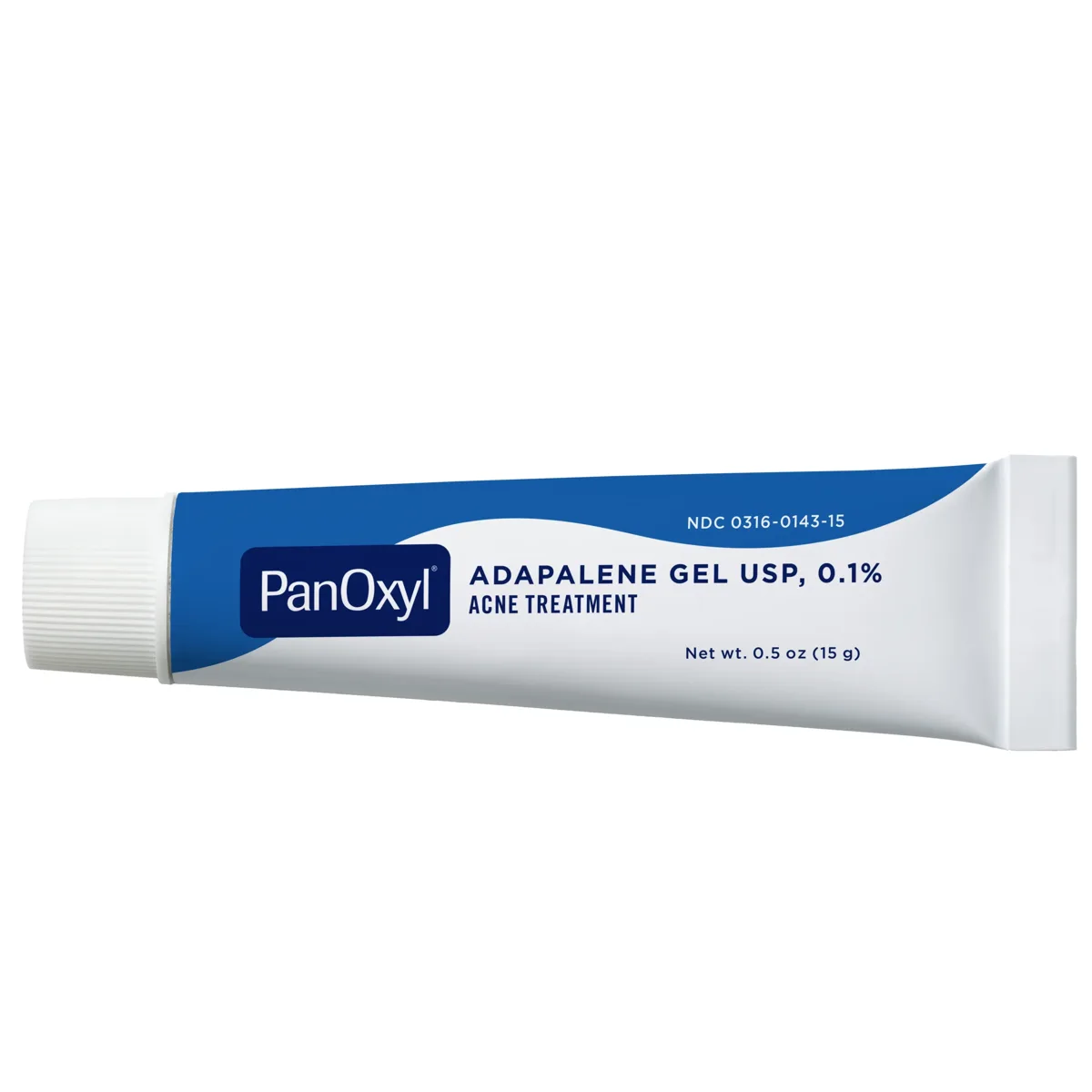
This is why the drugstore aisle so often fails people. A comedonal presentation genuinely is well served by an over-the-counter retinoid — Differin Adapalene Gel 0.1% made a prescription-strength retinoid available without one, and adapalene is unusually well-suited to this job because it is photostable and tolerable enough for nightly use. Equivalent formulations like PanOxyl Adapalene Gel 0.1% have since made the same active cheap and widely stocked. An inflammatory presentation needs the retinoid plus an antimicrobial, which is what fixed combinations such as Differin Epiduo Acne Gel deliver in one step and what PanOxyl Acne Creamy Wash approximates as a rinse-off. And a nodular presentation is not an aisle problem at all. The 2024 American Academy of Dermatology guideline strongly recommends oral isotretinoin for severe acne — and, crucially, also for acne causing scarring or psychosocial burden, or acne that has failed standard topical and oral therapy. Two of those three triggers have nothing to do with how the lesions score.
Half the grade is on your back
The single biggest omission in self-assessment is anatomical. In the standard grading system the chest and back carry the heaviest regional weighting of any zone — heavier than the forehead, heavier than either cheek — and most people grading themselves in a bathroom mirror never look at them.
The epidemiology says they should. In a study of consecutive patients presenting with facial acne, the prevalence of at least moderate truncal involvement on the back or chest was 47%; a referral cohort put chest or back involvement around half. The detail that should end the argument is behavioural rather than clinical: roughly one in four patients who turned out to have both facial and truncal acne did not mention the truncal component at all. It was found on examination, because nobody thinks of back acne as part of the complaint they came in with.
Truncal acne also changes the practical plan rather than just the score. The skin is thicker and more tolerant, which permits higher benzoyl peroxide concentrations than a face would accept, but the surface area is large and the geography is unreachable — a gel designed for a cheek is the wrong delivery format for a back. Rinse-off washes and sprayed applicators such as PanOxyl Acne Banishing Body Spray exist because of the reach problem, not because of the formulation one. Grading your trunk honestly, which mostly means asking someone or using a phone camera, is the step that stops half a disease going untreated.
Self-grading is biased — and the bias is fixable
The obvious objection to any of this is that people are terrible judges of their own skin, and the objection is broadly correct. Untrained self-assessment agrees with dermatologist grading only fairly.
What is more interesting is how quickly that changes. In a pilot study evaluating self-assessment instruments, agreement with clinician grading on the regional scoring system started at 77.92% with a kappa of 0.52 — moderate. After a brief training intervention on how to use the instrument, agreement rose to 94.80% with a kappa of 0.89, which is close to the ceiling of what two clinicians achieve with each other. On a photograph-based scale, agreement climbed from fair to substantial the same way. The gap between a patient's judgement and a clinician's is not mostly a perception problem. It is an instrument problem — people are bad at grading acne freehand and good at grading it against a defined rubric.
That is precisely what the Acne Severity Score tool is for: it walks the six zones, asks for the worst lesion type in each rather than a global impression, and does the weighting for you. Two habits sharply improve what you feed it. Grade in the same light, at the same time of day, because a bathroom downlight manufactures shadows that read as lesions. And grade from a photograph rather than a mirror — you will assess a picture of a stranger's face more accurately than your own reflection, and the photograph is the thing you can compare against later. The Progress Photo Tracker exists to make that comparison possible rather than notional, with a prep checklist that keeps distance and lighting constant between shots.
The score that means an aisle is reasonable, and the one that means it isn't
The point of a number is a decision, so here is the decision it should drive.
A grade that lands in the mild band, with no nodules anywhere and no scarring, is a legitimate place to run an over-the-counter plan: a nightly adapalene, a benzoyl peroxide wash if there is inflammation, a non-comedogenic moisturiser to make the retinoid survivable, and twelve weeks of patience. That is not a compromise; it is close to what a first prescription would look like anyway.
A grade in the moderate band is the ambiguous middle, and the deciding factor there is usually not the number. It is whether the lesions are leaving marks, how long the current plan has already had, and how much it is costing you outside the mirror. A grade in the severe band, or any nodules at all, or any scarring at all, means the aisle is not where this gets solved — and continuing to shop is the most expensive version of the mistake, because scarring accrues while you experiment. The acne therapy pathway sets out what escalation actually looks like at each rung and what a prescriber will want to have tried first.
The honest caveat on the whole exercise: severity scores describe lesions and say nothing about consequence. The guideline's inclusion of psychosocial burden as an independent trigger for the strongest treatment available is a formal acknowledgement that a moderate score on a face someone is avoiding leaving the house with is not a moderate problem. If your grade says mild and your life says otherwise, the grade is the less important of the two facts. Our acne question library works through the situations the grade cannot carry — from what to do when a treatment stalls to how the decisions change during pregnancy.
Grade twice, not every morning
The last discipline is temporal, and it is the one that rescues most treatment plans that get abandoned early.
Acne treatments are evaluated in trials at twelve weeks because that is roughly how long the biology takes: a retinoid normalises follicular keratinisation over weeks, existing microcomedones still have to surface and resolve, and inflammatory lesions have their own multi-week arc regardless of what you apply. Judging by the mirror on any given morning samples that process at one random point and mostly measures sleep, lighting and where you are in a hormonal cycle. Two graded scores twelve weeks apart measure the treatment.
The early-weeks confusion has its own answer. A retinoid started on comedonal skin frequently produces a visible worsening in the first month as microcomedones that were already there come to the surface — the phenomenon everyone has heard called purging and almost nobody can distinguish from a reaction in the moment. The distinction is real and it hangs on what you started, when, where the bumps appeared and what they look like; the Purging or Breaking Out? triage runs exactly those four questions rather than leaving you to guess. Getting that call wrong in week three is the single most common way an effective treatment gets thrown away.
Our position: grade yourself once, properly, before you buy anything, and once again three months later. If the number moved, keep going. If it did not, the answer is not another product from the same rung — it is the next rung, and you now have the one piece of evidence that makes that conversation short.
Products mentioned
Independently reviewed and scored — the real products behind this piece.



References
- A comparison of current acne grading systems and proposal of a novel system — International Journal of Dermatology, 1997
- Guidelines of care for the management of acne vulgaris — Journal of the American Academy of Dermatology, 2024
- A closer look at truncal acne vulgaris: prevalence, severity, and clinical significance — Journal of Drugs in Dermatology, 2007
- Prevalence and severity of facial and truncal acne in a referral cohort — Journal of Drugs in Dermatology, 2008
- Evaluation of an Acne Severity Grading Self-Assessment System Suitable for the Thai Population - A Pilot Study — Clinical, Cosmetic and Investigational Dermatology, 2023
Every cited link is verified to resolve to the paper named. Where a source could not be independently confirmed, it is listed without a link rather than pointing you somewhere wrong.
Frequently asked
Why does one nodule matter more than dozens of blackheads?
Because they are different processes with different endings. Comedones are follicular obstruction with essentially no scarring risk and respond to a single topical agent. A nodule involves deep inflammation, resolves over weeks, and can leave a permanent atrophic scar — so it changes both the urgency and the drug class, which is why grading systems weight lesion type rather than number.
Do I really need to grade my chest and back?
Yes, and they carry the heaviest weighting in the standard system. Around half of people with facial acne have truncal involvement, and roughly one in four of those never bring it up — it gets found on examination. It also needs a different delivery format, since a gel built for a cheek is unusable across a back.
Can I trust my own grading if I'm not a clinician?
Freehand, not especially — untrained self-assessment agrees only fairly with dermatologist grading. Against a structured rubric it improves sharply: one pilot study saw agreement rise from around 78% to nearly 95% after brief training on the instrument. Grade against defined criteria and from a photograph, not from a general impression in the mirror.
What grade means I should stop buying products and see someone?
Any nodules, any scarring, a score in the severe band, or a plan that has run twelve full weeks without moving the number. Scarring is the one that should override everything else, because it accrues permanently while you experiment — and it is an independent reason for the strongest available treatment under the 2024 guideline.
How often should I re-grade during a treatment?
Twice: once before you start, once at twelve weeks. Acne trials use that window because the biology needs it, and grading more often mostly measures lighting, sleep and hormonal timing. The exception is the first month on a retinoid, where a visible worsening is common and needs to be triaged as a purge or a reaction rather than re-scored.