Adapalene: The Drugstore Retinoid That Quietly Beats Most 'Retinol' Serums
A prescription-strength molecule went over-the-counter for the price of a sandwich — and most people quit it right before it starts working.
Read the preview
From the DermApproved blog, in Retinoids: the drugstore tube that quietly outclasses your fancy retinol serum. Picture it — a prescription-strength acne drug, two decades of trials behind it, suddenly sitting on the pharmacy shelf for about the price of a sandwich. Meanwhile the serum three feet away, five times the cost, is riding on a marketing claim and a pretty dropper. There's a receptor trick that makes this molecule tougher and gentler at once, a sunlight test that humbles its famous cousin, and a reason nearly everyone quits at exactly the wrong moment — right before it starts working. We lay out what the head-to-head trials actually found, where it fits, where it doesn't, and the one week that separates the people who win from the people who give up. Your acne — and your wallet — will want this one. That's at dermapproved.com/blog.
The cheapest serious retinoid on the shelf
For years, the only way to get a truly proven topical retinoid was a doctor's visit and a prescription. Then, in 2016, adapalene 0.1% — a molecule that had spent two decades as prescription-only Differin — was approved for over-the-counter sale in the United States. Overnight, the drug that dermatologists had been prescribing for acne since the 1990s was sitting on a drugstore endcap next to the lip balm, for roughly the price of a sandwich.
Here's the part the skincare aisle would rather you not notice: that unglamorous little tube quietly outperforms most of the "retinol" serums marketed three feet away, some of which cost five times as much. Not because retinol is useless — it isn't — but because adapalene is a different tier of evidence, a different tier of stability, and a genuine acne drug rather than a cosmetic that gestures at one.
The reason nobody talks about it that way is boring: adapalene doesn't market itself. It has no founder story, no serum-drop aesthetic, no promise of a glow by Friday. It's a treatment. And treatments ask for patience that skincare marketing has trained us out of.
Why the molecule is built differently
Retinol and adapalene are often lumped together as "retinoids," but they behave like different tools. Retinol is a cosmetic precursor: your skin has to convert it (retinol to retinaldehyde to retinoic acid) before it does anything, and it's chemically fragile — it oxidizes and degrades in light and air, which is why retinol products live in opaque, air-tight packaging and why a lot of what's in the bottle may be spent before it reaches your receptors.
Adapalene is a synthetic retinoid designed to fix exactly those weaknesses. It's receptor-selective — it binds primarily to the RAR-beta and RAR-gamma retinoic acid receptors rather than blanketing all three subtypes — which is the structural reason it delivers retinoid results with a lighter inflammatory footprint. And it's remarkably photostable. In a controlled comparison of the two molecules mixed with benzoyl peroxide and exposed to light, tretinoin degraded by roughly 95% within 24 hours while adapalene barely moved. That stability is why adapalene tolerates daylight and even co-application with benzoyl peroxide, situations that wreck more fragile retinoids.
So when a $12 tube of adapalene goes up against a $60 encapsulated-retinol serum, the retinoid inside the cheap tube is more stable, more receptor-targeted, and doesn't depend on a conversion step to become active. Price is not tracking potency here.
The evidence gap nobody mentions
This is the uncomfortable center of the whole topic. Adapalene didn't earn its reputation from before-and-after photos — it earned it from pivotal randomized controlled trials, the same kind of evidence a prescription drug needs.
Across head-to-head studies against tretinoin, the pattern is consistent: comparable acne clearance, better tolerability. In a randomized controlled trial, adapalene gel 0.1% delivered equivalent efficacy to tretinoin cream 0.05% while being significantly better tolerated on erythema, dryness, desquamation and stinging. A review of the pivotal trials — roughly 900 patients across three major studies — found adapalene 0.1% as effective as tretinoin 0.025% gel with superior local tolerability, and its benefits actually emerged faster. That is a serious body of evidence for acne, at drugstore prices.
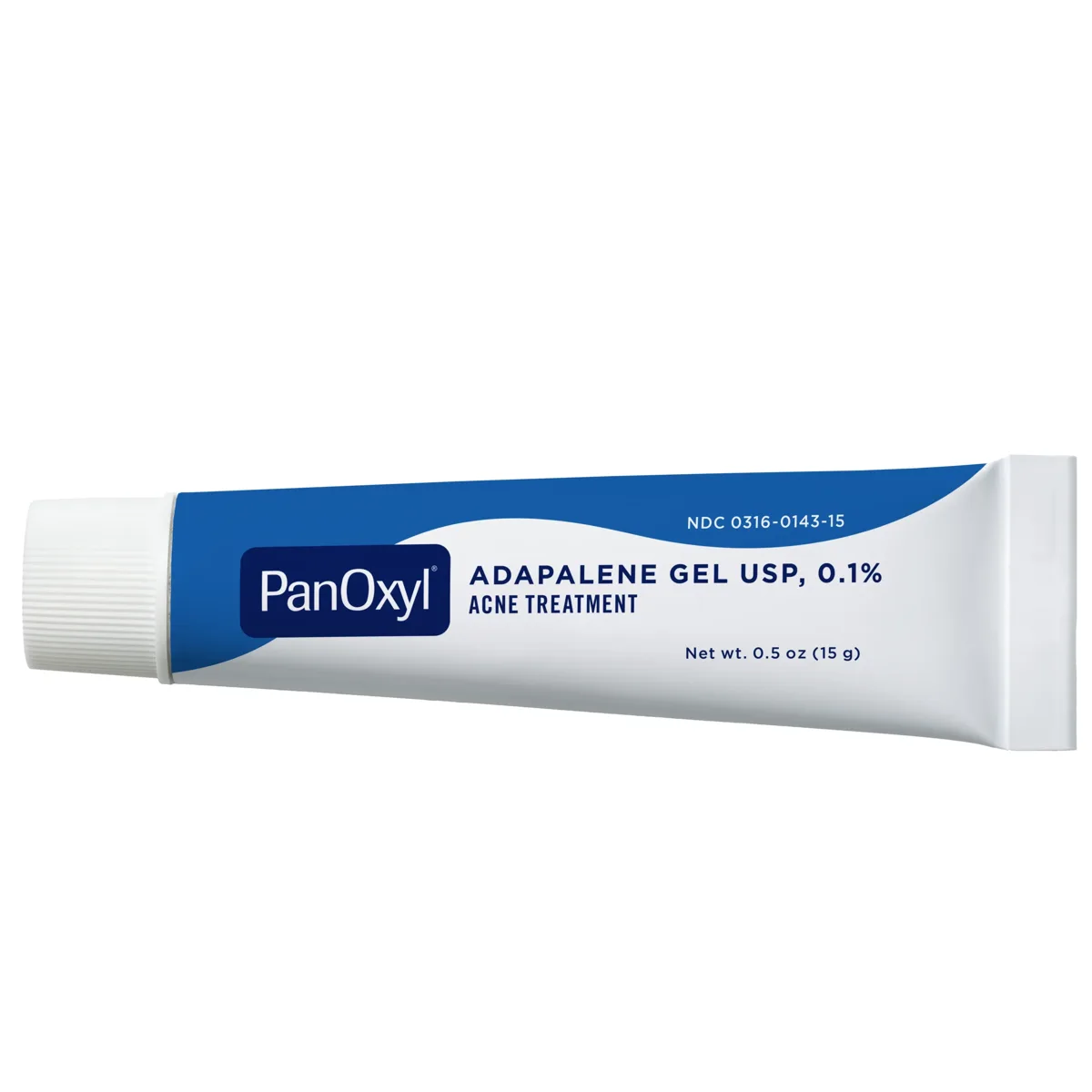
Now contrast that with a typical cosmetic retinol serum. Most have no published head-to-head acne trials at all; their claims lean on the general retinoid literature plus in-house testing. That doesn't make them worthless — retinol has real data of its own — but it does mean you're often comparing a drug with a decade of controlled trials to a marketing narrative. If your target is acne specifically, that gap is the whole story. Formulations like Differin Adapalene Gel 0.1%, PanOxyl Adapalene Gel 0.1%, and Proactiv Adapalene Gel 0.1% all carry the same active at the same clinically-studied strength — the choice between them is mostly price and vehicle, not potency.
The week-4 wall — and why people quit right before it works
Adapalene has one plot twist that sinks more first-timers than any other: it often looks like it's making things worse before it makes them better. Weeks two through four bring dryness, flaking, and frequently a wave of fresh breakouts — the "purge." For someone who bought an acne product expecting clearer skin, watching their skin get bumpier feels like proof the thing failed.
It isn't. Retinoids accelerate skin-cell turnover, which pushes microcomedones that were already brewing beneath the surface up and out all at once. You're not growing new acne; you're fast-forwarding acne that was coming anyway. The flare is a sign the drug is active, and it typically settles as skin adjusts over the following weeks, with meaningful clearing usually landing around the 8-to-12-week mark.
The problem is timing. Adapalene's onset is gradual, and the roughest stretch arrives exactly when patience runs thinnest. People quit at week four — precisely the point where holding on another month would have paid off. If you want to avoid the self-inflicted version of this, start slow: a pea-sized amount two or three nights a week, buffered with moisturizer, climbing to nightly only as your skin allows. Map that ramp with our [retinoid-ramp](/tools/retinoid-ramp/) tool, and before you pile it on the same night as acids or vitamin C, run the combination through the [conflict-checker](/tools/conflict-checker/) — adapalene tolerates benzoyl peroxide, but not everything.
Where it fits — and where it doesn't
Adapalene is an acne treatment first, and that framing keeps expectations honest. If your primary concern is comedonal or inflammatory acne, it is arguably the best-value active in all of skincare: prescription-grade evidence, drugstore price, minimal fuss.
For anti-aging, the answer is a more measured yes. Higher-strength adapalene (0.3%) has been studied for photodamage, and as a retinoid it drives the collagen and turnover pathways that improve texture and fine lines over time. But if wrinkles and tone are your only goal — no acne in the picture — adapalene isn't automatically the standout; a well-formulated retinal or prescription tretinoin may suit that job as well or better, and the smoother cosmetic vehicles can be more pleasant for dry, mature skin. Match the tool to the job.
The honest bottom line: adapalene is one of the most evidence-backed, underpriced products in the entire category, and it is badly served by the fact that it doesn't look or market like a hero product. If you have acne, the tube that costs less than your coffee order is very likely a better buy than the serum with the beautiful dropper. You just have to be the kind of person who makes it to week eight.
Products mentioned
Independently reviewed and scored — the real products behind this piece.


References
- Randomised, controlled trial of the efficacy and safety of adapalene gel 0.1% and tretinoin cream 0.05% in patients with acne vulgaris — European Journal of Dermatology, 2002
- Pivotal clinical trials of adapalene in the treatment of acne — Journal of the European Academy of Dermatology and Venereology, 2001
- Chemical stability of adapalene and tretinoin when combined with benzoyl peroxide in presence and in absence of visible light and ultraviolet radiation — British Journal of Dermatology, 1998
Every cited link is verified to resolve to the paper named. Where a source could not be independently confirmed, it is listed without a link rather than pointing you somewhere wrong.
Frequently asked
Is over-the-counter adapalene as strong as prescription Differin?
The OTC Differin gel is adapalene 0.1% — the exact same molecule and strength that was prescription-only before 2016. The main thing a prescription unlocks is the higher 0.3% concentration and combination products (like adapalene with benzoyl peroxide). For most acne, the 0.1% you can buy off the shelf is the clinically-studied dose.
Why did my skin break out more after starting adapalene?
That's the purge, and it's expected pharmacology, not failure. Adapalene speeds up cell turnover, which pushes already-forming clogs to the surface faster, so weeks two to four often look worse before clearing. It typically settles as your skin adjusts, with real improvement usually showing around 8 to 12 weeks.
Is adapalene better than a retinol serum for acne?
For acne specifically, the evidence strongly favors adapalene. It has pivotal randomized trials showing efficacy comparable to prescription tretinoin with better tolerability, whereas most cosmetic retinol serums have little to no head-to-head acne trial data. You're comparing a drug with published trials to a marketing claim.
Can I use adapalene with benzoyl peroxide at the same time?
Yes — adapalene is unusually photostable and, unlike tretinoin, doesn't rapidly degrade in the presence of benzoyl peroxide and light. That's why combination adapalene-benzoyl-peroxide products exist. Still, layering two actives can be drying, so introduce them gradually and moisturize.
Does adapalene help with wrinkles or just acne?
It helps with both, but it's an acne treatment first. As a retinoid it drives collagen and turnover pathways that improve texture and fine lines over months, and the 0.3% strength has been studied for photodamage. If anti-aging is your only goal with no acne, though, a retinal or prescription tretinoin may suit that job equally well.