


Lip Care: The Barrier That Physically Can't Hold Water
Lip skin loses moisture about three times faster than your cheek and has no oil gland to replace it — which explains most of the reapplication loop, and none of the part your balm is causing.
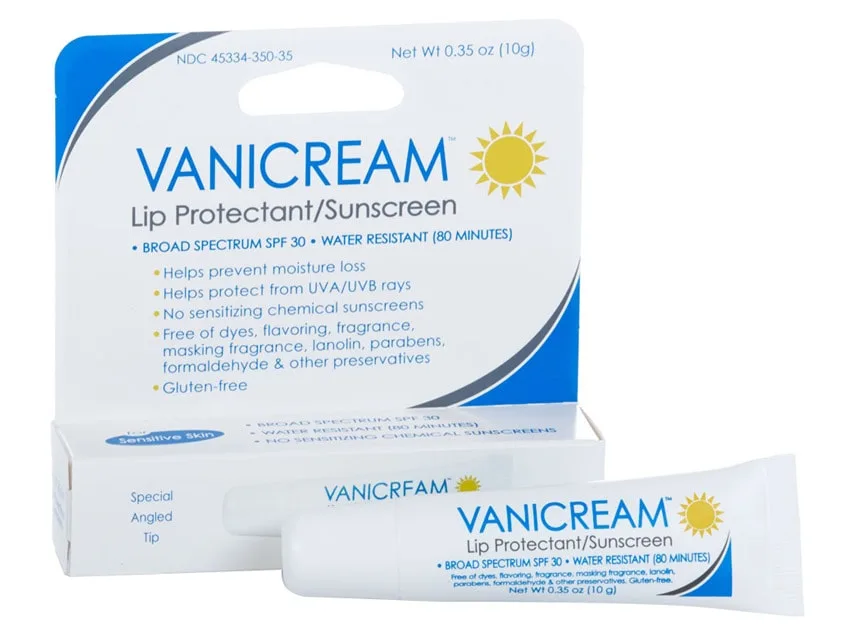
This is one of the only lip SPF products on the market formulated with zero common allergens, zero fragrance, and zero chemical UV filters. The ingredient list reads like a dermatologist's wish list for patients with contact allergies — just 14 ingredients, all mineral and non-sensitizing. For people who react to everything else, this was often the only option.
A no-frills mineral lip sunscreen engineered for the people who react to everything else. The white cast is real, the tube format is clunky, and it's now discontinued — but for allergy-prone users, this was the gold standard in lip UV protection, and nothing has fully replaced it.
The case for it
Same rule for everyone. “Strong choice” is the verdict on 1,459 of 45,024 concern verdicts across the catalog; rule R2 decided 892 of them. Unchanged since September 5, 2026, engine 5.1.1.
Brand or formulator? Disclose a concentration or correct a fact →
The studies behind the evidence row
The case for it
Same rule for everyone. “Strong choice” is the verdict on 1,459 of 45,024 concern verdicts across the catalog; rule R2 decided 892 of them. Unchanged since September 5, 2026, engine 5.1.1.
Brand or formulator? Disclose a concentration or correct a fact →
The studies behind the evidence row
The case for it
What would change this: A researched evidence row for the lead active would replace this with a verdict.
Same rule for everyone. “Good choice” is the verdict on 1,938 of 45,024 concern verdicts across the catalog; rule F2 decided 1,938 of them. Unchanged since September 5, 2026, engine 5.1.1.
Brand or formulator? Disclose a concentration or correct a fact →
The case for it
Same rule for everyone. “Good choice” is the verdict on 9,564 of 45,024 concern verdicts across the catalog; rule R5 decided 9,072 of them. Unchanged since September 5, 2026, engine 5.1.1.
Brand or formulator? Disclose a concentration or correct a fact →
The studies behind the evidence row
As a lip balmNot judged: what a lip balm is for — seals and protects, sun protection where it matters — cannot yet be measured from the ingredient list (only no sting-and-repeat ingredients, low allergen load can).
A verdict is DermApproved’s assessment of how well a product’s ingredients fit a concern — never a claim about what the product treats. Evidence dots and collected reviews sit beside it and are never blended in. Rules 0.5.1 · evidence table ev-2026.09-r228 · how we decide
There is a particular kind of frustration that comes with being allergic to lip balm. Not one lip balm — all of them. The fragrances, the flavors, the chemical UV filters, the lanolin, the preservatives. Every trip down the lip care aisle becomes a game of ingredient-list Minesweeper, and eventually you stop playing. You just let your lips crack.
Vanicream's Lip Protectant SPF 30 was made for that person. Born from the same Rochester, Minnesota pharmacy that created the original Vanicream Moisturizing Cream in 1975, this lip product carries the brand's founding philosophy to its logical extreme: strip out every ingredient that could possibly cause a reaction, and leave only what works.
The ingredient list is almost comically short. Fourteen ingredients total — three actives (zinc oxide at 15%, titanium dioxide at 1.5%, and dimethicone at 1.2% as a skin protectant) and eleven inactive ingredients, most of which serve as the vehicle to get those minerals onto your lips. No fragrance. No flavoring. No lanolin. No parabens. No dyes. No chemical UV filters. No gluten. The SkinSAFE database rates it 100, their highest hypoallergenic score, and that rating is earned.
The zinc oxide does the heavy lifting here. At 15%, it provides genuine broad-spectrum coverage across both UVA and UVB wavelengths — this matters more for lips than most people realize. Lip skin contains almost no melanin, which means it has essentially zero natural UV defense. The lower lip in particular is one of the most common sites for actinic keratosis and squamous cell carcinoma, conditions that develop from years of cumulative sun exposure. An SPF 30 mineral filter on the lips isn't vanity; it's preventive medicine. The catch that applies to every lip sunscreen applies doubly here: lips eat, drink, lick, and talk their protection off faster than any other body site, so reapplication after meals and drinks isn't perfectionism — it's the actual protocol the SPF number assumes. On the safety side there is nothing to weigh: an all-mineral filter list, no flavoring to swallow trace amounts of, and full compatibility with pregnancy.
The texture is an acquired taste. It's not a glossy, slippery lip balm that glides on like butter. It squeezes out of a tube as a thick, white ointment — think healing ointment crossed with sunscreen paste. You dab it onto your lips and rub it in, and while the white cast fades somewhat, it never fully disappears. You will look like you've been eating powdered donuts in certain lighting. For users who need this product, that trade-off is accepted without complaint. For everyone else, it's a dealbreaker.
The squeeze tube format is another love-it-or-hate-it element. Unlike twist-up lip balms that you can swipe on with one hand while walking, this requires squeezing product onto a fingertip and patting it onto the lips. It's a small inconvenience, but lip sunscreen needs to be reapplied every two hours, and every barrier to reapplication reduces compliance. A stick format would have been more practical.
Once applied, the feel is actually quite pleasant in a utilitarian way. The dimethicone creates a smooth, non-greasy barrier that protects against wind and cold as well as UV. It's water resistant for 80 minutes, which is the maximum rating the FDA allows. On winter ski trips and summer beach days alike, it stays put remarkably well.
The moisturizing performance is adequate but not exceptional. Caprylic/capric triglyceride and hydrogenated polyisobutene provide some emollient conditioning, but this is fundamentally a sun protection product, not a lip treatment. Users with severely dry or cracked lips may want to layer a dedicated lip balm underneath and use this as the UV shield on top.
The elephant in the room: Vanicream has discontinued this product. For the community of allergy-prone users who relied on it, this has been genuinely distressing. Forum threads and review sections are filled with people stockpiling remaining tubes and searching for alternatives. The fact that a humble pharmacy-brand lip sunscreen could inspire this level of devotion speaks to how underserved this population remains.
At its retail price of around six dollars, this was one of the best values in lip sun protection — mineral-only, broad-spectrum SPF 30, water resistant, and hypoallergenic, for less than the cost of a fancy lip gloss. The 0.35-ounce tube lasted two to three months with regular daily use.
Vanicream's Lip Protectant SPF 30 was never glamorous. It wasn't trying to be. It was trying to protect vulnerable lip skin from UV damage without triggering the contact allergies that made every other option unusable. It succeeded at that mission with quiet competence, and its discontinuation leaves a gap that the market has been slow to fill. The nine hundred reviews averaging 4.0 stars capture both the devotion and the friction: for a striking number of allergy-prone reviewers this was the only lip SPF they could wear at all, and the water resistance and price earned steady gratitude — while the white cast, the two-handed squeeze-tube ritual, and a finish some found more protective than pampering kept the score honest. (For completeness: it is also fungal-acne safe, one more box this fourteen-ingredient formula ticks almost by accident.) A 4.0 from a population with nowhere else to go is less a middling grade than a measure of how much its users were willing to forgive.
The hero actives that drive this product's performance.
| Ingredient | Function | Evidence |
|---|---|---|
| Zinc Oxide 15% (15%) | The primary UV filter in this formula, carrying the bulk of the SPF 30 protection. At 15%, zinc oxide provides true broad-spectrum coverage across UVA I, UVA II, and UVB wavelengths — critical for lip skin, which lacks melanin and is highly susceptible to actinic damage. Works in tandem with the small amount of titanium dioxide to close spectral gaps. | Regulator-approved for Sun Damage · limited certainty |
| Titanium Dioxide 1.5% (1.5%) | A secondary mineral UV filter included at a modest concentration to bolster UVB protection. Complements the zinc oxide rather than serving as a standalone filter, helping ensure consistent SPF performance across the thin, mobile skin of the lips. | Regulator-approved for Sun Damage · limited certainty |
| Dimethicone 1.2% (1.2%) | Listed as an active skin protectant rather than just a vehicle ingredient. At this concentration, it forms a breathable occlusive layer over lip skin that prevents transepidermal water loss and shields against wind and cold — working alongside the mineral filters to provide both UV and environmental barrier protection. | Regulator-approved for Dryness · established mechanism |
| Caprylic/Capric Triglyceride | A lightweight emollient derived from coconut oil that conditions lip skin and serves as the primary dispersing agent for the mineral filters. Helps the zinc oxide and titanium dioxide spread evenly across the lip surface for uniform sun protection without the heavy, draggy texture that high-zinc formulas can produce. | Established mechanism for Dryness · established mechanism |
Ingredient standings describe the active at treatment-level doses and vehicles; this product's own condition grades weigh its actual formula.
Active Ingredients: Dimethicone 1.2%, Titanium Dioxide 1.5%, Zinc Oxide 15%. Inactive Ingredients: Butylene/Ethylene/Styrene Copolymer, C12-15 Alkyl Benzoate, Caprylic/Capric Triglyceride, Ethylene/Propylene/Styrene Copolymer, Hydrogenated Polyisobutene, Isononyl Isononanoate, Microcrystalline Wax, Polyhydroxystearic Acid, Silica Dimethyl Silylate, Stearic Acid, Triethoxycaprylylsilane
sunscreen
AM
Apply generously to lips as the final step before going outdoors. Can be applied over lip balm for extra hydration. Reapply at least every two hours, or after eating, drinking, or toweling off.
Immediate UV protection upon application. Lip moisturizing and barrier protection benefits are felt within minutes. With consistent daily use over 2-4 weeks, chronically dry or wind-chapped lips should show improved condition.
The science behind this formula is straightforward but sound. Zinc oxide and titanium dioxide are the only two UV filters classified by the FDA as Category I — 'generally recognized as safe and effective' — out of the sixteen sunscreen actives evaluated. This distinction matters because the FDA requested additional safety data on all chemical UV filters (including avobenzone, oxybenzone, and octinoxate) due to evidence of systemic absorption, while mineral filters remain on the lips' surface without penetrating skin.
A 2011 review published in Nanotechnology, Science and Applications (Smijs & Pavel) examined the complementary spectral coverage of zinc oxide and titanium dioxide, finding that zinc oxide provides superior UVA absorption while titanium dioxide excels in the UVB range. This combination in the Vanicream formula — with zinc oxide as the dominant filter at 15% and titanium dioxide as a supporting filter at 1.5% — creates coverage across the full UV spectrum relevant to skin damage.
The lip-specific context is clinically significant. A 2020 review in the Canadian Medical Association Journal (Sander et al.) synthesized evidence showing that consistent sunscreen use resulted in a 40% lower incidence of squamous cell carcinomas. The lower lip is particularly vulnerable because it faces direct solar exposure, contains minimal melanin, and has a thinner stratum corneum than facial skin. Chronic UV exposure to unprotected lips leads to actinic cheilitis, a precancerous condition that dermatologists see regularly in outdoor workers and fair-skinned patients.
Dimethicone at 1.2% is listed as an active skin protectant, not merely a vehicle ingredient. FDA monograph-approved as a skin protectant, dimethicone forms a semi-occlusive barrier that reduces transepidermal water loss — particularly relevant for lip skin, which lacks sebaceous glands and is prone to dehydration.
Dermatologists frequently recommend mineral-only lip sunscreens for patients with allergic contact cheilitis, and the Vanicream Lip Protectant was a go-to recommendation in this category. Working dermatologists generally find that lip skin is uniquely vulnerable to UV damage due to its lack of melanin, thin epithelium, and absence of sebaceous glands. The lower lip receives disproportionate UV exposure and is one of the most common sites for actinic keratosis progression to squamous cell carcinoma. A mineral SPF 30 product that eliminates all common contact allergens addresses both the UV risk and the high prevalence of lip sensitivity in the general population. Dermatologists specializing in contact dermatitis often describe this as one of the few lip SPF products they could recommend to their most reactive patients without reservation.
Squeeze a small amount onto a clean fingertip and apply evenly to both lips, covering the full lip surface including the vermillion border. Apply at least 15 minutes before sun exposure. Reapply every two hours during prolonged outdoor activity, and immediately after eating, drinking, swimming, or toweling off. Can be layered over a moisturizing lip balm for additional hydration. For winter sports or extended outdoor exposure, pair with a scarf or balaclava for additional mechanical UV protection.
At approximately six dollars for a 0.35-ounce tube, this was among the most affordable mineral lip sunscreens available. The tube lasts two to three months with regular daily use, putting the cost at roughly two dollars per month for daily lip UV protection. For a product with SPF 30 broad-spectrum mineral coverage, 80-minute water resistance, and the highest hypoallergenic ratings available, the value proposition was excellent. The only caveat is that discontinued status has driven up prices on secondary markets — paying a premium above the original retail diminishes this value equation significantly.
Anyone with contact allergies, fragrance sensitivities, or a history of reacting to lip products should seek this out while stock remains. It's also ideal for dermatology patients needing a mineral-only lip SPF during post-procedure recovery or for daily UV protection on allergy-prone lip skin.
If you want a cosmetically elegant lip product with no white cast, this isn't it. Users who prioritize a glossy, flavored, or tinted lip experience will find this too utilitarian. And given its discontinued status, anyone looking for a long-term daily product should explore alternatives that remain in production.
Ready to try Vanicream Lip Protectant SPF 30?
Buy at Amazon ♥Thick, ointment-like cream that squeezes from a tube. Goes on smooth but with visible white pigment from the mineral filters. Users compare the feel to Aquaphor once rubbed into the lips — not a traditional waxy balm, more of a lotion-cream hybrid.
Completely unscented — no fragrance, no masking fragrance, and no flavoring of any kind.
Small white squeeze tube (0.35 oz) with Vanicream branding. Compact enough for a pocket or bag, though the tube format requires squeezing onto a finger for application.
On first use, expect a visible white layer on the lips from the mineral filters. It takes a moment of rubbing to even out, but the white tint never fully disappears. The feel is smooth and protective rather than slippery or glossy. No stinging, tingling, or adjustment period — it simply sits on the lips and does its job.
2-3 months with daily use, applying 2-3 times per day
All Year
Vanicream was born in a Rochester, Minnesota pharmacy in 1975, when pharmacists working with dermatologists realized that patients with contact allergies had almost no suitable skincare options. The Lip Protectant SPF 30 extended this hypoallergenic philosophy to sun protection for lips — a category dominated by products loaded with fragrances, flavors, and chemical UV filters. The product has since been discontinued, but retains a devoted following among allergy-prone users.
Vanicream was developed by pharmacists at Pharmaceutical Specialties, Inc. in Rochester, Minnesota in 1975, with input from dermatologists treating patients with contact allergies. The brand has nearly five decades of clinical use and is widely recommended by dermatologists for patients with sensitive and allergy-prone skin.
Mineral sunscreens don't provide enough UV protection for lips.
Zinc oxide at 15% provides true broad-spectrum protection across UVA and UVB wavelengths. The FDA classifies zinc oxide and titanium dioxide as the only two UV filters that are 'generally recognized as safe and effective,' and at SPF 30, this formula blocks approximately 97% of UVB radiation.
SPF lip products need flavoring or fragrance to be tolerable.
This product proves otherwise — it's completely unflavored and unscented, and many users with contact allergies report it's the only SPF lip product they can wear without reactions. Fragrance and flavoring are actually among the most common causes of lip contact dermatitis.
Yes, Vanicream has discontinued this product. Remaining stock may still be available through some retailers and online marketplaces, but availability is limited and prices may vary. Users seeking a similar mineral-only, hypoallergenic lip SPF may need to explore alternatives.
Yes, the 15% zinc oxide and 1.5% titanium dioxide produce a visible white tint on the lips that doesn't fully disappear. This is inherent to mineral UV filters at protective concentrations. Most users accept this trade-off for the product's exceptional allergen-free formulation.
Yes — this formula uses only mineral UV filters (zinc oxide and titanium dioxide) with dimethicone as a skin protectant. It contains no chemical UV filters, retinoids, or ingredients of concern during pregnancy. Mineral sunscreen ingredients are not absorbed systemically and are considered safe for use during pregnancy and breastfeeding.
This product was specifically designed for people with contact allergies. It eliminates fragrance, lanolin, parabens, dyes, flavoring, gluten, and other common allergens. It carries a SkinSAFE 100 rating, the highest hypoallergenic standard, and is one of the most allergen-free lip SPF products ever formulated.
Reapply at least every two hours during sun exposure, and immediately after eating, drinking, swimming, or toweling off. The product is water resistant for 80 minutes, so reapplication after water activities is essential. Lip skin is particularly vulnerable to UV damage due to its lack of melanin, making consistent reapplication important.
Flavorings are among the most common causes of allergic contact cheilitis (lip inflammation from contact allergies). Vanicream deliberately excludes all flavoring agents to minimize the risk of reactions in allergy-prone users. The product is designed for maximum tolerability, prioritizing function over sensory appeal.
Yes, it is water resistant for 80 minutes — the highest water resistance rating allowed by the FDA. This makes it suitable for outdoor activities, swimming, and sweating, though reapplication after the 80-minute window is necessary to maintain protection.
Recurring themes our editors read across retailer reviews of this product — summaries in our words, not quotations, and not a substitute for your own patch test.
Only SPF lip product many sensitive-skin users can tolerate
Effective mineral sun protection without chemical UV filters
Free from virtually every common allergen and irritant
Moisturizing ointment-like feel once applied
Affordable price point
Water resistant for 80 minutes
Noticeable white cast that does not fully disappear
Squeeze tube is less convenient for on-the-go reapplication than a twist-up stick
Product has been discontinued, making replacement difficult
Some users find it slightly drying rather than deeply moisturizing
Ointment-like texture is not universally preferred
Verified answers from our questions library — the nuance a product page cannot carry.