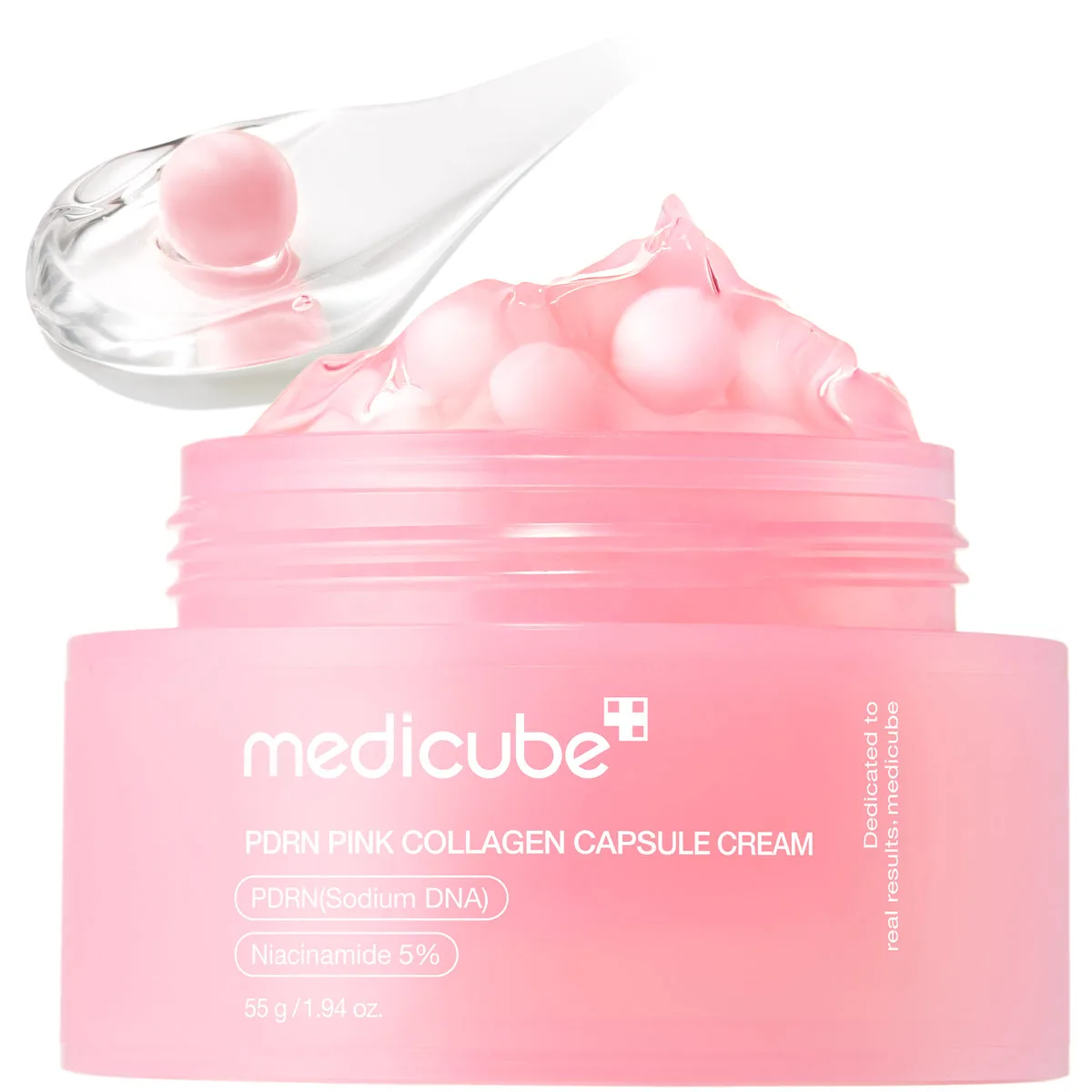
Most jelly-cream moisturizers in the K-beauty mid-tier rely on a single hero ingredient — green tea, propolis, snail mucin — with hydration support around it. This one builds an entire active stack into the jelly format: PDRN as the headline, niacinamide doing the visible early work, trehalose and proteoglycan handling hydration and matrix-mimicry, and seven collagen variants forming a surface film. The trade-off is the same as the brand's serums — broad coverage at modest individual doses rather than depth at any single one.
A bouncy hydrogel-format moisturizer that holds 0.5% PDRN, meaningful niacinamide, trehalose, and salmon-derived proteoglycan against the skin long enough for the actives to do their slow surface-level work. Best understood as the layering cream that complements TOSOWOONG's stronger PDRN serum rather than as a standalone hero — and best skipped if you're fungal-acne-prone or live somewhere properly dry.
Released in early 2025, this cream has six to twelve months of post-launch tracking and consolidated review counts in the low hundreds across YesStyle, Amazon, and specialty K-beauty retailers. The score leans on the published evidence base for the individual heroes — niacinamide and trehalose well-established, proteoglycans well-supported, topical PDRN emerging but credible — rather than on outcome data measured specifically on this jelly-cream stack. Long-term firmness and texture results remain extrapolated from the actives' individual research rather than directly observed for this formula.
Verdicts
How well it fits each concern
Verdict by concern tap a concern for the case
Supporting rolefor AgingIn your profileYou chose · Niacinamide has early evidence for aging, and hydration and barrier support is the recognised companion to treating it — a reasonable supporting choice, short of a recommendation.Moderate evidenceGentleNo reviews collected yet
The case for it
Niacinamide has early or mechanistic evidence for this concern, not trial-backed standing.
It is plausibly present at a working level, though the concentration is not declared.
The formula carries none of the triggers this concern is sensitive to.
What would change this: A declared concentration would move this to a firmer reading of the dose.
Same rule for everyone. “Supporting role” is the verdict on 8,197 of 45,024 concern verdicts across the catalog; rule R8a decided 1,489 of them.
Unchanged since September 5, 2026, engine 5.1.1.
R8a — A plausible-tier active in a category with a supportive job: the sentence names the active instead of saying nothing targets the concern (the AmLactin / CeraVe SA case for keratosis pilaris, where no guideline and single trials leave the keratolytics at early evidence). · the full register
Carrying active
Niacinamide
Standing
plausible — trials support it
Form
plausible — studied range 4–5%, from the trials on the row; needs leave-on contact; judge it after ~8 weeks
Tolerability
gentle
Row checked
against its sources on July 17, 2026 (evidence table ev-2026.09-r228)
Supporting rolefor DehydrationIn your profileYou chose · Nothing here targets dehydration directly; humectant hydration is the recognised companion to treating it, and this gel cream does that without known triggers.Not yet assessedGentleNo reviews collected yet
The case for it
Niacinamide has no evidence row yet for this concern — it is in the research queue.
The formula carries none of the triggers this concern is sensitive to.
What would change this: A researched evidence row for the lead active would replace this with a verdict.
Same rule for everyone. “Supporting role” is the verdict on 8,197 of 45,024 concern verdicts across the catalog; rule R8 decided 4,250 of them.
Unchanged since September 5, 2026, engine 5.1.1.
R8 — The category's job (barrier care, humectant hydration, gentle cleansing, photoprotection) is the documented supportive role for this concern. This is the honest verdict for a moisturizer on an acne page. · the full register
Good choicefor Compromised Skin BarrierIn your profileYou chose · Niacinamide is a reference standard by mechanism for compromised skin barrier; this gel cream carries it high in the ingredient list.Moderate evidenceGentleNo reviews collected yet
The case for it
Niacinamide has trial-supported standing for this concern.
It is present at an effective concentration, declared or high in the ingredient list.
The formula carries none of the triggers this concern is sensitive to.
Same rule for everyone. “Good choice” is the verdict on 9,564 of 45,024 concern verdicts across the catalog; rule R5 decided 9,072 of them.
Unchanged since September 5, 2026, engine 5.1.1.
Also listed for Dullness — the actives here (Niacinamide, PDRN (Polydeoxyribonucleotide) are in our research queue for that concern; there is no verdict until their evidence rows are written. That is a gap in our table, not a mark against the product.
Falls shortJudged as a moisturizer, it comes up short on: seals moisture in, supplies barrier lipids.
A verdict is DermApproved’s assessment of how well a product’s ingredients fit a concern — never a claim about what the product treats. Evidence dots and collected reviews sit beside it and are never blended in.
Rules 0.5.1 · evidence table ev-2026.09-r228 · how we decide
Assessment
Pros & Cons
Pros
✓ Bouncy jelly format gives PDRN extended skin contact time vs serum delivery
✓ Niacinamide at meaningful concentration handles the visible early work
✓ Trehalose plus soluble proteoglycan deliver layered, evidence-backed hydration
✓ Pairs well with TOSOWOONG's stronger PDRN serum as a layered system
✓ Genuinely fragrance-free and free of artificial color additives
✓ Pleasant cosmetic experience — cooling, plumping, dewy finish
Cons
✗ 0.5% PDRN sits at the lower end of the topical category — modest effect on its own
✗ 50-mL jar is small for a moisturizer at this price point
✗ Alcohol presence in the formula concerns reactive-skin users
✗ Heavy collagen and salmon-biomolecule load raises fungal-acne risk
✗ Not occlusive enough for very dry skin or winter without a second layer on top
✗ Jar packaging exposes the formula to air and contamination on each use
Review
Full Review
There's a reason the brand chose a jelly format for this product instead of a third serum, and it isn't aesthetic. PDRN at any topical concentration faces the same fundamental challenge: it's a large biomolecule trying to do something useful at the skin's surface, and the longer it stays in contact with the stratum corneum, the more chance it has to actually engage adenosine A2A receptors and contribute to the slow signaling work it's known for. A watery serum evaporates and absorbs within thirty seconds. A hydrogel-like jelly sits on the skin's surface longer, holds water against it, and gives the active ingredients in the formula extended contact time. That choice — format as delivery strategy — is the most thoughtful thing about this cream.
The PDRN headline number tells a humbler story than the brand's own serum. At 5,000 ppm (0.5%), the cream carries half the PDRN concentration of the serum and sits at the lower end of the topical PDRN market overall, where competing creams range from roughly 3,000 to 10,000 ppm. So if PDRN is the only reason you're buying this product, the math is unflattering. What makes the formula more defensible is what surrounds the PDRN.
Niacinamide sits ninth on the INCI, almost certainly in the 2-4% range — high enough to be doing the bulk of the visible early work users report. Ceramide synthesis support, mild oil regulation, the gentle tone-evening effect. In a jelly-cream base, niacinamide releases slightly slower and more sustainedly than in a watery serum, which is a small but real benefit for daytime contact. Trehalose, the disaccharide humectant that lets tardigrades survive complete desiccation, sits twelfth — quietly one of the most useful supporting ingredients in the formula, both for moisture retention and for stabilizing the larger biomolecules against breakdown. Adenosine, the KFDA-approved Korean anti-wrinkle active, contributes its own modest collagen-signaling work at what is almost certainly the regulated functional dose.
Then there's the collagen stack — and here's where the formula starts to overstate. Seven different collagen molecular weights (hydrolyzed, atelocollagen, desamido, soluble, regular, collagen amino acids, procollagen) plus hydrolyzed elastin. At every molecular weight, topical collagen is too large to cross into the dermis and rebuild structural tissue. What this stack delivers is a humectant film on the skin's surface that smooths texture and gives the immediate plumping users feel — a real cosmetic benefit, but not the structural rebuilding the marketing implies. The soluble proteoglycan, sourced commercially from salmon nasal cartilage, is more interesting: proteoglycans have a growing body of research supporting their use for skin hydration and matrix support, and they can hold up to a thousand times their weight in water.
The formula's quieter decisions are worth reading too. A polyol spine of propanediol, butylene glycol, dipropylene glycol and methylpropanediol carries the water phase and gives the jelly its slippery lightness. Two acrylate-family polymers — the beheneth-25 methacrylate crosspolymer high on the list and a glyceryl acrylate copolymer lower down — are what actually create the bounce; without them this is just an essence. Sodium phytate chelates trace metals to protect the biomolecules, arginine and citric acid set the pH, and 1,2-hexanediol with caprylyl glycol and ethylhexylglycerin handle preservation without parabens. The pink tint, notably, is not a dye: cyanocobalamin — vitamin B12 — is naturally that color, and the brand let the ingredient do the branding.
The texture is genuinely pleasant — a light, almost-transparent jelly with a slight bounce-back when pressed, transforming into a watery essence within seconds of skin contact. It absorbs cleanly without residue, doesn't pill under sunscreen or makeup, and leaves a soft glow finish. Nothing tingles, nothing warms, nothing purges. The cream's only meaningful occlusive ingredient is squalane at the bottom of the INCI, which means it functions more like a hydrating-treatment cream than a barrier-sealing moisturizer. In dry climates or winter months, you'll want to layer something richer on top — that isn't a flaw so much as a category boundary the product never claimed to cross.
The main limitations are the same ones that constrain most of the brand's formulas. Fifty millilitres at $22 is a small bottle in a moisturizer category where 100-mL options dominate, and it lasts realistically six to eight weeks at twice-daily use. The alcohol raises a flag for reactive skin. And the heavy biomolecule load — collagen variants, salmon proteoglycan, PDRN — creates real fungal-acne risk for anyone with confirmed Malassezia susceptibility. The jar packaging is the other quiet cost: every use exposes an active-dense formula to air and fingers, which is not what you want for biomolecules that would rather be left alone. Keep it in a drawer rather than a steamy bathroom shelf.
Expectation-setting matters more here than with most creams, because the PDRN name carries clinic-injection connotations it cannot possibly honor. An injection bypasses the stratum corneum entirely and deposits PDRN into the dermis at high local concentration, with measurable change inside a month. A topical at 0.5% works at the surface, by diffusion, and needs eight to twelve weeks of consistent use before anything attributable shows up — and even then, honestly, the niacinamide and the humectants will have done most of the visible work. That is not an argument against the cream. It is an argument against the internet's framing of it.
Value calibration: at $22 for 50 mL, the price is fair for what's in the bottle, especially given the active complexity, and it undercuts the larger K-beauty houses' PDRN creams by a comfortable margin. The right way to think about this cream is as the layering moisturizer that completes a PDRN routine — paired with the brand's own PDRN serum underneath, it gives a layered system that compensates for the cream's lower headline concentration through extended contact time and complementary actives. Used standalone, it's more accurately described as a niacinamide-and-trehalose hydrating cream with PDRN as a supporting contributor rather than a featured hero. With only a hundred-odd reviews on the board since its early-2025 launch, that read is still provisional — the actives are well-understood individually, but this particular stack hasn't been on enough faces for long enough to say more.
Good product, honest pricing, narrow-but-real audience: dry-to-combination skin users curious about topical PDRN who want a layering cream rather than a standalone hero. Skip it if you have fungal acne or live somewhere arid enough that you need real occlusive sealing from a single product.
Formula
Key Ingredients
The hero actives that drive this product's performance.
The headline number sits at half the concentration of the brand's Pink Peptide PDRN Serum but the cream format gives PDRN more contact time on the skin and the occlusive squalane lock-in keeps it from evaporating off. PDRN works at the surface through adenosine A2A receptor activation; in a cream base its modest contribution to barrier-recovery signaling is more meaningful than the serum-only delivery would be.
Sits ninth on the INCI — almost certainly in the 2-4% range, which is doing the bulk of the visible early work this cream is known for. Ceramide synthesis support, mild oil regulation, and pigment-transfer modulation. In a jelly-cream format the niacinamide release profile is slightly slower and more sustained than in a watery serum, giving the active longer skin contact during the day.
Established mechanismfor Compromised Skin Barrier · established mechanism
A disaccharide humectant that protects cell membranes during dehydration stress — the molecule that lets tardigrades survive complete desiccation. In this cream it works alongside the glycerin and propanediol layer to draw and retain moisture, with the added benefit of stabilizing the larger biomolecules (PDRN, the collagen fragments, the proteoglycan) against breakdown. Quietly one of the most useful supporting ingredients in the formula.
Seven different collagen molecular weights plus hydrolyzed elastin, working as a layered humectant film that smooths surface texture and gives the immediate plumping users feel. Topical collagen molecules at any molecular weight are too large to structurally rebuild dermal tissue — this stack delivers temporary surface-level benefits, not collagen replacement.
Proteoglycans are the extracellular matrix molecules that hold up to 1,000 times their weight in water — sourced commercially from salmon nasal cartilage. Pair with adenosine, the KFDA-approved Korean anti-wrinkle active, and you get a low-key but credible firmness-and-hydration combination that operates beyond the PDRN and collagen marketing. Proteoglycans in particular are gaining real published support for skin hydration applications.
Limitedfor Aging
Ingredient standings describe the active at treatment-level doses and
vehicles; this product's own condition grades weigh its actual formula.
Use as the moisturizer step at the end of your routine — the jelly format works equally well over a hydrating serum or a treatment ampoule. A pea-sized amount covers the face; spread upward in light layers rather than slathering. Squalane provides the only meaningful occlusive element, so anyone in a particularly dry climate may want to seal it with a richer cream or a sleeping mask on top during winter months.
Results Timeline
Immediate: a bouncy hydration boost and visible plumping from the multi-collagen surface film. Short-term (1-3 weeks): smoother surface texture and noticeably softer skin from the niacinamide-trehalose-proteoglycan layer. PDRN's slower repair contribution shows up over 8-12 weeks of consistent twice-daily use as part of a broader PDRN routine; alone, the cream is more accurately a hydration-and-niacinamide product with PDRN as a supporting actor.
Pairs Well With
PDRN serums or peptide serums underneathHydrating toners and essencesMineral or hybrid sunscreens during the day
The headline active — PDRN (Sodium DNA) — sits at 5,000 ppm, on the lower end of the topical PDRN market. The injectable form of PDRN (Rejuran Healer) carries published clinical evidence for dermal regeneration and fine-line improvement when delivered intradermally; the topical form has a thinner but growing body of small studies and case series suggesting surface hydration, barrier-recovery, and post-procedure healing benefits over 8-12 weeks of consistent use. At 0.5%, this cream delivers modest PDRN exposure that benefits from the jelly-format's extended contact time but cannot match the higher-dose serum or, certainly, the injection.
Niacinamide at 2-5% is supported by extensive published research on barrier ceramide synthesis, pigment-transfer modulation, and sebum regulation. The clinical evidence for daily-use topical niacinamide at these concentrations is among the strongest in cosmetic dermatology. Trehalose has well-established research on cell-membrane protection during dehydration stress and is widely used in pharmaceutical formulations for biomolecule stabilization. Adenosine carries Korean clinical data supporting its KFDA designation as an anti-wrinkle functional ingredient.
Soluble proteoglycan, sourced commercially from salmon nasal cartilage, is the most interesting supporting ingredient — recent published research supports its use as a humectant matrix-mimic with measurable improvements in skin hydration and visible firmness over 8-12 weeks of topical use. The multiple collagen variants are individually studied as humectant film-formers; the published literature does not support topical collagen at any molecular weight as a structural rebuilder of dermal collagen networks, despite consumer-facing marketing in the category that implies otherwise.
Dermatologist Perspective
Dermatologists generally view multi-collagen-plus-PDRN topical formulas as low-risk additions to a hydration-focused routine for patients with dry or dehydrated skin, particularly those who want a layered K-beauty system rather than a single-active product. The clinical positioning is consistent across practitioners: the most credible work in this cream comes from niacinamide and proteoglycan, with PDRN as an interesting supporting actor and the collagen variants as humectant film-formers rather than structural rebuilders. The lower PDRN dose here means clinicians who recommend topical PDRN typically pair this cream with a higher-dose PDRN serum underneath rather than using it as a standalone PDRN source. The presence of alcohol is a small concern for patients with rosacea or severely reactive skin; in those cases, simpler alcohol-free moisturizers are usually preferable.
Guidance
Usage & Recommendations
How to Use
Take a pea-sized amount onto clean fingertips after your serum step. Spread upward across face and neck in light layers rather than slathering. Wait sixty seconds for the jelly to fully absorb before applying SPF or sleeping. Use morning and evening for cumulative benefit; the niacinamide and PDRN are consistency-dependent rather than dose-dependent. Pair underneath with a PDRN or peptide serum to compensate for this cream's lower PDRN concentration. On retinol or AHA evenings, apply the active first, give it ten to fifteen minutes, then layer this cream on top to support barrier recovery overnight.
Value Assessment
At $22 for 50 mL — roughly 44 cents per mL — this cream is fairly priced for an active-stacked PDRN-and-niacinamide jelly format. Competing PDRN creams from larger brands like Medi-Peel and VT Cosmetics typically run $30-50 for similar volumes, while simpler Korean moisturizers without PDRN run $10-18 for 100 mL jars. The pricing reflects the active complexity rather than premium positioning. The 50-mL jar is the formula's main commercial constraint — six to eight weeks of twice-daily use depletes the bottle, which makes the per-application cost less competitive than a 100-mL option would deliver. Best value comes from pairing this cream with the brand's PDRN serum as a layered system; standalone, it's harder to argue the price against simpler niacinamide-and-hyaluronic-acid moisturizers at half the cost.
Who Should Buy
Dry-to-combination skin users curious about topical PDRN who want a layering moisturizer to complete a PDRN-focused routine. Particularly well-suited to people already using TOSOWOONG's Pink Peptide 12 PDRN Serum and looking for a complementary cream from the same line. A reasonable hydrating-treatment moisturizer for users who appreciate the cosmetic experience of a jelly format and don't need heavy occlusive sealing.
Who Should Skip
Pass on this cream if you have oily or acne-prone skin — the heavy collagen and salmon-biomolecule load raises fungal-acne risk and the jelly format doesn't deliver enough oil regulation. Skip if you live in a dry climate or experience seasonal winter dryness and need a single, richer moisturizer rather than a hydration layer that requires a follow-up. Bypass it if alcohol in any concentration is a known trigger for your skin. Not the right product for users who want maximum PDRN dose in a single product — a higher-concentration serum will deliver more attributable PDRN benefit.
Light, almost transparent jelly with a slight bounce-back when pressed; transforms into a watery essence within seconds of contact with skin, absorbing without residue.
Scent
No added fragrance and no essential oils — what little scent is present comes from the salmon-derived biomolecules and is faint enough to disappear within seconds.
Packaging
50-mL jar in opaque pink-tinted plastic that matches the brand's PDRN line aesthetic. Jar packaging exposes the formula to air and contamination with each use; users particularly concerned about PDRN stability should keep it stored in a cool, dark drawer rather than a humid bathroom.
Finish
lightweightdewyfast-absorbingnon-greasy
What to Expect on First Use
First applications register as a cooling, pleasant jelly that disappears into the skin with a soft glow. No tingling, no warming, no purging — the formula sits at a low irritation profile despite the active stack. Plumping and softer texture become noticeable within the first week.
How Long It Lasts
About six to eight weeks applied morning and night face and neck application, using a small pea-sized amount per use. Slightly longer if used only at night.
TOSOWOONG entered the PDRN cream category in early 2025 after their Pink Peptide PDRN Serum gained traction in late 2024, riding the topical-PDRN wave that Rejuran's clinic injectables had built into a defining K-beauty trend. The jelly-cream format was chosen specifically to maximize PDRN contact time on the skin — a serum delivery would let the active evaporate faster, while the jelly's hydrogel-like matrix holds the formula on the surface long enough for receptor signaling to occur.
About TOSOWOONG Established Brand (5–20 years)
TOSOWOONG launched in 2009 and built early credibility through clinical-grade silicone cleansing brushes before transitioning to ingredient-forward skincare. The PDRN Collagen Jelly Cream launched in early 2025 as part of the brand's expanded PDRN line, riding the topical PDRN wave that Rejuran clinic injectables had built into one of the most-requested categories in Korean dermatology.
Brand founded: 2004 · Product launched: 2025
Myth vs. Reality
Common Myths
Myth
A PDRN cream gives results comparable to the Rejuran clinic injection.
Reality
The injection bypasses the stratum corneum and delivers PDRN directly into the dermis at high local concentration, producing measurable change in two to four weeks. A topical cream at 0.5% PDRN works at the surface through diffusion and is significantly slower — measurable benefit over 8-12 weeks of consistent use, not weeks.
Myth
Seven different collagen molecular weights provide layered structural rebuilding.
Reality
Topical collagen at any molecular weight cannot cross into the dermis to rebuild structural tissue. The seven collagen variants in this cream function as a humectant film on the skin's surface — they smooth texture and provide temporary plumping but do not regenerate the collagen network.
FAQ
Frequently Asked Questions
How does the PDRN Collagen Jelly Cream compare to TOSOWOONG's Pink Peptide PDRN Serum?
The serum carries PDRN at twice the concentration (10,320 ppm vs 5,000 ppm) and adds twelve peptides plus bakuchiol and an antioxidant cluster. The cream halves the PDRN headline but adds trehalose, soluble proteoglycan, and a much larger collagen-variant stack in a jelly-format base that gives PDRN longer skin contact. The most thoughtful use is to layer them — the serum as a treatment step, the cream as the moisturizer step on top.
Is 5,000 ppm of PDRN enough to see real results?
5,000 ppm (0.5%) sits at the lower end of topical PDRN dosing — most competing K-beauty PDRN creams range from 3,000 to 10,000 ppm. At this concentration, expect modest surface hydration and barrier-recovery support over 8-12 weeks of consistent use rather than dramatic firmness or fine-line change. Users who want to maximize PDRN benefit should layer this cream over a higher-dose PDRN serum rather than relying on the cream alone.
Will this jelly cream provide enough moisture for dry skin in winter?
Probably not on its own. The cream's only meaningful occlusive ingredient is squalane at the bottom of the INCI, and the watery jelly base evaporates relatively quickly compared to a traditional cream. In dry climates or winter conditions, layer a richer occlusive moisturizer or a sleeping mask on top, or use this cream as the morning moisturizer and a heavier product at night.
Is the TOSOWOONG PDRN Collagen Jelly Cream fungal-acne safe?
No — the formula contains multiple collagen molecular weights and salmon-derived biomolecules that can feed Malassezia yeast in users with confirmed fungal acne. Hydrolyzed proteins and the soluble proteoglycan can also raise the risk profile. If you have fungal acne or suspect it, patch-test on the jawline for a week before committing to full-face use.
Can I use this cream alongside retinol or AHA exfoliants?
Yes, as the moisturizer step on top of either. The niacinamide and PDRN both support barrier recovery, and the collagen-and-proteoglycan surface film softens any tightness or flaking that retinol can cause. Apply your retinol or AHA first, give it ten to fifteen minutes to absorb, then layer this jelly cream on top. The cream is well-suited to retinol-night recovery routines.
Why is alcohol in a moisturizer formula?
The alcohol sits at low concentration on the INCI and functions as both a penetration enhancer for the larger biomolecules (PDRN, collagen variants, proteoglycan) and a viscosity modifier that helps the jelly-cream texture spread quickly. It's a common formulation choice in Korean PDRN topicals, but users with very reactive skin or compromised barriers may want to patch-test or choose a fragrance-free, alcohol-free alternative.
Does the PDRN Collagen Jelly Cream contain any animal-derived ingredients?
Yes. PDRN is derived from salmon DNA, and several of the collagen variants are sourced from marine or bovine origins. The soluble proteoglycan is commonly sourced from salmon nasal cartilage. This cream is not vegan and is not appropriate for users avoiding animal-derived skincare actives.
Reviews
What Reviewers Tend to Say
Recurring themes our editors read across retailer reviews of this product — summaries in our words, not quotations, and not a substitute for your own patch test.
Common Praise
Genuinely bouncy jelly texture that's pleasant to use and absorbs cleanly
Visible plumping and smoother surface after the first few applications
No fragrance and no artificial color — pure functional formula
Pairs well with TOSOWOONG's own PDRN serums as a layered system
Common Complaints
50 mL bottle is small for a moisturizer at this price point
Not occlusive enough for very dry skin in winter — needs a second layer
Hard to attribute results to PDRN specifically given the niacinamide and collagen weight
Alcohol in the formula concerns reviewers with reactive skin
Notable Endorsements
Featured in early-2025 K-beauty 'best PDRN cream' YouTube comparison videosListed in The Skincare Library and KPTOWN curated K-beauty selections
Post-menopausal skin runs on different chemistry — less oil, fewer ceramides, slower repair — and a regimen built to control younger, oilier skin now quietly undermines it. The whole priority list has to flip.
That headline is the story every brand tells about trehalose. It is also, as of a 2017 paper in Molecular Cell, not quite true — which turns out to be the most interesting thing about the ingredient.
Four dated case studies through the same conveyor. The pattern has repeated often enough to be predictive — which means you can evaluate the next arrival before the marketing reaches you.
Products, answers, therapy guides, tools and articles in one search. Brand names,
slang and abbreviations all work — accutane finds isotretinoin, bacne finds truncal acne.