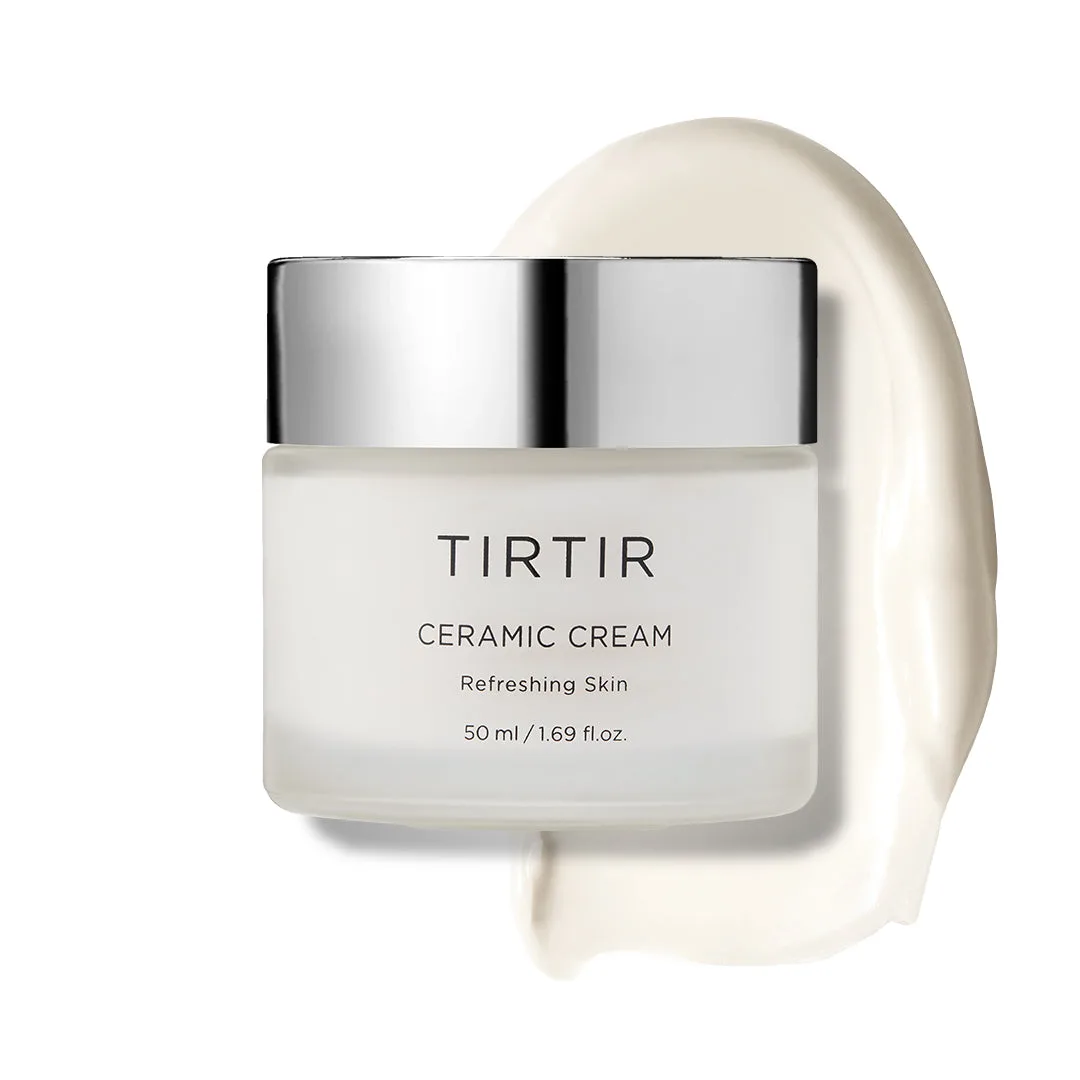
This is one of the few K-beauty barrier creams under $30 that combines two identical-to-skin ceramides with polyglutamic acid and a multi-extract botanical complex in a rich emollient base — the formulation reads like a more thoughtful version of the standard 'ceramide cream' that most brands launch with token concentrations. The combined ceramide level (around 0.25-0.45%) is meaningfully higher than typical drugstore ceramide moisturizers.
TIRTIR Ceramic Cream is one of the more thoughtfully formulated K-beauty barrier creams in the under-$30 tier — a rich, glossy moisturizer with two identical-to-skin ceramides, polyglutamic acid, and a multi-extract botanical complex that delivers genuine glass-skin finish. Best for dry, normal, or barrier-compromised skin; too rich for most oily users (try the Light version). The post-viral price bump stings, but the formula earns its slot.
TIRTIR is a younger label than the K-beauty mainstays, so the roughly 4,500 retailer reviews and the formula's ingredient profile carry most of the weight here. What thins out at this brand age is independent, long-horizon dermatologist commentary — the score leans on real-world feedback more than clinical literature.
Verdicts
How well it fits each concern
Verdict by concern tap a concern for the case
Good choicefor DrynessIn your profileYou chose · Ceramides is a reference standard by mechanism for dryness; this cream carries it at 0.25%.Moderate evidenceGentleNo reviews collected yet
The case for it
Ceramide NP + Ceramide 3 has trial-supported standing for this concern.
It is present at an effective concentration, declared or high in the ingredient list.
The formula carries none of the triggers this concern is sensitive to.
Same rule for everyone. “Good choice” is the verdict on 9,564 of 45,024 concern verdicts across the catalog; rule R5 decided 9,072 of them.
Unchanged since September 5, 2026, engine 5.1.1.
R5 — Trial-supported or guideline-supported active, adequately or plausibly dosed. · the full register
Carrying active
Ceramide NP + Ceramide 3
Standing
supported — its mechanism is established
Form
adequate (declared 0.25%)
Tolerability
gentle
Row checked
against its sources on July 17, 2026 (evidence table ev-2026.09-r228)
The studies behind the evidence row
Elias PM, Feingold KR (eds), Skin Barrier — stratum corneum ceramides are the principal intercellular lamellar lipid; their depletion is the biochemical signature of dry/xerotic skin — reference work
Supporting rolefor DehydrationIn your profileYou chose · Nothing here targets dehydration directly; humectant hydration is the recognised companion to treating it, and this cream does that without known triggers.Not yet assessedGentleNo reviews collected yet
The case for it
Beeswax has no evidence row yet for this concern — it is in the research queue.
The formula carries none of the triggers this concern is sensitive to.
What would change this: A researched evidence row for the lead active would replace this with a verdict.
Same rule for everyone. “Supporting role” is the verdict on 8,197 of 45,024 concern verdicts across the catalog; rule R8 decided 4,250 of them.
Unchanged since September 5, 2026, engine 5.1.1.
R8 — The category's job (barrier care, humectant hydration, gentle cleansing, photoprotection) is the documented supportive role for this concern. This is the honest verdict for a moisturizer on an acne page. · the full register
Supporting rolefor Compromised Skin BarrierIn your profileYou chose · Ceramides is a reference standard by mechanism for compromised skin barrier, but this cream carries it below the studied range — a supporting role at best.Moderate evidenceStandard tolerabilityNo reviews collected yet
The case for it
Ceramide NP + Ceramide 3 has trial-supported standing for this concern.
It is present below the studied range.
The formula carries no trigger this concern is sensitive to, with the cautions noted.
Cautions: known irritants.
What would change this: A concentration inside the studied range would raise this a step.
Same rule for everyone. “Supporting role” is the verdict on 8,197 of 45,024 concern verdicts across the catalog; rule R7 decided 258 of them.
Unchanged since September 5, 2026, engine 5.1.1.
R7 — A supported active under-dosed cannot be recommended for the concern; if the category has a supportive job it may still help alongside treatment. · the full register
Carrying active
Ceramide NP + Ceramide 3
Standing
supported — its mechanism is established
Form
sub threshold (declared 0.25%) — studied range 0.5–1%, from the trials on the row; needs leave-on contact; judge it after ~4 weeks
Tolerability
standard — irritant load
Row checked
against its sources on July 17, 2026 (evidence table ev-2026.09-r228)
The studies behind the evidence row
Elias PM, Skin Barrier / Coderch et al., ceramides and skin barrier function — ceramides ~50% of SC intercellular lipid mass, essential to the permeability barrier — reference work
Supporting rolefor SensitivityIn your profileYou chose · Mostly gentle: known irritants — usable for sensitive skin with a patch test.Not yet assessedStandard tolerabilityNo reviews collected yet
The case for it
Centella Asiatica Extract has been researched for this concern and the evidence does not support it.
It is plausibly present at a working level, though the concentration is not declared.
The formula carries no trigger this concern is sensitive to, with the cautions noted.
Cautions: known irritants.
What would change this: A declared concentration would move this to a firmer reading of the dose.
Same rule for everyone. “Supporting role” is the verdict on 8,197 of 45,024 concern verdicts across the catalog; rule F3 decided 183 of them.
Unchanged since September 5, 2026, engine 5.1.1.
Supporting rolefor AgingIn your profileYou chose · Nothing here targets aging directly; hydration and barrier support is the recognised companion to treating it, and this cream does that without known triggers.Not yet assessedGentleNo reviews collected yet
The case for it
Beeswax has no evidence row yet for this concern — it is in the research queue.
The formula carries none of the triggers this concern is sensitive to.
What would change this: A researched evidence row for the lead active would replace this with a verdict.
Same rule for everyone. “Supporting role” is the verdict on 8,197 of 45,024 concern verdicts across the catalog; rule R8 decided 4,250 of them.
Unchanged since September 5, 2026, engine 5.1.1.
R8 — The category's job (barrier care, humectant hydration, gentle cleansing, photoprotection) is the documented supportive role for this concern. This is the honest verdict for a moisturizer on an acne page. · the full register
Supporting rolefor Winter SkinIn your profileYou chose · Nothing here targets winter skin directly; occlusive hydration is the recognised companion to treating it, and this cream does that without known triggers.Not yet assessedGentleNo reviews collected yet
The case for it
Beeswax has no evidence row yet for this concern — it is in the research queue.
The formula carries none of the triggers this concern is sensitive to.
What would change this: A researched evidence row for the lead active would replace this with a verdict.
Same rule for everyone. “Supporting role” is the verdict on 8,197 of 45,024 concern verdicts across the catalog; rule R8 decided 4,250 of them.
Unchanged since September 5, 2026, engine 5.1.1.
R8 — The category's job (barrier care, humectant hydration, gentle cleansing, photoprotection) is the documented supportive role for this concern. This is the honest verdict for a moisturizer on an acne page. · the full register
Excellent at the jobDoes what a moisturizer is for, on every measure we can take from the label: supplies barrier lipids, draws in water.
A verdict is DermApproved’s assessment of how well a product’s ingredients fit a concern — never a claim about what the product treats. Evidence dots and collected reviews sit beside it and are never blended in.
Rules 0.5.1 · evidence table ev-2026.09-r228 · how we decide
Assessment
Pros & Cons
Pros
✓ Two identical-to-skin ceramides at meaningful cosmetic concentration
✓ Polyglutamic acid adds a layered humectant story beyond standard hyaluronic acid
✓ Centella asiatica and botanical complex support reactive skin
✗ Post-viral price increases have eroded the original value proposition
Review
Full Review
It's tempting to dismiss any K-beauty product that goes viral on TikTok as a hype play with a thinner formulation than the marketing implies. TIRTIR earned that reputation in 2023 when its Mask Fit Red Cushion exploded on Beauty TikTok and the brand became one of the most-searched Korean labels on Sephora's wishlist tracker. What makes the Ceramic Cream interesting is that it actually predates the viral wave by three years — TIRTIR launched it in 2020, well before international skincare communities knew the brand existed, and it was already a quietly well-regarded product among Korean skincare enthusiasts before it caught the attention of the Western audience. When the brand became famous overnight in 2023, the Ceramic Cream came along for the ride, and reading the formulation now, the fundamentals hold up better than the post-viral pricing might lead you to expect.
The ceramide story is the formula's real headline. Two identical-to-skin ceramides — Ceramide NP and Ceramide 3 — sit at the very bottom of the INCI but at concentrations that ingredient databases estimate around 0.25 to 0.45% combined. That's meaningfully higher than the token ceramide inclusions you find in most under-$30 moisturizers, which often contain a single ceramide at trace levels meant to qualify the product for ceramide-based marketing without delivering meaningful barrier-repair benefits. TIRTIR's positioning is closer to the prestige tier in this respect — not as high as some specialized barrier creams, but well into the range where the ceramides are doing real work alongside the rest of the emollient system. Paired with shea butter, macadamia oil, and olive oil as supporting lipids, the formula reads like a thoughtful attempt at modern barrier-repair chemistry rather than a marketing exercise.
The second ingredient story is polyglutamic acid, a peptide-based humectant that's been gaining attention in K-beauty over the last few years as an alternative or complement to hyaluronic acid. The pitch on polyglutamic acid is real: gram for gram, it holds significantly more water than hyaluronic acid and forms a thin protective film on the skin surface that helps lock in moisture from the layers below. In practice, what this means for the Ceramic Cream is that the hydration delivered by the glycerin, butylene glycol, and trehalose at the top of the INCI gets sealed in by both the silicone-shea-beeswax occlusive system and the polyglutamic acid film — a multi-layered approach to moisture retention that gives the cream its characteristic glossy 'glass skin' finish on first application.
The botanical complex is more of a brand-signature inclusion than a treatment story. Centella asiatica, licorice root, green tea, rosemary, chamomile, baicalin, and a few others are dosed at the supporting-cast level — they contribute mild antioxidant and soothing effects, particularly for users who layer this cream over compromised or post-active skin, but they're not delivering measurable treatment benefits at these concentrations. The exception is the centella, which is high enough on the list to do meaningful soothing work, and which is well-supported by Korean dermatological research as a barrier-supportive ingredient.
The texture is exactly what the 'ceramic' name suggests. It's rich, cushiony, and substantial when you scoop it out of the jar — closer to a cold cream than a gel — and it melts into the skin within thirty seconds to a minute, leaving a noticeably glossy finish. For dry, normal, or barrier-compromised skin, this is genuinely lovely; the cream cocoons without smothering, and you wake up with skin that feels comfortable rather than tight. For oily skin, it's too heavy. The combination of shea butter, beeswax, olive oil, and isopropyl myristate is a recipe for trapped sebum and potential congestion in users prone to either, and the comedogenic ingredient flags on this formula are real. TIRTIR makes a Ceramic Cream Light version that strips out the heavy emollients and reformulates the same ceramide and polyglutamic acid story into a gel-cream base — that's the version to choose if your skin runs oily or if you live somewhere humid.
The packaging is the formula's biggest unforced weakness. It comes in a frosted glass jar with a screw lid — beautiful aesthetically but non-airless, which means the ceramides and polyglutamic acid will degrade faster than they would in a pump or tube format. For a product whose entire pitch is meaningful active concentrations of barrier-repair ingredients, the choice to put it in a jar is at odds with the formulation goals. Use clean fingers or a spatula, keep the lid screwed tight, and finish the jar within eight months of opening rather than stretching it to the twelve-month PAO marker. This is a product that rewards quick consumption.
The value math is more complicated than it used to be. TIRTIR has gradually raised prices across its lineup since the 2023 viral wave, and the Ceramic Cream has crept up alongside the rest. At $25 for 50ml, the per-ml cost is reasonable for a K-beauty cream with this active profile but not as compelling as it was at the brand's pre-viral pricing. Compared to CeraVe Moisturizing Cream (significantly cheaper, ceramide-rich, fragrance-free, but with petroleum derivatives and a more clinical texture), TIRTIR offers a more sensorially pleasing experience and a more sophisticated supporting-ingredient story at roughly twice the per-ounce cost. Compared to prestige K-beauty barrier creams from Sulwhasoo or Tatcha at $60-90, TIRTIR is the value option with a meaningful share of the formulation quality. Where it lands in your personal calculus depends on how much you value sensory experience and the K-beauty botanical aesthetic vs raw per-dollar barrier repair.
The brand context is worth acknowledging honestly. TIRTIR is still a relatively young company with a limited independent clinical track record on individual products. The brand has built credibility through volume of users and through the technical quality of its formulations, but it doesn't have the decades of dermatological research behind it that legacy K-beauty brands like Sulwhasoo or Innisfree can point to. The Ceramic Cream is one of the brand's stronger formulations and is well-validated by user feedback at this point, but the data confidence here is medium — we have a few years of real-world experience to draw on, not the twenty years that would let us say definitively how this formula performs across different populations and conditions over time.
Who this is for: dry, normal, or barrier-compromised skin types looking for a K-beauty barrier cream with meaningful ceramide content and a glossy glass-skin finish. Particularly good for fall and winter use, post-active recovery, and reactive skin needing soothing. Who it isn't for: oily or acne-prone skin (try the Light version or a different category entirely), shoppers who need airless packaging for active stability, vegan-only routines (contains beeswax), and budget-conscious shoppers who can spend less on CeraVe and get most of the same barrier benefits.
Formula
Key Ingredients
The hero actives that drive this product's performance.
The brand-identity ingredients — two identical-to-skin ceramides paired together at meaningful cosmetic concentration. They sit at the very bottom of the INCI but at higher concentrations than the typical token ceramide gesture, working alongside the shea butter and macadamia oil to rebuild the lipid matrix of compromised barriers.
Established mechanismfor Dryness · established mechanism
A peptide-based humectant that holds significantly more water per molecule than hyaluronic acid — it forms a thin film on the skin that locks in moisture and works synergistically with the ceramide complex to give this cream its 'glass skin' finish.
The K-beauty soothing standby — provides anti-inflammatory and barrier-supporting effects that complement the ceramide repair story. Particularly relevant for users dealing with sensitivity or post-active redness.
A protective sugar humectant with documented evidence for stabilizing membrane proteins under dehydration stress — it pairs with glycerin and betaine to deliver layered hydration without leaving a heavy or greasy finish.
The primary occlusive in the formula's emollient system — it provides the cushiony, cocoon-like skin feel that the 'ceramic' name evokes, and it's the reason this cream is rich enough for genuinely dry skin without feeling petroleum-jelly heavy.
Established mechanismfor Dryness · established mechanism
A natural occlusive that adds film-forming protection on top of the silicone and shea butter system — it's part of the reason this cream stays put through the night and works well as a final protective layer.
Not yet assessed
Ingredient standings describe the active at treatment-level doses and
vehicles; this product's own condition grades weigh its actual formula.
Apply as the final hydration step after serums and treatments. The rich texture pairs particularly well with watery essences and lighter serums underneath. Can be layered as a sleeping mask on extra-dry nights.
Results Timeline
Immediate plumping and a glossy 'glass skin' finish from first use. Visible barrier improvement (less reactivity, reduced winter dryness) within 2-3 weeks. Full ceramide-driven barrier repair benefits emerge over 4-8 weeks of consistent use.
This formula's strongest evidence base is the ceramide complex. Ceramides are structural lipids that make up roughly 50% of the intercellular matrix in healthy stratum corneum, and their depletion is one of the central mechanisms in barrier dysfunction across conditions like atopic dermatitis, dry skin, and aging. Peer-reviewed research on ceramide replacement has consistently shown that topical application of identical-to-skin ceramides — particularly when delivered alongside cholesterol and free fatty acids in physiologic ratios — can support barrier repair and reduce transepidermal water loss. The Elias barrier model, which has guided ceramide-based formulation design for over two decades, suggests that the most effective barrier-repair products use multiple ceramide subtypes rather than relying on a single ceramide at higher concentration. TIRTIR's pairing of Ceramide NP and Ceramide 3 follows this principle, even if the absolute concentrations are modest compared to medical-grade barrier-repair products.
Polyglutamic acid is a more recently characterized cosmetic ingredient with a growing but still emerging evidence base. It's a peptide polymer derived from fermented soybeans, and its primary cosmetic claim is significantly higher water-binding capacity per molecule than hyaluronic acid. In vitro and small clinical studies have shown that polyglutamic acid can form a thin film on the skin surface and contribute to short-term hydration, particularly when paired with other humectants. The strongest evidence is for its film-forming and humectant effects rather than for any direct cellular activity, which positions it as a hydration-system component rather than a treatment active.
Centella asiatica has well-developed evidence for its anti-inflammatory and barrier-supportive effects in topical use. Asiaticoside and madecassoside, the two main pentacyclic triterpenoids in centella, have been studied extensively in the Korean dermatological literature and are widely incorporated into K-beauty barrier-repair products. Research has shown them to support fibroblast proliferation, collagen synthesis, and anti-inflammatory activity at concentrations achievable in cosmetic formulations.
The supporting humectants — glycerin, butylene glycol, betaine, trehalose — are all well-studied for their hydration effects, with glycerin being the most extensively characterized. Trehalose has additional documented evidence for protein stabilization under dehydration stress, which is particularly relevant for compromised skin.
The rich emollient system (shea butter, beeswax, olive oil, macadamia oil, isopropyl myristate) provides the occlusive component of the moisturization story. These ingredients are well-established in cosmetic chemistry, but several carry comedogenic potential for acne-prone users — a real consideration that tempers the formula's universality.
Dermatologist Perspective
Dermatologists frequently recommend ceramide-rich moisturizers as foundational therapy for patients with dry skin, atopic dermatitis, eczema, and barrier dysfunction. Clinicians generally consider products with multiple identical-to-skin ceramides at meaningful concentrations to be more effective than single-ceramide token formulations, which positions TIRTIR Ceramic Cream favorably within the K-beauty barrier-cream category. The standard professional caution is around the comedogenic ingredients (isopropyl myristate, olive oil, beeswax) for patients with active acne or fungal acne, which can contribute to congestion and breakouts in susceptible users. Dermatologists managing those patients often recommend the Light version or a different formulation entirely. For dry, sensitive, or barrier-compromised patients without acne concerns, the formula is typically well-tolerated and a reasonable mid-tier K-beauty choice, with the caveat that the non-airless jar packaging is suboptimal for active stability and the brand's relatively short track record means longer-term confidence is still building.
Guidance
Usage & Recommendations
How to Use
Apply twice daily as the final hydration step, after cleansing, toning, and any treatment serums. Scoop a pea-sized amount onto clean fingers (or a spatula to protect the non-airless jar), warm between fingertips, and press into damp skin in upward motions. For extra-dry nights, layer a slightly thicker application as a sleeping mask. Pair particularly well with watery essences and lighter serums underneath — the cream traps the water-soluble actives against the skin while delivering its own ceramide and polyglutamic acid story.
Value Assessment
At $25 for 50ml, this works out to about $0.50 per ml — reasonable for a K-beauty barrier cream with this ceramide and polyglutamic acid profile, but not the bargain it was at the brand's pre-2023 pricing. Compared to CeraVe Moisturizing Cream (significantly cheaper, ceramide-rich, but more clinical and fragrance-free without the K-beauty botanical aesthetic), TIRTIR offers a more sensorially pleasing experience at roughly twice the per-ml cost. Compared to prestige K-beauty barrier creams at $60-90, TIRTIR is the smarter value choice with a meaningful share of the formulation quality. The 100ml size offers slightly better per-ml value for committed daily users, but the jar packaging means buying smaller and finishing faster is the right move for active stability. Where this lands in your personal calculus depends on how much you value the K-beauty experience and the supporting botanical complex over raw per-dollar barrier-repair efficacy.
Who Should Buy
Dry, normal, or barrier-compromised skin types wanting a K-beauty barrier cream with meaningful ceramide content and a glossy glass-skin finish. Particularly excellent for fall and winter use, post-active recovery, and sensitive skin needing soothing.
Who Should Skip
Oily or acne-prone skin (try the Ceramic Cream Light or a different category entirely), vegan routines (contains beeswax), users needing airless packaging for active stability, and budget-conscious shoppers — CeraVe Moisturizing Cream offers comparable barrier benefits at roughly half the price.
Rich, cushiony cream that melts into a glossy, dewy finish
Scent
Fragrance-free with a faint clean ingredient note
Packaging
50ml white frosted glass jar with screw lid
Finish
dewyglowyvelvetynon-greasy
What to Expect on First Use
First application feels rich and substantial — the cream sinks in within a minute, leaving skin with a noticeably glossy 'glass skin' finish. Some users notice immediate plumping. No tingling, no purging. Pairs especially well over watery essences.
TIRTIR launched in South Korea in 2018 with the Mask Fit Cushion as its flagship product. The Ceramic Cream debuted in 2020 as the brand's first major skincare extension beyond base makeup, designed to deliver the 'glass skin' finish that was central to TIRTIR's identity in a treatment moisturizer format. The brand gained significant international attention in 2023 when its Red Cushion went viral on TikTok, which carried over to growing visibility for the rest of the lineup.
About TIRTIR Established Brand (5–20 years)
TIRTIR launched in South Korea in 2018 and gained significant international visibility starting in 2023 through TikTok virality of its Mask Fit Red Cushion. The brand's formulations use well-studied K-beauty ingredients but the company has a relatively short track record and limited independent clinical validation of specific products.
Brand founded: 2016 · Product launched: 2020
Myth vs. Reality
Common Myths
Myth
You only need ceramides if your skin is dry
Reality
All skin types benefit from ceramides for barrier maintenance — they're a structural component of healthy skin regardless of oiliness. The texture of this specific cream is too rich for oily skin, but ceramides themselves are universally relevant.
Myth
Polyglutamic acid is just a marketing version of hyaluronic acid
Reality
They're chemically distinct. Polyglutamic acid is a peptide-based humectant that holds significantly more water per molecule than hyaluronic acid and forms a thin film on the skin surface, which is why the two are often combined for layered hydration rather than used as substitutes.
FAQ
Frequently Asked Questions
Does TIRTIR Ceramic Cream really contain meaningful ceramides?
Yes — at approximately 0.25-0.45% combined Ceramide NP and Ceramide 3, the concentration is meaningfully higher than most token ceramide inclusions in drugstore moisturizers. It's not at prescription-tier ceramide concentrations, but it's well within the cosmetic effective range.
Is it good for oily skin?
Not the best fit. The rich emollient base (shea butter, beeswax, olive oil, isopropyl myristate) makes this cream too heavy for most oily skin types. TIRTIR also makes a Ceramic Cream Light version that's better suited to combination and oily skin.
Can sensitive skin tolerate Ceramic Cream?
Yes, generally. The fragrance-free formulation, centella asiatica, and ceramide complex make it well-tolerated by reactive skin. The only concerns are the comedogenic ingredients for acne-prone users and the beeswax for users with bee product allergies.
How does it compare to CeraVe Moisturizing Cream?
Different positioning. CeraVe is fragrance-free, jar-packaged, ceramide-rich, and significantly cheaper — but uses petroleum derivatives and a more clinical texture. TIRTIR is K-beauty styled with botanical extracts, polyglutamic acid, and a glossier 'glass skin' finish, but at roughly twice the per-ounce cost.
What's the difference between the original and the Light version?
The Ceramic Cream Light reformulates the same ceramide and polyglutamic acid hero ingredients into a lighter gel-cream base without the heavy shea butter and beeswax — better for combination and oily skin types who want the active story without the rich texture.
Is Ceramic Cream pregnancy-safe?
Yes. The formula contains no retinoids, no salicylic acid, and no other actives on standard pregnancy-caution lists.
Why did the price go up after it went viral?
TIRTIR's overall brand visibility increased significantly after the Red Cushion's TikTok virality in 2023, and the brand has gradually adjusted prices across its lineup as international demand grew. The Ceramic Cream is one of the products affected by this gradual repricing.
Reviews
What Reviewers Tend to Say
Recurring themes our editors read across retailer reviews of this product — summaries in our words, not quotations, and not a substitute for your own patch test.
That headline is the story every brand tells about trehalose. It is also, as of a 2017 paper in Molecular Cell, not quite true — which turns out to be the most interesting thing about the ingredient.
Topically, the molecule the argument tells you to avoid is one the stratum corneum is structurally built from — and in acne-prone skin the documented finding is a shortage of it.
Natural formulators swap shea, cocoa, mango and murumuru as though they were interchangeable. One carries roughly ten times the non-fat material of the others, and one is functionally a wax.
Aug 28, 2026· 9 min
Questions people ask about sensitive skin
Verified answers from our questions library — the nuance a product page cannot carry.
Products, answers, therapy guides, tools and articles in one search. Brand names,
slang and abbreviations all work — accutane finds isotretinoin, bacne finds truncal acne.