



Peptides: Signal, Carrier, Copper — Which Ones Actually Do Anything?
'Peptides' is one word standing in for a dozen unrelated molecules with wildly different evidence — most serums are hope in a bottle, but a few classes earn their place.
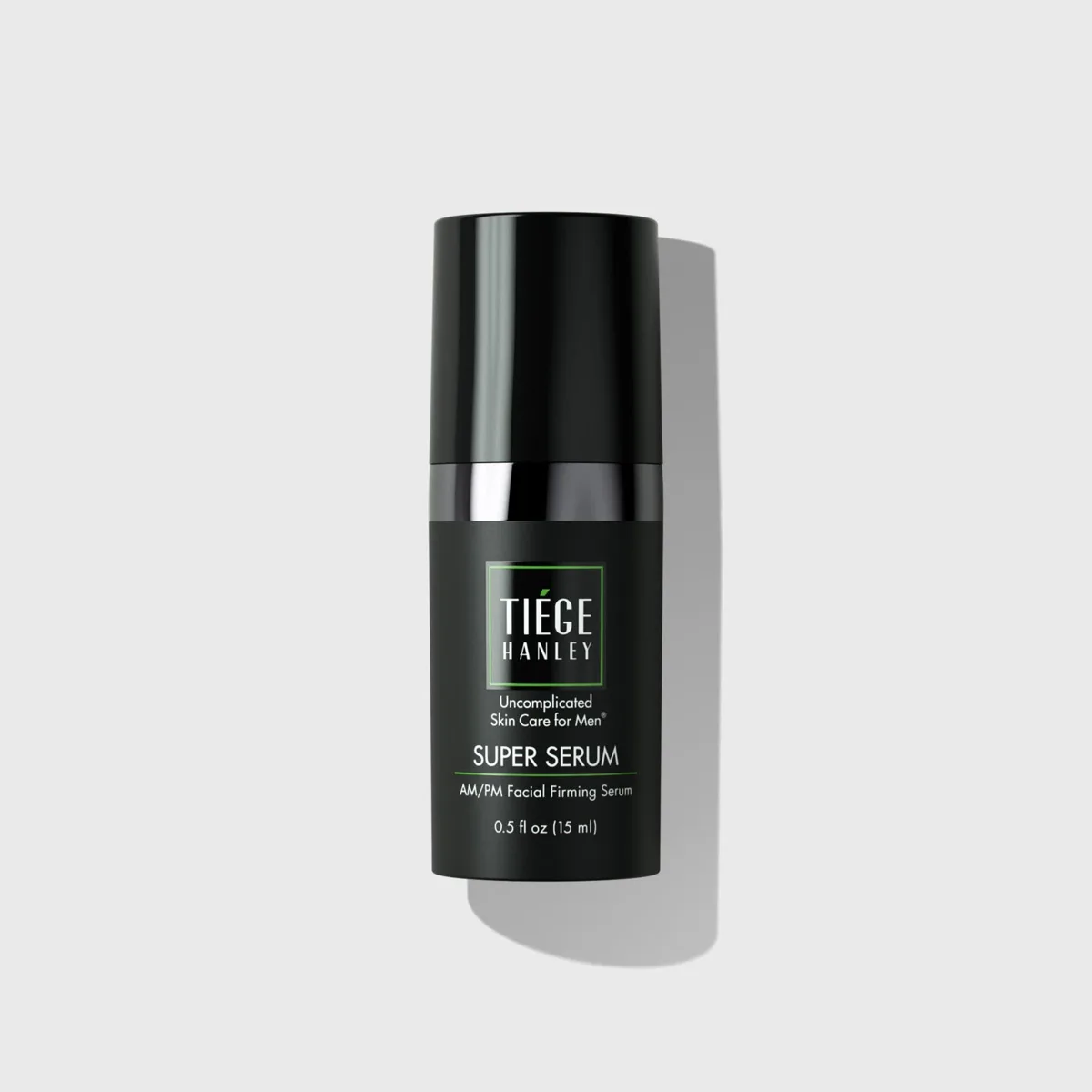
This is one of the only mass-market men's anti-aging serums distributed via a subscription model targeting men who explicitly don't want to think about skincare. It's not the strongest formula in any single category, but it slots into the Tiege Hanley routine system in a way that single-product purchases don't.
Tiege Hanley Super Serum is a pleasant, gentle, well-tolerated men's anti-aging serum that's better at being convenient than at being effective. The retinyl palmitate is the weakest active form on the market, the peptides sit at the very bottom of the INCI where they can't deliver the Botox-like effects the marketing implies, and at $30 for 0.5 oz the per-ounce math doesn't favor anyone shopping for results. It earns its slot in the Tiege Hanley routine system more than it earns its price tag.
The case for it
What would change this: A declared concentration would move this to a firmer reading of the dose.
Same rule for everyone. “Good choice” is the verdict on 9,564 of 45,024 concern verdicts across the catalog; rule R5 decided 9,072 of them. Unchanged since September 5, 2026, engine 5.1.1.
Brand or formulator? Disclose a concentration or correct a fact →
The studies behind the evidence row
Also listed for Aging and Rough Texture — the actives here (Hyaluronic Acid, Retinyl Palmitate, Argireline (Acetyl Hexapeptide-8) are in our research queue for those concerns; there is no verdict until their evidence rows are written. That is a gap in our table, not a mark against the product.
A verdict is DermApproved’s assessment of how well a product’s ingredients fit a concern — never a claim about what the product treats. Evidence dots and collected reviews sit beside it and are never blended in. Rules 0.5.1 · evidence table ev-2026.09-r228 · how we decide
Tiege Hanley built an empire on a specific insight: most men don't want to think about skincare. They want a brown box delivered to their door with a numbered routine printed on it, and they want to follow steps one through five without doing any research, comparing any ingredients, or learning what an INCI list is. The brand's co-founder Aaron Marino, who built a YouTube following as a men's grooming personality, has been remarkably honest about this positioning over the years — the company's value isn't in clinical formulation, it's in removing the cognitive load of skincare for an audience that finds the entire category alienating. By that standard, Tiege Hanley has been wildly successful, with over 600,000 subscribers and a recurring revenue model that most indie skincare brands would kill for.
The Super Serum is the brand's anti-aging step, added to the lineup in 2017 as the fifth box in the routine system. It's marketed around three claims: peptides for wrinkle reduction, retinyl palmitate for cell turnover, and hyaluronic acid for hydration. All three claims are technically true in the sense that those ingredients are present in the formula, but the actual dosing tells a more complicated story than the marketing language suggests. Acetyl hexapeptide-8 (Argireline) and pentapeptide-18 — the two 'Botox-like' peptides the brand emphasizes — sit at positions 25 and 26 on a 26-ingredient INCI, below preservatives, below pH adjusters, below extracts that are themselves at minor concentrations. At those positions on the ingredient list, the peptides are functionally trace inclusions, not active doses.
The research on Argireline is itself worth being honest about. There are some small, often industry-funded studies showing minor effects on muscle contraction signaling at higher concentrations — the kind of data that supports a claim like 'shown to reduce wrinkle appearance' in cosmetic regulatory contexts but doesn't translate to anything resembling injectable Botox results. Even at peak concentrations in well-formulated peptide serums, Argireline's real-world effect on facial wrinkles is mild and slow. At the trace concentration in this Tiege Hanley formula, the effect is essentially indistinguishable from no peptide at all. The marketing language overpromises what the formula can deliver, and that's the central honesty problem with this product.
The retinyl palmitate is a similar story. Of all the retinoid forms used in cosmetics, retinyl palmitate is the weakest — it has to be converted twice in the skin (first to retinol, then to retinoic acid) before becoming biologically active, and the conversion is inefficient at every step. The effective dose at the cellular level after two conversions is a small fraction of what a comparable retinol serum delivers, and a tiny fraction of what prescription tretinoin (which is already retinoic acid, no conversion required) provides. It's a 'starter retinoid' in the sense that it's gentle enough for beginners and unlikely to cause irritation or purging — but the gentleness comes from the fact that not much is happening at the cell level. For experienced retinoid users, this is a downgrade. For complete beginners, it's a reasonable on-ramp but you'll want to graduate within months, not years.
Where the formula does work is the supporting cast. The hyaluronic acid (sodium hyaluronate) provides genuine immediate hydration — you'll feel your skin smoother and slightly plumper from the first application. The jojoba oil and the carefully chosen lightweight emollients give the serum a pleasant fluid texture that absorbs quickly without leaving a greasy or sticky residue, which is important for the male audience the brand serves (men who reflexively associate skincare with 'goopy' tend to abandon products that feel anything other than fast-absorbing). The fragrance-free formulation is an honest plus. So is the smooth dropper application and the easy fit into a 60-second routine. As a daily moisturizing serum that won't cause problems and slots cleanly into a beginner skincare habit, this works fine.
As an anti-aging serum that delivers visible results, this doesn't work very well. Eight to twelve weeks of consistent nightly use will give you mild improvements in skin smoothness and possibly a slightly more even tone — the kind of changes that come more from the consistent moisturizing routine itself than from any specific active in the bottle. For dramatic anti-aging effects, you'd need a true retinol serum (Paula's Choice 1% Retinol, The Ordinary Granactive Retinoid 2%, or any number of comparable options at lower price points), or a prescription retinoid from a dermatologist. Either of those will outperform this serum substantially while costing less per ounce.
The value math is the second honest problem. At $30 for 0.5 ounces, the per-ounce cost is approximately $60, which puts this in prestige skincare territory for a formulation that's genuinely beginner-tier. CeraVe Resurfacing Retinol Serum runs about $20 for a full ounce of true encapsulated retinol; The Ordinary Granactive Retinoid 2% Emulsion is about $10 for a full ounce of a well-tolerated, modern retinoid form. Both of these will deliver more measurable anti-aging results than the Tiege Hanley Super Serum at a fraction of the price. The premium you're paying with Tiege Hanley isn't for the formulation — it's for the brown box, the numbered routine, the subscription convenience, and the fact that you don't have to think about which product to buy. For some users, that convenience is genuinely worth the markup; for users who care about results, the math is hard to defend.
The brand context matters too. Tiege Hanley has been transparent that their target customer is the man who doesn't shop skincare as a hobby and isn't going to compare ingredient lists. The brand's value proposition is the routine system, not the individual product chemistry. Within that ecosystem, the Super Serum makes sense — it's the gentle anti-aging step that doesn't require any user effort to incorporate, and it pairs well with the rest of the line. As a standalone purchase or as a recommended buy for someone who's already in skincare communities and shopping for results, it's not where I'd send anyone.
Who this is for: Tiege Hanley subscribers who want an anti-aging step that fits the routine system, complete skincare beginners who want a gentle starter retinoid in a fragrance-free format, and men who specifically value subscription convenience and brand simplicity over per-dollar formulation strength. Who it isn't for: anyone with retinoid experience, anyone who shops actives by INCI position, pregnant or breastfeeding users, and shoppers who want results-per-dollar performance from their anti-aging serum.
The hero actives that drive this product's performance.
| Ingredient | Function | Evidence |
|---|---|---|
| Acetyl Hexapeptide-8 (Argireline) | The marketing centerpiece of the formula — Argireline is positioned at the very end of the INCI, which is structurally meaningful because it sits below preservatives and below where peptide concentrations would need to be to deliver clinical results. It's here for the label, not for the wrinkle-reducing claims. | Not yet assessed |
| Pentapeptide-18 | Paired with Argireline as the second 'Botox-like' peptide claim. Same positioning issue — at the bottom of the INCI, the concentration is too low to expect the clinical effects the brand markets. | Not yet assessed |
| Retinyl Palmitate | The weakest of the retinoid ester family — it must be converted twice in the skin (to retinol, then to retinoic acid) before becoming biologically active, which means the effective dose at the cell level is a small fraction of what's applied. Acceptable as a gentle 'starter retinoid' but not a meaningful anti-aging active for experienced users. | Not yet assessed |
| Sodium Hyaluronate | Provides the actual hydration in this serum — sitting near the bottom of the INCI but doing more functional work than the headline peptides. It's the ingredient most users will notice the effect of in the first week. | Established mechanism for Dehydration · established mechanism |
| Jojoba Seed Oil | A lightweight emollient that gives the serum its smooth-application feel without obvious greasiness — chosen because it's well-tolerated by male skin types that historically resist heavier facial oils. | Not yet assessed |
Ingredient standings describe the active at treatment-level doses and vehicles; this product's own condition grades weigh its actual formula.
Water, Glycerin, Sodium Polystyrene Sulfonate, Isopropyl Palmitate, Beheneth-5, Polyglyceryl-3 Stearate, Simmondsia Chinensis (Jojoba) Seed Oil, Phenoxyethanol, Caprylyl Glycol, Cetearyl Olivate, Xanthan Gum, Sorbitan Olivate, Retinyl Palmitate, Acrylates/C10-30 Alkyl Acrylate Crosspolymer, C32-36 Isoalkyl Stearate, Zea Mays (Corn) Oil, Trisodium Ethylenediamine Disuccinate, Camellia Sinensis Leaf Extract, Prunus Armeniaca (Apricot) Fruit Extract, Sodium Hydroxide, Sodium Hyaluronate, Citric Acid, Potassium Sorbate, Sodium Benzoate, Acetyl Hexapeptide-8, Pentapeptide-18
serum
PM
Apply at night after cleansing and toning, before moisturizer. Avoid layering with strong AHAs or BHAs in the same routine — the retinyl palmitate is gentle but can still compound with other actives.
Immediate hydration and a smoother skin feel from the hyaluronic acid and jojoba oil. Visible benefits to fine lines and texture from the retinyl palmitate are slow and modest — typically 8-12 weeks at minimum, and considerably less dramatic than what a true retinol or prescription tretinoin delivers.
This formula's science section is largely about the gap between marketing language and ingredient dosing. Acetyl hexapeptide-8 (Argireline) is a synthetic peptide that has been studied for its effect on the SNARE complex involved in neurotransmitter release at neuromuscular junctions. Some in vitro and small in vivo studies have shown that Argireline can modestly reduce muscle contraction signaling, leading to the 'topical Botox' marketing language used across the cosmetic peptide category. The clinical reality is more limited: the studies showing meaningful wrinkle reduction have used Argireline at concentrations of 5-10%, while typical cosmetic formulations contain 0.05-0.5%. At the position Argireline sits in the Tiege Hanley INCI (second to last, below preservatives), the concentration is well below the level even the optimistic studies have used.
Pentapeptide-18 (Leuphasyl) is a similarly positioned cosmetic peptide marketed as a complement to Argireline. The research base is even thinner, with mostly manufacturer-funded studies and small sample sizes. Like Argireline, the clinical reality at cosmetic-typical doses is far less impressive than the marketing language suggests, and at the very bottom of an INCI, the practical effect is essentially negligible.
Retinyl palmitate is the most extensively studied of the cosmetic retinoid esters. Peer-reviewed dermatology research has consistently shown that retinyl palmitate's biological activity is significantly lower than retinol's, which is itself lower than retinoic acid's (the prescription form). The conversion efficiency from retinyl palmitate to retinoic acid in human skin is poor, with most studies suggesting that gram-for-gram, retinyl palmitate delivers less than 10% of the cellular activity of retinol. For users who can't tolerate stronger retinoid forms, this can be a useful starter — but for users seeking measurable anti-aging results, it's an underpowered choice.
The supporting cast is more straightforward. Sodium hyaluronate is well-studied for its humectant effects and immediate skin plumping. Jojoba seed oil has solid evidence for its emollient and barrier-supporting properties. These ingredients are doing real work in the formula, even if they're not the marketing focus.
For pregnancy safety, all retinoids — including retinyl palmitate — are generally recommended to be avoided during pregnancy and breastfeeding by major dermatology associations, even though the systemic absorption from topical use is low.
Dermatologists generally view retinyl palmitate as the gentlest cosmetic retinoid form, suitable as a starter for patients who haven't used retinoids before and who are nervous about irritation. Dermatology practitioners typically recommend that patients seeking real anti-aging results graduate to a true retinol formulation within a few months of starting on retinyl palmitate, or move directly to prescription tretinoin if they can tolerate it. The peptide marketing for products like this serum is a common source of professional skepticism — dermatologists generally consider Argireline and pentapeptide-18 to be cosmetically interesting but clinically underwhelming, particularly at the trace concentrations typical of mass-market formulations. For male patients specifically, dermatologists often note that consistency and routine compliance matter more than ingredient sophistication for first-time skincare users, which is the demographic Tiege Hanley serves successfully — even if the individual product chemistry is modest.
Apply 3-4 drops at night after cleansing and toning, before moisturizer. Warm between palms and press into face and neck — avoid the immediate eye area. Use only at night because retinyl palmitate, while mild, can still cause photosensitivity. Always pair with daily SPF in the morning. Skip nights when using strong AHAs or BHAs to avoid stacking actives. New users can start with every other night for the first two weeks before moving to nightly use, though this serum is gentle enough that most users won't need a ramp-up period.
At $30 for 0.5 oz, the per-ounce cost is roughly $60 — prestige skincare pricing for a beginner-formulation product. Comparable retinoid serums from CeraVe, The Ordinary, Naturium, and Paula's Choice deliver stronger active forms (true retinol or modern retinoid esters) at significantly lower per-ounce costs. For users committed to the Tiege Hanley subscription ecosystem and the convenience it provides, the markup is part of the brand experience. For users shopping standalone for anti-aging serum effectiveness, the math doesn't work — you can buy a meaningfully more effective product for half the price elsewhere. The brand's value is in the routine system and the subscription model, not in per-dollar formulation strength.
Tiege Hanley subscribers wanting an anti-aging step that fits the routine system, men new to skincare who want a gentle fragrance-free starter retinoid, and shoppers who specifically value subscription convenience over per-dollar formulation strength.
Anyone with retinoid experience (graduate to true retinol or tretinoin), pregnant or breastfeeding users, and shoppers prioritizing results-per-dollar value — comparable or better products exist at half the price.
Light, slightly milky serum with a smooth fluid finish
Fragrance-free with faint ingredient note
0.5 oz frosted glass bottle with dropper
Pleasant cool feel on application, absorbs in about a minute, leaves skin slightly softer immediately. No tingling, no purging — the retinyl palmitate is mild enough that most users won't notice any adjustment effects. The visible results, if any, develop slowly over months of consistent use.
2-3 months with nightly use of 3-4 drops
All Year
Tiege Hanley launched in 2015 as a subscription-based men's skincare brand co-founded by YouTube grooming personality Aaron Marino. The Super Serum was added to the lineup in 2017 as the brand's first dedicated anti-aging step, designed to fit into the brand's signature numbered routine system (Wash, Scrub, Eye, Moisturize, Serum) without overwhelming users new to skincare.
Tiege Hanley was founded in 2015 by Aaron Marino, Kelley Thornton, and Rob Hoxie as one of the first subscription-based men's skincare brands. The brand has built credibility through volume of customers (over 600,000 subscribers) and a focus on simple, no-nonsense routines, though formulations are pitched at the men's-grooming tier rather than clinical.
Retinyl palmitate works as well as retinol for anti-aging
Not even close. Retinyl palmitate must convert twice in the skin (to retinol, then to retinoic acid) before becoming biologically active. The conversion is inefficient, and the effective dose is a small fraction of what a comparable retinol serum delivers. It's a beginner-friendly starter, not an equivalent.
Argireline gives Botox-like results
In vitro and small-scale studies have shown Argireline can have minor effects on muscle contraction signaling, but at the low concentrations typical of cosmetic formulations (and especially at the bottom of the INCI like in this serum), the real-world effect on facial wrinkles is minimal. The 'Botox-like' marketing oversells the science substantially.
Modest hydration and texture improvements, yes. Dramatic wrinkle reduction, no. The retinyl palmitate is the weakest member of the retinoid family and the peptides sit at the very bottom of the INCI — neither is dosed strongly enough to deliver the anti-aging results the marketing implies.
Retinyl palmitate is several conversion steps removed from retinoic acid, the form your skin actually uses. The effective dose at the cellular level is a small fraction of what a comparable retinol serum delivers. It's gentle but considerably weaker.
No — even though retinyl palmitate is the weakest retinoid, dermatologists generally recommend avoiding all retinoids during pregnancy and breastfeeding. Choose a peptide-only or vitamin-C-based serum instead.
This formula is mild enough to qualify as a beginner option for users with no retinoid experience. Just be aware that the gentleness comes from a weak active form, and if you want to see meaningful anti-aging results, you'll eventually need to graduate to a true retinol or prescription tretinoin.
Yes — it's specifically designed to slot into the Tiege Hanley numbered routine system (Wash, Scrub, Eye, Moisturize, Serum) and is sold as part of multiple subscription tiers.
Hydration and skin smoothness benefits are immediate. Visible improvements to fine lines and texture from the retinyl palmitate take 8-12+ weeks of consistent nightly use, and the effects are subtle even with long-term use.
Per-ounce, it's expensive — roughly $60/oz, which is prestige tier pricing for a beginner-tier active formulation. For the convenience of the subscription model and the simplicity of the routine, some users find it worth the premium. For results-per-dollar, there are stronger and cheaper options elsewhere.
Recurring themes our editors read across retailer reviews of this product — summaries in our words, not quotations, and not a substitute for your own patch test.
smooth application
skin feels softer
easy fit into Tiege Hanley routine
subscription convenience
gentle enough for daily use
small 0.5 oz bottle
high price per ounce
no dramatic anti-aging results
peptide claims feel overstated
retinyl palmitate is weak