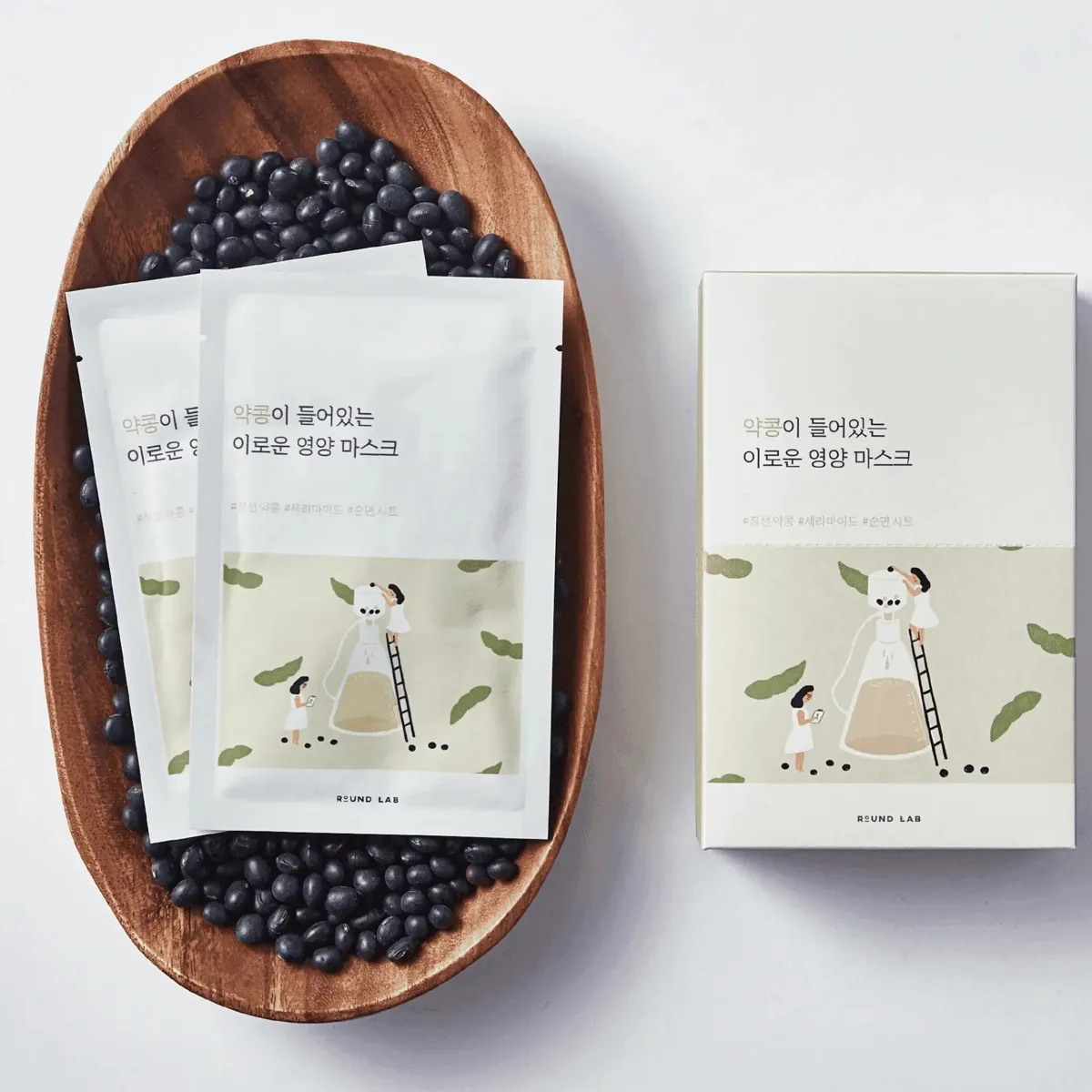
Where most Korean sheet masks carry a watery humectant essence, this one carries a milky cream with ceramide NP, sphingolipids, cholesterol and a caprylic triglyceride, plus the line's black soybean, adenosine and a glycine-hollyhock humectant pair, fragrance-free on a close-fitting microfiber sheet. It is the sheet mask to use when the skin needs lipids rather than water, and it says so honestly in the word nourishing.
A fragrance-free cream-essence sheet mask that puts ceramide NP, sphingolipids, cholesterol and a light triglyceride on dry skin under occlusion for twenty minutes, which is a genuinely useful barrier treat and something a water mask cannot do. Its black soybean is at a tenth of a percent and its wrinkle claim rests on adenosine's Korean registration rather than anything a weekly sheet delivers, and the lipids make it wrong for oily or fungal-acne-prone faces; for dry, winter or retinoid-worn skin at $3.60 to $4 a sheet, it is a well-made comfort.
A few dozen reviews on the brand's US site and pools at Korean retailers over four years give the mask a modest record, and its firming and wrinkle claims rest on unpublished Korean panels and adenosine's regulatory status. The assessment draws on the disclosed cream essence and the well-documented behaviour of ceramide-lipid formulations under occlusion rather than on this mask's own outcome data.
Verdicts
How well it fits each concern
Verdict by concern tap a concern for the case
Good choicefor DrynessIn your profileYou chose · Ceramides is a reference standard by mechanism for dryness; this sheet mask carries it.Moderate evidenceGentleNo reviews collected yet
The case for it
Ceramide NP with Sphingolipids and Cholesterol has trial-supported standing for this concern.
It is plausibly present at a working level, though the concentration is not declared.
The formula carries none of the triggers this concern is sensitive to.
What would change this: A declared concentration would move this to a firmer reading of the dose.
Same rule for everyone. “Good choice” is the verdict on 9,564 of 45,024 concern verdicts across the catalog; rule R5 decided 9,072 of them.
As of September 25, 2026, engine 5.1.1.
R5 — Trial-supported or guideline-supported active, adequately or plausibly dosed. · the full register
Carrying active
Ceramide NP with Sphingolipids and Cholesterol
Standing
supported — its mechanism is established
Form
plausible
Tolerability
gentle
Row checked
against its sources on July 17, 2026 (evidence table ev-2026.09-r228)
The studies behind the evidence row
Elias PM, Feingold KR (eds), Skin Barrier — stratum corneum ceramides are the principal intercellular lamellar lipid; their depletion is the biochemical signature of dry/xerotic skin — reference work
Supporting rolefor DehydrationIn your profileYou chose · Nothing here targets dehydration directly; humectant hydration is the recognised companion to treating it, and this sheet mask does that without known triggers.Not yet assessedGentleNo reviews collected yet
The case for it
Glycine with Hollyhock Flower Extract has no evidence row yet for this concern — it is in the research queue.
The formula carries none of the triggers this concern is sensitive to.
What would change this: A researched evidence row for the lead active would replace this with a verdict.
Same rule for everyone. “Supporting role” is the verdict on 8,197 of 45,024 concern verdicts across the catalog; rule R8 decided 4,250 of them.
As of September 25, 2026, engine 5.1.1.
R8 — The category's job (barrier care, humectant hydration, gentle cleansing, photoprotection) is the documented supportive role for this concern. This is the honest verdict for a moisturizer on an acne page. · the full register
Good choicefor Compromised Skin BarrierIn your profileYou chose · Ceramides is a reference standard by mechanism for compromised skin barrier; this sheet mask carries it.Moderate evidenceGentleNo reviews collected yet
The case for it
Ceramide NP with Sphingolipids and Cholesterol has trial-supported standing for this concern.
It is plausibly present at a working level, though the concentration is not declared.
The formula carries none of the triggers this concern is sensitive to.
What would change this: A declared concentration would move this to a firmer reading of the dose.
Same rule for everyone. “Good choice” is the verdict on 9,564 of 45,024 concern verdicts across the catalog; rule R5 decided 9,072 of them.
As of September 25, 2026, engine 5.1.1.
R5 — Trial-supported or guideline-supported active, adequately or plausibly dosed. · the full register
Carrying active
Ceramide NP with Sphingolipids and Cholesterol
Standing
supported — its mechanism is established
Form
plausible — studied range 0.5–1%, from the trials on the row; needs leave-on contact; judge it after ~4 weeks
Tolerability
gentle
Row checked
against its sources on July 17, 2026 (evidence table ev-2026.09-r228)
The studies behind the evidence row
Elias PM, Skin Barrier / Coderch et al., ceramides and skin barrier function — ceramides ~50% of SC intercellular lipid mass, essential to the permeability barrier — reference work
Promisingfor AgingIn your profileYou chose · Adenosine has trial-level evidence for aging but no guideline or regulatory standing yet — promising, short of a recommendation; the other actives here are not yet assessed for it.Moderate evidenceGentleNo reviews collected yet
The case for it
Adenosine has trial-level evidence for this concern but no guideline or regulatory standing yet.
It is plausibly present at a working level, though the concentration is not declared.
The formula carries none of the triggers this concern is sensitive to.
What would change this: A declared concentration would move this to a firmer reading of the dose.
Same rule for everyone. “Promising” is the verdict on 7,858 of 45,024 concern verdicts across the catalog; rule R9p decided 7,858 of them.
As of September 25, 2026, engine 5.1.1.
R9p — 0.5.0: 'Unproven' beside three filled dots read as one question answered twice with opposite words (7,018 rows). The chip measures standing, the dots measure trial volume; where the row carries at least one RCT or a tier-2 source (moderate dots) and the active is present at a working level, the honest word is Promising. Unproven is reserved for plausible-standing rows with limited or weak evidence, or an under-dosed form. Same rank as Unproven — a bet either way; the dots order them. · the full register
Carrying active
Adenosine
Standing
plausible — trials support it
Form
plausible — studied range 1%, from the trials on the row; needs leave-on contact
Tolerability
gentle
Row checked
against its sources on July 17, 2026 (evidence table ev-2026.09-r228)
As a maskNot judged: what a mask is for — works within its wear time, benefit outlasts the mask, comes off cleanly — cannot yet be measured from the ingredient list (only intensity without injury can).
A verdict is DermApproved’s assessment of how well a product’s ingredients fit a concern — never a claim about what the product treats. Evidence dots and collected reviews sit beside it and are never blended in.
Rules 0.5.1 · evidence table ev-2026.09-r228 · how we decide
Assessment
Pros & Cons
Pros
✓ Cream essence with ceramide NP, sphingolipids, cholesterol and a light triglyceride under occlusion
✓ Fragrance-free, alcohol-free and calm on sensitive or retinoid-worn skin
✓ Softness and comfort last to the next morning, unlike a water mask
✓ Glycine and hollyhock hydrate without a heavy feel
✓ Allantoin and licorice-derived glycyrrhizate soothe during wear
✓ Can replace the night cream on dry skin
✓ Fairly priced for a ceramide cream mask, especially in the ten-pack
Cons
✗ Black soybean is declared at a tenth of a percent; identity rather than active
✗ Wrinkle claim rests on adenosine's Korean registration, not a weekly mask's effect
✗ Triglyceride and lipids make it heavy on oily skin and unsuitable for fungal-acne-prone skin
✗ Thin microfiber sheet tears on unfolding
✗ Pouch copy borrows lines from the line's cleanser
✗ Small US review pool for a four-year-old product
Review
Full Review
Pick up most Korean sheet masks and the essence runs out of the pouch like water, which is what they are: humectants in solution, a drink for the skin that lasts a day. Round Lab's Soybean Nourishing Sheet Mask is milky instead, and the difference is the review. Its essence carries caprylic/capric triglyceride third, ceramide NP tenth, sphingolipids and cholesterol lower down, emulsified with glyceryl stearate, sucrose distearate and cetearyl alcohol into a light cream, which means that for twenty minutes under a close-fitting microfiber sheet the skin is bathed in barrier lipids as well as water. That is a different job from the brand's Birch and Dokdo masks, and a useful one: dry, tight, winter-worn or retinoid-stripped skin comes out of it soft, cushioned and calm, with a satin film that on dry skin can replace the night cream, and the softness is still there in the morning, which a water mask rarely manages. Whether that lipid film is a virtue or a burden depends entirely on the face it lands on, and that is the whole of the buying decision.
The rest of the essence is the Black Soybean line's furniture. Glycine sits second as the humectant in place of glycerin, with Althaea rosea, the hollyhock, for a slight soothing film; Glycine max black soybean extract is declared at 1,000 parts per million, a tenth of a percent, fourth in the list; allantoin and licorice-derived dipotassium glycyrrhizate calm; adenosine appears mid-list; and caffeine near the end adds a small de-puffing note. There is no fragrance, alcohol or dye, and the preservation is a gentle hydroxyacetophenone-hexanediol set. It is a considerate, fragrance-free formula, and the parts that carry the anti-ageing language deserve a plainer reading than the pouch gives them. The soybean's isoflavones have antioxidant and collagen-supporting data in vitro at concentrations well above a tenth of a percent, so here it is the line's identity and a light antioxidant note. The adenosine is a Korean-registered functional anti-wrinkle ingredient at 0.04 percent, which is what lets the brand print 'strong wrinkle reduction effect'; its small clinical evidence comes from daily leave-on use over weeks, and a weekly twenty-minute sheet delivers a fraction of that. The wrinkle claim is regulatory, not visible, and a buyer who expects firming from this mask will get softness instead, which is the better outcome for the skin and the worse one for the pouch.
Softness is worth having. In use the sheet clings well, warms rather than cools, and the twenty minutes pass without tingle or scent; the film left behind is light enough not to feel greasy on normal skin and rich enough that dry skin needs nothing over it. After a retinoid or acid night, or in a dry January, it is exactly the mask to reach for, and the few dozen reviews on the brand's US site, unanimous as small pools are, praise it in those terms, with the complaints coming from oily faces that found the film heavy and from the thin sheet's tendency to tear on unfolding. The lipids that make it good for dry skin are also why oily and fungal-acne-prone skin should choose the brand's water-based masks; a triglyceride under occlusion is not what a Malassezia-prone T-zone wants, however calm the rest of the list.
The limits are the format's and the copy's. A sheet mask, cream or water, changes nothing beneath the surface; the ceramides support the barrier for a day or two and the humectants plump for an evening, and that is the honest ceiling. The soybean and adenosine are marketing at the doses and exposure involved. The pouch's copy, which at one point describes 79 percent plant oils and low-pH surfactants that belong to the line's cleanser, has clearly been assembled from other products, which is a small carelessness in a brand that usually prints its doses, and a reminder to read the ingredient list rather than the paragraph above it.
On price, $4 a sheet or $3.60 in the ten-pack is fair for a fragrance-free ceramide cream mask, which is a rarer thing than a water mask and delivers something a bottle of toner cannot, namely lipids under occlusion; it is not cheap hydration, and two or three sheets a week makes a ten-pack a month. As a winter barrier treat or a post-retinoid rescue it earns its price; as an anti-ageing purchase it does not. The ten-pack is the sensible buy for anyone who knows their skin is in the first group.
So the recommendation is for dry faces. Dry, normal, sensitive or barrier-stressed skin that wants a fragrance-free cream sheet mask to soften and calm, especially in winter or after actives, will find this one of the more genuinely nourishing masks on the shelf. Oily and fungal-acne-prone skin should take the water masks next to it, and anyone reading the pouch for firming should read the ingredient list instead.
Formula
Key Ingredients
The hero actives that drive this product's performance.
The barrier lipids that make this a cream mask rather than a water one: ceramide NP tenth, with sphingolipids and cholesterol lower down and a caprylic triglyceride third, delivered in a twenty-minute occluded sheet to dry, cracked skin. It is the genuinely nourishing part of the name and the reason the mask leaves a softness a water essence would not.
Established mechanismfor Dryness · established mechanism
The line's Jeongseon black soybean at a declared 1,000 ppm, fourth in the list, an isoflavone-and-peptide extract with in vitro antioxidant and firming data; at a tenth of a percent it is the mask's identity and a light antioxidant note, not the firming mechanism the copy implies.
The 'strong wrinkle reduction' of the copy: adenosine is registered in Korea as a functional anti-wrinkle ingredient at 0.04 percent, and its presence lets the brand make the claim. It has small clinical data for smoothing fine lines with daily use; a weekly sheet mask delivers a fraction of that, so read the wrinkle claim as regulatory rather than visible.
Glycine second, the small natural-moisturising-factor amino acid that does the humectant work in place of glycerin, with the mucilage-rich hollyhock flower the brand uses across its sheet masks for a slight film and soothing; the pair keeps a cream essence from feeling heavy.
The calming set plus a low dose of caffeine near the end: allantoin and the licorice-derived anti-inflammatory soothe stressed skin during the twenty minutes, and the caffeine adds a small de-puffing note, all supporting rather than leading.
Not yet assessed
Ingredient standings describe the active at treatment-level doses and
vehicles; this product's own condition grades weigh its actual formula.
After cleansing and toner, lay the microfiber sheet over the face for twenty minutes, remove it before it dries and pat the cream essence in; on dry skin it can replace the night cream, on normal skin follow with a light moisturiser. It suits the night after a retinoid or acid, when the ceramides and cholesterol do the most good.
Results Timeline
Immediate: skin comes out soft, plumped and comfortable, with a light cream film rather than a watery dewiness. Short-term (2-3 uses a week): dry, tight or barrier-stressed skin feels steadier. Long-term: no cumulative firming or wrinkle change from a weekly mask; the adenosine claim is regulatory, and the benefit is barrier comfort.
Pairs Well With
a hydrating toner underneatha retinoid night the evening beforea light moisturizer on normal skin
The mask is a cream-emulsion sheet mask, and its distinguishing feature is a lipid phase under occlusion. Caprylic/capric triglyceride, third in the list, ceramide NP, sphingolipids and cholesterol, emulsified with glyceryl stearate, sucrose distearate, cetearyl alcohol and hydrogenated lecithin, deposit a partial barrier-lipid film during twenty minutes of sheet occlusion; ceramide-cholesterol mixtures have controlled evidence for improving stratum corneum hydration, reducing transepidermal water loss and accelerating barrier recovery after damage, with the effect dependent on dose and ratio, both undeclared here, and the semi-occlusive microfiber sheet increases delivery relative to open application. Glycine, second, is a natural moisturising factor amino acid providing humectancy in place of glycerin; Althaea rosea flower extract contributes mucilage polysaccharides with film-forming and soothing traditional use. Allantoin and dipotassium glycyrrhizate are established soothing agents, and caffeine at a low position provides transient vasoconstriction.
The anti-ageing components are present at levels or exposures below their evidence. Glycine max (black soybean) seed extract at 1,000 ppm supplies isoflavones such as genistein and daidzein with in vitro antioxidant, anti-collagenase and oestrogen-receptor activity; topical studies of soy isoflavones showing improvement in photoageing markers used concentrations of 1 to 4 percent applied daily for weeks, well above a 0.1 percent extract in a weekly mask. Adenosine is registered by the Korean MFDS as a functional anti-wrinkle ingredient at 0.04 percent on the basis of small controlled studies of twice-daily leave-on creams over eight to twelve weeks; its presence permits the brand's wrinkle claim under Korean cosmetic law, and a weekly twenty-minute application provides a small fraction of the studied exposure. The mask contains no retinoid, peptide or other active with evidence for structural change.
Tolerance is favourable for most skin: no fragrance, alcohol, essential oils or dyes, and preservation by hydroxyacetophenone, 1,2-hexanediol, caprylyl glycol and ethylhexylglycerin with disodium EDTA. The triglyceride and lipid content make the formula a Malassezia substrate and unsuitable for fungal-acne-prone skin, and heavier than oily skin usually tolerates; soy extract is a consideration for soy-allergic individuals, though topical reactions to purified extracts are rare. The formula is suitable in pregnancy and on eczema-prone skin. The brand's Korean panel claims are unpublished, and no independent study of the mask exists.
Dermatologist Perspective
Dermatologists regard sheet masks as short-lived hydration and comfort steps, and a cream-type mask with ceramides, cholesterol and a light triglyceride under occlusion is the version they would consider genuinely useful for dry, atopic or barrier-impaired skin and for patients recovering from retinoid or acid irritation, provided it is fragrance-free, which this is. They would set aside the firming and wrinkle language: the black soybean is at a tenth of a percent, adenosine's Korean functional registration reflects daily leave-on studies rather than a weekly sheet, and no mask alters wrinkles or elasticity. Patients with oily, acne-prone or Malassezia-prone skin would be steered to a water-based mask, since occluded lipids on a congested T-zone are unhelpful, and soy-allergic patients would be told the extract is present. Hygiene is the practical note: clean skin, one sheet, no reuse.
Guidance
Usage & Recommendations
How to Use
In the evening, with the face cleansed and toned, open the pouch, unfold the microfiber sheet carefully since it is thin, and lay it over the face, aligning the openings and smoothing it flat so it clings. Leave it for about twenty minutes and remove it before the sheet dries. Pat the cream essence into the face and neck; on dry skin it can be the last step, on normal skin follow with a light moisturiser, and the extra essence in the pouch can go on the hands. Use it two or three times a week in winter or after a retinoid or acid night, and less often on combination skin. Keep it off oily, congested or fungal-acne-prone areas, and discard the sheet after one use.
Value Assessment
Four dollars a sheet, or $3.60 in the ten-pack, is fair for a fragrance-free ceramide cream sheet mask from an established brand; cream-essence masks with real barrier lipids are less common than water masks and the occluded delivery gives something a bottle of toner does not. It is not cheap hydration, and two or three sheets a week makes a ten-pack a month's supply; the leftover essence stretches to the neck and hands. Good value as a winter barrier treat or a post-retinoid rescue for dry skin; poor value as an anti-ageing purchase, since the firming and wrinkle claims are not what the sheet delivers.
Who Should Buy
Dry, normal, sensitive or barrier-stressed skin that wants a fragrance-free cream sheet mask with real ceramides and cholesterol for winter evenings and post-retinoid recovery, and anyone who has found water-essence masks fade by morning. It suits Black Soybean line users and eczema-prone faces that most masks irritate.
Who Should Skip
The lipids make it wrong for oily, acne-prone and fungal-acne-prone skin, which should choose a water-based mask, since the triglyceride and lipids sit heavily and feed Malassezia. Anyone buying it for firming or wrinkle reduction will find softness rather than structural change, and soy-allergic skin should note the extract.
Ready to try ROUND LAB Soybean Nourishing Sheet Mask?
A soft, thin microfiber sheet saturated with a milky cream essence that clings closely, warms on the skin and leaves a light, cushiony, faintly satin film on removal
Scent
None; fragrance-free, with only the faint neutral note of the cream base
Packaging
A single foil pouch holding a folded microfiber sheet; sold singly and in five- and ten-packs
Finish
satinvelvety
What to Expect on First Use
The first use is a comfort rather than a jolt: a milky sheet that clings well, no cooling to speak of, and after twenty minutes skin that feels soft, cushioned and calm with a light cream film that does not need a moisturiser over it on dry skin. Oily skin may find the film heavy. There is no scent, no sting and nothing to adjust to; the softness lasts to morning and the firming the pouch mentions does not appear.
How Long It Lasts
Single use; a ten-pack covers 3-5 weeks at two or three masks a week
Round Lab's Black Soybean line is built on isoflavone-rich beans from Jeongseon and pitched at nourishing and firming, and its sheet mask, launched in 2022 alongside the toner and cream, was formulated as a cream-type mask with ceramides and adenosine to carry the line's anti-ageing positioning into a single-use format. It sells beside the brand's water-essence and hydrogel masks as the rich option.
About ROUND LAB Established Brand (5–20 years)
A Korean brand founded in 2017, ROUND LAB reached US shelves at Sephora and Amazon on the strength of its Dokdo and Birch lines and its unscented, sensitive-skin positioning. The Soybean Nourishing Sheet Mask is the cream-essence mask of its black-soybean line, with a small US review pool; its wrinkle and firming claims rest on the brand's Korean panels and on adenosine's cosmetic registration.
Brand founded: 2017 · Product launched: 2022
Myth vs. Reality
Common Myths
Myth
A sheet mask with adenosine reduces wrinkles
Reality
Adenosine's wrinkle claim comes from its registration as a functional anti-wrinkle ingredient in Korea at 0.04 percent, supported by small studies of daily leave-on use over weeks; a weekly twenty-minute sheet mask delivers a small fraction of that exposure. The mask's real effect is barrier comfort and softness from its ceramides and lipids.
Myth
Black soybean firms the skin
Reality
The extract is declared at 1,000 ppm, a tenth of a percent, and its isoflavones have in vitro antioxidant and collagen-supporting data at higher concentrations. In this mask it is the line's identity and a light antioxidant note; the plumping a user sees is hydration and lipid replenishment.
FAQ
Frequently Asked Questions
What makes the Round Lab Soybean Nourishing Sheet Mask different from the brand's other sheet masks?
Its essence is a milky cream rather than a watery ampoule: ceramide NP, sphingolipids, cholesterol and a light triglyceride under a close-fitting microfiber sheet, with black soybean extract, adenosine and a glycine-hollyhock humectant pair. It is the mask for dry, tight or barrier-stressed skin that needs lipids; the Birch and Dokdo masks are the lighter, water-based options.
Does the Soybean Nourishing Sheet Mask firm skin or reduce wrinkles?
Not meaningfully. The wrinkle claim rests on adenosine, a Korean-registered functional ingredient with small evidence for daily leave-on use, and the black soybean is at a tenth of a percent; a weekly sheet mask cannot deliver the exposure those studies used. What it does deliver is a softer, plumper, more comfortable barrier for a day or two.
Is the Soybean Sheet Mask good for sensitive or eczema-prone skin?
Yes, as a barrier treat: it is fragrance-free and alcohol-free, its actives are ceramides, cholesterol, allantoin and licorice-derived glycyrrhizate, and the cream essence soothes rather than stings. Soy-allergic skin should note the extract, and the lipids are best on dry rather than oily faces.
Can I use the Soybean Sheet Mask on oily or acne-prone skin?
It is not the best fit. The cream essence with caprylic/capric triglyceride, cholesterol and sphingolipids leaves a light film that oily skin may find heavy, and the triglyceride makes it unsuitable for fungal-acne-prone skin. Oily faces do better with the brand's water-based Dokdo or Birch masks.
How long should I leave the Soybean Sheet Mask on?
About twenty minutes, and remove it before the sheet dries; pat the cream essence in and, on dry skin, skip the night cream, or add a light moisturiser on normal skin. The extra essence in the pouch can go on the neck and hands.
Is the Soybean Nourishing Sheet Mask worth $4?
For a fragrance-free ceramide cream mask it is fairly priced, and the ten-pack brings it to $3.60 a sheet; cream-essence masks with real barrier lipids are less common than water masks and the format delivers something a toner cannot. It is not cheap hydration, and as a firming treatment it delivers little; as a winter barrier treat it earns its price.
Reviews
What Reviewers Tend to Say
Recurring themes our editors read across retailer reviews of this product — summaries in our words, not quotations, and not a substitute for your own patch test.
Common Praise
skin feels nourished, not just wet
microfiber sheet fits closely
fragrance-free and calm
good after a retinoid night
cream essence lasts to morning
Common Complaints
too rich for oily skin
essence can feel heavy in summer
no visible firming
single pouches are pricey
sheet is thin and tears
Notable Endorsements
Sold on the brand's US site and at SephoraPart of the Black Soybean line
Topically, the molecule the argument tells you to avoid is one the stratum corneum is structurally built from — and in acne-prone skin the documented finding is a shortage of it.
Piling on richer cream treats the symptom. The reason the dryness keeps coming back is a leaky barrier and a broken lipid ratio — and you fix those differently.
Products, answers, therapy guides, tools and articles in one search. Brand names,
slang and abbreviations all work — accutane finds isotretinoin, bacne finds truncal acne.