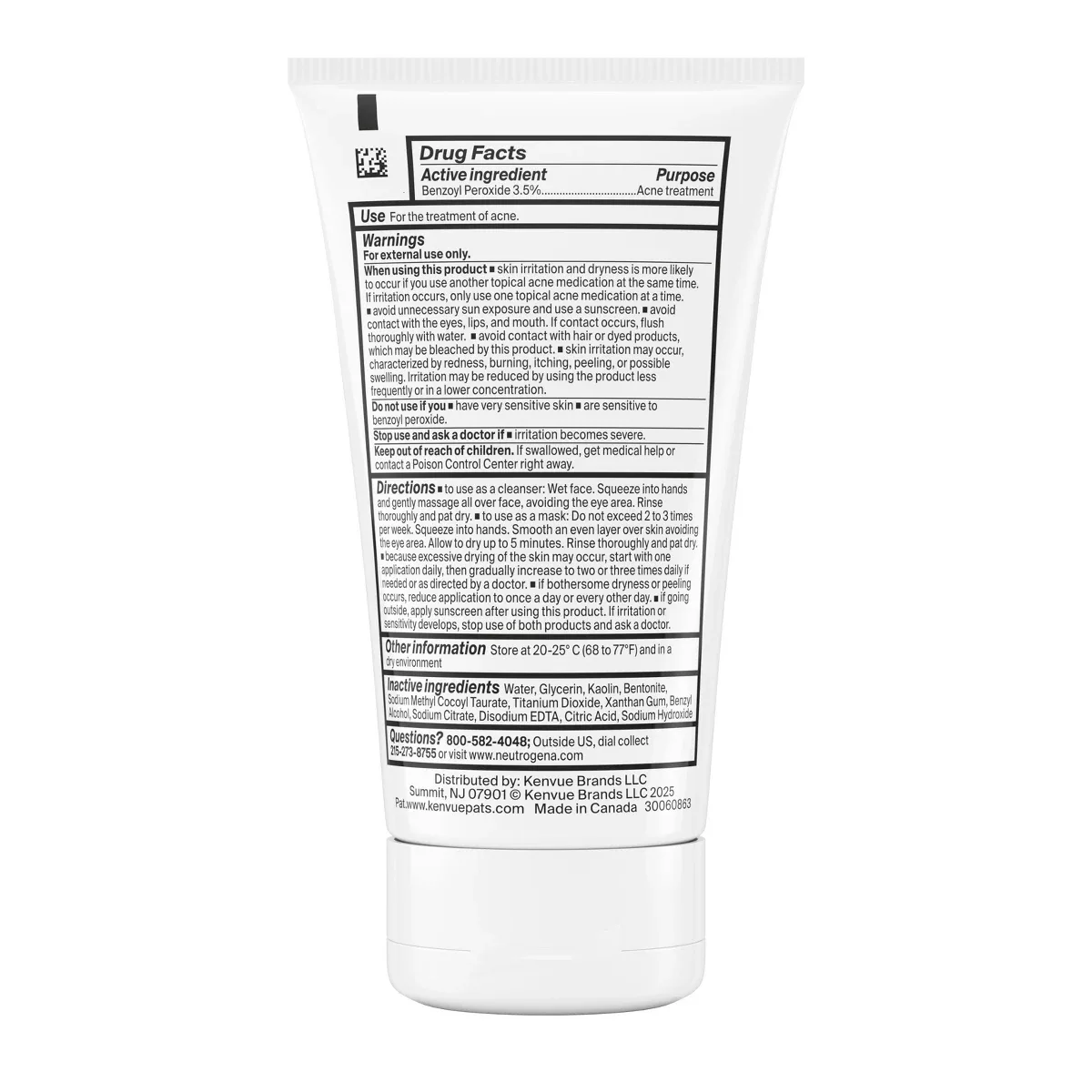
It is benzoyl peroxide at an unusual 3.5 percent, deliberately between the gentle 2.5 and the harsh 5 to 10, delivered as a short-contact clay mask and cleanser rather than a leave-on, with only twelve ingredients, no fragrance and glycerin at second. Short-contact benzoyl peroxide is how dermatologists reduce its irritation on skin of colour, and this is one of the few drugstore products built on that idea.
A clever twelve-ingredient benzoyl peroxide product: 3.5 percent in a kaolin-bentonite clay with a single mild taurate and glycerin at second, used as a five-minute mask or a wash so the peroxide kills acne bacteria without the all-day irritation, bleaching and marks of a leave-on. Cheap, fragrance-free and genuinely effective on oily, inflamed skin; still benzoyl peroxide, so dry, sensitive and rosacea-prone faces should pass.
The mask has been on sale since November 2025 with a strong first-year review base and a DailyMed label fixing its active, but Neutrogena's specific efficacy claims for the 3.5 percent short-contact format come from unpublished in-house testing, so the assessment rests on the extensive benzoyl peroxide and short-contact literature, the twelve-ingredient formula and retailer feedback. The efficacy and tolerability judgements are confident on that basis; the comparison with leave-on products is drawn from the general literature rather than a head-to-head trial of this tube.
Verdicts
How well it fits each concern
Verdict by concern tap a concern for the case
Strong choicefor AcneIn your profileYou chose · Benzoyl Peroxide is an approved or monograph active for acne; this clay mask carries it at 3.5%.Strong evidenceGentleNo reviews collected yet
The case for it
Benzoyl Peroxide 3.5% is a first-line active — approved, monograph-listed or named in current guidelines — for this concern.
It is present at an effective concentration, declared or high in the ingredient list.
The formula carries none of the triggers this concern is sensitive to.
Same rule for everyone. “Strong choice” is the verdict on 1,459 of 45,024 concern verdicts across the catalog; rule R2 decided 892 of them.
As of September 25, 2026, engine 5.1.1.
R2 — A regulator- or guideline-recognised first-line active, declared at an effective strength, in a form the claim supports. · the full register
Carrying active
Benzoyl Peroxide 3.5%
Standing
first line — a regulator recognises it for this use; trials support it · per 21 CFR § 333.310 - Acne active ingredients. (US Code of Federal Regulations (Legal Information Institute, Cornell Law School)), opened July 27, 2026
Form
adequate (declared 3.5%) — studied range 2.5–10%, from the OTC monograph or label; judge it after ~6 weeks
Tolerability
gentle
Row checked
against its sources on July 27, 2026 (evidence table ev-2026.09-r228)
Also listed for Excess Oiliness and Blackheads — the actives here (Benzoyl Peroxide, Glycerin, Kaolin Clay, Cleansing Surfactants) are in our research queue for those concerns; there is no verdict until their evidence rows are written. That is a gap in our table, not a mark against the product.
A verdict is DermApproved’s assessment of how well a product’s ingredients fit a concern — never a claim about what the product treats. Evidence dots and collected reviews sit beside it and are never blended in.
Rules 0.5.1 · evidence table ev-2026.09-r228 · how we decide
Assessment
Pros & Cons
Pros
✓ 3.5 percent benzoyl peroxide, declared on a Drug Facts panel, at a deliberately mid-range dose
✓ Short-contact mask-or-wash format cuts irritation, bleaching and mark risk
✓ Kaolin and bentonite absorb oil while the peroxide works
✓ Glycerin at second keeps the rinse-off from feeling tight
✓ Twelve ingredients, fragrance-free, oil-free, alcohol-free and vegan
✓ Replaces a benzoyl peroxide wash and a clay mask for thirteen dollars
✓ Tolerable for people who could not use leave-on benzoyl peroxide
Cons
✗ Slower than a leave-on benzoyl peroxide, two to four weeks to visible change
✗ Still bleaches towels, pillowcases and hairline hair if not rinsed thoroughly
✗ Dries combination skin with daily use
✗ Stings on already-inflamed spots in the first week
✗ Cannot be stacked with adapalene on the same night at first
✗ Does nothing for existing dark marks
Review
Full Review
There is a trick that dermatologists have used for a long time with patients whose skin cannot handle benzoyl peroxide: apply it, wait a few minutes, wash it off. Short-contact therapy, as it is called, keeps most of the drug's antibacterial punch, since benzoyl peroxide works fast by flooding the follicle with oxygen that Cutibacterium acnes cannot survive, and drops most of its irritation, bleaching and, on deeper skin tones, the post-inflammatory marks that a day of exposure produces. Neutrogena's Evenly Clear Acne Cleansing Mask is that trick in a tube. It is a benzoyl peroxide clay paste, registered as an OTC drug at 3.5 percent, meant to be used as a five-minute mask or a wash and rinsed away, and it is one of the few drugstore products built on the idea rather than fighting it.
The dose is the first interesting choice. Trials comparing 2.5, 5 and 10 percent benzoyl peroxide found roughly the same clearance and sharply more irritation at each step up, which is why modern dermatology leans low; Neutrogena chose 3.5, above the gentlest leave-ons and well below the 10 percent of the classic washes, and put it in a short-contact format that lowers the effective exposure further. The format is the second choice. Kaolin and bentonite, third and fourth on the inactives, thicken the paste so it stays on the face and absorb oil while it sits; a single mild taurate surfactant lets it lather and rinse as a cleanser without sulfate stripping; and glycerin is second on the list, an unusually high humectant position for a product made of clay and peroxide, which is why the mask rinses off without the drum-tight feel a five-minute peroxide mask would otherwise leave. Twelve ingredients, no fragrance, no oil, no alcohol. It is a spare, well-judged formula.
In use it does what benzoyl peroxide does. A thin white layer on a damp face, five minutes of gentle tightening and a faint peroxide smell, a lather, a rinse, and oily skin is matte and calmer; two or three masks a week, and inflamed breakouts come less often within two to four weeks. That is slower than a leave-on and it is the trade for being able to use benzoyl peroxide at all on combination skin, on deeper skin tones and on faces that flake at the sight of a 10 percent wash. The nearly five hundred Target reviews at four and a half stars are mostly people who had given up on benzoyl peroxide and found this version tolerable, which is exactly the customer it was made for. Used as a daily cleanser rather than a mask it is gentler still and slower still, and the label's once-a-day start is the right rhythm for that.
The cautions are benzoyl peroxide's, in reduced form. It stings on already-inflamed skin for the first week. It dries combination cheeks if used daily, and the label's instruction to cut back is one to obey. It bleaches, less than a leave-on and still enough to ruin a coloured towel or an eyebrow at the hairline if it is not rinsed thoroughly, and white towels are the sensible habit. It does not play well on the same night as adapalene until the skin has adjusted, and the Drug Facts warning about combining acne medications is a real one about cumulative dryness. Benzyl alcohol preserves it and is an occasional sensitiser. And it is a treatment for inflamed acne, not for marks: benzoyl peroxide prevents new marks by preventing new inflammation, and the fading of old ones belongs to the line's retinoid, its PHA exfoliant and sunscreen.
A note on the two modes, because they are not interchangeable. As a mask, the clay holds the peroxide against the skin for five minutes and the product behaves like a treatment; as a cleanser, massaged and rinsed in thirty seconds, it behaves like a benzoyl peroxide wash, gentler and slower again. Someone with a handful of inflamed spots a week does well with the mask two or three evenings and a plain cleanser otherwise; someone with persistent whole-face oiliness and breakouts may prefer the daily wash and reserve the five-minute mask for flares. Either way the total exposure stays a fraction of a leave-on's, which is the point, and the Drug Facts instruction to build up gradually applies to both.
The clay also needs a proper rinse. Kaolin and bentonite dry into the hairline and around the nostrils, and a white residue left overnight is a bleached patch of hair by morning; a second pass with wet hands and a check in the mirror are worth the ten seconds.
Thirteen dollars for 4.2 ounces, two to three months at two or three masks a week, is drugstore money for a product that replaces both a benzoyl peroxide wash and a clay mask, and short-contact benzoyl peroxide products from dermatologist-founded brands cost two to three times as much. It is one of the better value acne treatments on a drugstore shelf.
So the recommendation is clear within its lane. Oily and combination skin with inflamed breakouts, especially anyone with a deeper skin tone or a history of benzoyl peroxide leaving them raw, will find this a tolerable, effective way to use the drug two or three times a week and see fewer spots within a month. Dry, sensitive, rosacea-prone and eczema-prone skin should not be using benzoyl peroxide in any format, and anyone whose problem is marks rather than active acne should look to the other steps in the line.
Formula
Key Ingredients
The hero actives that drive this product's performance.
An intermediate dose between the 2.5 percent shown in trials to match higher strengths with less irritation and the 5 to 10 percent of the classic washes, declared on a Drug Facts panel; as a short-contact product, a wash or a five-minute mask, it releases oxygen into the follicle to kill Cutibacterium acnes without the all-day exposure that makes leave-on benzoyl peroxide bleach pillowcases and strip skin. The dose and the format are both chosen to lower irritation on deeper skin tones, where inflammation leaves marks.
Two clays, third and fourth on the inactives, that turn a benzoyl peroxide cleanser into a mask: kaolin absorbs oil gently and bentonite swells and draws more strongly, so the five-minute set pulls surface sebum while the peroxide works underneath. They are also why the product is thick enough to stay put on the face and why oily skin comes away matte.
A single mild taurate surfactant, the only foaming agent in the formula, chosen so the mask can be massaged and rinsed as a cleanser without sulfate stripping on top of the peroxide; it produces a low, creamy lather and rinses the clay away cleanly.
Second on the inactive list, an unusually high humectant position for a clay-and-peroxide product, and the reason a formula built entirely from drying ingredients rinses off without the tightness a five-minute benzoyl peroxide mask would otherwise leave; it is the formula's whole concession to comfort, and it is a meaningful one.
Not yet assessed
Ingredient standings describe the active at treatment-level doses and
vehicles; this product's own condition grades weigh its actual formula.
Use it as a wash-off, never a leave-on: as a cleanser, massage and rinse; as a mask, a thin layer for up to five minutes, then rinse, two or three times a week. Start once a day and build, as the Drug Facts say, and do not stack it with adapalene, salicylic leave-ons or another benzoyl peroxide on the same day until the skin has adjusted. Moisturise straight after, and keep it off towels and hair it can bleach.
Results Timeline
Oily skin is matte and less congested after the first five-minute mask. Fewer inflamed breakouts follow within two to four weeks of two or three masks a week, which is the horizon benzoyl peroxide works on; short-contact use is slower than a leave-on and gentler, and stopping brings the acne back, since benzoyl peroxide suppresses rather than cures.
Pairs Well With
Neutrogena Evenly Clear Gentle Acne Foaming Face Cleanser on non-mask daysNeutrogena Evenly Clear Acne Gel Face Moisturizer afterwardA non-comedogenic sunscreen every morning
Adapalene or other retinoids on the same night before the skin adjustsLeave-on salicylic acid the same day on sensitive skinOther benzoyl peroxide products in the routineDyed hair, coloured towels and pillowcases
Neutrogena Evenly Clear Gentle Acne Foaming Face Cleanser
Moisturiser
Sunscreen
Sample PM Routine
Neutrogena Evenly Clear Acne Cleansing Mask (5-minute mask 2-3x weekly, or as cleanser)
Neutrogena Evenly Clear Acne Gel Face Moisturizer
Evidence
Science & Expert Perspective
The Science
Benzoyl peroxide is the most thoroughly studied over-the-counter acne active, and this product's design choices follow its evidence closely. As a lipophilic oxidiser it penetrates the follicle and releases oxygen free radicals that kill Cutibacterium acnes, an anaerobe, without inducing bacterial resistance, and it has mild keratolytic and anti-inflammatory effects; comparative trials of 2.5, 5 and 10 percent concentrations found equivalent reductions in inflammatory lesions with irritation rising steeply with dose, the basis for the current preference for lower strengths, and 3.5 percent sits in the lower-middle of that range. Short-contact application, a wash or a mask rinsed after minutes, is supported by clinical studies showing that benzoyl peroxide washes and brief-contact formulations reduce inflammatory acne, more slowly than leave-on gels but with markedly less erythema, dryness and peeling, and with less of the post-inflammatory hyperpigmentation that irritation provokes in darker skin phototypes; kaolin and bentonite in this paste prolong contact to the labelled five minutes and adsorb sebum, and bentonite's swelling gives the mask its drawing effect.
The vehicle is minimal and well chosen. Sodium methyl cocoyl taurate is a mild anionic surfactant that lathers the clay off without the barrier disruption of sulfates, glycerin at second offsets the drying of the peroxide and clays through humectancy, titanium dioxide whitens the paste, and xanthan gum, citrate buffering and sodium hydroxide set the texture and pH; benzyl alcohol preserves the formula and is a recognised low-frequency contact allergen. The Drug Facts warnings are the standard ones for the active: benzoyl peroxide is a contact sensitiser in a small minority, it bleaches hair and fabric by oxidising dyes, it increases photosensitivity so sun protection is advised, and its dryness is additive with retinoids, salicylic acid and other peroxides, which is the reason for staggering introductions. It has no effect on existing pigment. Pregnancy guidance generally regards topical benzoyl peroxide as acceptable given its minimal systemic absorption. The evidence supports the mask as an effective, better-tolerated short-contact benzoyl peroxide treatment for inflammatory acne in oily and combination skin, and identifies dry, sensitive and rosacea-prone skin as the wrong candidates.
Dermatologist Perspective
Short-contact benzoyl peroxide is a long-standing clinical strategy for patients who cannot tolerate leave-on gels, and particularly for patients with darker skin, in whom the irritation of continuous benzoyl peroxide is a direct cause of post-inflammatory hyperpigmentation; a drugstore product built on that strategy, at a moderate dose with a mild surfactant and a humectant, is the kind of thing dermatologists would previously have had to assemble by telling a patient to wash off a prescription gel, and it is welcome. The clinical framing is as an antibacterial step for inflammatory acne, used two or three times a week and staggered with adapalene until the skin adapts, with the reminder that benzoyl peroxide prevents new marks rather than fading old ones and that sunscreen is part of the regimen. The exclusions are standard: benzoyl peroxide sensitivity, rosacea, atopic dermatitis, a compromised barrier and dry skin, for which the product is inappropriate in any format. Patients are warned about bleaching of hair and fabrics and told to keep the paste off the hairline and brows. Pregnant patients may generally use topical benzoyl peroxide, and are advised to confirm with their clinician.
Guidance
Usage & Recommendations
How to Use
As a mask, two or three times a week in the evening, smooth a thin, even layer over a damp, cleansed face, avoiding the eyes, lips, hairline and eyebrows, and leave it for up to five minutes while it sets; then wet the hands, massage gently to lift a light lather, and rinse thoroughly until no white residue remains, particularly along the hairline. As a cleanser, wet the face, squeeze a small amount into the hands, massage over the face and rinse. Follow with a moisturiser, and use sunscreen every morning. Start with one application a day if using it as a wash and build up only if the skin tolerates it, cutting back at the first sign of excess dryness; do not use it on the same night as adapalene or another acne medication until the skin has adjusted. Use white towels, wash hands before touching fabrics, keep the cap closed, and use within twelve months of opening.
Value Assessment
Thirteen dollars for 4.2 ounces, two to three months at two or three masks a week, is drugstore pricing for a product that stands in for both a benzoyl peroxide cleanser and a clay mask, and short-contact benzoyl peroxide masks from dermatologist-founded brands run twenty-five to forty dollars for similar or smaller tubes; against the classic 10 percent benzoyl peroxide washes it costs about the same and is far kinder. What the money buys is a monograph-registered active at a well-judged dose, a twelve-ingredient formula with nothing wasted and a format that makes benzoyl peroxide usable for people it previously was not. For oily and combination acne-prone skin it is one of the best-value acne treatments on the shelf; for anyone who should not use benzoyl peroxide it is thirteen dollars better spent elsewhere.
Who Should Buy
Oily and combination skin with inflamed breakouts, especially people with deeper skin tones or a history of leave-on benzoyl peroxide leaving them raw and marked, who want an effective, tolerable, inexpensive way to use benzoyl peroxide two or three times a week. Anyone building an Evenly Clear routine gets the line's antibacterial step.
Who Should Skip
Benzoyl peroxide at this strength is too much for dry, sensitive, rosacea-prone, eczema-prone and barrier-compromised skin, which should not use benzoyl peroxide in any format, and anyone with a known benzoyl peroxide allergy is ruled out by the label. People whose concern is existing dark marks rather than active acne need a retinoid, an exfoliant and sunscreen instead, and anyone unwilling to rinse thoroughly should expect bleached towels.
Ready to try Neutrogena Evenly Clear Acne Cleansing Mask with Benzoyl Peroxide?
A thick, smooth, white clay paste that spreads evenly on a damp face, sets slightly over five minutes without cracking, and lathers into a low, creamy foam when massaged with water before rinsing clean.
Scent
Fragrance-free with the faint, distinctive sharp note of benzoyl peroxide and a mineral clay smell, gone on rinsing.
Packaging
A 4.2-ounce white squeeze tube with a flip cap in the Evenly Clear blue-and-white livery; hygienic, easy to dose and beach-bag-proof, and it should be capped promptly since benzoyl peroxide degrades with air and light.
Finish
matte
What to Expect on First Use
The first mask is straightforward: a thick white clay layer that tightens gently over five minutes with a faint peroxide smell, lathers off with water, and leaves oily skin matte and noticeably calmer. A mild sting on active spots and a little dryness are normal in the first week; more than that means too much, too often, and the label's once-a-day start applies. Keep it off the hairline and eyebrows.
How Long It Lasts
About two to three months at two or three masks a week, or six weeks as a daily cleanser.
FDA OTC monograph acne drugFragrance-freeOil-freeVeganNon-comedogenic
Background
The Story Behind This Product
Neutrogena added the Cleansing Mask to Evenly Clear in November 2025 as the line's benzoyl peroxide step, choosing a wash-off clay format and a mid-range dose so the antibacterial could be used on deeper skin tones without the irritation and post-inflammatory marks that leave-on benzoyl peroxide causes; the format draws on the short-contact-therapy approach dermatologists have used for years to make benzoyl peroxide tolerable.
About Neutrogena Legacy Brand (20+ years)
Neutrogena, a Kenvue brand with nine decades of dermatologist-marketed acne care, registers this mask as an FDA OTC acne drug with a DailyMed label fixing its benzoyl peroxide at 3.5 percent, an unusual intermediate dose. Evenly Clear is its 2025 line built for post-acne marks on skin of colour, and its efficacy claims come from in-house panels rather than published trials.
Brand founded: 1930 · Product launched: 2025
Myth vs. Reality
Common Myths
Myth
Benzoyl peroxide only works if it stays on the skin.
Reality
Short-contact benzoyl peroxide, a wash or a five-minute mask, has clinical evidence for reducing inflammatory acne, because the molecule releases oxygen into the follicle quickly and Cutibacterium acnes cannot develop resistance to it; it works more slowly than a leave-on and irritates far less, which is the whole trade this mask is making. The clay keeps it in contact long enough to matter.
Myth
A higher percentage of benzoyl peroxide clears acne faster.
Reality
Trials comparing 2.5, 5 and 10 percent benzoyl peroxide found similar efficacy and steeply rising irritation with dose, which is why dermatology has moved toward lower strengths. Neutrogena's 3.5 percent in a short-contact format sits at the gentle end of that evidence, and pushing to a 10 percent wash would add dryness, bleaching and, on darker skin, marks, without adding clearance.
FAQ
Frequently Asked Questions
How much benzoyl peroxide is in the Neutrogena Evenly Clear Acne Cleansing Mask?
3.5 percent, declared on its Drug Facts panel and DailyMed listing, an intermediate dose between the 2.5 percent shown in trials to match higher strengths with less irritation and the 5 to 10 percent of classic acne washes. As a wash-off clay mask it is designed for short-contact use, which lowers irritation and bleaching further.
How do you use the Neutrogena Evenly Clear Acne Cleansing Mask?
Two ways, per the label: as a cleanser, wet the face, massage the paste over it avoiding the eyes, and rinse; as a mask, smooth a thin, even layer over a damp face, leave it for up to five minutes, then wet, massage into a light lather and rinse thoroughly. Use it two or three times a week as a mask, start once daily if using it as a wash, and cut back if the skin dries out.
Will the Neutrogena Evenly Clear benzoyl peroxide mask bleach towels and hair?
It can. Benzoyl peroxide oxidises dyes, and the label warns that it may bleach hair and coloured fabrics; rinse thoroughly, keep it off the hairline and eyebrows, use white towels, and wash hands well before touching clothes or pillowcases. Short-contact use reduces but does not remove the risk.
Can I use the Evenly Clear Cleansing Mask with adapalene or the Evenly Clear retinoid?
Yes, but not on the same night at first. The Drug Facts warn that combining topical acne medications increases dryness and irritation; the usual approach is the mask two or three evenings a week with the retinoid on the other nights, then more overlap once the skin has adjusted. Benzoyl peroxide and adapalene are a well-established pairing when staggered.
Is the Neutrogena Evenly Clear Acne Cleansing Mask good for dark spots and skin of colour?
It was designed with skin of colour in mind, and its short-contact format and mid-range dose exist to reduce the irritation that causes post-inflammatory marks; benzoyl peroxide itself does not fade marks, and by clearing inflamed acne it prevents new ones. Pair it with sunscreen and the line's retinoid or PHA exfoliant for the marks that are already there.
Who should not use the Neutrogena Evenly Clear benzoyl peroxide mask?
Anyone with very sensitive skin or a known benzoyl peroxide allergy, per the label, and in practice anyone with rosacea, eczema, a compromised barrier or dry skin, for whom a peroxide-and-clay mask is the wrong tool. Pregnant users generally may use benzoyl peroxide, but should check with their clinician.
Reviews
What Reviewers Tend to Say
Recurring themes our editors read across retailer reviews of this product — summaries in our words, not quotations, and not a substitute for your own patch test.
Common Praise
Clears inflamed breakouts within a couple of weeks
Less drying and bleaching than leave-on benzoyl peroxide
The strongest counterexample to blanket botanical scepticism is also one of the more common contact allergens — and holding both facts at once is the only honest way to read it.
The cheapest humectant on the ingredient list is also the best-studied, the most reliable in dry air, and the one your favorite moisturizer is quietly built around.
The average teen routine on TikTok runs eleven active ingredients and $168. The version that actually clears acne is three products, barrier-friendly, and mostly under fifty dollars.
Sep 20, 2025· 6 min
Questions people ask about Acne
Verified answers from our questions library — the nuance a product page cannot carry.
Products, answers, therapy guides, tools and articles in one search. Brand names,
slang and abbreviations all work — accutane finds isotretinoin, bacne finds truncal acne.