CoQ10's Problem Isn't the Evidence. It's Getting Through the Skin.
A large, orange, fat-soluble molecule with genuine antioxidant credentials and a delivery problem nobody solved by putting more of it in the jar.
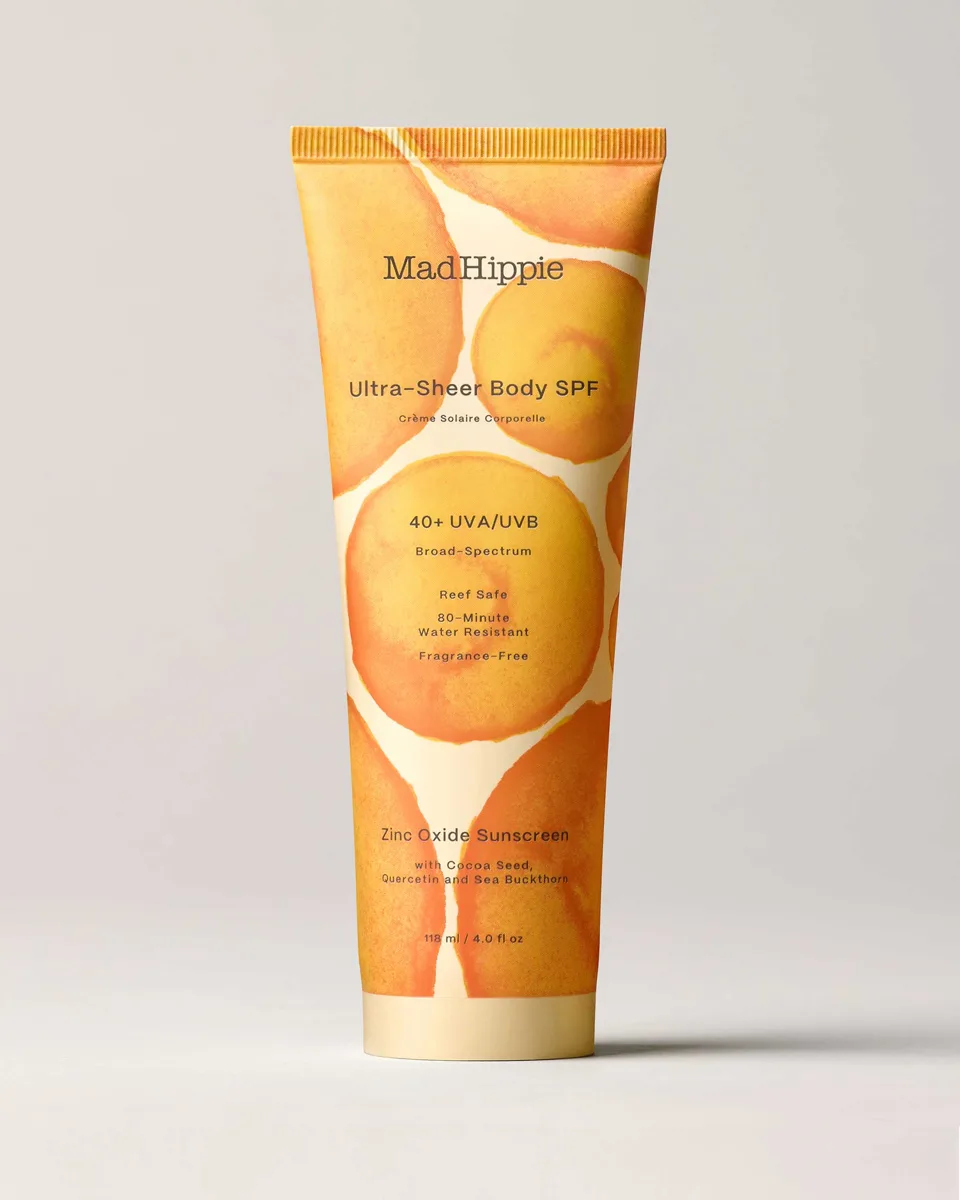
It carries 20.5 percent non-nano zinc — the most in Mad Hippie's range — in a body lotion that actually blends, thanks to the same butyloctyl salicylate and polyhydroxystearic acid dispersion the brand uses on the face, with eighty-minute water resistance and no fragrance. The trio on the front — cocoa seed, quercetin, sea buckthorn — is the brand's antioxidant habit applied to the body, and the 'blue light' line is the one claim the formula cannot keep.
A 20.5 percent non-nano zinc body sunscreen that blends far better than that number suggests, moisturizes like a body lotion, holds through eighty minutes of water and contains no fragrance — a genuinely good clean mineral body screen. Too rich for acne-prone backs, faintly white on deep skin, and its 'blue light protection' line is the one claim the untinted formula cannot honour.
Forty-five brand-site reviews at 87 percent five-star give this body sunscreen a positive but small and self-selected record after five years on sale, and the Ulta and Amazon counts could not be retrieved this session. The brand publishes neither its SPF nor its water-resistance test data, so the protection figures come from the label, and the 'blue light protection' claim on the listing is unsupported by the untinted formula.
The case for it
Same rule for everyone. “Full protection” is the verdict on 2,288 of 45,024 concern verdicts across the catalog; rule P1 decided 2,232 of them. As of September 25, 2026, engine 5.1.1.
Brand or formulator? Disclose a concentration or correct a fact →
The studies behind the evidence row
The case for it
What would change this: A declared concentration would move this to a firmer reading of the dose.
Same rule for everyone. “Good choice” is the verdict on 9,564 of 45,024 concern verdicts across the catalog; rule R5 decided 9,072 of them. As of September 25, 2026, engine 5.1.1.
Brand or formulator? Disclose a concentration or correct a fact →
The studies behind the evidence row
The case for it
What would change this: A researched evidence row for the lead active would replace this with a verdict.
Same rule for everyone. “Good choice” is the verdict on 1,938 of 45,024 concern verdicts across the catalog; rule F2 decided 1,938 of them. As of September 25, 2026, engine 5.1.1.
Brand or formulator? Disclose a concentration or correct a fact →
The case for it
What would change this: A researched evidence row for the lead active would replace this with a verdict.
Same rule for everyone. “Full protection” is the verdict on 2,288 of 45,024 concern verdicts across the catalog; rule P1 decided 2,232 of them. As of September 25, 2026, engine 5.1.1.
Brand or formulator? Disclose a concentration or correct a fact →
Does the jobDoes what a sunscreen is for: UVA coverage, kind to the skin wearing it. Not measured from the label: pleasant enough to actually use.
A verdict is DermApproved’s assessment of how well a product’s ingredients fit a concern — never a claim about what the product treats. Evidence dots and collected reviews sit beside it and are never blended in. Rules 0.5.1 · evidence table ev-2026.09-r228 · how we decide
Start with the arithmetic, because with a body sunscreen it decides everything. The dose that earns the number on the label is about an ounce for a body in swimwear — a full shot glass, a teaspoon per limb — and this tube holds four. That is three or four proper applications, a long weekend at the beach, or a month of daily arms-and-neck for someone who commutes on foot. Every body sunscreen lives or dies by whether it is pleasant enough to apply at that dose and cheap enough to reapply at it, and the reason most people burn is not the formula but the third-of-a-dose they actually use. So the question for a nineteen-dollar clean mineral body screen is not whether it protects — 20.5 percent zinc oxide protects — but whether it is the kind of thing you will smear on generously, twice, on a hot afternoon.
Mad Hippie, the Portland clean-beauty brand that grew out of a Whole Foods vitamin C serum, launched this in 2021 as the body-sized version of its zinc facial screens, and it inherits the part of those formulas that matters most. Butyloctyl salicylate wets and spreads the zinc particles and lifts the measured SPF; polyhydroxystearic acid keeps them from clumping; a glucoside emulsifier holds it together. That dispersion chemistry is why a lotion that is one-fifth non-nano zinc — the most in the brand's range — blends over a minute to a faint sheen on light-to-medium skin rather than the chalk that number promises. It is not invisible; deep skin tones will see some whiteness, and the brand's 'ultra-sheer' is generous. But for a high-zinc body product it is unusually wearable, and the forty-five reviewers on the brand's site say so in almost the same words.
The base is a body lotion, deliberately. Shea and cocoa butter, sunflower, safflower and coconut oils, fatty alcohols, glycerin, hyaluronate, squalane: rich enough that nothing else is needed on the legs, and the reason the finish, after an initial tack, settles to a moisturized rather than a greasy feel. On arms, legs, shoulders and the backs of hands that richness is a virtue. On an acne-prone back or chest it is not — coconut oil and lecithin are in the list, and congestion-prone skin there will know within a week — and the brand's lighter facial serum would be the better pick for a breakout-prone torso.
It is fragrance-free in the strict sense, which is rarer in body sunscreens than it should be, and calm: bisabolol, echinacea and aloe soothe, there is no alcohol or essential oil, and it is comfortable on freshly shaved legs and on children. The eighty-minute water resistance — the maximum claim the rules allow — comes from a film-forming polymer in the base and holds up through a swim or a run, which turns a daily-wear lotion into a real beach option. The antioxidant trio on the front of the tube, cocoa seed, quercetin and sea buckthorn, with milk thistle and vitamin E behind them, is the brand's serum instinct applied to the body: a rational supplement to the filter, at levels that support rather than compete with it.
That trio is also the source of the one claim to push back on. The listing says the sunscreen offers blue light protection. Blue light is visible light, and untinted zinc oxide — however carefully dispersed — blocks very little of it; only visible pigments such as iron oxides do, which is why tinted sunscreens exist. Antioxidants may blunt some of the oxidative stress visible light causes, and that is presumably the basis of the line, but 'blue light protection' is an overstatement on an untinted product, and in a market where independent testing has repeatedly caught sunscreen labels running ahead of their chemistry, a clean brand should be careful. The raspberry seed oil and sea buckthorn deserve the same note: neither adds to the SPF, whatever the internet says, and the tube correctly lists them as inactives.
The SPF 40+ is the right number for a body product, and worth a sentence on what it buys. A higher label does not stretch the two-hour reapplication window; it buys margin for under-application, which at body doses is nearly universal. Shake the tube — the zinc settles — apply the shot glass, reapply after eighty minutes in water or two hours in sun, and the 40+ does what it says. Skimp, and no number will.
Nineteen dollars for four ounces is about four-seventy an ounce, which is mid-range for a mineral body sunscreen and cheap for a clean one, though the arithmetic at the top means a beach week costs a tube. What the price buys is a high-zinc, fragrance-free, water-resistant body screen with real dispersion chemistry and a moisturizing base, in a recyclable tube from a brand with fifteen years of retail history and no published test data. For sensitive, dry or normal skin — and for anyone who wants a mineral body sunscreen they will actually apply at the right dose — it is one of the better options in its lane. Just ignore the line about blue light.
The hero actives that drive this product's performance.
| Ingredient | Function | Evidence |
|---|---|---|
| Zinc Oxide (non-nano) 20.5% (20.5%) | The single filter at 20.5 percent — the highest zinc load in the brand's range — delivering broad-spectrum protection labelled SPF 40+ and eighty minutes of water resistance; on the body, where a faint cast matters less and a higher number matters more, this is the right place to put the most zinc, and it is why the tube can claim reef-safe and fragrance-free without qualification. | Regulator-approved for Sun Damage · limited certainty |
| Butyloctyl Salicylate + Polyhydroxystearic Acid | The dispersion pair that lets a fifth of the tube be zinc without turning it to paste: an emollient ester that wets and spreads the particles and raises the measured SPF, and a dispersant that keeps them from clumping — the reason a 20.5 percent non-nano zinc lotion can honestly be called sheer on most skin. | Not yet assessed |
| Shea Butter, Cocoa Butter, Sunflower, Safflower + Coconut Oil | A body-lotion lipid base — two butters and three plant oils — that carries the zinc across large areas with slip and leaves limbs moisturized rather than chalky; it is richer than the brand's face screens and suits arms, legs and shoulders, though coconut oil and lecithin make it a poorer choice for acne-prone backs and chests. | Established mechanism for Dryness · established mechanism |
| Quercetin + Sea Buckthorn Juice + Cocoa Extract | The three antioxidants the front of the tube names — a flavonoid, a carotenoid-rich berry juice and cocoa polyphenols — with milk thistle and tocopherol behind them, meant to quench the free radicals generated by whatever UV gets past the zinc; a rational supplement to the filter at inactive-list levels, and also the source of the tube's claim to 'blue light protection', which they cannot fully deliver. | Not yet assessed |
| Bisabolol + Echinacea + Aloe | The soothing set that supports the fragrance-free, sensitive-skin positioning — chamomile-derived bisabolol for anti-inflammatory calm, echinacea for its soothing reputation, aloe for water — sensible companions for a sunscreen that will be worn on sun-stressed shoulders and reapplied over warm skin. | Not yet assessed |
| Sodium Hyaluronate + Squalane | The humectant-and-light-lipid pair that keeps the finish from feeling heavy despite the butters — hyaluronate to hold water under the film, squalane for a skin-identical slip — the reason reviewers describe an initial tack that settles into a moisturized feel rather than a greasy one. | Established mechanism for Dryness · established mechanism |
Ingredient standings describe the active at treatment-level doses and vehicles; this product's own condition grades weigh its actual formula.
Active Ingredient: Zinc Oxide (non-nano) 20.5%. Inactive Ingredients: Aloe Barbadensis Leaf Juice, Ananas Sativus (Pineapple) Fruit Extract, Arachidyl Alcohol, Arachidyl Glucoside, Behenyl Alcohol, Bisabolol, Butyloctyl Salicylate, Butyrospermum Parkii (Shea) Butter, Caprylhydroxamic Acid, Capryloyl Glycerin/Sebacic Acid Copolymer, Caprylyl Glycol, Carthamus Tinctorius (Safflower) Seed Oil, Cellulose Gum, Cetearyl Alcohol, Cetyl Alcohol, Citric Acid, Coco-Glucoside, Cocos Nucifera (Coconut) Oil, Echinacea Purpurea Extract, Glycerin, Helianthus Annuus (Sunflower) Seed Oil, Hippophae Rhamnoides Fruit Juice, Lecithin, Methyl Dihydroabietate, Microcrystalline Cellulose, Polyhydroxystearic Acid, Quercetin, Rubus Idaeus (Raspberry) Seed Oil, Silybum Marianum Extract, Sodium Gluconate, Sodium Hyaluronate, Sodium Stearoyl Glutamate, Squalane, Theobroma Cacao (Cocoa) Seed Butter, Tocopherol, Water
sunscreen
AM
Shake the tube well and apply generously to exposed skin fifteen minutes before going out — a shot-glass measure for the whole body, the equivalent of a full teaspoon per limb. It doubles as a body moisturizer, so nothing is needed beneath it. Reapply every two hours, and after eighty minutes of swimming or sweating. On the face it works in a pinch but the cast is heavier than the brand's facial screens; keep it off acne-prone backs and chests.
Protection is immediate and lasts two hours, or eighty minutes in water. Skin feels moisturized through the day from the butters and oils. The antioxidants add a layer of defence that does not show; the benefit of a daily body sunscreen is the sun damage — and the burn — that does not happen.
Two threads of the current sunscreen literature bear on this product, and the newest review of the field covers both. In their 2025 review in the Journal of the American Academy of Dermatology, Abdel Azim, Bainvoll, Vecerek, DeLeo and Adler traced the history of FDA regulation of sunscreen and the safety questions now shaping product choice: recent FDA studies clearly demonstrate that organic — chemical — ultraviolet filters are systemically absorbed during routine use, though without evidence to date of associated harm; the review also examined the evidence on sunscreen and vitamin D, frontal fibrosing alopecia, benzene contamination and the possible environmental effects of UV filters. Those are the concerns that have pushed many consumers toward mineral filters, and zinc oxide is the answer the FDA's own proposed rule treats as generally recognised as safe and effective. This product is a zinc-only formula, and its 'reef-safe' and 'clean' positioning rests on that regulatory and safety footing rather than on any testing of the tube.
The protection itself is conventional and well built. Non-nano zinc oxide at 20.5 percent attenuates across UVB and UVA; the labelled SPF 40+ is consistent with that load in a properly dispersed emulsion, and the dispersion system — butyloctyl salicylate, an emollient ester documented to improve zinc spread and measured SPF, with polyhydroxystearic acid as a particle dispersant — is what keeps a high-zinc lotion cosmetically wearable. The capryloyl glycerin/sebacic acid copolymer is the film former behind the eighty-minute water-resistance claim. The butters and plant oils constitute a body-lotion emulsion that moisturizes and, on congestion-prone skin, occludes.
The 'blue light' claim is where the science and the listing part. Visible light, including the blue band, contributes to pigmentation and oxidative stress, but untinted mineral filters — micro or nano — transmit most of it; protection against visible light requires visible pigments such as iron oxides, which this untinted product does not contain. The quercetin, sea buckthorn, cocoa, milk thistle and tocopherol antioxidants can quench some of the reactive oxygen species that visible and UV photons generate, a mechanism with laboratory and some clinical support in leave-on products, and that is the most charitable reading of the claim; it is not photoprotection in the sense the label implies. Raspberry seed oil, similarly, contributes carotenoids and tocopherols and no measurable UV attenuation. Bisabolol, echinacea and aloe supply anti-inflammatory and soothing support; methyl dihydroabietate, a rosin ester film former, is a rare contact sensitizer for colophony-allergic users, and echinacea a daisy-family allergen.
For body use, dermatology's priorities are a high SPF, broad spectrum, water resistance and a texture people will apply at the full dose — and a zinc-only formula is the routine recommendation for children, pregnant patients and anyone with sensitive or eczema-prone skin who wants to avoid chemical filters. This product meets that brief: 20.5 percent non-nano zinc at SPF 40+, eighty-minute water resistance, no fragrance, and a moisturizing base that makes generous application easy on dry limbs. Skin specialists would flag two things. The rich butter-and-coconut base is the wrong choice for acne-prone backs and chests, where an oil-free mineral fluid is preferred. And the 'blue light protection' language would be corrected: untinted zinc does not block visible light, and patients concerned about visible-light pigmentation — melasma, post-inflammatory marks — need an iron-oxide-tinted product. The standard counsel on dose and reapplication applies with extra force to body sunscreen, where under-application is nearly universal; the cast on deeper skin tones would be noted as a cosmetic rather than a safety issue.
Fifteen minutes before going outside, shake the tube well — the zinc settles — and apply generously to all exposed skin: about a teaspoon per limb, a full shot glass for a body in swimwear. Spread it in long strokes for a minute until the initial whiteness settles to a faint sheen and the tack fades; it works as your body moisturizer, so nothing is needed beneath. Reapply every two hours in sun and after eighty minutes of swimming or sweating, and towel-dry first. It can stand in on the face if you have nothing else, but the cast is heavier than the brand's facial screens. Keep it off acne-prone backs and chests. At the end of the day, wash it off with a body wash or a cleansing oil, since the zinc and film former do not rinse away with water alone. Store the tube out of a hot car and use it within a year of opening.
Nineteen dollars for four ounces is about four-seventy an ounce — mid-range for a mineral body sunscreen, inexpensive for a clean-label one, and with a subscription discount available. The arithmetic of body doses is what sets the real cost: a tube is three or four full-body applications, so a beach holiday runs through one and daily arms-and-neck wear lasts about a month. What the price buys is a high-zinc, well-dispersed, fragrance-free, water-resistant screen that also moisturizes, from a brand with fifteen years of retail history and no published test data. The value is best for sensitive, dry and normal skin using it as a combined body lotion and sunscreen, and for families wanting one gentle mineral tube; it is weaker for acne-prone torsos, for deep skin tones the cast bothers, and for anyone whose beach habits would be better served by a larger, cheaper mineral bottle. As a clean daily body screen at the right dose, it is priced fairly.
People with sensitive, dry or normal skin — and families with children — who want a fragrance-free, zinc-only body sunscreen that blends without heavy chalk on light-to-medium skin, moisturizes as it protects and holds through a swim. It suits daily walkers and commuters as much as beach-goers willing to buy a tube per holiday.
Anyone prone to breakouts on the back or chest, who should choose an oil-free mineral fluid; deeper skin tones the untinted zinc will whiten; anyone looking for visible or blue-light protection, which needs an iron-oxide tint; and anyone with a rosin or daisy-family allergy, given the methyl dihydroabietate and echinacea.
Ready to try Mad Hippie Ultra-Sheer Body SPF?
Buy at Amazon ♥A thick, creamy white lotion that needs a moment of spreading, blends over a minute to a faint sheen, feels slightly tacky at first and settles to a soft, moisturized, non-greasy finish
Fragrance-free; a faint neutral butter-and-oil note that disappears once applied
Four-ounce squeeze tube with a flip cap in an FSC-certified carton with soy inks — the brand is a Pact Collective partner for empties; shake before use, as the zinc settles
The first application feels like a rich body lotion with a mission: thick out of the tube, a minute of spreading, an initial tack, then a settled, moisturized, faintly luminous finish with no chalk on light-to-medium skin. There is no scent and nothing stings, and it is comfortable on freshly shaved legs. Deeper skin tones will notice a slight whiteness on the first day; acne-prone backs may notice congestion within a week from the butters and coconut oil.
Two to three applications of a full-body dose per tube — a week of beach days — or about a month used daily on arms and neck alone
spring summer
Mad Hippie launched its body sunscreen in 2021, five years after its first facial SPF, as clean mineral body screens became a category of their own and customers asked for the brand's zinc formula in a size for arms and legs. It took the facial dispersion chemistry, raised the zinc to 20.5 percent for a body-appropriate SPF 40+, built a richer butter-and-oil base, and dressed it in the brand's watercolour-orange tube in the 2024 rebrand.
Mad Hippie, a Portland clean-beauty brand founded in 2010, is known for a vitamin C serum carried by Whole Foods, Ulta and Anthropologie and for fully disclosed, antioxidant-heavy formulas. It has no dermatological founder and publishes no SPF or clinical data — 'dermatologist recommended' is a marketing phrase — and its credibility comes from fifteen years of consistent retail reviews and OTC-compliant labelling.
This sunscreen protects against blue light, as the listing says.
Blue light is part of the visible spectrum, and untinted zinc — however non-nano — blocks very little of it; only visible pigments like iron oxides do. The antioxidants may blunt some oxidative effect, which is presumably the basis of the claim, but 'blue light protection' overstates what an untinted mineral sunscreen offers.
SPF 40+ on the body means you can reapply less often.
A higher number buys more margin for under-application, not more time. Every sunscreen needs reapplying every two hours in sun and after eighty minutes in water, and a body dose is a full shot glass — most people use a third of that.
Raspberry seed and sea buckthorn add to the SPF.
Neither contributes measurable UV protection; the internet SPF figures for raspberry seed oil trace to a misread study. The 20.5 percent zinc supplies all of the tube's protection, and the brand correctly lists the oils and juice as inactives.
Less than most 20 percent zinc lotions — the dispersion system spreads the non-nano zinc thinly, and light-to-medium skin sees a faint sheen rather than chalk after a minute of blending. Deeper skin tones will notice some whiteness, as with any untinted high-zinc body screen.
Yes — labelled water resistant for eighty minutes, the maximum claim allowed, which makes it usable for swimming and running. Reapply after eighty minutes in water or sweat, and every two hours otherwise.
In a pinch, yes — it is the same filter and dispersion chemistry as the brand's facial screens, and fragrance-free. But at 20.5 percent zinc in a rich butter base the cast is heavier and the texture thicker than the facial versions, which are built for the job.
Not meaningfully. Untinted zinc oxide blocks very little visible light, blue included; only visible pigments such as iron oxides do. The antioxidants in the formula may reduce some oxidative stress, which is likely what the claim rests on, but it is an overstatement.
Not ideal. The base carries shea and cocoa butter, coconut oil and lecithin, which congestion-prone skin on the back and chest tends to react to. A lighter mineral fluid or an oil-free body sunscreen is the safer choice for bacne-prone skin.
A full shot-glass measure, about an ounce, for the whole body in swimwear — a teaspoon per limb. That means a four-ounce tube covers three or four full-body applications, or about a month of daily use on arms and neck. Under-applying is the most common way to lose the labelled protection.
Recurring themes our editors read across retailer reviews of this product — summaries in our words, not quotations, and not a substitute for your own patch test.
Blends in without a heavy white film for a 20 percent zinc
Moisturizes like a body lotion — no separate cream needed
No scent, no sting, fine on kids and reactive skin
Holds through a swim or a run
Thick on application and slightly tacky before it settles
Four ounces goes quickly at a proper full-body dose
Faint cast remains on deeper skin tones
Too rich for acne-prone backs and chests