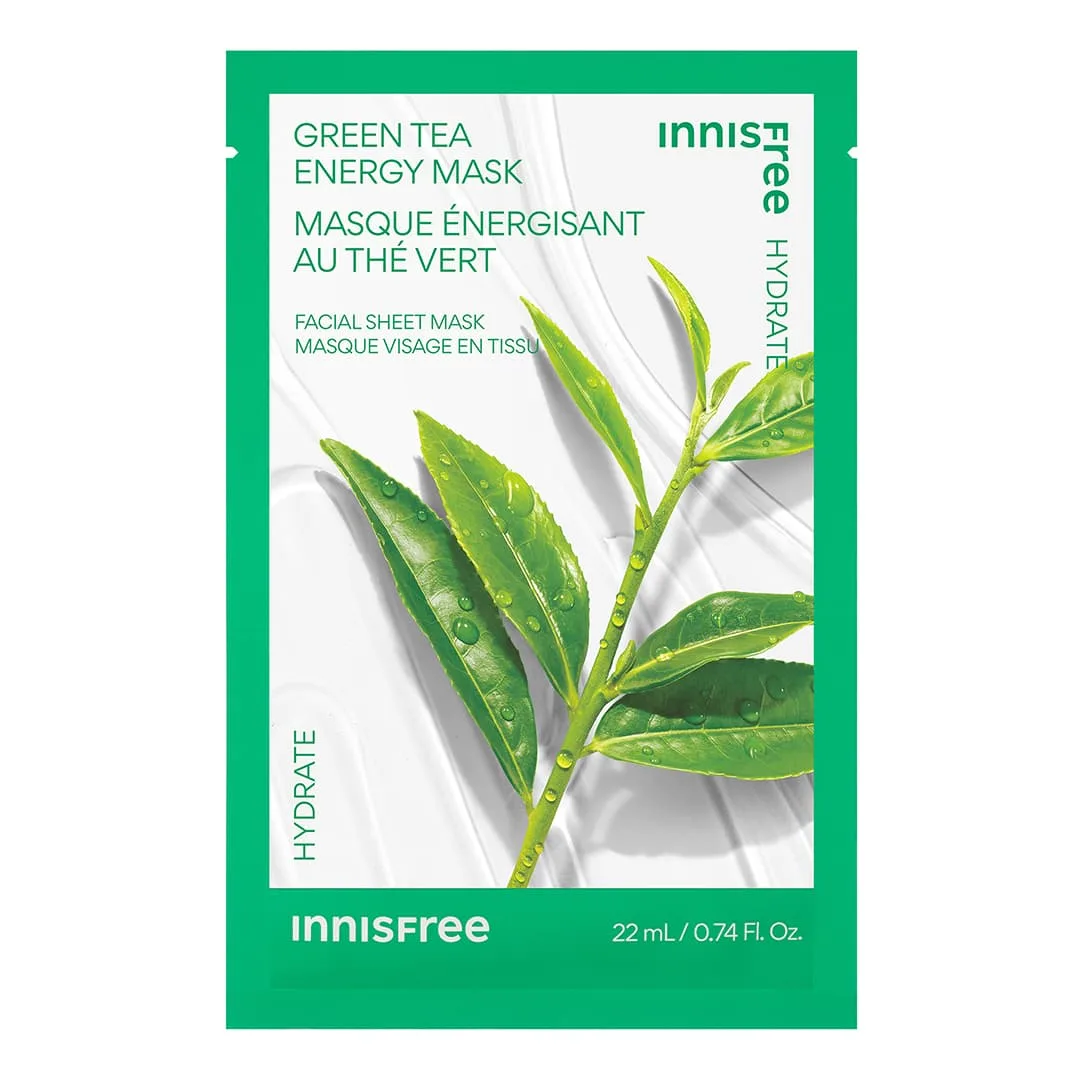
Where most $2 to $3 sheet masks pad a glycol base with a single headline botanical, Innisfree pairs the humectants with a small shared calming complex of centella, chamomile and peony root across every variant and then swaps the botanical on top, and it uses a biodegradable sheet rather than the usual non-woven synthetic. It is also one of the few mass sheet masks with a genuinely large, consistent review base rather than a viral spike.
A $2.50 humectant sheet mask that does exactly what a sheet mask can do, which is load the skin with water for a night, and does it with a thin sheet that stays put and enough essence to spare. The botanicals are garnish and the scent will bother some faces, but as a cheap, reliable hydration ritual it earns its 650-plus reviews.
$2.50
0.74 fl oz / 22 mL per sheet (single) · other sizes available
Good choicefor DehydrationIn your profileYou chose · Glycerin is a reference standard by mechanism for dehydration; this sheet mask carries it high in the ingredient list.Moderate evidenceGentleNo reviews collected yet
The case for it
Glycerin with Butylene and Dipropylene Glycol has trial-supported standing for this concern.
It is present at an effective concentration, declared or high in the ingredient list.
The formula carries none of the triggers this concern is sensitive to.
Same rule for everyone. “Good choice” is the verdict on 9,564 of 45,024 concern verdicts across the catalog; rule R5 decided 9,072 of them.
As of September 25, 2026, engine 5.1.1.
R5 — Trial-supported or guideline-supported active, adequately or plausibly dosed. · the full register
Carrying active
Glycerin with Butylene and Dipropylene Glycol
Standing
supported — its mechanism is established
Form
adequate — studied range 20%, from the trials on the row; needs leave-on contact; judge it after ~1 weeks
Tolerability
gentle
Row checked
against its sources on July 17, 2026 (evidence table ev-2026.09-r228)
The studies behind the evidence row
USP glycerin monograph / Fluhr et al., glycerol and the skin (review) — glycerin is the reference humectant, drawing and holding water in the stratum corneum — reference work
Promisingfor DullnessIn your profileYou chose · Glycerin has trial-level evidence for dullness but no guideline or regulatory standing yet — promising, short of a recommendation; the other actives here are not yet assessed for it.Moderate evidenceGentleNo reviews collected yet
The case for it
Glycerin with Butylene and Dipropylene Glycol has trial-level evidence for this concern but no guideline or regulatory standing yet.
It is present at an effective concentration, declared or high in the ingredient list.
The formula carries none of the triggers this concern is sensitive to.
What would change this: Guideline or regulatory standing for the active on this concern would move this from a promising bet to a recommendation.
Same rule for everyone. “Promising” is the verdict on 7,858 of 45,024 concern verdicts across the catalog; rule R9p decided 7,858 of them.
As of September 25, 2026, engine 5.1.1.
R9p — 0.5.0: 'Unproven' beside three filled dots read as one question answered twice with opposite words (7,018 rows). The chip measures standing, the dots measure trial volume; where the row carries at least one RCT or a tier-2 source (moderate dots) and the active is present at a working level, the honest word is Promising. Unproven is reserved for plausible-standing rows with limited or weak evidence, or an under-dosed form. Same rank as Unproven — a bet either way; the dots order them. · the full register
Carrying active
Glycerin with Butylene and Dipropylene Glycol
Standing
plausible — trials support it
Form
adequate — studied range 2–20%, from the trials on the row; needs leave-on contact; judge it after ~1 weeks
Tolerability
gentle
Row checked
against its sources on July 17, 2026 (evidence table ev-2026.09-r228)
The studies behind the evidence row
Harry's Cosmeticology / Baran & Maibach Textbook of Cosmetic Dermatology — humectant, emollient and occlusive classification — standard reference text
As a maskNot judged: what a mask is for — works within its wear time, benefit outlasts the mask, comes off cleanly — cannot yet be measured from the ingredient list (only intensity without injury can).
A verdict is DermApproved’s assessment of how well a product’s ingredients fit a concern — never a claim about what the product treats. Evidence dots and collected reviews sit beside it and are never blended in.
Rules 0.5.1 · evidence table ev-2026.09-r228 · how we decide
Assessment
Pros & Cons
Pros
✓ Thin biodegradable cellulose sheet that clings well and stays in place
✓ Generous 22 mL of essence with enough left for neck and hands
✓ Humectant-led base gives a clear overnight plumping effect
✓ Shared centella, chamomile and peony calming thread in every variant
✓ No denatured alcohol, silicones or acids to sting occluded skin
✓ Sub-$3 single-sheet price with bundle options
✓ Very large, consistent review base rather than a viral spike
Cons
✗ Botanical extracts sit low on the list and add little beyond scent
✗ Rose water and vetiver oil in the Green Tea variant can trouble sensitive skin
✗ Aloe variant is conventionally perfumed under occlusion
✗ Hydration is short-lived and needs a moisturizer to hold
✗ No instrumental data from the brand for this essence
Review
Full Review
Sheet masks occupy a strange place in evidence-based skincare. They are among the best-selling formats on earth, they are almost never studied, and when researchers do put a corneometer on a face after one, the finding is consistent and unglamorous: the skin holds noticeably more water for a few hours, then drifts back toward baseline within a day. That is not a failure. It is simply what fifteen minutes under a wet, occluded sheet does, and it is a pleasant thing to do to a tired face. The right way to judge Innisfree's Energy Sheet Mask, then, is not against the language on the sachet about reviving and energising, but against the narrower question of whether it delivers that short-term hydration well, cheaply and without irritating the skin it is meant to comfort. On the first two counts it does. The third depends on which variant you pick and how your skin feels about scent.
The range is four sachets, Green Tea, Aloe, Pomegranate and Kombucha, and reading the ingredient lists side by side shows that Innisfree built one essence and dressed it four ways. The Green Tea variant reviewed here opens with water, butylene glycol, dipropylene glycol and glycerin, which is the humectant quartet that carries every hydrating sheet mask ever made, thickened with a polymethacrylate gel and carbomer so the essence clings rather than runs. Arginine, a preservative system of hexanediol, glyceryl caprylate and ethylhexylglycerin, and then the botanicals: green tea leaf extract at thirteen, followed by a shared trio of peony root, centella and chamomile that appears in all four variants, and then rose water, pear, melon seed, iris root, a little sodium hyaluronate and, at the very end, vetiver root oil. The Aloe version substitutes aloe juice up at position five and lists fragrance outright. Kombucha adds a lactobacillus ferment and amyris bark oil. Pomegranate is a fruit-extract stack with no added scent oil.
The sheet itself is the thing to praise. It is a thin, translucent biodegradable cellulose, closer to a tissue than the felt-like non-woven sheets of the cheapest masks, and it does what a thin sheet does: it drapes into the sides of the nose and under the jaw and does not slide off if you sit up. It arrives generously soaked, enough that the last third of the sachet can go on the neck and the backs of the hands, which is the small pleasure reviewers keep mentioning. Over the twenty-minute window the face cools, and when the sheet comes off the skin looks plumper and feels smoother in the way that a well-hydrated stratum corneum does. The leftover essence is tacky for a few minutes and then not, and a moisturizer over the top holds the effect until morning.
As for what the botanicals contribute, honesty requires saying not much, and that is fine at this price. Green tea leaf extract this far down the list is a scent and a mild astringency, not a polyphenol dose. Centella and chamomile are in every variant at a level that suggests a soothing intent rather than a soothing effect you would measure. Sodium hyaluronate is second from last. None of this is a criticism unique to Innisfree; it is the anatomy of the mass sheet mask, and Innisfree's version at least has a coherent calming idea running through it and skips the denatured alcohol that some competitors use to make the essence feel lighter.
The real caveat is scent. Innisfree does not put fragrance on the Green Tea label, but rose water and vetiver root oil are aromatic ingredients, and the Kombucha variant's amyris oil is the same story; the Aloe variant simply says parfum. For most skin this is a pleasant tea-and-rose note that fades. For rosacea-prone or eczema-prone faces, and for anyone who has learned to avoid essential oils, it is a reason to choose the Pomegranate variant or a different brand's unscented sheet, because occlusion is exactly the condition under which a fragrance allergen penetrates best. The reviews, which run above 4.8 stars across more than 650 on the brand site, include a scattering of scent complaints and almost no reports of stinging, which is about what the ingredient list predicts.
Innisfree has been doing this since the My Real Squeeze days of the 2010s, and the Energy line that replaced it in late 2023 is a tighter, better-made version of the same idea: fewer variants, a biodegradable sheet, a recycling scheme for the sachets and a price that has stayed under $3. That heritage matters less for a sheet mask than for a serum, since there is nothing here to go wrong, but it does mean the essence and sheet have been refined over a very large number of faces.
So who is this for? Anyone who likes the ritual and wants a dependable, inexpensive version of it: dehydrated skin after a flight or a long day, dry skin in winter as a pre-moisturizer step, combination and oily skin that wants water without oil. It is not a treatment for anything, it will not brighten or firm beyond the overnight plumping, and the green tea on the front is decoration. Used two or three times a week with a good moisturizer on top, it is one of the more sensible ways to spend $2.50 on your face, and it is a more pleasant twenty minutes than most of the sheet masks that cost twice as much.
Formula
Key Ingredients
The hero actives that drive this product's performance.
Positions two through four are three humectants and they are the entire hydration engine of this essence; under an occluded sheet for fifteen minutes they load the stratum corneum with water far more effectively than the same fluid patted on bare, which is the real reason a sheet mask outperforms a toner in the short term.
Established mechanismfor Dehydration · established mechanism
The variant's namesake sits thirteenth, after the preservative system, so this is a light antioxidant and astringent note rather than the polyphenol dose found in Innisfree's green-tea serums; it gives the Hydrate variant its faint tea scent and a mild tightening feel that oily skin tends to like.
Shared across all four variants at a low position, centella adds a soothing thread to a formula that otherwise has nothing calming in it; the dose is too small to expect wound-healing effects, but it is consistent with the brand's pitch that a tired, slightly reactive face can wear this without flushing.
Chamomile's bisabolol and apigenin bring a mild anti-inflammatory contribution that, together with centella and peony root, forms the small calming complex common to every Energy variant; at these levels it is a comfort ingredient more than a treatment.
Second to last in the list, the hyaluronate contributes a slippery afterfeel and a little surface water-binding once the sheet comes off, but it is the glycols and glycerin, not this, that deliver the plumping the reviews describe.
Established mechanismfor Dehydration · established mechanism
Ingredient standings describe the active at treatment-level doses and
vehicles; this product's own condition grades weigh its actual formula.
Wear it after cleansing and toner, before serum, and treat the essence left on the skin as your hydrating layer; pat it in and go straight to moisturizer rather than washing it off. It is a poor carrier for actives, so keep retinoids and acids for a different night, and on oily skin the essence alone can stand in for moisturizer.
Results Timeline
The plumped, cooled look is immediate and lasts through the evening and into the next morning; corneometry studies of sheet masks show the extra hydration falls back toward baseline within a day, so there is no cumulative change from occasional use, only the repeatable overnight effect.
Pairs Well With
Innisfree Green Tea Hyaluronic Acid Hydrating TonerInnisfree Green Tea Ceramide Creama plain occlusive moisturizer to seal the essence
The evidence relevant to this mask is less about its ingredients than about its format. A 2024 study in the Journal of Tissue Viability measured short-term skin reactions and stratum corneum changes after different ways of using facial sheet masks and found the expected pattern: a marked rise in stratum corneum hydration immediately after use that declines over the following hours, with no adverse barrier effects from ordinary use. That is the mechanism Innisfree is selling, and it depends on the humectants that dominate this essence, butylene glycol, dipropylene glycol and glycerin, held against the skin by an occlusive sheet long enough for the corneocytes to take up water. Glycerin's ability to raise stratum corneum hydration and support barrier function is among the best documented facts in cosmetic science, and the polymethacrylate gel here exists to keep that humectant phase in contact with skin rather than dripping away. The calming trio common to all four variants has a thinner evidentiary base at these doses. Centella asiatica's triterpenes, chiefly asiaticoside and madecassoside, have a substantial wound-healing and anti-inflammatory literature summarised in a 2024 Pharmaceutics review, but the extract sits fifteenth on this list and a single fifteen-minute exposure is not the regimen those studies used, so it is reasonable to describe it as a soothing intent rather than a proven contribution. Chamomile's bisabolol and flavonoids are similarly credible anti-inflammatories at meaningful concentrations and decorative at trace ones. Green tea leaf extract, the variant's namesake, is far too low on the list to expect the sebum or antioxidant effects reported for concentrated EGCG. The practical takeaway is that this mask works through water and occlusion, that it does so reliably, and that the botanicals mainly determine how it smells.
Sheet masks are generally regarded in clinical settings as a comfort step rather than a treatment, and the usual guidance is that they are harmless for most skin provided the formula is free of actives and the wearer does not leave the sheet on until it dries. This one fits that description: a humectant essence, no acids or retinoids, no denatured alcohol. The reservations dermatologists raise are about occlusion amplifying whatever is in the fluid, which is why the fragrance in the Aloe variant and the vetiver and rose components in the Green Tea variant draw attention for patients with rosacea, atopic dermatitis or a known fragrance allergy; the Pomegranate variant is the one most often acceptable for those patients. Sheet masks are also sometimes suggested as a gentle way to rehydrate skin that has become dry and tight during a retinoid or benzoyl peroxide course, used on off-nights, and a plain, cheap mask like this suits that role better than one loaded with extras. No one in clinical practice expects it to brighten, firm or treat, and the marketing language should be read accordingly.
Guidance
Usage & Recommendations
How to Use
Cleanse, apply your toner, and open the sachet over a sink because the sheet is fully saturated. Unfold it carefully since the cellulose is thin, position the eye and mouth openings first, then smooth the sheet outward from the nose so it lies flat against the cheeks and jaw. Leave it on for ten to twenty minutes, never until it starts to dry, and press the essence remaining in the sachet onto the neck and hands while you wait. Remove the sheet, pat the essence into the skin until it stops feeling tacky, and follow with a moisturizer to seal the water in; do not rinse. Two or three times a week is Innisfree's suggestion, and evening use is best since the plumped, slightly dewy finish sits better under nothing than under makeup.
Value Assessment
At $2.50 a sheet, or less in the brand's multipacks, this sits at the affordable end of the sheet-mask market and well below the $6 to $8 that prestige and boutique K-beauty masks charge for an essence built on the same humectants. The 22 mL fill is generous and the biodegradable sheet is better than what most sub-$3 masks use, so the money buys a good version of a simple thing. What it does not buy is any active worth paying for; the botanicals are trace and the hyaluronate is near the bottom of the list, so anyone hoping a sheet mask will substitute for a serum is spending small money on the wrong product. Innisfree's long run in this format and the size of its review base add confidence that the sheet and essence are consistent from sachet to sachet. As an occasional hydration ritual, the value is excellent; as skincare in any treatment sense, it is a pleasant extra rather than a purchase that moves anything.
Who Should Buy
People who enjoy a sheet-mask ritual and want an inexpensive, well-made one for dehydrated, dull or travel-worn skin, dry skin in winter looking for a pre-moisturizer hydration boost, and anyone rehydrating on off-nights from a drying acne routine. Combination and oily skin get water without any oil.
Who Should Skip
Fragrance-sensitive, rosacea-prone or eczema-prone skin should avoid the Aloe, Green Tea and Kombucha variants, whose scent components are amplified by occlusion, and probably choose an unscented mask altogether. Anyone expecting brightening, firming or a meaningful green tea dose should put the money toward a leave-on serum instead.
A watery, faintly slippery essence soaked into a thin, translucent biodegradable cellulose sheet; it drips a little on unfolding and sets to a tacky-then-soft film once patted in.
Scent
The Green Tea variant carries a light green-tea and rose note from the rose water and vetiver root oil; the Aloe variant is conventionally perfumed, and the Kombucha and Pomegranate variants smell faintly fruity.
Packaging
Individual foil sachets in a pastel colour per variant, sold singly at $2.50 or in bundles; the sachets are recyclable through Innisfree's TerraCycle programme rather than kerbside.
Finish
dewylightweight
What to Expect on First Use
The sheet is thinner than most drugstore masks and needs a moment to unfold without tearing, then it settles close to the face and stays put for the full twenty minutes. Skin feels cool and looks plumper as soon as it comes off; the tackiness of the leftover essence fades within a few minutes. There is no tingling and nothing to adjust to, though scent-sensitive users will notice the fragrance or essential oil in the first minute.
How Long It Lasts
One sheet is one use; at the brand's suggested two to three masks a week, a ten-sheet bundle lasts around a month.
Innisfree's original My Real Squeeze Mask, sold in dozens of fruit and botanical variants, was one of the products that introduced Western shoppers to Korean sheet masking in the 2010s. The brand retired it and rebuilt the range as the Energy Mask line, trimming the roster to four variants, moving to biodegradable sheets and relaunching it in the US in late 2023 with a shared calming base and a sub-$3 single-sheet price.
About Innisfree Established Brand (5–20 years)
Innisfree, founded by Amorepacific in 2000, built much of its global following on inexpensive single-use sheet masks, first the My Real Squeeze range and, since 2023 in the US, the Energy Sheet Mask line that replaced it. The brand's claims rest on consumer testing and its parent company's formulation resources rather than on published clinical work.
Brand founded: 2000 · Product launched: 2023
Myth vs. Reality
Common Myths
Myth
Leaving the sheet on longer than twenty minutes gives skin more hydration.
Reality
Once the sheet begins to dry it starts pulling water back out of the skin rather than into it; the essence in this 22 mL sachet is the whole dose, and the brand's ten-to-twenty-minute window is where the benefit sits.
Myth
The Green Tea variant delivers a meaningful dose of green tea antioxidants.
Reality
The leaf extract sits thirteenth on the list, after the preservatives. What you are getting is a hydrating glycol-and-glycerin essence with a tea note; for green tea polyphenols at a working level, Innisfree's leave-on serums are the place.
FAQ
Frequently Asked Questions
Which Innisfree Energy Sheet Mask variant should I choose?
All four share the same glycol-and-glycerin base and the same centella, chamomile and peony calming trio, so the difference is the botanical on top and the scent. Green Tea is the balanced default with a rose-and-vetiver note, Aloe is the most perfumed, Pomegranate leans on fruit extracts, and Kombucha adds a lactobacillus ferment for the glow claim.
How often can I use the Innisfree Energy Sheet Mask?
Innisfree suggests two to three times a week and the formula is mild enough for that; there are no acids or retinoids in it. Nightly use is fine for most skin, though scent-sensitive or rosacea-prone faces may find the fragranced variants build up irritation with daily exposure.
Should I rinse after using the Energy Sheet Mask?
No. The leftover essence is the product's hydrating layer; pat it into the face and neck until it stops feeling tacky, then apply your moisturizer to seal it in. Rinsing throws away most of what you paid for.
Is the Innisfree Energy Sheet Mask fragrance-free?
Not quite. The Aloe variant lists fragrance outright, and the Green Tea and Kombucha variants get their scent from vetiver root oil and amyris bark oil respectively, plus rose water in Green Tea. The Pomegranate variant is the closest to unscented, relying on fruit extracts.
Is the Energy Sheet Mask safe during pregnancy?
Yes. It is a humectant essence with botanical extracts and no retinoids, salicylic acid, hydroquinone or other ingredients that pregnancy guidance restricts. Anyone avoiding essential oils during pregnancy should pick the Pomegranate or Aloe variant over Green Tea or Kombucha.
Is the Innisfree Energy Sheet Mask the same as the old My Real Squeeze Mask?
It is the successor. Innisfree retired the sprawling My Real Squeeze range and rebuilt it as the Energy Mask line with four variants, a shared calming base and a biodegradable sheet. The concept and price point carried over; the specific formulas did not.
Reviews
What Reviewers Tend to Say
Recurring themes our editors read across retailer reviews of this product — summaries in our words, not quotations, and not a substitute for your own patch test.
Common Praise
Thin sheet that clings well and does not slide
Plenty of essence left over for neck and arms
Skin feels plump and calm the next morning
Cheap enough to use several times a week
Common Complaints
Scent is noticeable in some variants
Hydration is short-lived without a moisturizer on top
Chamomile's active fraction inhibits the same inflammatory pathways a steroid does, at a fraction of the strength — and the version that works best is grubbed out of Brazilian cerrado, while the synthetic substitute is half inactive by construction.
The internet's favorite hydrator has a counterintuitive dark side — in dry air, a humectant with nothing to seal it can pull water out of your skin instead of into it.
Products, answers, therapy guides, tools and articles in one search. Brand names,
slang and abbreviations all work — accutane finds isotretinoin, bacne finds truncal acne.