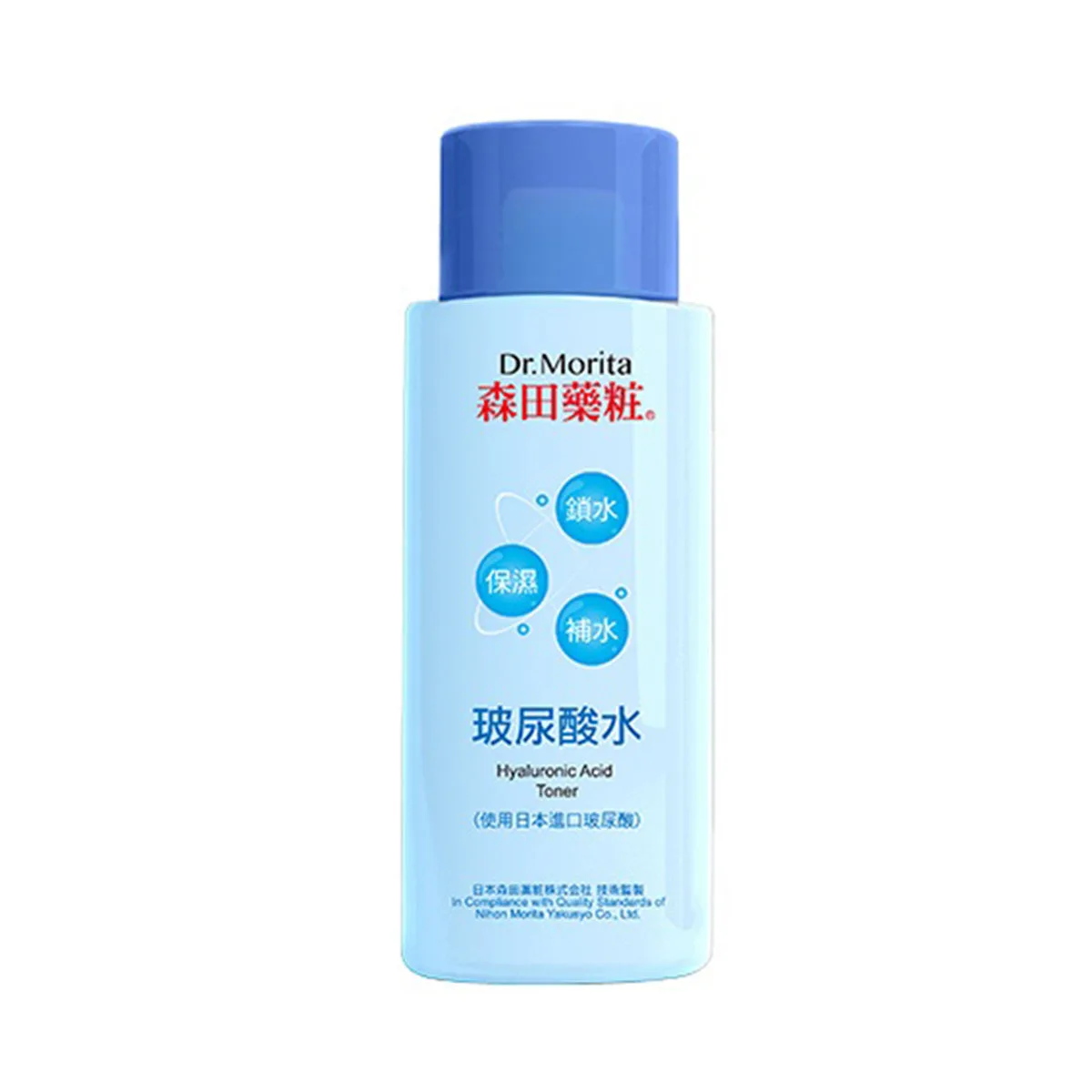
It is a deliberately minimal hydrating toner — fourteen ingredients, no alcohol — that tucks a collagen-supporting signal peptide and a licorice-derived soother into what is otherwise a hyaluronic acid water. The label lists the featured actives ahead of water, a Taiwanese marketing convention worth knowing about.
A simple, alcohol-free hydrating toner that does one thing well: it leaves skin plumper and more comfortable after cleansing, with two hyaluronic acid sizes, panthenol, trehalose and a licorice-derived soother. The peptide and collagen are nice extras with undisclosed doses, the actives-first label is misleading, and added fragrance makes it a questionable pick for sensitive skin.
No verifiable English-language review count exists for this toner, which sells mainly in Taiwan and through a few exporters. Its assessment leans on a short, disclosed ingredient list — one that places actives ahead of water — and Dr. Morita's manufacturing history; long-term user experience is not documented.
Verdicts
How well it fits each concern
Verdict by concern tap a concern for the case
Good choicefor DehydrationIn your profileYou chose · Hyaluronic Acid is a reference standard by mechanism for dehydration; this liquid carries it.Moderate evidenceStandard tolerabilityNo reviews collected yet
The case for it
Sodium Hyaluronate has trial-supported standing for this concern.
It is plausibly present at a working level, though the concentration is not declared.
The formula carries no trigger this concern is sensitive to, with the cautions noted.
What would change this: A declared concentration would move this to a firmer reading of the dose.
Same rule for everyone. “Good choice” is the verdict on 9,564 of 45,024 concern verdicts across the catalog; rule R5 decided 9,072 of them.
As of September 25, 2026, engine 5.1.1.
R5 — Trial-supported or guideline-supported active, adequately or plausibly dosed. · the full register
Carrying active
Sodium Hyaluronate
Standing
supported — its mechanism is established
Form
plausible — studied range 0.1%, from the trials on the row; needs leave-on contact; judge it after ~1 weeks
Tolerability
standard
Row checked
against its sources on July 17, 2026 (evidence table ev-2026.09-r228)
The studies behind the evidence row
Draelos ZD, Cosmetic Dermatology: Products and Procedures — hyaluronic acid classified as a humectant water-binding agent holding many times its weight in water — reference work
Does the jobDoes what a toner is for: not alcohol-driven, adds something real. Not measured from the label: restores skin pH, plays well with what follows.
A verdict is DermApproved’s assessment of how well a product’s ingredients fit a concern — never a claim about what the product treats. Evidence dots and collected reviews sit beside it and are never blended in.
Rules 0.5.1 · evidence table ev-2026.09-r228 · how we decide
Assessment
Pros & Cons
Pros
✓ Short fourteen-ingredient formula with no drying alcohol
✓ Two hyaluronic acid sizes give light, even hydration
✓ Panthenol and glycyrrhizinate add gentle soothing support
✓ Absorbs within seconds and leaves no residue
✓ Oil-free formula suits oily and fungal-acne-prone skin
✓ Twice-daily use gives the peptide more exposure than a mask
Cons
✗ Added fragrance and methylparaben are unnecessary for sensitive skin
✗ Actives-first label order obscures real concentrations
✗ Peptide dose is undisclosed and likely modest
✗ Open flip-top cap pours too quickly
Review
Full Review
Flip this frosted blue bottle over and the ingredient list begins with sodium hyaluronate. Not water, not glycerin, not any of the usual bulk ingredients. Hyaluronic acid first, then dipropylene glycol, then water, then a peptide and collagen. For anyone who has learned that ingredients are listed in descending order of concentration, this looks like a remarkably potent toner. It is not. A solution that was mostly sodium hyaluronate would be a thick, stringy gel, not the water-thin liquid that comes out of this bottle. What you are looking at is a labelling habit seen on some Taiwanese products, where the featured actives are put at the front and the rest follow. It is worth knowing, because it changes how the whole product should be judged.
Read with that in mind, Dr. Morita's Hyaluronic Acid Toner is a straightforward hydrating water. The working base is water and dipropylene glycol, a light humectant that also helps other ingredients dissolve, with two sodium hyaluronate entries of different molecular weights, trehalose and panthenol doing the moisture work. Allantoin and dipotassium glycyrrhizinate, the licorice-derived soother that Japanese and Taiwanese formulators like, add a calming layer. Palmitoyl tripeptide-5 and hydrolyzed collagen provide the anti-ageing garnish the box mentions as three peptides, though only one peptide appears in the ingredient list itself. Phenoxyethanol and methylparaben preserve it, and a fragrance finishes it off. Fourteen ingredients, no drying alcohol, no oils, no exfoliants.
That simplicity is the best argument for it. A hydrating toner has a narrow job: put a layer of water-binding ingredients on skin that has just been stripped by cleansing, so the next steps absorb more evenly and the skin does not feel tight in the meantime. This one does that job cleanly. Patted on with the hands, it vanishes in seconds and leaves a faint bounce, and moisturizer spreads noticeably better on top. Oily and combination skin will like that it adds no shine. Dry skin will appreciate it as a first layer, although it is too light to be the only hydration they use.
The peptide is the ingredient most people will be curious about. Palmitoyl tripeptide-5 is designed to mimic a fragment of a protein that activates TGF-beta, a signal involved in collagen production, and small studies on leave-on products have reported modest wrinkle improvements over a couple of months. In a toner, two things work against it. The dose is undisclosed and, given the list's structure, impossible to guess; and much of a toner ends up on cotton pads or rinsed away by the next step. On the other hand, a toner is used twice a day, every day, which gives a peptide far more exposure than a weekly sheet mask. Call it a plausible small bonus rather than a reason to buy.
The collagen deserves a plainer verdict. Hydrolyzed collagen is a good humectant and film-former, and it helps the toner feel a touch silkier, but topical collagen cannot reach the dermis or replace the skin's own. It is a moisturizing ingredient that happens to share a name with a structural protein.
Where this toner falls short is sensitivity. Fragrance is listed, methylparaben is present, and there is nothing in the formula that needs either for performance. For most people that will pass without incident, but anyone with fragrance allergies, rosacea or eczema-prone skin has plenty of fragrance-free alternatives in the hydrating-toner category and should start there. The packaging is also basic: an open flip-top orifice that pours quickly, which makes it easy to overshoot into the palm. A pump or reducer cap would save product.
One practical point about hyaluronic acid toners in general applies here too. In very dry air, a humectant layer left on its own can feel tight after half an hour, because there is little moisture in the environment for it to hold. The fix is simple and costs nothing: apply the toner to damp skin, and put a serum or moisturizer on top while the face still feels slightly tacky. Used that way, this toner feels noticeably more hydrating than when it is splashed on and left to dry. Layering two thin passes, sometimes sold as the seven-skin method, also works well with a liquid this light, and the generous bottle makes it affordable to do. As for hype, there is very little to worry about. Dr. Morita is a mass-market brand, and this is priced and positioned as an everyday drugstore toner, not a miracle in a bottle. The carton's promise of improved elasticity is the only claim that stretches beyond what the formula can deliver, and even that is gently phrased. A Taiwanese import shop in the US sells the 150 ml bottle for under nine dollars, which is cheap for a competently made hydrating toner and not far above its home shelf price.
The final judgement depends on your skin more than on the formula. For normal, combination and oily skin that wants a light, reliable hydration step before serum, this is an easy, pleasant daily toner with a thoughtful soothing edge. For dry skin it works as a first layer under richer products. For sensitive or fragrance-averse skin, the added scent tips it into the skip column. And for anyone reading the label, remember that the first ingredient is marketing: the bottle is mostly water, and that is exactly what a hydrating toner should be.
Formula
Key Ingredients
The hero actives that drive this product's performance.
The label's headline: two sodium hyaluronate entries of different molecular sizes give this watery toner a faintly slippery feel and a surface water-binding film that primes skin for the next step.
Established mechanismfor Dehydration · established mechanism
A signal peptide studied for collagen support in daily leave-on use; in a toner patted on twice a day it at least gets repeated contact, although the dose is not disclosed.
Pat it onto damp skin straight after cleansing, then follow within a minute with serum or moisturizer so the hyaluronic acid has something to hold water under.
Results Timeline
Immediate: skin feels bouncier and less tight after cleansing, and moisturizer spreads more easily. Over two to four weeks, dehydrated skin may feel more comfortable through the day. Visible firming from the peptide should not be expected at an undisclosed toner dose.
Pairs Well With
A niacinamide or peptide serumA cream moisturizer in dry weather
Hydrating toners work by depositing humectants on the skin surface immediately after cleansing, when the stratum corneum has lost some of its water-binding capacity.
The two sodium hyaluronate entries suggest different molecular weights. Larger hyaluronic acid forms a viscoelastic film that holds water at the surface and reduces evaporation, while smaller fragments can sit within the upper stratum corneum. Neither reaches the dermis in meaningful amounts, but both improve surface hydration and the feel of skin. Dipropylene glycol and trehalose add humectancy; trehalose is a disaccharide known for stabilising proteins and membranes during dehydration, which is why it appears in many hydration-focused formulas.
Panthenol is converted in the skin to pantothenic acid and has been shown in controlled studies to improve stratum corneum hydration and reduce transepidermal water loss. Allantoin and dipotassium glycyrrhizinate provide mild soothing; glycyrrhizinate salts from licorice have demonstrated anti-inflammatory activity in laboratory models.
Palmitoyl tripeptide-5 is a lipopeptide designed to mimic a sequence of thrombospondin-1, a protein that activates latent TGF-beta and stimulates collagen synthesis in fibroblast cultures. Small clinical studies of leave-on products applied daily for several weeks have reported modest reductions in wrinkle depth. In a toner, a meaningful share of the product may be absorbed by cotton or diluted by subsequent layers, and the concentration here is not disclosed, so any effect is likely small.
Hydrolyzed collagen fragments are too large to penetrate to the dermis. They act as film-forming humectants at the surface, contributing to softness rather than structural change.
Dermatologist Perspective
Hydrating toners are optional in most dermatological routines, but they can help people with dehydrated or combination skin who find moisturizers alone insufficient. The mainstream view is that hyaluronic acid and panthenol are safe, well-tolerated humectants and that alcohol-free formulas are preferable. Dermatologists would note that the fragrance in this toner offers no skin benefit and increases the risk of contact dermatitis in susceptible patients, so those with eczema, rosacea or known fragrance allergy are generally steered toward fragrance-free options. Peptide claims in rinse-free toners are viewed cautiously because concentrations are rarely disclosed and supporting trials are small.
Guidance
Usage & Recommendations
How to Use
After cleansing, while the face is still slightly damp, pour a coin-sized amount into your palm and press it over the face and neck with both hands. A second layer can go on for extra hydration once the first has absorbed. Cotton pads also work, but they soak up more liquid. Apply serum or moisturizer within a minute so the hyaluronic acid is sealed in. It suits morning and evening routines and sits happily under retinoids, peptides or vitamin C. Pour carefully — the open cap dispenses quickly.
Value Assessment
At a verified $8.99 for 150 ml from a US-facing Taiwanese import shop, this is inexpensive for an alcohol-free hydrating toner, and a bottle lasts two to three months used by hand. The formula is simple, and that is partly the point — you are paying for reliable hydration and a gentle soothing layer rather than exotic technology. The peptide and collagen add perceived value without clear evidence at this dose. Dr. Morita's decades of mass-market manufacturing mean there is no hype tax here; the main value question is whether you need a fragranced toner at all.
Who Should Buy
Normal, combination or oily skin that wants a light, quick hydration step before serum or moisturizer. It is also a sensible, affordable first layer for dry skin and anyone building a simple routine around a retinoid or active serum.
Who Should Skip
Sensitive, rosacea-prone or eczema-prone skin, and anyone with a fragrance or paraben allergy, since both are present without adding performance. Those expecting measurable firming from the peptide and collagen should look to a dedicated leave-on treatment.
A thin, water-clear liquid with the barest slip, closer to water than to an essence.
Scent
A light, clean fragrance that fades as it dries down.
Packaging
A 150 ml frosted blue plastic bottle with a flip cap and an open orifice rather than a pump or dropper.
Finish
invisiblefast-absorbing
What to Expect on First Use
It sinks in within seconds and leaves skin feeling slightly plumper and ready for the next step. No tingling should occur; any itch or redness points to the fragrance or preservatives.
How Long It Lasts
Around two to three months patted on by hand twice daily; closer to six weeks if applied with cotton pads, which soak up more.
Dr. Morita extended its mask formulas into a line of simple bottled toners, and this one borrows the hyaluronic acid, collagen and peptide theme of the brand's best-selling essence masks. The bottle notes it uses Japanese-imported hyaluronic acid and is made to the standards of the Japanese Morita affiliate.
About Dr. Morita Legacy Brand (20+ years)
Dr. Morita's roots run to a 1943 pharmacy business, and the company built its name in Taiwan as a mass-market sheet-mask maker before extending into toners and cleansers. This toner states it is produced to the quality standards of the Japanese affiliate Nihon Morita Yakusyo; no product-specific studies are published.
Brand founded: 1943
Myth vs. Reality
Common Myths
Myth
Because sodium hyaluronate is listed first, it is the main ingredient in the bottle.
Reality
Water and dipropylene glycol almost certainly make up most of the liquid. The label front-loads featured actives, a practice seen on some Taiwanese products, so the order does not reflect concentration.
Myth
Hyaluronic acid toners dry the skin out in low humidity.
Reality
Hyaluronic acid only pulls water from deeper skin if nothing seals the surface in very dry air. Following promptly with a moisturizer prevents that.
FAQ
Frequently Asked Questions
Does the Dr. Morita Hyaluronic Acid Toner contain alcohol?
No drying alcohol is listed. Its hydration comes from sodium hyaluronate, dipropylene glycol and trehalose.
Why is sodium hyaluronate listed before water on this Dr. Morita toner?
The label places featured actives first. Water and dipropylene glycol are almost certainly the main components, so the list order should not be read as concentration.
Can the Dr. Morita HA toner be used with retinol?
Yes. It contains no acids or exfoliants, so it can go on before a retinoid; its hydration may make the retinoid feel more comfortable.
Is Dr. Morita's hyaluronic acid toner fragrance-free?
No, it contains a light added fragrance and methylparaben, so fragrance-sensitive skin should patch-test first.
Should I apply this toner with a cotton pad or my hands?
Hands waste less and let you press the liquid in. Cotton pads work but absorb a good share of each pour.
Is the Dr. Morita HA toner good for oily skin?
Yes. It is oil-free and leaves no residue, giving oily or combination skin hydration without shine.
Reviews
What Reviewers Tend to Say
Recurring themes our editors read across retailer reviews of this product — summaries in our words, not quotations, and not a substitute for your own patch test.
That headline is the story every brand tells about trehalose. It is also, as of a 2017 paper in Molecular Cell, not quite true — which turns out to be the most interesting thing about the ingredient.
The internet's favorite hydrator has a counterintuitive dark side — in dry air, a humectant with nothing to seal it can pull water out of your skin instead of into it.
Products, answers, therapy guides, tools and articles in one search. Brand names,
slang and abbreviations all work — accutane finds isotretinoin, bacne finds truncal acne.