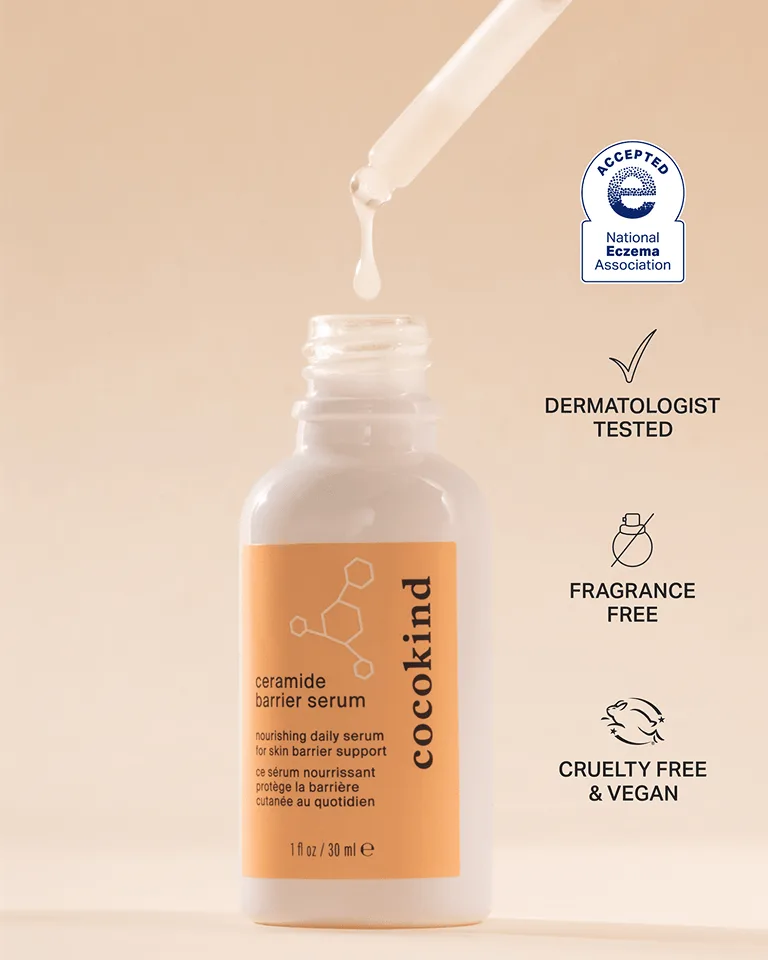
Most affordable ceramide serums include one or two ceramide types and call it a day. Cocokind includes five distinct ceramides (NP, NS, AP, EOS, EOP) alongside cholesterol and behenic acid — recreating the complete three-class lipid system that the skin barrier actually needs. The 80% aloe vera juice base is also unusual, providing a more biologically active solvent than the water used in most serums, and the 5% beta-glucan concentration is higher than many competing products.
A quietly impressive barrier serum that gets the lipid science right where many competitors don't — five ceramides, cholesterol, and fatty acids in one lightweight formula that absorbs like water. At $22 for one ounce it's not the cheapest option, but the formulation depth justifies the price, and the jumbo size offers better value for committed users.
Good choicefor DrynessIn your profileYou chose · Squalane is a reference standard by mechanism for dryness; this serum carries it high in the ingredient list.Moderate evidenceGentleNo reviews collected yet
The case for it
Squalane has trial-supported standing for this concern.
It is present at an effective concentration, declared or high in the ingredient list.
The formula carries none of the triggers this concern is sensitive to.
Same rule for everyone. “Good choice” is the verdict on 9,564 of 45,024 concern verdicts across the catalog; rule R5 decided 9,072 of them.
Unchanged since September 5, 2026, engine 5.1.1.
Good choicefor DehydrationIn your profileYou chose · Aloe Vera is a reference standard by mechanism for dehydration; this serum carries it at 80%.Moderate evidenceGentleNo reviews collected yet
The case for it
Aloe Barbadensis Leaf Juice has trial-supported standing for this concern.
It is present at an effective concentration, declared or high in the ingredient list.
The formula carries none of the triggers this concern is sensitive to.
Same rule for everyone. “Good choice” is the verdict on 9,564 of 45,024 concern verdicts across the catalog; rule R5 decided 9,072 of them.
Unchanged since September 5, 2026, engine 5.1.1.
Good choicefor Compromised Skin BarrierIn your profileYou chose · Ceramides is a reference standard by mechanism for compromised skin barrier; this serum carries it.Moderate evidenceGentleNo reviews collected yet
The case for it
Five Ceramides has trial-supported standing for this concern.
It is plausibly present at a working level, though the concentration is not declared.
The formula carries none of the triggers this concern is sensitive to.
What would change this: A declared concentration would move this to a firmer reading of the dose.
Same rule for everyone. “Good choice” is the verdict on 9,564 of 45,024 concern verdicts across the catalog; rule R5 decided 9,072 of them.
Unchanged since September 5, 2026, engine 5.1.1.
R5 — Trial-supported or guideline-supported active, adequately or plausibly dosed. · the full register
Carrying active
Five Ceramides
Standing
supported — its mechanism is established
Form
plausible — studied range 0.5–1%, from the trials on the row; needs leave-on contact; judge it after ~4 weeks
Tolerability
gentle
Row checked
against its sources on July 17, 2026 (evidence table ev-2026.09-r228)
The studies behind the evidence row
Elias PM, Skin Barrier / Coderch et al., ceramides and skin barrier function — ceramides ~50% of SC intercellular lipid mass, essential to the permeability barrier — reference work
Good choicefor SensitivityIn your profileYou chose · No fragrance, drying alcohol, declarable allergens or sensitising preservatives in this serum — the profile sensitive skin looks for.Not yet assessedGentleNo reviews collected yet
The case for it
Aloe Barbadensis Leaf Juice has no evidence row yet for this concern — it is in the research queue.
The formula carries none of the triggers this concern is sensitive to.
What would change this: A researched evidence row for the lead active would replace this with a verdict.
Same rule for everyone. “Good choice” is the verdict on 1,938 of 45,024 concern verdicts across the catalog; rule F2 decided 1,938 of them.
Unchanged since September 5, 2026, engine 5.1.1.
A verdict is DermApproved’s assessment of how well a product’s ingredients fit a concern — never a claim about what the product treats. Evidence dots and collected reviews sit beside it and are never blended in.
Rules 0.5.1 · evidence table ev-2026.09-r228 · how we decide
Assessment
Pros & Cons
Pros
✓ Five distinct ceramide types (NP, NS, AP, EOS, EOP) plus cholesterol and behenic acid for complete barrier lipid support
✓ 5% beta-glucan provides meaningful humectant and anti-inflammatory support beyond typical barrier serums
✓ Ultra-lightweight texture absorbs in seconds and layers perfectly under any moisturizer
✓ Fragrance-free, silicone-free, vegan, and cruelty-free formula
✓ Lysolecithin delivery system helps ceramides integrate into the skin's lipid matrix
✓ Available in jumbo 2 oz size for better per-ounce value
✓ Available at accessible retailers including Target, Ulta, and Whole Foods
Cons
✗ Lactic acid in the formula causes stinging for some very sensitive users
✗ Standard 1 oz bottle feels small for $22 — jumbo size offers better value
✗ Texture may feel too thin for users expecting a richer barrier repair product
✗ 80% aloe base is more marketing philosophy than proven efficacy advantage over water
✗ Results are gradual and subtle — not a dramatic overnight barrier fix
Review
Full Review
Priscilla Tsai was working on Wall Street when her skin decided to stage a rebellion. Hormonal acne, a wrecked barrier, and a skincare market offering two options: expensive clinical products, or cheap products that did not work. She left finance, founded Cocokind in 2014, and started making skincare in her apartment. A decade later the Ceramide Barrier Serum sits on Target shelves beside brands with ten times the marketing budget — and it holds its own, because whoever formulated it actually did the reading.
The reading, in this case, is understanding that ceramides alone do not repair a barrier. The stratum corneum is organized like bricks and mortar: the bricks are dead skin cells, and the mortar is a precise mixture of three lipid classes — ceramides, cholesterol and free fatty acids — in roughly a 3:1:1 ratio. Most affordable ceramide serums include one or two ceramide types and skip the cholesterol and the fatty acids entirely, which is like trying to build a wall with mortar missing two of its three ingredients and then wondering why it leaks.
Cocokind includes five ceramide types: NP, NS, AP, EOS and EOP. That is not a marketing number. Each subtype has a different molecular structure and a different job. NP and AP are among the most abundant in human skin. EOS and EOP are the ultra-long-chain ceramides — thirty-plus carbon atoms — critical for the long periodicity phase that gives the barrier its actual waterproofing. Cholesterol and behenic acid complete the trio, and caprooyl phytosphingosine and caprooyl sphingosine round out the sphingolipid family. This is the complete kit, at twenty-two dollars.
The delivery is thoughtful too. Lysolecithin — a phospholipid derived from lecithin — emulsifies the lipids into a watery formula. Phospholipids are structurally close cousins of the skin's own lipid bilayers, which means they help the ceramides integrate into the existing lamellae rather than merely sitting on top of them. It is a small choice that separates a formula built by someone who understands barrier biology from one built by someone who read a trend report.
Beta-glucan at 5% is the other standout. It is a polysaccharide with established humectant behaviour — drawing and holding water much as hyaluronic acid does — plus documented anti-inflammatory and wound-healing activity. Five percent is a real concentration, not a dusting for the label, and it supplies the immediate comfort and hydration you feel on application while the ceramides get on with their slower structural work underneath.
The 80% aloe base is a brand signature, and honesty demands a slightly deflating note here: using aloe leaf juice instead of water as the solvent provides some polysaccharides and mild anti-inflammatories, but the active compounds sit at low levels even at 80%, and whether it beats purified water in any measurable way is genuinely debatable. It does no harm and it fits the brand's philosophy. It is not a formulation breakthrough, and it should not be the reason you buy this.
Texturally, the serum is startlingly thin — almost watery, closer to an essence. Anyone expecting the rich viscosity of a classic ceramide cream may assume it is doing nothing. But thickness is not efficacy. The thin texture absorbs in seconds, leaves no residue, and interferes with nothing you layer on top. It is the kind of product you forget you applied ten minutes later, which is precisely what a well-built barrier serum should be. Squalane adds lightweight emollience without grease, and being biomimetic — the human body makes its own — it dissolves into the skin's lipid environment rather than fighting it.
One practical note the label leaves out: like every humectant-forward serum, this performs best on skin that is still slightly damp, sealed under a moisturizer. The lipids will do their structural work regardless, but the beta-glucan needs water to hold onto, and giving it none is how people conclude a good serum did nothing.
A few caveats. The formula contains lactic acid and gluconolactone, both functioning as pH adjusters rather than exfoliants, but gluconolactone is a PHA and lactic acid is an AHA, and a small minority of users do report stinging or redness on first use. If your barrier is genuinely wrecked — the state in which people most often reach for a product like this — patch test before committing your whole face. The 1oz bottle also feels small for twenty-two dollars, though a jumbo 2oz exists at better per-ounce value once you have confirmed you tolerate it. And the lipid content means this is not fungal-acne safe.
What you get in return arrives on a sensible schedule: immediate soothing from the aloe and beta-glucan, softer and less reactive skin within a week, and the real barrier improvements across four to six weeks as the lipids do their slow reorganizing. Three thousand reviews describe exactly that — subtle, cumulative, unglamorous.
This is not the most glamorous product in the barrier category. It has no cult following and no clinical positioning. But it may be the most formulation-literate option at its price — a serum that respects the actual science of barrier lipids rather than name-dropping 'ceramides' and stopping there. For a brand that began in an apartment and now sits in Target, that is a genuinely impressive thing to have built.
Formula
Key Ingredients
The hero actives that drive this product's performance.
Five distinct ceramide types mirror the diversity of ceramides found in healthy human stratum corneum — NP, NS, AP for barrier lipid replacement, EOS and EOP for long-chain barrier organization — working alongside the cholesterol and behenic acid in this formula to recreate the three essential lipid classes (ceramides, cholesterol, fatty acids) needed for proper barrier function.
Established mechanismfor Dryness · established mechanism
Provides lightweight, non-comedogenic emollience that helps the ceramides integrate into the skin's lipid matrix — squalane mimics the skin's own sebum composition, creating a comfortable vehicle for the ceramide complex that won't leave a greasy residue or clog pores.
Established mechanismfor Dryness · established mechanism
At 5%, beta-glucan serves as the primary humectant and soothing agent, drawing moisture into the skin and calming inflammation — research shows beta-glucan can stimulate collagen synthesis and promote wound healing, making it a strong complement to the ceramide barrier repair in this formula.
One of the three essential lipid classes in the skin barrier's mortar-and-brick structure — cholesterol works alongside the five ceramides and behenic acid (a fatty acid) to recreate the complete lipid environment needed for proper stratum corneum organization, a detail that many ceramide serums overlook.
Serves as the formula's primary solvent (80% of the formula) instead of water, providing natural polysaccharides and anti-inflammatory compounds that create a soothing base for the ceramide and lipid complex — a more biologically active foundation than plain water, though the skincare benefits of the aloe concentration are modest at best.
Established mechanismfor Dehydration · measured
Ingredient standings describe the active at treatment-level doses and
vehicles; this product's own condition grades weigh its actual formula.
Apply to slightly damp skin after cleansing and toning. The lightweight texture absorbs quickly and layers well under moisturizer. Can be used morning and evening. Pairs especially well with a ceramide-rich moisturizer to lock in the serum's lipid delivery.
Results Timeline
Immediate soothing and hydrating effect from the aloe and beta-glucan. Skin feels softer and more comfortable within 1-2 days. Noticeable barrier improvement with reduced dryness and reactivity within 2-3 weeks. Full ceramide barrier restoration benefits typically appear after 4-6 weeks of consistent use.
The five-ceramide approach in this serum reflects current understanding of stratum corneum lipid organization. A clinical trial reported in the Journal of Lipid Research has identified at least 12 ceramide subclasses in human skin, with ceramides NP, NS, AP, EOS, and EOP among the most functionally important. EOS and EOP are ultra-long-chain ceramides (containing 30-34 carbon atoms) that are essential for the long periodicity phase (LPP) of the lamellar lipid structure — the organized lipid sheets that give the skin barrier its waterproofing and protective properties.
Critically, this formula includes all three lipid classes needed for proper barrier assembly: ceramides, cholesterol, and a fatty acid (behenic acid). A landmark study by Holleran et al. published in the Journal of Clinical Investigation demonstrated that all three lipid classes must be present in a roughly 3:1:1 molar ratio for optimal barrier repair — supplementing ceramides alone without cholesterol and fatty acids produces suboptimal barrier recovery.
Beta-glucan at 5% is a clinically relevant concentration. A study reported in the International Journal of Biological Macromolecules (2020) demonstrated that topical beta-glucan at concentrations between 1-5% significantly improved skin hydration, reduced transepidermal water loss (TEWL), and promoted wound healing. Beta-glucan's mechanism involves both direct humectant hydration and immunomodulatory effects — it can stimulate macrophage activity and collagen synthesis, contributing to skin repair that complements the structural lipid restoration from the ceramides.
The lysolecithin delivery vehicle is worth noting. Lysophospholipids have been studied as penetration enhancers that facilitate the delivery of lipophilic actives through the stratum corneum. Their structural similarity to the skin's own phospholipid bilayers allows them to integrate ceramides more effectively into the existing lipid lamellae compared to conventional emulsifier systems.
Dermatologist Perspective
Clinically, effective barrier repair products should include the complete lipid trio — ceramides, cholesterol, and fatty acids — rather than ceramides alone. This serum's five-ceramide complex with cholesterol and behenic acid aligns with the dermatological understanding of barrier lipid biology. Dermatologists frequently recommend ceramide-based serums for patients with compromised barriers from overuse of retinoids, chemical exfoliants, or environmental damage. The fragrance-free, silicone-free formulation is appropriate for most patients, though dermatologists may caution that the lactic acid content could irritate severely compromised skin.
Guidance
Usage & Recommendations
How to Use
Dispense 3-4 drops into palms and press gently onto slightly damp face and neck after cleansing and toning. The lightweight texture absorbs quickly — no waiting required before applying moisturizer. Use morning and evening for best results. In the AM, follow with moisturizer and sunscreen. In the PM, follow with a richer moisturizer or sleeping mask. Pairs exceptionally well with ceramide-rich moisturizers to maximize barrier lipid restoration.
Value Assessment
At $22 for 1 ounce, this serum sits in the mid-range for barrier repair products. The formulation depth — five ceramides, cholesterol, fatty acid, 5% beta-glucan, squalane — provides genuine value at this price point. The jumbo 2 oz size improves the per-ounce economics for committed users. Cocokind, founded in 2014, has built credibility as an accessible clean beauty brand without the premium pricing of clinical lines. You're getting a formulation that rivals more expensive ceramide serums from clinical brands, wrapped in clean beauty packaging and available at Target.
Who Should Buy
Anyone experiencing barrier damage from over-exfoliation, retinoid use, harsh weather, or environmental stress. Ideal for dry, dehydrated, and sensitive skin types who want a lightweight, fragrance-free ceramide serum with genuine lipid science behind it. Clean beauty enthusiasts who want formulation depth without clinical-brand pricing.
Who Should Skip
Those with severely compromised, stinging skin should patch test first due to the lactic acid content. Users who prefer a richer, more viscous serum texture may find this too thin. Very oily skin types may find the squalane and lipid content unnecessary if their barrier is intact.
Very lightweight, almost watery serum with a slightly gel-like quality. Absorbs within seconds, leaving skin soft and hydrated without any residue or stickiness.
Scent
Unscented — no fragrance added. Very faint natural scent from the aloe base.
Packaging
Glass bottle with dropper. Clean, minimalist cream-colored design with recycled materials consistent with Cocokind's sustainability focus. A jumbo 2 oz size is also available.
Finish
lightweightnaturalfast-absorbing
What to Expect on First Use
The serum is thinner than you might expect from a 'barrier' product — it's almost watery, closer to an essence than a traditional serum. Absorbs within seconds, leaving skin immediately soft and slightly dewy. No tingling or adjustment period for most users, though a small minority reports initial stinging, possibly from the lactic acid. The lightweight texture makes it easy to layer under any moisturizer.
Cocokind founder Priscilla Tsai launched the brand in 2014 after struggling with hormonal acne and frustration with the clean beauty market's lack of affordable, science-backed options. The Ceramide Barrier Serum represents the brand's evolution from simple superfood-based products to more sophisticated formulations — it's become one of Cocokind's bestsellers and a Target shelf staple, proving that effective barrier repair doesn't need to cost $50.
About Cocokind Established Brand (5–20 years)
Cocokind was founded in 2014 by Priscilla Tsai, a former Wall Street banker who built the brand on affordable, clean skincare. Now available at Target, Ulta, and Whole Foods, Cocokind has built credibility through ingredient transparency and accessible pricing, though the brand's formulations lean more toward clean beauty philosophy than clinical-grade efficacy.
Brand founded: 2014 · Product launched: 2022
Myth vs. Reality
Common Myths
Myth
More ceramides means better barrier repair.
Reality
The number of ceramide types matters less than whether the formula includes the supporting lipids — cholesterol and fatty acids — that ceramides need to organize properly in the stratum corneum. This serum includes all three lipid classes, which is more important than the ceramide count alone.
Myth
Barrier repair serums need to feel thick and heavy to be working.
Reality
The lightweight, watery texture of this serum doesn't diminish its efficacy. The ceramides, cholesterol, and fatty acids are delivered via lysolecithin — a phospholipid emulsifier that helps these lipids integrate into the skin's barrier without requiring a heavy occlusive base.
FAQ
Frequently Asked Questions
How many ceramides does the Cocokind Ceramide Barrier Serum contain?
This serum contains five distinct ceramide types: Ceramide NP, Ceramide NS, Ceramide AP, Ceramide EOS, and Ceramide EOP. It also includes cholesterol and behenic acid (a fatty acid), providing the complete three-class lipid system needed for proper barrier function — a detail that sets it apart from many single-ceramide competitors.
Can Ceramide Barrier Serum and retinol go in the same routine?
Yes — this ceramide serum is an excellent companion for retinol. The five-ceramide complex helps reinforce the barrier that retinol can compromise, reducing dryness and irritation. Apply the serum before or after retinol, or on alternate nights if your skin is particularly reactive.
Is the Cocokind Ceramide Barrier Serum good for sensitive skin?
The fragrance-free, silicone-free formula is designed for sensitive skin. However, it contains a small amount of lactic acid that has caused stinging in some very reactive users. If you have severely compromised skin, patch test first. Most sensitive skin types tolerate it well.
Why is aloe vera the first ingredient instead of water?
Cocokind uses 80% aloe barbadensis leaf juice as the formula base instead of water. Aloe provides natural polysaccharides and anti-inflammatory compounds, creating a more soothing base for the ceramides and lipids. It's a clean beauty formulation choice that offers marginal benefits over purified water.
Is there a bigger size available?
Yes — Cocokind offers a jumbo 2 fl oz size of the Ceramide Barrier Serum, which provides better value per ounce than the standard 1 fl oz bottle for those who've confirmed the product works well for their skin.
Reviews
What Reviewers Tend to Say
Recurring themes our editors read across retailer reviews of this product — summaries in our words, not quotations, and not a substitute for your own patch test.
Common Praise
Lightweight texture absorbs instantly without stickiness
Noticeably calmer, less reactive skin within days
Affordable five-ceramide formula with clean ingredient list
Fragrance-free and suitable for sensitive skin
Visible improvement in barrier function and hydration
Common Complaints
Caused redness and stinging for some sensitive users
1 oz bottle feels small for the price
Aloe base may not suit all skin types
Some found the texture too thin for their barrier repair needs
Results are subtle — not dramatic overnight changes
That headline is the story every brand tells about trehalose. It is also, as of a 2017 paper in Molecular Cell, not quite true — which turns out to be the most interesting thing about the ingredient.
The burn trials are real and the skeptics who dismiss aloe as folklore are wrong — but the same substance has delayed healing in other wounds, and none of it says anything about what a soothing gel does to intact skin.
'Barrier repair' is the most over-used phrase in skincare, usually printed on products that contain none of the lipids a barrier is actually built from.
Jun 12, 2026· 6 min
Questions people ask about sensitive skin
Verified answers from our questions library — the nuance a product page cannot carry.
Products, answers, therapy guides, tools and articles in one search. Brand names,
slang and abbreviations all work — accutane finds isotretinoin, bacne finds truncal acne.