Beta-Glucan Does Niacinamide's Job Without the Marketing Budget
It hydrates, calms, and quietly supports the barrier with one of the better safety records in skincare. So why has almost nobody heard of it?
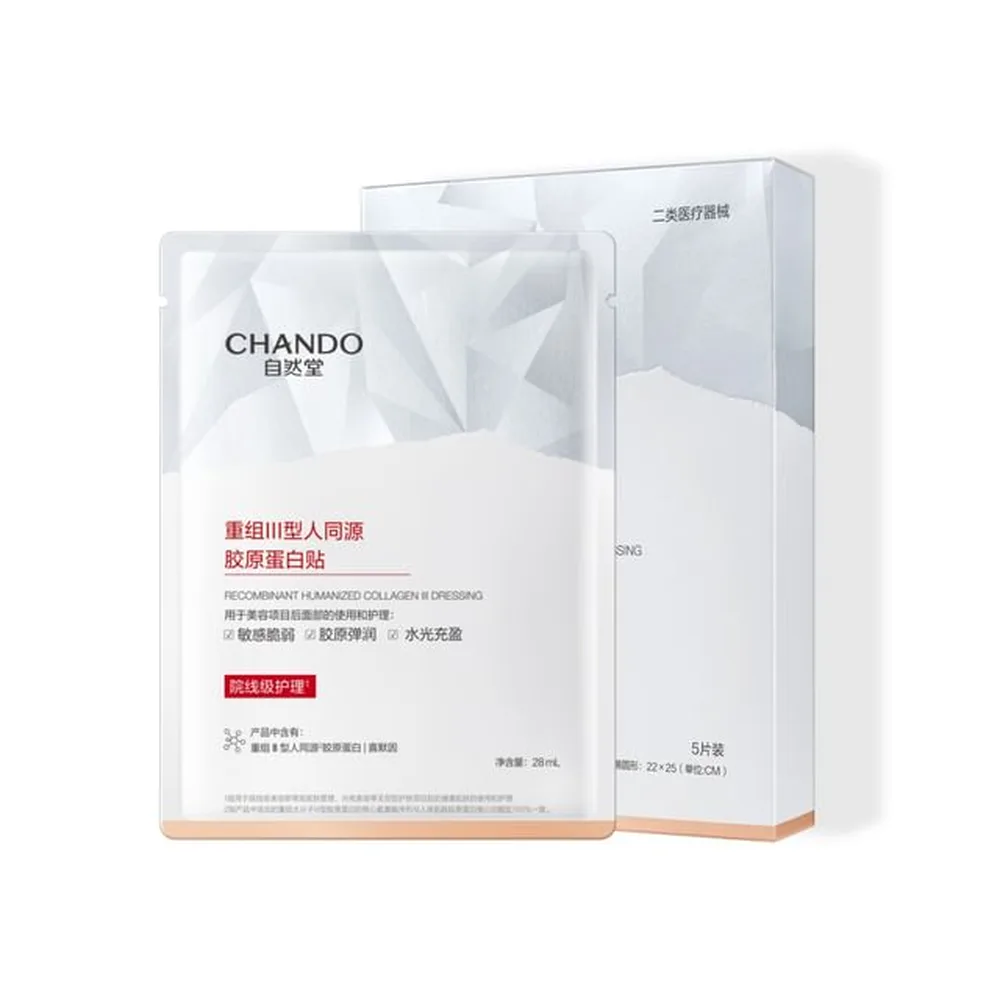
It is a Chinese Class II medical-device dressing sold abroad as a sheet mask: an eighteen-ingredient, fragrance-free, oil-free essence built around a recombinant human-sequence type III collagen film, Chando's HiMurchaSin ferment and, unusually, tranexamic acid to head off post-procedure pigmentation. The collagen hydrates rather than rebuilds, but the restraint of the formula is the point and the tranexamic acid is a genuinely clever inclusion for skin of colour recovering from lasers.
A Chinese post-procedure medical dressing wearing a sheet-mask name abroad: eighteen ingredients, no fragrance, oil, alcohol or silicone, a recombinant human-sequence collagen film, Chando's yeast ferment and a smart dose of tranexamic acid to head off post-laser darkening. On raw skin it is exactly right. On healthy skin it is a very gentle, fairly expensive hydrating sheet, and the collagen builds nothing.
Launched in 2025 and registered as a device in China on the strength of Chando's own submissions, this dressing has only a handful of English-language reviews and no independent published testing; its collagen and ferment claims are the manufacturer's. The evaluation reads the complete eighteen-ingredient list against peer-reviewed evidence on tranexamic acid, humectants and recombinant collagen films, and treats the Class II registration as a manufacturing standard rather than proof of effect.
The case for it
What would change this: A researched evidence row for the lead active would replace this with a verdict.
Same rule for everyone. “Good choice” is the verdict on 1,938 of 45,024 concern verdicts across the catalog; rule F2 decided 1,938 of them. As of September 25, 2026, engine 5.1.1.
Brand or formulator? Disclose a concentration or correct a fact →
The case for it
Same rule for everyone. “Good choice” is the verdict on 9,564 of 45,024 concern verdicts across the catalog; rule R5 decided 9,072 of them. As of September 25, 2026, engine 5.1.1.
Brand or formulator? Disclose a concentration or correct a fact →
The studies behind the evidence row
Also listed for Post-Procedure and Compromised Skin Barrier — the actives here (Glycerin, Tranexamic Acid, Trehalose, Collagen) are in our research queue for those concerns; there is no verdict until their evidence rows are written. That is a gap in our table, not a mark against the product.
As a maskNot judged: what a mask is for — works within its wear time, benefit outlasts the mask, comes off cleanly — cannot yet be measured from the ingredient list (only intensity without injury can).
A verdict is DermApproved’s assessment of how well a product’s ingredients fit a concern — never a claim about what the product treats. Evidence dots and collected reviews sit beside it and are never blended in. Rules 0.5.1 · evidence table ev-2026.09-r228 · how we decide
On the sachet the product is called a dressing, 重组III型人同源胶原蛋白贴, and it carries the small printed line that marks it as a Class II medical device under Chinese regulation. On YesStyle it is called a mask. That translation is the most useful thing to understand about Chando's Recombinant Humanized Collagen III Mask, because the two words describe two different products with the same contents. As a dressing, applied to skin that has just been lasered, peeled, needled or extracted, it is a carefully restrained, sterile-grade sheet with a rationale for every one of its eighteen ingredients. As a mask, applied to healthy skin on a Tuesday, it is a pleasant, unscented, slightly pricey hydrating sheet whose headline ingredient does nothing the name suggests.
Start with the recombinant collagen, since it is on the box in red. Recombinant humanized collagen is one of the defining ingredients of Chinese skincare in this decade: a collagen fragment made by engineered yeast or bacteria to match part of a human sequence, here type III, the collagen of young and healing skin, rather than extracted from cows or fish. Chinese consumers have embraced it with the fervour Western ones once reserved for hyaluronic acid, and Chando entered the category in 2025 with this dressing. The molecule is real and its wound-model research is interesting; the brand adds that it carries an RGD motif that lets it adhere to skin cells. What it cannot do is penetrate. Collagen fragments of any origin are far too large to cross an intact stratum corneum, and even on a freshly treated one they sit at the surface. There they form a hydrating, protein-rich film that soothes and protects, which on raw skin is a genuinely useful thing to be. They do not rebuild the dermis, and nobody should buy this box expecting a collagen top-up.
What makes the dressing clever is the fifth ingredient, which the packaging barely mentions. Tranexamic acid, best known as a leave-on treatment for melasma, works by blocking plasmin, the enzyme whose activity in inflamed keratinocytes sets off the prostaglandin signalling that tells melanocytes to make more pigment. That signalling is exactly what a laser or a peel provokes, and post-inflammatory hyperpigmentation after procedures is the leading complication in skin of colour, which is most of China. Putting tranexamic acid in a post-procedure sheet at a meaningful position is therefore a rational, targeted decision, and it is the ingredient in this formula with the best clinical argument for being there. It is also gentle enough for compromised skin, which not every brightener is.
The rest of the list is a lesson in leaving things out. Water, glycerin, butylene glycol, then Chando's HiMurchaSin polar-yeast ferment in fourth place, the proprietary Saccharomyces strain the brand developed in 2021 and builds its repair claims on, with hydration and barrier-support evidence that lives in its own laboratories. Then the tranexamic acid, trehalose as a desiccation-protecting sugar, a preservative, polyglycerin-3, a glycol, three thickeners, the collagen, a second preservative, an emulsifier and two phosphate buffers. No fragrance. No essential oil. No alcohol, no silicone, no plant oil, no extract with an allergen profile, no exfoliant. For skin whose barrier has been deliberately broken that morning, that list is not sparse; it is correct. The sheet itself is larger and denser than a cosmetic mask, 22 by 25 centimetres in 28 mL of essence, and it stays wet for the full twenty minutes the instructions ask for, which matters when the point is to keep a healing surface cool and hydrated rather than to deliver an active.
The medical-device status deserves a straight explanation, because it is used to sell and it is worth exactly what it is worth. China's Class II registration for post-procedure dressings imposes manufacturing, sterility and labelling requirements stricter than those for cosmetics, and for a product going onto freshly needled skin that is a real reassurance. It says nothing about potency. It does not exist in American or European law, where this is simply a cosmetic sheet. And China's own regulator, in 2020, publicly ruled that there is no such thing as a 'medical device mask', that dressings registered this way are for post-procedure care and may not be marketed as everyday skincare, a crackdown on exactly the 械字号 marketing that had made these products a craze. Chando's packaging, to its credit, says 'for facial use and care after cosmetic procedures' on the front. The export name says mask. The regulator would prefer the sachet.
Chando itself is a manufacturer of scale, founded in Shanghai in 2001, one of the largest domestic skincare groups in China, with an R&D centre of around twenty laboratories and a Himalaya research institute since 2017, and the discipline in this dressing is consistent with that. Its evidence, as always, is internal, and the product is new enough that the English-language review record is a handful of entries; the confidence here is in the restraint of the list and in the independent science on tranexamic acid and humectants, not in a track record.
On price, YesStyle lists a box of five at around CA$26 before shipping, roughly four dollars a sheet, with no US retailer to quote. For the ten days after a laser, three sheets a week of something this clean and this thoughtfully built is money well spent, and cheaper than what most clinics sell at the front desk. As a weekly hydrating mask for skin that has not been near a procedure, four dollars buys glycerin, a ferment and a collagen film that a two-dollar sheet would match, and the name would be doing the selling. Use it as the dressing it was registered to be.
The hero actives that drive this product's performance.
| Ingredient | Function | Evidence |
|---|---|---|
| Recombinant Humanized Type III Collagen | A collagen fragment produced by engineered microbes to match the human type III sequence, listed simply as collagen near the end, which is the ingredient the whole product is named for and registered on; it forms a hydrating, film-forming layer on freshly treated skin and, the brand claims, adheres to skin cells through an RGD motif. It does not penetrate to the dermis or replace collagen there, but as a wound-surface dressing it is a plausible and very gentle choice. | Not yet assessed |
| HiMurchaSin Polar Yeast Ferment (Saccharomyces Ferment Filtrate) | Chando's proprietary cold-adapted yeast ferment sits fourth, ahead of the actives, bringing amino acids, small peptides and natural antioxidants to the water phase; in a post-procedure dressing it is the brand's repair signature, with hydration and barrier-support claims that come from its own laboratories. | Not yet assessed |
| Tranexamic Acid | Fifth on the list, an unusual inclusion for a post-procedure sheet: tranexamic acid calms the plasmin-driven inflammatory signalling that leads to redness and, in skin of colour, to post-inflammatory pigmentation after lasers and peels, which is exactly the window this dressing is sold for. It is the most interesting decision in the formula and the one with the best clinical rationale. | Not yet assessed |
| Trehalose | Sixth, a desiccation-protecting sugar that shields cell membranes and proteins from drying stress and holds water in the essence; on skin whose barrier has just been disrupted by a procedure it is a sensible, non-irritating hydrator and a stabiliser for the collagen and ferment around it. | Not yet assessed |
| Glycerin and Polyglycerin-3 | Glycerin second on the list and its oligomer polyglycerin-3 lower down are the humectant backbone of an otherwise sparse, eighteen-ingredient essence; they are why the sheet keeps compromised skin hydrated for twenty minutes without any emollient oil, silicone or fragrance to complicate a healing surface. | Established mechanism for Dehydration · established mechanism |
Ingredient standings describe the active at treatment-level doses and vehicles; this product's own condition grades weigh its actual formula.
Water, Glycerin, Butylene Glycol, Saccharomyces Ferment Filtrate, Tranexamic Acid, Trehalose, Hydroxyacetophenone, Polyglycerin-3, 1,2-Hexanediol, Xanthan Gum, Carbomer, Pentylene Glycol, Hydroxyethylcellulose, Collagen, Sodium Benzoate, Polysorbate 60, Disodium Phosphate, Sodium Phosphate
treatment
AM & PM
Use it on clean skin as the only step, or before a bland moisturizer, in the days after a laser, peel, microneedling or extraction session when the skin wants nothing with a scent or an active; Chando suggests up to three times a week in that window and once a week as maintenance. Do not layer acids, retinoids or vitamin C over healing skin in the same session. Once the skin has recovered it can go back to being an ordinary hydrating sheet under any routine.
Straight after a session the skin is cooler, calmer and less red, with the tight, raw feeling of a fresh procedure eased for several hours. Used three times a week after a treatment, redness and dryness settle faster over the first week and post-inflammatory darkening is somewhat less likely, thanks to the tranexamic acid. As a maintenance mask it hydrates and plumps for a day; it does not build dermal collagen or remove lines, whatever the name implies.
The formula's clinical logic rests on tranexamic acid. A synthetic lysine analogue that inhibits the conversion of plasminogen to plasmin, tranexamic acid interrupts the plasmin-mediated release of arachidonic acid and prostaglandins from keratinocytes that stimulates melanocyte activity after ultraviolet or inflammatory injury. Topical tranexamic acid at 2 to 5 percent has randomised-trial support in melasma, with efficacy comparable to hydroquinone at lower strengths in several studies, and smaller trials and case series report that applying it after fractional laser and other resurfacing procedures reduces the incidence and severity of post-inflammatory hyperpigmentation, particularly in Fitzpatrick types III to V. Its fifth-place position in an eighteen-ingredient essence is consistent with a concentration in the low percent range, and its tolerability on compromised skin is good.
Recombinant humanized collagen is produced by expressing a designed gene, typically encoding repeated fragments of human type III collagen sequence, in yeast or Escherichia coli, yielding a protein free of animal-origin risks and, in the versions marketed in China, containing RGD cell-adhesion motifs. In-vitro and animal wound studies report enhanced fibroblast adhesion, migration and faster epithelialisation when it is applied to wounds, which is the basis for its use in post-procedure dressings. As a molecule of tens of kilodaltons it does not cross the stratum corneum, so on intact skin its action is limited to surface hydration and film formation; clinical trials showing dermal collagen increase from topical use do not exist. The Chinese Class II registration for dressings of this type governs sterility, manufacturing and labelling rather than efficacy, and the National Medical Products Administration stated in 2020 that such devices are not cosmetics and cannot be marketed as masks for routine use.
Saccharomyces ferment filtrate has supplier and brand evidence for hydration and barrier support and little independent trial data, with none in English for the HiMurchaSin strain. Trehalose is a non-reducing disaccharide that stabilises proteins and membranes under desiccation and has in-vitro evidence for protecting keratinocytes from drying stress, and glycerin and polyglycerin-3 are well-established humectants. The absence of fragrance, essential oils, alcohol, silicones and plant extracts is itself evidence-based: post-procedure skin has a transiently disrupted barrier through which sensitisers and irritants penetrate more readily, and the contact-dermatitis literature consistently identifies fragrance and botanical allergens as the leading culprits in that setting.
Dermatologists would recognise this as a post-procedure hydrating dressing of the type widely used in Chinese and Korean aesthetic clinics after fractional laser, microneedling and chemical peels, and would rate its formulation as appropriate for that purpose: fragrance-free, preservative-light, free of oils and botanicals, with humectants to keep the healing surface moist and tranexamic acid as a reasonable adjunct against post-inflammatory hyperpigmentation, especially in darker skin types. The recombinant collagen would be described as a surface film with wound-healing rationale rather than a means of increasing dermal collagen, and patients would be counselled not to expect anti-ageing effects. Clinicians would advise using it only once any open wounds have epithelialised and after the treating practitioner has cleared sheet masks, since occlusion over broken skin can trap bacteria, and would note that the Chinese device registration, while indicating stricter manufacturing standards, does not imply therapeutic potency and carries no regulatory meaning in Western jurisdictions. Outside the recovery period it functions as a gentle hydrating mask, and daily sunscreen remains the more important protection against post-procedure pigmentation.
Once any open wounds from a procedure have closed and the clinician has cleared sheet masks, cleanse gently with lukewarm water and pat dry. Open the sachet, unfold the large sheet, lay it over the face from the centre outward and smooth it flat, avoiding the eyes; the 22 by 25 cm sheet may need folding at the jaw. Leave it for fifteen to twenty minutes, remove it while still wet, and massage the remaining essence in lightly rather than rinsing, then apply a bland barrier cream and, by day, a mineral sunscreen. Chando suggests up to three sheets a week during recovery and one a week afterwards as maintenance. Do not apply acids, retinoids or vitamin C in the same session on healing skin, keep hands clean throughout, and store the box somewhere cool; a chilled sheet is more soothing on post-laser skin.
YesStyle's roughly CA$26 for five sheets, plus international shipping and with no US retailer to anchor a dollar figure, works out to about four dollars a mask, which is premium for a hydrating sheet and typical for recombinant-collagen dressings, which are priced as post-procedure care rather than everyday masks. Judged for that purpose the value is good: three sheets a week for the ten days after a laser, of an eighteen-ingredient, fragrance-free essence with tranexamic acid and a collagen film, costs less than the recovery kits many clinics sell and less than a single follow-up visit. Judged as a routine mask for healthy skin the value is poor, because the collagen adds a name rather than a benefit and a two-dollar hydrating sheet would do the same job. Chando's scale and its registration of the product as a device make the manufacturing dependable; its efficacy claims stay in-house. Buy it for recovery, not for Tuesdays.
People recovering from lasers, peels, microneedling, extractions or aggressive facials who want a fragrance-free, oil-free, allergen-free sheet built for that window, with tranexamic acid to reduce the risk of post-procedure darkening, and anyone with very reactive skin who wants the plainest possible hydrating mask. It suits skin of colour after resurfacing particularly well.
Anyone buying it for anti-ageing, firming or collagen-building, which a surface film cannot provide, and anyone who wants a routine hydrating mask at a routine price. Skin with open wounds or weeping areas should wait for clearance before occluding, fungal-acne-prone skin may prefer a sheet without polysorbate, and readers who dislike paying for a regulatory label that means nothing in their country should note that the device status is Chinese only.
Ready to try Chando Recombinant Humanized Collagen III Mask?
Buy at Amazon ♥A thin, clear, faintly viscous essence with a slight gel body, soaked into a soft, dense, silky sheet that drapes heavily and stays wet; skin is left with a light, breathable film rather than a slick.
None; the essence is unfragranced and effectively odourless.
Five white-and-grey sachets with a faceted ice motif, labelled Recombinant Humanized Collagen III Dressing and marked as a Class II medical device, each holding a 22 by 25 cm sheet in 28 mL of essence, in a box of five.
On raw, post-procedure skin the first thing noticed is what is absent: no sting, no scent, no warmth, just a cool, heavy, drenched sheet that eases the tight, hot feeling within minutes. The sheet is larger and denser than a typical cosmetic mask and holds its essence for the full twenty minutes. Skin afterwards is calm, plump and lightly filmed, and the redness of a fresh treatment is visibly softer for the evening. On healthy skin the experience is that of a very gentle hydrating mask and no more.
A box of five covers the first ten days after a procedure at three masks a week, or five weeks used weekly as maintenance.
All Year
Recombinant humanized collagen, produced by engineered yeast or bacteria to match human sequences, became one of the hottest categories in Chinese skincare in the mid-2020s, and post-procedure 'medical dressings' registered as Class II devices are a distinct Chinese market with tighter manufacturing rules than cosmetics. Chando entered both in 2025 with this dressing, pairing the collagen with its own HiMurchaSin ferment and pitching it as clinic-grade care after facials, lasers and microneedling; it reached YesStyle the same year under the mask name.
Chando (自然堂), founded in Shanghai in 2001, is one of China's largest domestic skincare groups, with an R&D centre of around twenty laboratories, a Himalaya research institute since 2017 and a patented polar-yeast ferment, HiMurchaSin, developed in 2021. This dressing is registered in China as a Class II medical device, a category for post-procedure wound-care sheets that carries no equivalent status in the US or EU; the brand's supporting data is internal, and no independent English-language evaluation of the product exists.
Recombinant human collagen in a mask replaces the collagen lost from ageing skin.
Collagen, even a recombinant fragment engineered to match the human type III sequence, is far too large to cross the stratum corneum and reach the dermis where age-related collagen loss occurs. What it does on the surface is form a hydrating, protein-rich film that soothes and protects, which is valuable on freshly treated skin. The regeneration language belongs to the cell-culture and wound-model studies, not to a twenty-minute sheet.
Because it is a registered medical device, it is stronger or safer than a cosmetic mask.
China's Class II device category for post-procedure dressings imposes stricter manufacturing and sterility controls than cosmetics, which is meaningful for skin with an open barrier, and the regulator has explicitly ruled that such dressings cannot be marketed as 'medical masks' for everyday use. The status says nothing about potency, does not exist in US or EU law, and outside a post-procedure context the product is simply a very gentle hydrating sheet.
A collagen fragment produced by engineered microbes to match part of the human type III collagen sequence, rather than extracted from animals. In this dressing it forms a hydrating, protein-rich film on the skin surface; it cannot penetrate to the dermis, so its benefit is soothing and protecting freshly treated skin rather than rebuilding collagen.
In China it is registered as a Class II medical device dressing, a category for sterile post-procedure sheets that must meet stricter manufacturing rules than cosmetics; Chinese regulators have also ruled such dressings cannot be marketed as everyday 'medical masks'. That status has no equivalent in the US or EU, where it is sold simply as a sheet mask.
Chando suggests up to three times a week in the recovery window after facials, lasers, peels or microneedling, once any open wounds have closed and the clinician allows sheet masks, then once a week as maintenance. Its fragrance-free, oil-free, alcohol-free essence is designed for that raw-skin period; ask the treating clinician before using anything on freshly treated skin.
Tranexamic acid, fifth on the list, calms the plasmin-driven inflammation that drives post-procedure redness and the post-inflammatory hyperpigmentation that lasers and peels can trigger, especially in darker skin tones. It is an unusual and well-reasoned inclusion for a recovery dressing, and it is gentle enough for compromised skin.
No. It hydrates and calms, which softens dehydration lines for a day, but the collagen stays on the surface and nothing in the formula stimulates dermal collagen. For firming, a retinoid or a peptide product used daily over months is needed; this dressing is for the recovery days when those are off-limits.
YesStyle lists a box of five at around CA$26 plus shipping, roughly four dollars a sheet, and no US retailer stocks it. That is premium for a hydrating mask but in line with other recombinant-collagen dressings, which are priced as post-procedure products rather than everyday sheets.
Recurring themes our editors read across retailer reviews of this product — summaries in our words, not quotations, and not a substitute for your own patch test.
Very calming on skin after lasers and microneedling
Nothing in it stings or smells
Thick, drenched sheet stays put for the full twenty minutes
Redness fades faster than with a plain hydrating mask
Expensive per sheet for a maintenance mask
No visible firming or wrinkle effect despite the collagen name
'Medical device' status is confusing outside China
Hard to buy at retail in the West