Your Hair Is a UPF 5 Hat: The Case for Treating Your Scalp as Skin
Men arrive at scalp care through flaking and stop there, which leaves the two bigger problems — sun dose and misdiagnosed folliculitis — running quietly for years.
Read the preview
From the DermApproved blog, in Men's Grooming: your hair is not a hat. In full sun, a head of hair scores a UV protection factor near five — roughly a thin t-shirt. Which is why the scalp grows cancers the rest of the body doesn't. And the flaking? A separate problem, treated wrong for years. For the full breakdown, visit dermapproved.com/blog.
Hair is coverage the way a mesh tent is shelter
Skincare advice stops at the hairline. So does most men's grooming, and the assumption underneath that boundary — that hair counts as coverage — has actually been measured, which is the rare mercy of this topic.
Researchers in Queensland put miniature dosimeters under two lengths of human head hair and read the erythemally effective ultraviolet coming through at solar zenith angles from 17 to 51 degrees. With the head upright in full sun, the ultraviolet protection factor of hair ranged from roughly 5 to 17. Not 50. Five, at the low end, in the conditions where it matters most — high sun, head up. Counterintuitively, the longer hair performed slightly worse than the short, and the authors' own conclusion was that scalp exposure limits can be exceeded within short timeframes. A thin cotton t-shirt outperforms the thing growing out of your head.
Now subtract the hair. Male-pattern balding converts the most horizontally oriented surface on the human body into unshaded skin, positioned at precisely the angle that collects the most midday dose. In a prospective cohort of men, male-pattern baldness was significantly associated with incident squamous cell and basal cell carcinoma. A 2023 Mendelian-randomisation analysis went further and separated the two candidate explanations: the site-specific associations tracked ultraviolet exposure rather than androgens. The baldness is not causing the cancer. It is removing the hat.
Then there is the finding that changes the stakes. Within head-and-neck melanoma, scalp location is an independent predictor of worse outcome — worse melanoma-specific survival (hazard ratio 1.75) and worse overall survival (1.62) — while non-scalp head-and-neck primaries behave much like melanoma of the trunk and limbs. Scalp primaries arrive thicker and more often ulcerated. Part of that is biology, and part of it is the least mysterious fact in dermatology: nobody looks at the top of their own head, and neither does anyone else except a barber, who is not screening you.
The protection problem is a delivery problem
Knowing the scalp needs sunscreen and getting sunscreen onto a scalp are different projects. Lotion in hair is a texture disaster, which is why the compliance rate on this advice is close to zero and why the advice usually gets dropped.
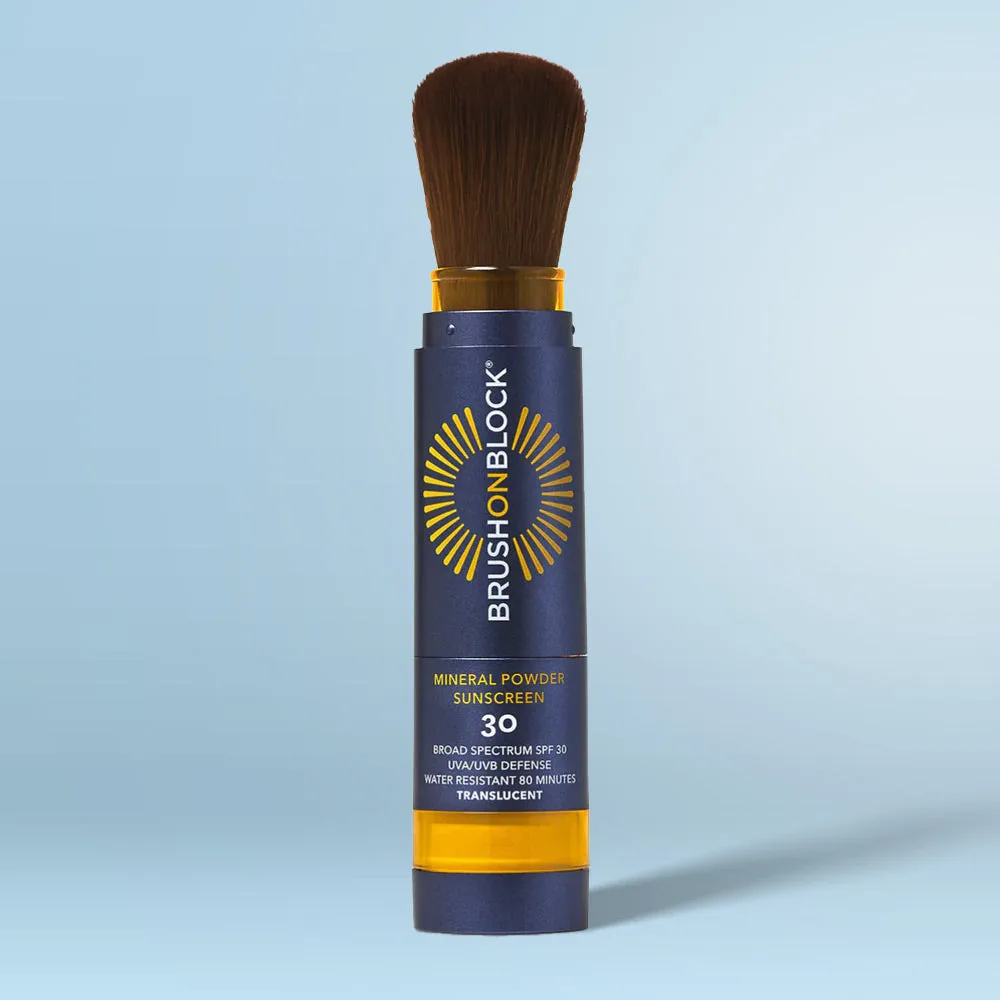
The formats that survive contact with real hair are the ones designed around it. A dedicated scalp mist like Australian Gold SPF 50 Face & Scalp Mist sprays into a parting without wetting the hair into strands, which is the difference between a product you use and a product you own. For a defined part line rather than a whole exposed crown, a brush-on mineral powder such as Brush On Block Mineral Sunscreen Powder SPF 30 sits where you aim it and can be topped up over a full head of hair without a shower afterwards. For a shaved head, ordinary sunscreen works fine, and a sweat-resistant stick like La Roche-Posay Anthelios UVsport Pro Resistance Stick is easier to reapply on a bike or a job site than anything you have to pour.
The honest caveat is the one nobody prints on the bottle: mists and powders are the formats where real-world application falls furthest below the laboratory dose that earns the SPF number on the label. Treat them as a serious improvement over nothing and a poor substitute for a hat. The hat is still the best product in this category, and it is the one that costs nothing to reapply. Our answer on how much sunscreen a bald scalp actually needs works through the quantities, and the sun safety tool translates the local UV index into how long unprotected skin has before it burns — a number that gets uncomfortable fast once you stop assuming your hair is doing the work.
Four different things flake, and the shampoo aisle only recognises one
Everything that sheds off a scalp gets called dandruff, and that word has quietly absorbed at least four distinct conditions with four different treatments.
Seborrhoeic dermatitis is the one the aisle is built for: greasy, yellowish, adherent scale on a pink base, usually with company elsewhere — the eyebrows, the nasolabial folds, the ear canals, the centre of the chest. It runs on Malassezia yeasts metabolising sebum, which is why antifungal actives work and why moisturising alone does nothing.
Simple dry scalp is the impostor. Fine, white, non-adherent flakes on skin that feels tight rather than itchy, no redness, no involvement anywhere else, and a clear trigger history — winter air, a new clarifying shampoo, daily washing with a stripping surfactant. Treating it with a medicated shampoo makes it worse, and this is the single most common self-misdiagnosis in the category. Our dandruff-or-dry-scalp answer lays out the distinguishing signs side by side.
Scalp psoriasis presents as sharply demarcated plaques with thick silvery scale that characteristically extends past the hairline onto the forehead, behind the ears or down the nape — a border you can feel with a fingertip. It often travels with nail pitting and elbow or knee plaques. It responds to keratolytics and tar, not to antifungals alone; a coal tar formula like DHS Tar Shampoo remains one of the few genuinely evidence-backed over-the-counter options, and it earns its reputation for smelling like a roofing project. The psoriasis therapy pathway covers where topical steroids and prescription vitamin D analogues enter, which is earlier than most men assume.
Malassezia folliculitis is the one that gets missed for years. It is not scale at all — it is a crop of uniform, itchy papules and pustules, all the same size, clustered at the hairline, the forehead and the upper back. Because it looks like acne, it gets treated as acne. In a study of 320 consecutive patients clinically diagnosed with acne vulgaris, 28.8% turned out to have Malassezia folliculitis, either alone or alongside true acne. Two features carried most of the diagnostic weight: itch raised the odds more than sevenfold, and lesions at the scalp or hairline raised them nearly ninefold. Antibiotics do nothing for it. Antifungals clear it. If you have been on a long course of doxycycline for stubborn "acne" that itches and lives at your hairline, that is a conversation worth having, and our answer on folliculitis and flaking together is where to start.
The active matters less than the minutes
Men shop this category as if the active ingredient were the whole decision. It is the smaller half.
Take the best head-to-head evidence available. In a multicentre randomised trial of 343 people with severe dandruff or seborrhoeic dermatitis, ketoconazole 2% produced a 73% improvement in total severity score at four weeks against 67% for zinc pyrithione 1%, with a lower recurrence rate over the following four weeks. Real, statistically significant, and worth having — but a six-point gap is not the chasm the packaging implies. An antifungal shampoo such as Nizoral Anti-Dandruff Shampoo and a high-strength pyrithione zinc formula like Vanicream Dandruff Shampoo are closer to each other than either is to nothing.
Now look at what the labels say about time. The prescription-strength ketoconazole shampoo instructs you to lather, leave it in place for five minutes, and then rinse. The over-the-counter version's directions read, in full: wet hair, apply, lather, rinse thoroughly. No dwell time at all. That difference is not pharmacology — it is what happens when consumer directions get written for a shower, and it means most people are running an antifungal at a contact time somewhere near twenty seconds.
No trial has isolated dwell time as a variable, and we are not going to pretend one has. But the mechanism is not subtle: these actives work against yeasts colonising the follicular openings of the scalp, and an antifungal that leaves before it arrives is not an antifungal. Two corollaries follow. Apply the product to the scalp, not to the hair — the hair is not the patient, and lathering the lengths wastes most of the dose. And set a timer, because five minutes in a shower feels like fifteen and everyone cheats it.
The active choice, once you have that right, is mostly a matter of what your scalp tolerates. Selenium sulfide as in Head & Shoulders Clinical Strength Advanced Oil Control is the most aggressive sebum-control option and can dull colour-treated hair. Salicylic acid, the active in Neutrogena T/Sal, is a keratolytic rather than an antifungal — it dissolves adherent scale but does not touch the yeast, which makes it a partner to an antifungal rather than a replacement for one. Our zinc pyrithione ingredient page covers where that active sits on the evidence, and the dandruff pathway maps the escalation route when over-the-counter options stall out.
Your shampoo did not stop working
Ask around and you will be told, with total confidence, that anti-dandruff shampoos lose effectiveness and you have to rotate. Sixty-four per cent of dermatologists in an international survey of 722 believed exactly that, most of them expecting the fade within three months of use.
It was tested. Two double-blind, randomised, placebo-controlled studies ran pyrithione zinc shampoos at 1% and 2% against a matched placebo continuously — one for 24 weeks, one for 48 — with dermatologists scoring adherent scalp flaking at intervals throughout. Benefit held at every time point in every arm. No tachyphylaxis appeared at all.
The disclosure belongs in the same breath: that work was run by Procter & Gamble, which makes the largest pyrithione zinc brand on the market, and a manufacturer testing its own active for durability has an obvious interest in the answer. Weigh it accordingly. But weigh what it displaced, too — an unmeasured clinical intuition held by two-thirds of prescribers — and note that the finding is not flattering in the way marketing money usually buys. It points the finger at compliance. People feel better, quietly drop from three washes a week to one, watch the flaking return, and conclude the product died. It didn't. They did the equivalent of stopping an antibiotic when the fever breaks.
The practical read: keep using the thing that worked, at the frequency that worked, indefinitely. Seborrhoeic dermatitis is a chronic condition under management, not an infection you finish. If it genuinely stops responding after a fair trial at a real contact time, that is a signal to reconsider the diagnosis — psoriasis, folliculitis, a contact allergy to a shampoo ingredient — not a signal to buy a different bottle of the same idea.
Pomade, sweat, and the hard water myth
Three mechanical problems sit on top of everything above, and men tend to have all three.
Styling product is the first. Heavy waxes, clays and oil-based pomades are occlusive by design, which is the point on hair and a liability on scalp: they trap sebum in an environment already rich in the yeast that feeds on it, and the residue itself sheds as flake that looks exactly like dandruff. Two flake sources, one appearance, and only one of them responds to a medicated shampoo. A weekly exfoliating step — a salicylic scalp treatment like The INKEY List Salicylic Acid Exfoliating Scalp Treatment, or a clarifying wash such as Briogeo Scalp Revival Dandruff Relief Shampoo — clears build-up that daily conditioner keeps reinstalling. Our answer on pomade, grease and flaking separates the two sources properly.
Sweat is the second. Malassezia is lipophilic and thrives warm and occluded, which is a precise description of a scalp under a cap during a lifting session and for the hour afterwards in the car. The fix is unglamorous and effective: rinse after training, and take the cap off as soon as you are done rather than wearing it home. See the gym sweat answer for the detail.
Hard water is the third, and here the popular story overreaches. Mineral-rich water genuinely deposits calcium and magnesium salts on hair, dulling it and roughening the cuticle, and a chelating wash genuinely removes them. What the evidence does not support is hard water as a cause of seborrhoeic dermatitis. If you have moved to a hard-water city and started flaking, the water probably changed how your hair feels while something else changed your scalp. Treat both; do not let the water filter become the reason you never treat the yeast.
What treating your scalp as skin actually looks like
Strip this down to a sequence and it is shorter than most men's face routines.
Wash with a medicated shampoo two or three times a week during a flare, applied to the scalp with fingertips rather than nails, left on for the full five minutes, then rinsed — and keep going at a maintenance frequency once it clears rather than stopping. Use a normal shampoo on the other days if you want; nothing about that undoes the treatment. Add a clarifying or keratolytic step weekly if you use styling product. Rinse after the gym. And put ultraviolet protection on the crown and the part line every day you will be outside in daylight for more than a few minutes, which is a habit best attached to something you already do rather than treated as a decision you make each morning.
If the hairline is receding, two things follow at once. The exposed skin is new sun-naive territory that has never carried a dose before, so the protection stops being optional. And the trajectory is worth knowing rather than guessing at: the hair loss stages tool maps the standard classification patterns so you can see where you actually sit, which matters because the treatments with real evidence work far better at holding ground than at recovering it. The men's routine profile is where the whole thing assembles into a sequence you can follow without thinking about it.
Here is the opinion, since a piece like this owes you one. Of everything on this page, the flaking is the least important problem and it gets almost all of the attention, because it is visible on a navy jacket and the other one is invisible for thirty years. A scalp that itches is annoying. A scalp that has been collecting unshaded ultraviolet since your thirties is a different category of thing, with an epidemiology that says it is caught late and does worse when it is. Fix the flaking, absolutely. Then do the boring thing that has no symptoms.
Products mentioned
Independently reviewed and scored — the real products behind this piece.



- Therapy guide Dandruff Where the escalation route sits once over-the-counter actives stall.
- Therapy guide Psoriasis Scalp psoriasis needs a different escalation ladder than seborrhoeic dermatitis.
- Routine The Men's Skincare Routine That Actually Sticks Assembles the scalp steps into a routine sequence.
- Ingredient Zinc Pyrithione (ZPT) Where the most-used dandruff active sits on the evidence.
- Question Is this dandruff or just a dry scalp? The distinguishing signs for the most common self-misdiagnosis in the category.
- Question What are the spots on my scalp alongside the flakes? For readers whose 'acne' itches and lives at the hairline.
- Question Is the grease I have always used part of the problem? Separates styling-product residue from true scale.
- Question Does sweating at the gym make it worse? The post-training routine that stops occlusion feeding the yeast.
- Question How much sunscreen does a bald scalp actually need? Quantities for a scalp, which are not the same as quantities for a face.
References
- Solar ultraviolet protection provided by human head hair — Photochemistry and Photobiology, 2009
- The prognostic importance of scalp location in primary head and neck melanoma — Journal of Surgical Oncology, 2017
- Male pattern baldness and risk of incident skin cancer in a cohort of men — International Journal of Cancer, 2016
- Uncovering the complex relationship between balding, testosterone and skin cancers in men — Nature Communications, 2023
- The Prevalence, Associated Factors, and Clinical Characterization of Malassezia folliculitis in Patients Clinically Diagnosed with Acne Vulgaris — Clinical, Cosmetic and Investigational Dermatology, 2022
- A multicenter randomized trial of ketoconazole 2% and zinc pyrithione 1% shampoos in severe dandruff and seborrheic dermatitis — Skin Pharmacology and Applied Skin Physiology, 2002
- Does tachyphylaxis occur in long-term management of scalp seborrheic dermatitis with pyrithione zinc-based treatments? — International Journal of Dermatology, 2009
- Malassezia Folliculitis: An Underdiagnosed Mimicker of Acneiform Eruptions — Journal of Fungi, 2025
Every cited link is verified to resolve to the paper named. Where a source could not be independently confirmed, it is listed without a link rather than pointing you somewhere wrong.
Frequently asked
Does a full head of hair protect my scalp from the sun?
Only partially. Dosimeter measurements put the ultraviolet protection factor of human head hair at roughly 5 to 17 in full sun, and the same work found scalp exposure limits can be exceeded within short timeframes. Hair helps; it is not a substitute for a hat or a scalp-format sunscreen.
How do I tell scalp folliculitis from dandruff?
Dandruff sheds flakes; Malassezia folliculitis produces uniform itchy bumps and pustules with no scale, clustered at the hairline and upper back. Itch and hairline location were the two strongest predictors in the study cited above, and antibiotics prescribed for it as acne will not clear it — antifungals will.
How long should I leave anti-dandruff shampoo on?
The prescription-strength ketoconazole label specifies five minutes of contact before rinsing, while the over-the-counter version's directions say only to lather and rinse. Apply it to the scalp rather than the hair and give it the full five minutes; a twenty-second wash is a dose reduction you are choosing without realising it.
Do I need to rotate anti-dandruff shampoos so they keep working?
The evidence says no. Two double-blind placebo-controlled studies running 24 and 48 weeks found no loss of benefit from continuous pyrithione zinc use, despite most surveyed dermatologists expecting one. If a product genuinely stops responding, reconsider the diagnosis rather than the brand.
What kind of sunscreen actually works on a scalp with hair?
Mists and brush-on mineral powders are the two formats that reach a parting without turning hair into strands, which is why they get used. Both realistically deliver less than the laboratory dose behind their SPF number, so treat them as a real improvement over nothing and keep a hat for long exposure.
Is hard water causing my scalp to flake?
Probably not on its own. Hard water deposits mineral salts that dull hair and roughen the cuticle, and a chelating wash removes them, but there is no good evidence it causes seborrhoeic dermatitis. Treat the water problem as a hair problem and treat the scalp separately.